
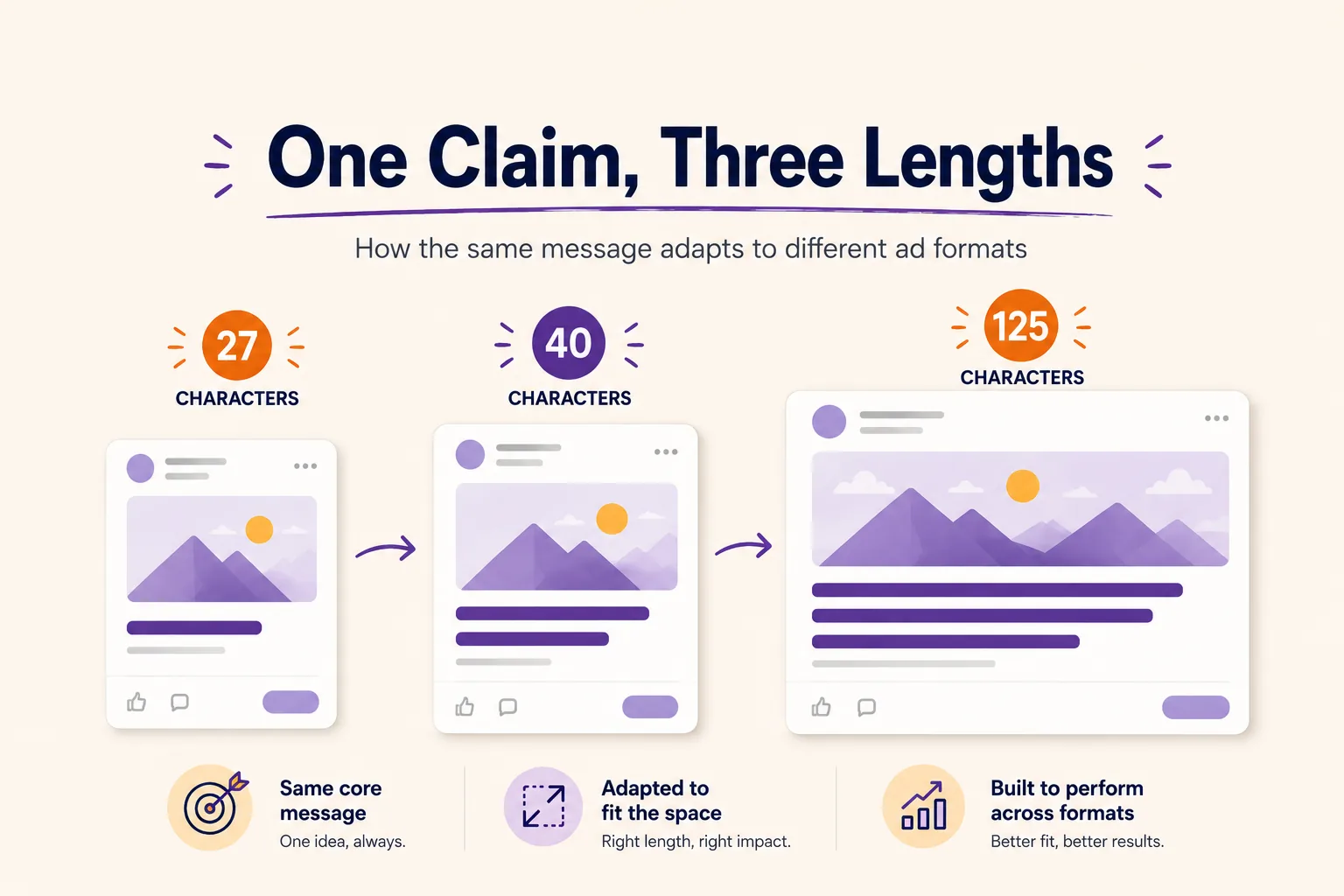
Meta will accept a headline of 255 characters. It will show about forty of them, and on a small phone closer to twenty-seven.
It will accept five hundred characters of primary text. It shows roughly a hundred and twenty-five before folding the rest behind “See more,” which most people never tap.
So the field limits published across every specification page in this search are not the constraint. The visible window is, and it is between a fifth and a tenth of what the box lets you type.
The short answer
Primary text allows up to 500 characters but only around 125 display before “See more” — and Meta’s own guidance points to copy under 100 characters often outperforming longer. Headlines allow 255 but only about 40 are reliably visible, collapsing to roughly 27 on smaller phones. The description field takes 30 characters and does not render in Feed, Reels or Stories at all. Which means writing Meta copy is really writing one claim three times, at 27, 40 and 125 characters, and checking that each version stands alone.
Key takeaways
- 125 characters of primary text show. The rest is behind “See more.”
- Headlines are visible at about 40 characters, and 27 on small phones. Design for 27.
- The description field is invisible in Feed, Reels and Stories. Never put anything essential there.
- Write the claim three times, at each length, and check each stands alone.
- Indian scripts render wider per character, so language-variant copy truncates earlier than the count suggests.
- Preview by placement before publishing. It takes two minutes and it is skipped almost universally.
The specifications, stated once
Primary text. Up to 500 characters in the composer, with a reported hard ceiling of 2,200. Around 125 characters display before the “See more” clamp. Meta’s guidance indicates that primary text under 100 characters frequently outperforms longer copy.
Headline. Up to 255 characters accepted. Around 40 are reliably visible. On smaller devices the window can collapse to roughly 27.
Description. 30 characters maximum, and it renders only in Marketplace, Audience Network, Facebook search results and in-stream video.
Read that last one again. Feed, Reels and Stories — the placements carrying most delivery in most Indian accounts — do not show the description at all. If your offer, your price or your deadline is in that field, a large share of your audience has never seen it.
The Three Lengths
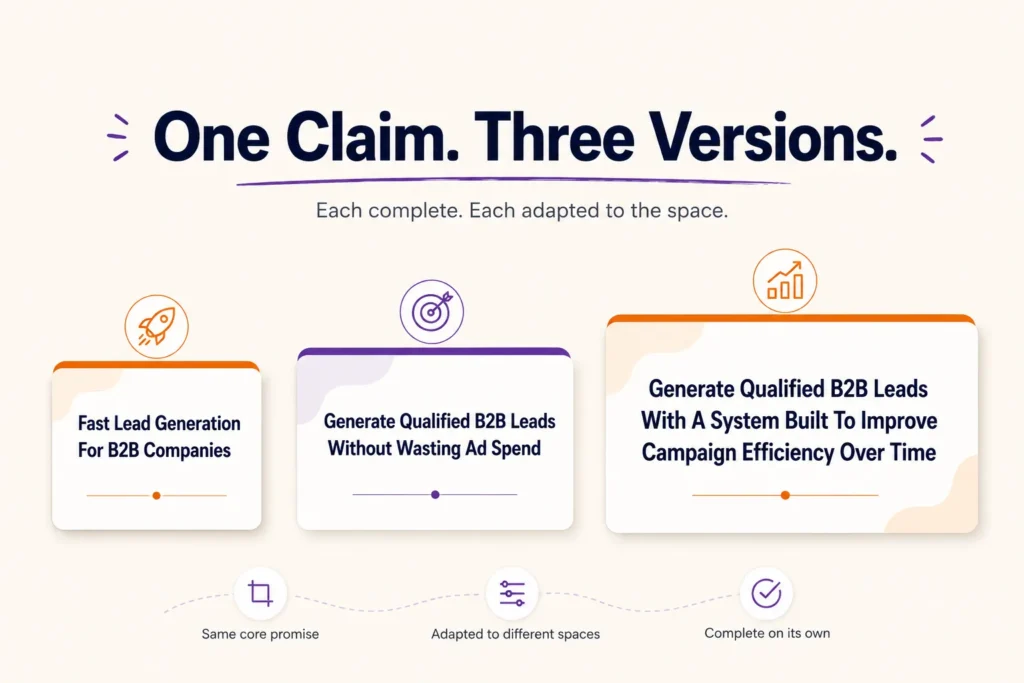
A Meta ad is one claim written three times: at 27 characters, at 40, and at 125. Each version has to work alone, because a different share of your audience sees each one. A claim that only holds together at 125 characters is a claim most of your audience will never receive.
Take a real example and put it through the process.
The claim, from the brief: You will get your first qualified enquiry within two weeks, or you stop paying. That is 79 characters and it came from somewhere — the process for arriving at it is at how to brief creative that works first time.
At 125 characters — primary text, first line.
First qualified enquiry within two weeks, or you stop paying. No lock-in, no setup fee. — 87 characters, complete, and it survives the clamp with room to spare.
At 40 characters — headline.
First enquiry in 14 days or it’s free — 37 characters. Whole thought, nothing dangling.
At 27 characters — small-phone headline.
Enquiry in 14 days or free — 26 characters. Still a complete proposition.
Notice what happened. The claim did not get shorter by deleting words from the end. It got rewritten at each length, and each version can stand on its own if it is the only thing a person reads.
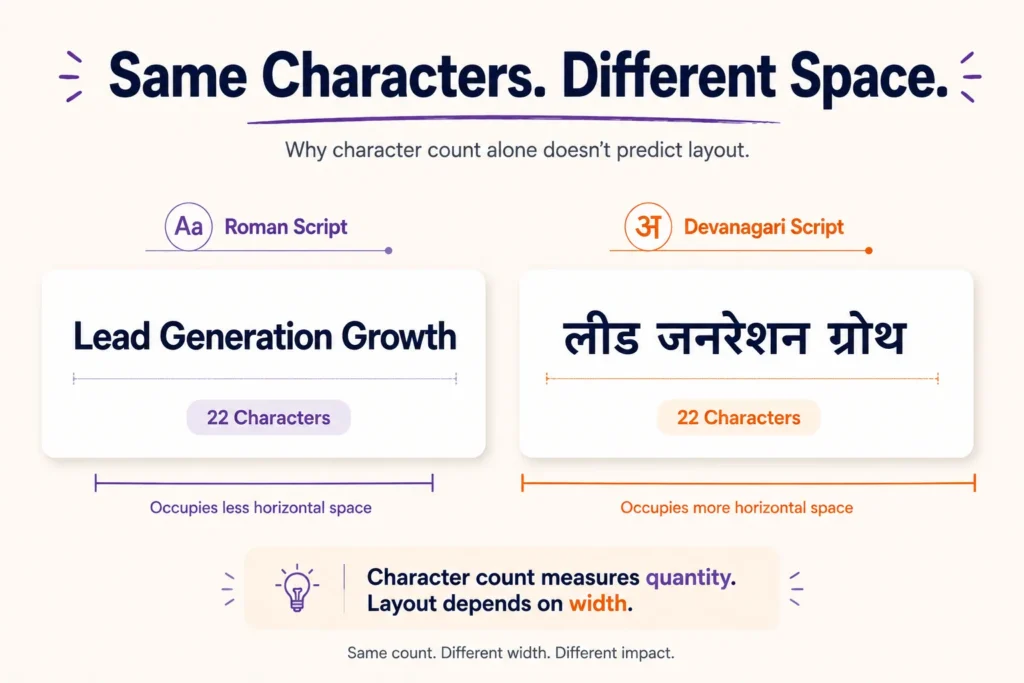
That is the discipline. Most ad copy is written once at a comfortable length and then truncated by the platform, which produces headlines that stop mid-phrase and primary text where the interesting half is behind “See more.”
What goes in each field
Primary text, first line. The claim. Not a greeting, not the brand name, not context. The first line is the whole ad for most of your audience, so it has to carry the proposition on its own.
Primary text, after the fold. Detail for the people who tapped — proof, specifics, terms. Write it, but assume nobody reads it. Nothing essential goes here.
Headline. The offer or the outcome, at 27 characters if you can manage it. This is the field with the highest ratio of attention to length, and the one most often wasted on a brand name.
Description. Something useful for the four placements that show it, and nothing you cannot afford to lose. Treat it as optional.
A rule that saves arguments. Every field should be readable in isolation. If your headline only makes sense after reading the primary text, you have written a sentence across two fields that render independently.
What Indian scripts do to your length
Here is something no specification page anywhere mentions.
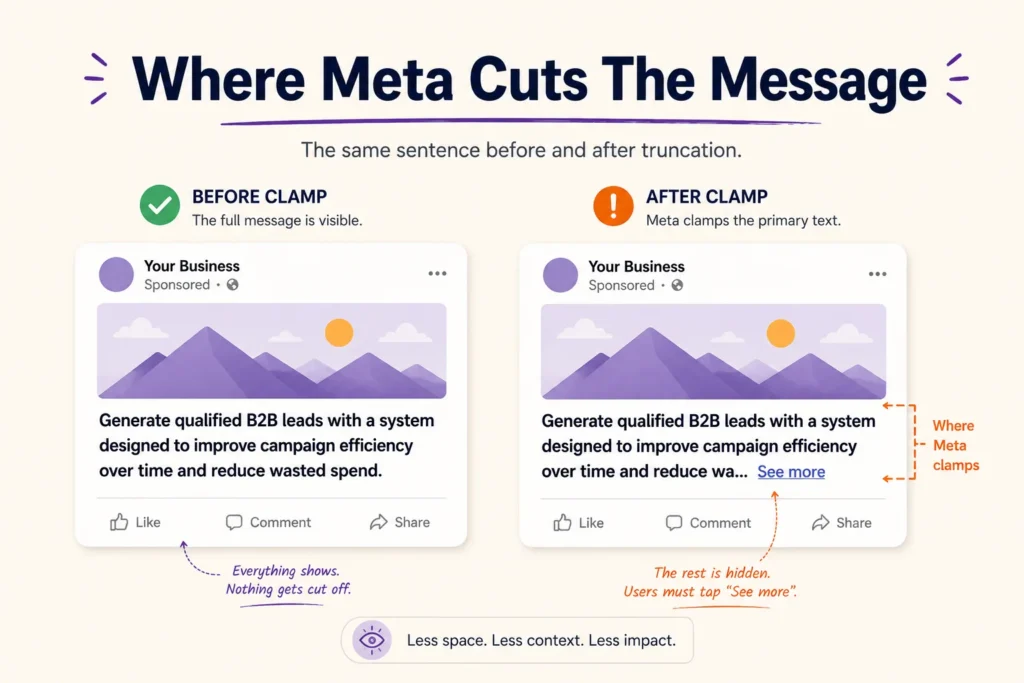
Meta counts characters. Screens render width. Devanagari, Tamil, Telugu, Bengali and most Indian scripts occupy more horizontal space per character than Latin, and several use combining marks that add vertical weight.
Which means a 40-character Hindi headline does not occupy the same space as a 40-character English one, and can truncate visually before the character count suggests it should.
We have observed this rather than measured it, so treat it as a testable proposition rather than a rule. The test is cheap: write the same claim in both scripts at identical character counts, load both into Ads Manager, and look at the placement previews side by side. Ten minutes, and it will tell you your own working limit.
The practical implication either way is to write Indian-language copy shorter than the English version, not the same length — which is the opposite of what happens when copy is translated, because translation into Hindi usually runs longer. Which language and script to choose in the first place is covered at advertising in Indian languages.
Preview before you publish
Ads Manager will show you exactly where each placement cuts your copy, and almost nobody looks.
Two minutes, three checks. Does the headline show a complete thought on the smallest preview. Does the primary text carry the claim before “See more.” Does anything essential sit in the description.
Do it on the phone preview, not the desktop one. Desktop shows more of everything and will tell you your copy is fine when it is not.
And check every placement you are actually running, not just Feed. Reels, Stories and Search each clamp differently, and an ad that reads well in Feed can lose its headline entirely elsewhere.
Does shorter actually perform better
Mostly, and for a reason that has little to do with attention spans.
Shorter copy is more often complete. A 90-character primary text is fully visible; a 300-character one is a fragment plus a link nobody taps. When people report that short copy outperforms, a large part of what they are measuring is the difference between an ad someone finished and an ad someone saw a third of.
There are real exceptions. Considered purchases, unfamiliar categories and anything requiring reassurance can support longer copy — but the first 125 characters still have to earn the tap, so the discipline holds regardless.
The useful reframing: you are not choosing between short and long copy. You are choosing what goes in the visible window, and then writing whatever you like underneath it.
Mistakes worth the money they cost
Writing to the field limit instead of the visible window. The error underneath most of the others.
Putting the offer in the description. Invisible in Feed, Reels and Stories.
Opening primary text with the brand name. Spends the most valuable line in the ad on something nobody searched for.
Headlines that read as fragments. “Get 30% off on your first” is what a 40-character plan looks like on a 27-character screen.
Splitting one sentence across headline and primary text. They render independently and often separately.
Translating copy without shortening it. Indian-language versions usually run longer and truncate sooner.
Skipping the placement preview. Two minutes that would have caught all of the above.
When copy is not the problem
When the visual fails. If nobody stops, nobody reads — the visual side sits at what actually moves the first three seconds.
When the claim is weak. Compression cannot fix an argument nobody wanted; that is a brief problem.
When the offer is uncompetitive. Clearer wording delivers the bad news faster.
When you are testing copy at low volume. Text variations are usually smaller differences than your account can detect, so change the argument rather than the phrasing.
When the landing page contradicts the ad. Message match matters more than either piece of copy on its own.
The copy checklist
☐ Claim taken from the brief, not invented at the keyboard
☐ Claim written at 125, 40 and 27 characters
☐ Each version checked to stand alone as a complete proposition
☐ Primary text first line carrying the claim, with no greeting or brand opener
☐ Nothing essential placed after the “See more” fold
☐ Headline written to 27 characters where possible, never over 40
☐ Nothing essential in the description field
☐ No sentence split across two fields
☐ Indian-language copy written shorter than the English version, not equal
☐ Both scripts previewed if running a language variant
☐ Placement previews checked on the phone view, not desktop
☐ Every running placement previewed, Feed included but never Feed alone
Questions we get asked
What is the character limit for Facebook ads?
Primary text accepts up to 500 characters, headlines 255 and descriptions 30. The numbers that matter are the visible ones: roughly 125, 40 and 30.
How long should Meta ad copy be?
Short enough that the claim lands inside the visible window. Meta’s guidance points to primary text under 100 characters often outperforming longer, and that matches what we see.
Does the description field show on Facebook ads?
Only in Marketplace, Audience Network, Facebook search results and in-stream video. Not in Feed, Reels or Stories.
What should the headline say on a Meta ad?
The offer or the outcome, complete at 27 characters. Not the brand name.
Does shorter ad copy perform better?
Usually, partly because short copy is more often read in full rather than truncated. Longer copy can work for considered purchases, but the first 125 characters still have to earn the tap.
Should Hindi ad copy be the same length as English?
Shorter. Translation typically runs longer than the original and Indian scripts occupy more width per character, so the same character count fills more of the visible window.
The two-minute habit worth building
Before publishing anything, open the placement preview on the phone view and read only what is visible.
If the headline stops mid-phrase, rewrite it at twenty-seven characters. If the claim is behind “See more,” move it to the first line. If the offer is in the description, move it anywhere else.
Most accounts we audit fail at least one of those three, and every one of them is free to fix.
If you want your ad copy rewritten to the three lengths and previewed across every placement you run, you can reach out to us on whatsapp at +91 7738844851 .
☐ The Three Lengths published as a pull quote and as its own section
More in Blog
Keep reading
All articles →
Ready to talk about your growth?
Tell us what's stuck and we'll tell you what we'd do first. Free, 30 minutes, no pitch.