
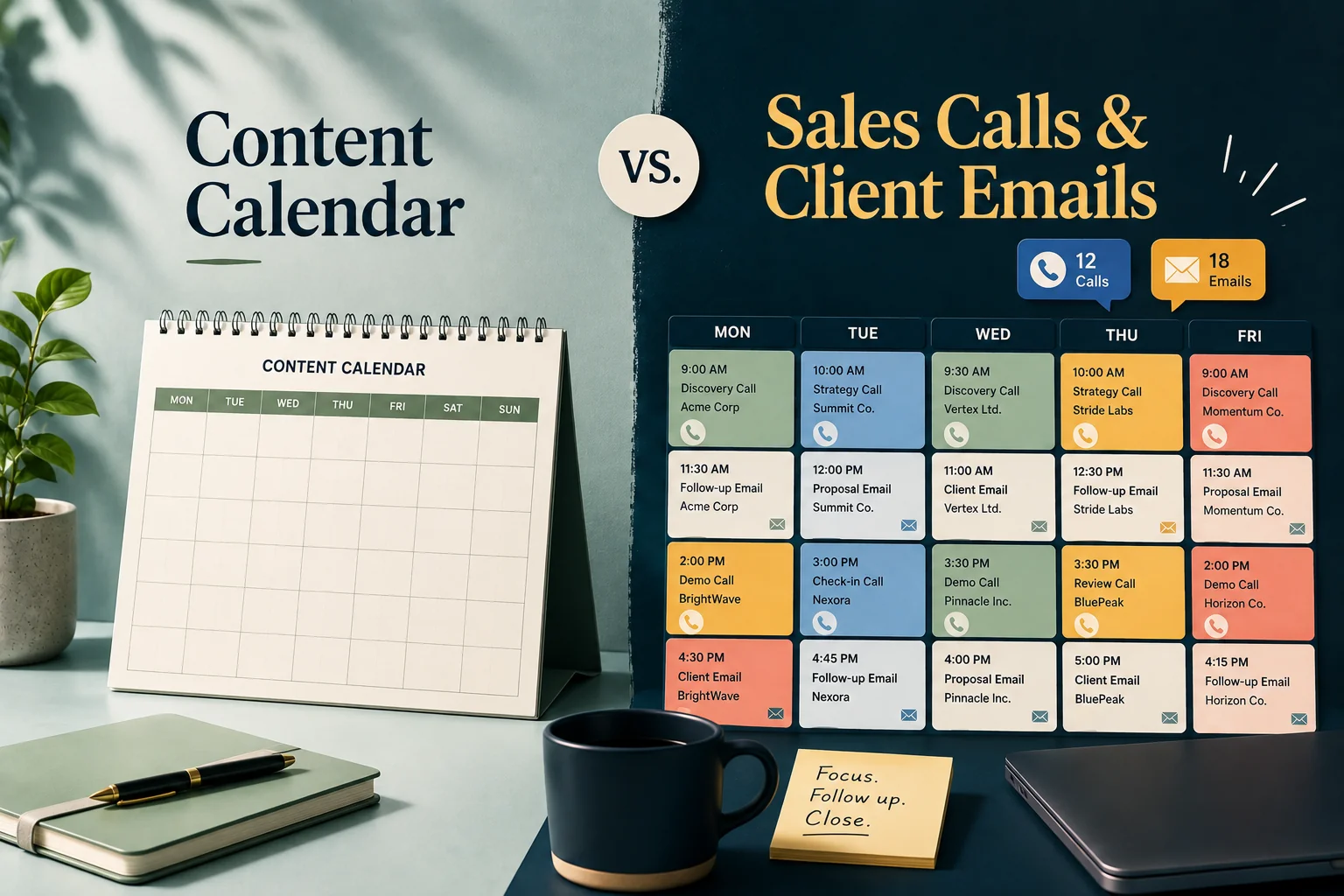
Most B2B LinkedIn programmes follow the same arc. A confident start, twelve good posts, then thinner ones, then a gap, then silence.
The post-mortem usually blames strategy or the algorithm. Neither is right. What happened is simpler: somebody committed to three posts a week and then ran out of things to say by week four.
That is not a strategy failure. It is a supply failure, and it has a fix that has nothing to do with content calendars.
The short answer
B2B LinkedIn content dies from shortage of material, not shortage of planning. The material already exists inside your business — in sales calls, client questions, project retrospectives, internal disagreements and data reviews — and nobody writes it down. Build a capture habit before a posting schedule, source from buyer conversations rather than industry news, and repurpose each captured insight across several formats. A business capturing properly has more to publish than it can use.
Key takeaways
- Programmes fail from empty hands, not bad plans. Fix supply before cadence.
- Five internal sources generate publishable material weekly without anyone sitting down to write.
- Source from buyer questions, not peer debates. Most B2B content is written to impress competitors.
- One captured insight yields four to six posts across formats, which is where cadence actually comes from.
- Capture takes minutes; writing from a blank page takes hours. The system is the difference.
Why the calendar approach fails
Content calendars assume the constraint is organisation. Decide the topics, assign the dates, publish on schedule.
That works for a month, because the first month runs on everything the business has been meaning to say for years. Then the backlog empties and the calendar keeps demanding.
What happens next is predictable. Somebody fills a slot with an industry news roundup. Then a company announcement. Then a motivational observation about consistency. Each is easier to write than the last and worth less than the one before.
The audience notices before the team does, and by then the account has taught people that its posts are skippable — which is harder to undo than starting later would have been.
The alternative is to invert the order. Build supply first, and let cadence follow from what you actually have.
The Five Sources
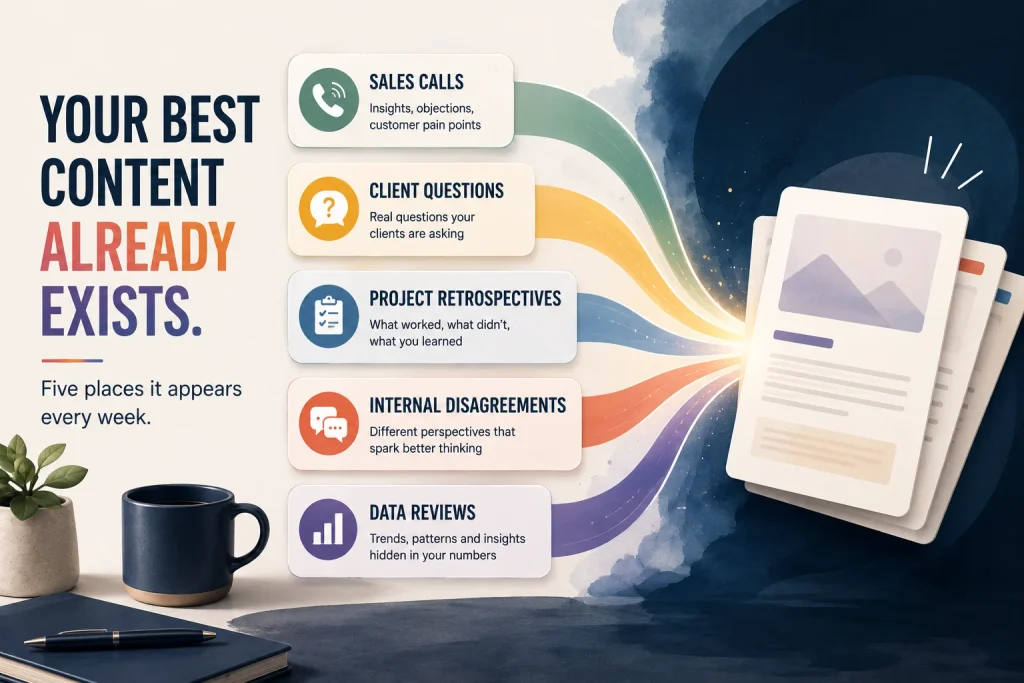
Every week your business generates publishable material in five places. None of it requires anyone to sit down and think of content. It requires somebody to write down what already happened.
1. Sales calls
The richest source and the least used.
Every call contains a question a real buyer asked, an objection they raised, a comparison they made, or a misunderstanding they arrived with. Each of those is a post, and each is guaranteed to be relevant because a buyer generated it.
The capture habit. After each call, the salesperson writes one line in a shared document: the question, verbatim if possible. Thirty seconds. Ten calls a week produces ten prompts, and most weeks two or three are genuinely worth publishing.
Why this beats keyword research. A question asked out loud by someone with budget is better evidence of demand than any tool, and it arrives in the buyer’s own words.
2. Client questions
What existing clients ask during delivery — how something works, why a decision was made, what a number means.
These are the questions people ask once they trust you enough to admit not knowing. They are also, reliably, the questions prospects have and do not ask.
The capture habit. Anyone client-facing forwards the question to a shared inbox or channel. No writing required.
3. Project retrospectives
What went differently from expected. What was quoted versus what it took. What you would do differently.
This is the mistakes material, and it is the most under-published category in Indian B2B, where LinkedIn skews heavily toward announcements. A plainly written account of something not working is read more carefully than any prediction.
The capture habit. A standing question at the end of every project: what surprised us?
4. Internal disagreements
When two experienced people in your business disagree about method, both usually have a defensible position — and the disagreement itself is the post.
Anything your own team argues about is something the industry has not settled, which makes it worth publishing and impossible to generate artificially.
The capture habit. When a debate happens in a meeting, someone writes the two positions down before everyone forgets.
5. Data reviews
Your own numbers. Conversion rates, cycle lengths, cost figures, win rates, what proportion of enquiries turn out unqualified.
One real number with context is unbeatable, because nobody else has it. It also need not be flattering — the unflattering ones perform better.
The capture habit. Whenever anyone pulls a report, ask whether one figure in it is publishable.
Source from buyers, not peers
A filter worth applying to everything the five sources produce.
Most B2B LinkedIn content is written for an audience of competitors. It uses industry vocabulary, references frameworks only practitioners know, and takes positions designed to sound sophisticated to peers.
Your buyers are not your peers. They do not know your jargon, they are not following industry debates, and they have a specific problem they would describe in ordinary words.
The test. Would the question you are answering have been asked by a buyer or by someone in your industry? Buyer questions come from sources one and two. Peer questions come from reading what other agencies post.
This matters more than it sounds, because around 5% of B2B buyers are in-market at any moment, per Ehrenberg-Bass research for the LinkedIn B2B Institute. Content aimed at peers reaches an audience that will never buy, generates encouraging engagement from people like you, and misleads you about whether it is working.
Once you have the raw material, how to judge whether a post is worth publishing covers the editorial filter that decides what actually goes out.
Repurposing: one insight, several posts

The part almost no guide covers properly, and the reason a capture habit produces more than you expect.
A single captured insight — say, a pattern you have seen across a dozen client projects — is not one post. It is several, each addressing a different reader at a different depth.
The short text post. The observation stated plainly in 150 words. Cheapest to produce, widest reach, and the version most people will see.
The carousel or document. The same insight broken into steps or examples. Slower to consume, better for demonstrating method, and document formats reward this on LinkedIn.
The short video. You saying it, in ninety seconds. Different audience, and it carries a face — which matters more on LinkedIn than most B2B teams accept.
The long-form article. The full version with the reasoning and the caveats. Fewer readers, but it is what someone reads when they are evaluating whether to contact you.
The internal use. The same insight in a sales email, in a proposal, in an onboarding document. Content produced this way pays for itself twice.
The sequencing that works. Publish the short post first, see whether it lands, and only invest in the longer formats for the ones that do. Most teams do the reverse and spend their effort on the version nobody asked for.
What a working system looks like
Not a calendar. A short weekly loop.
Capture continuously. One shared document, everyone adds to it, thirty seconds at a time. This is the only part that must happen daily and the only part that is nearly free.
Select weekly. One person reviews what was captured and picks one or two items. Selection is fast when supply is real.
Write in one sitting. A captured insight takes twenty minutes to write up because the thinking already happened during the work.
Repurpose the winners. After a fortnight, take whatever performed and produce the longer formats.
Review monthly, not weekly. Look for patterns in what landed — which source, which format, which length.
Set cadence from supply. If capture reliably produces two publishable items a week, post twice. Committing to five and delivering two is worse than committing to two and delivering two, both for the audience and for the team’s willingness to continue.
Mistakes that cost real money
Building the calendar before the capture habit. The error this article exists for.
Assigning content to the marketing team alone. They are the furthest from sales calls and client questions, which is where the material lives.
Writing for peers. Encouraging engagement from people who will never buy.
Publishing the long-form version first. Expensive, slow, and you learn nothing about whether anyone cares.
Treating a gap as failure. A missed week is recoverable. A month of filler is not.
Never asking sales what people ask. The cheapest research available in any business, and almost nobody does it systematically.
When this is the wrong investment
When nobody client-facing will spend thirty seconds capturing. The system is small but it is not zero, and without participation there is no supply.
When you need pipeline this quarter. Content compounds slowly — what each LinkedIn route actually costs covers the faster options honestly.
When the business genuinely has no unusual experience. Rare, but a pure reseller with no delivery involvement may have little to capture.
When your follow-up is broken. Content that generates enquiries nobody answers is expensive. The Harvard Business Review audit of 2,241 companies found an average first response of 42 hours, with 23% never responding — what makes a B2B lead qualified covers the process side.
The capture system checklist
☐ Shared capture document created and accessible to everyone client-facing
☐ Sales call question logged after every call, verbatim where possible
☐ Client questions forwarded to the capture document during delivery
☐ “What surprised us?” added as a standing question at project close
☐ Internal disagreements written down when they happen
☐ One publishable figure identified whenever a report is pulled
☐ Weekly selection by a named person
☐ Buyer-versus-peer filter applied before writing
☐ Cadence set from actual supply, not from an aspiration
☐ Short post published first, longer formats only for what performs
☐ Repurposing pass scheduled fortnightly
☐ Monthly review of which source and format performs
Questions we get asked
What should a B2B company post on LinkedIn?
Whatever your buyers asked you this month, whatever surprised you on a project, and whatever your own numbers show. Not industry news, which anyone can repost.
How do I come up with LinkedIn content ideas?
You do not need ideas. You need a record of what already happened — the five sources above generate more material than most businesses can publish.
How often should we post?
As often as your capture reliably supplies something worth reading. Two a week held for a year beats five a week for six weeks.
How do I repurpose content for LinkedIn?
Publish the short version first, watch what performs, then produce the carousel, video and long-form versions only for the winners.
Why does our LinkedIn content get no engagement?
Usually because it is written for peers rather than buyers, or because it says something anyone in your category could have said.
Who should own this?
Someone with access to sales conversations. Marketing can write and schedule, but a content system cut off from client contact runs dry within a quarter.
Start capturing this week
Open a shared document. Give it one heading: what people asked us this week.
Ask everyone who speaks to clients or prospects to add one line after each conversation. Not a summary — the question, in the words they used.
By Friday you will have more publishable material than a month of brainstorming produces, and the reason is straightforward: it came from people with budget describing problems they actually have.
Then apply the editorial filter and publish the two best.
If you would like help building a capture system that survives past month three, you can reach out to us on whatsapp at +91 7738844851 .
More in Blog
Keep reading
All articles →
Ready to talk about your growth?
Tell us what's stuck and we'll tell you what we'd do first. Free, 30 minutes, no pitch.