
Search this and you will find nine rate cards. They agree with each other, they are broadly accurate, and every one of them is published by a company that sells you the access and adds its own margin to the number it just quoted.
None of them explains the thing that actually determines your bill.
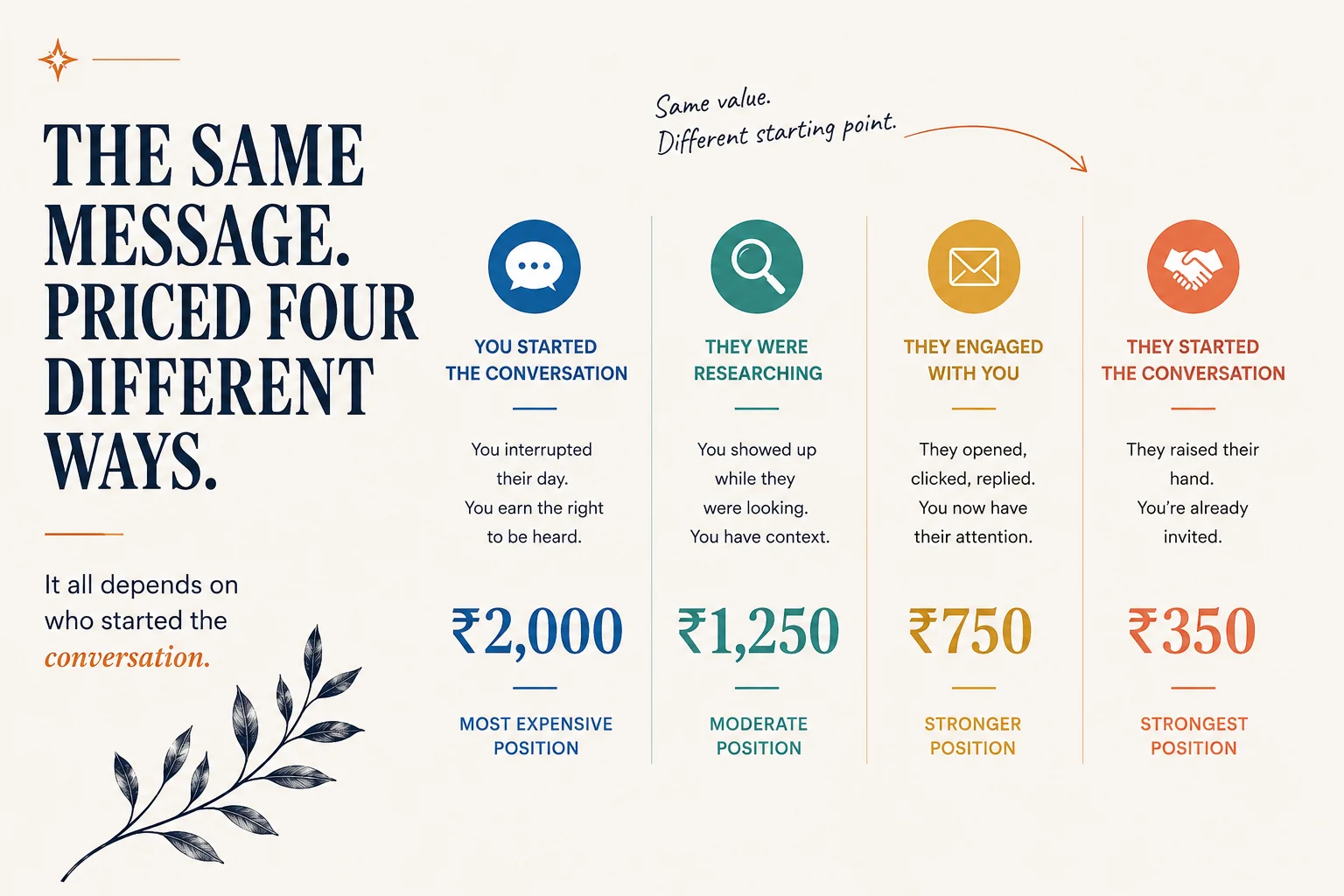
It is not the message. It is not the audience. It is who opened the conversation.
The short answer
WhatsApp Business messaging in India is billed per delivered message. Marketing messages cost about ₹0.8631 — a 10% increase on 1 January 2026 — while utility and authentication sit near ₹0.115. Inside a customer-opened 24-hour window, non-template messages and utility templates are free. And if a user reaches you through a click-to-WhatsApp ad and you reply inside that window, a further 72-hour window opens in which every message type is free. So the cheapest WhatsApp programme is one where customers message you first, and the most reliable way to make that happen is to buy it through Meta ads. On top of all of it, your provider adds 10–30%.
Key takeaways
- Marketing messages cost 7.5 times utility messages. ₹0.8631 against ₹0.115.
- Inside a customer-opened window, non-template messages and utility templates are free.
- Reply within 24 hours to a click-to-WhatsApp user and you open 72 further free hours — timed from your reply, not from their tap.
- Utility and authentication rates fall with monthly volume. Almost no provider mentions the tiers.
- At ₹15 a click, that window pays for itself after about 17 marketing messages.
- Your BSP adds 10–30% to Meta’s rates, and rarely says so on the pricing page.
- You cannot label a marketing message as utility. Meta reclassifies and charges the higher rate.
The four prices
Meta moved from conversation-based billing to per-delivered-message on 1 July 2025. Four categories, and the spread between them is the whole story.
Marketing — ₹0.8631. Promotions, offers, re-engagement, anything business-initiated that is not transactional. This rose 10% on 1 January 2026, from ₹0.7846. It is the most expensive message you can send and the one most businesses send most of.
Utility — around ₹0.115. Order confirmations, shipping updates, appointment reminders, account alerts. Transactional messages tied to something the customer did.
Authentication — around ₹0.115. One-time passwords and verification codes.
Service — free. Any reply you send inside a 24-hour window that the customer opened by messaging you. Free since 1 November 2024, with no monthly cap — Meta removed the old first-thousand-free limit at the same time.
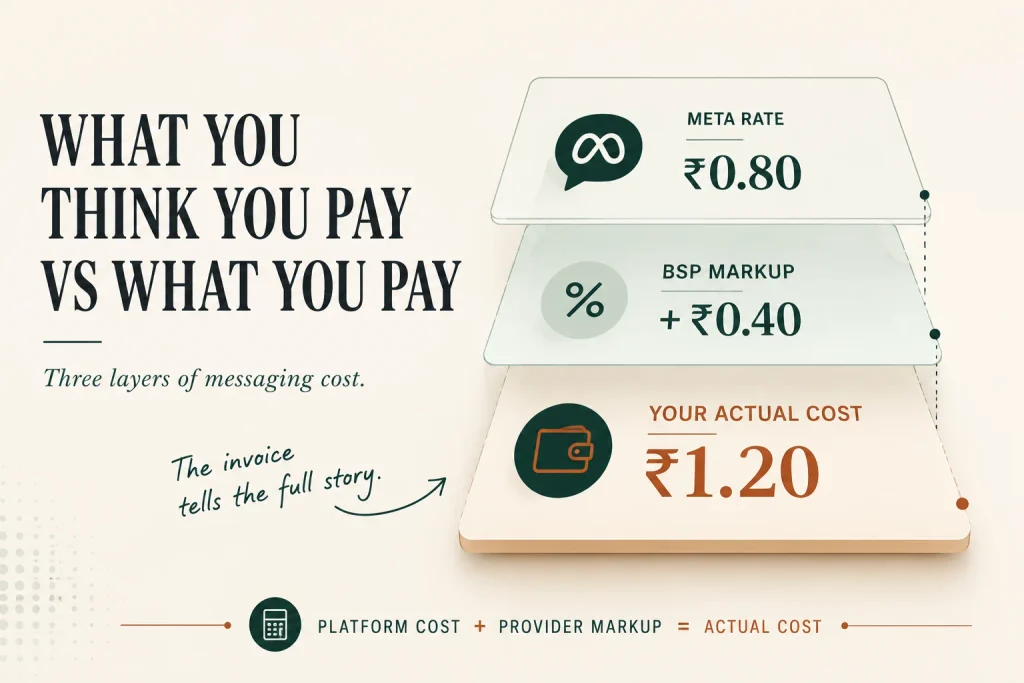
Then add your provider’s margin. Indian BSPs typically add 10–30% on top. At 30%, a marketing message costs you about ₹1.12 rather than ₹0.8631, and almost no provider shows that as a separate line.
Who Speaks First
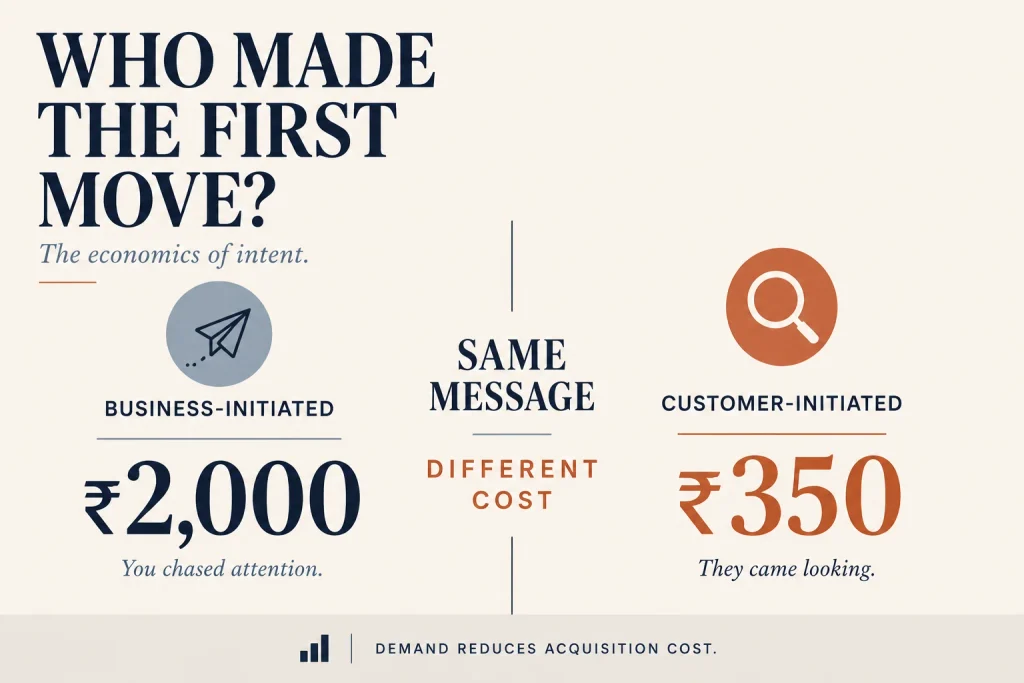
The price of a WhatsApp message is set by who opened the conversation, not by what the message says. If the customer started it, you are free. If you started it, you pay — and you pay 7.5 times more if Meta decides it is marketing.
This single fact reorganises the whole channel.
Most businesses treat WhatsApp as a broadcast tool. Build a list, send a campaign, pay per message, repeat. That is the most expensive possible way to use it, and it is what every BSP dashboard is designed to encourage, because that is what they earn on.
The cheap version runs the other way. You engineer situations where the customer messages you, then you have a free window to be useful in.
Which raises the obvious question — how do you make customers message first? Three answers, in ascending order of reliability.
Passively. Put the number everywhere — website, invoices, packaging, email signatures, Google Business Profile. Free, slow, and it works better than most people expect.
Structurally. Make WhatsApp the path of least resistance for things people already want to do. Order status, appointment changes, reordering. Every one of those is a customer-initiated conversation you did not pay for.
By buying it. Which is where this stops being a messaging decision and becomes a media decision.
The free entry point, and why it is a media buy
Here is the mechanism almost nobody costs properly — and almost nobody describes accurately either, so it is worth getting exactly right from Meta’s own documentation.
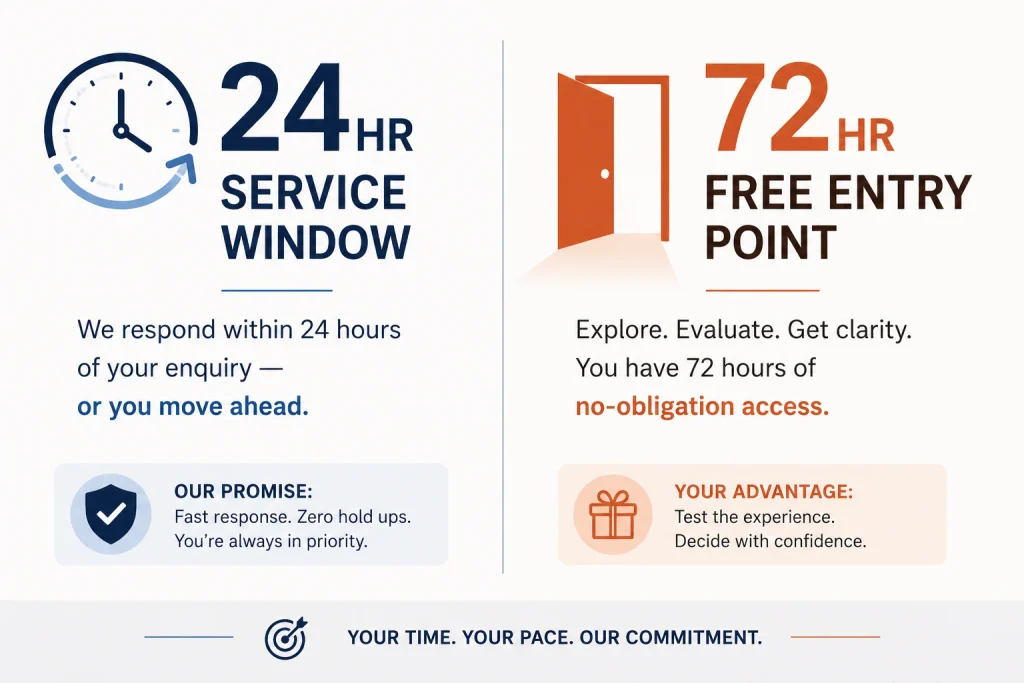
A user messages you after tapping a click-to-WhatsApp ad or a Facebook Page call-to-action button. That opens a normal 24-hour customer service window.
If you reply within those 24 hours, your reply is free — and a separate 72-hour free entry point window opens, timed from your reply. While it is open, any message type costs nothing, marketing templates included.
Three details that decide whether you get it. The user must be on the Android or iOS app — desktop and web do not qualify. You must respond inside 24 hours or the window never opens. And the customer service window runs independently, so once it closes you can send templates only, free but not conversational.
Which makes speed of reply a pricing decision, not just a service one. A business that answers within the hour opens 72 free hours. A business that answers on day two pays full rate for everything that follows.
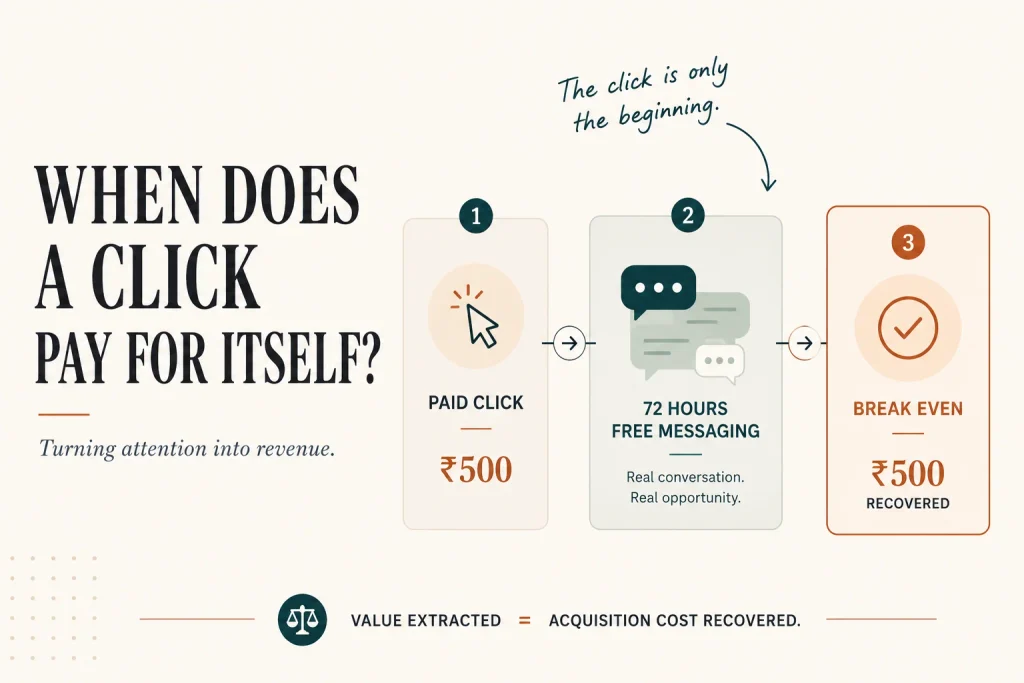
So run the arithmetic against templates. A marketing template costs ₹0.8631. At a click-to-WhatsApp cost of ₹15 per click, that click buys a free window worth about 17 marketing messages. At ₹8 a click, about nine. At ₹25, about twenty-nine.
Which means for any conversation likely to run past that many messages — and a real sales conversation usually does — buying the click is cheaper than paying for templates. You are not just buying a lead. You are buying three days of free messaging with it.
And it changes how you compare Meta objectives. A lead form gives you a phone number you must then pay to contact. A click-to-WhatsApp ad gives you a live conversation with seventy-two free hours attached. Those are not the same product at the same price, and they are almost always compared as if they were — the form-side trade-offs sit at why frictionless forms produce unqualified leads.
What determines whether this is affordable is your cost per click, which is a media question — what drives your CPM and cost per result covers the inputs.
A claim doing the rounds that we could not stand up
Several provider pages state that free service messages inside the 24-hour window become chargeable on 1 October 2026.
Meta’s own pricing documentation does not say this. It lists “service conversations are now free for all businesses” under previous updates, effective 1 November 2024, with no announced reversal. Its pricing calendar commits to changing rates only on the first day of a quarter, with a month’s notice for a rate card change and six months for a change to the pricing model.
So either the change has not been announced, or it has been announced somewhere we have not found. We are not repeating it as fact.
What the calendar does tell you is useful on its own: pricing can move on 1 January, 1 April, 1 July or 1 October, and you are entitled to notice. Anyone budgeting a year of WhatsApp messaging should assume one or two rate movements in it and check the documentation each quarter rather than trusting a provider’s blog.
The cost lever most pages skip
Utility and authentication messages have volume tiers. Send more in a month and the rate falls, aggregated across every WhatsApp Business Account in your business portfolio, per market and per category.
Two things do not count toward the tier — utility templates delivered inside an open customer service window, and anything sent inside a free entry point window. Which is logical, because those were free.
Tiers reset monthly. For a business sending genuine transactional volume, this is a real saving and it is almost never mentioned by the people billing you.
Why you cannot simply call it utility
The 7.5x gap between marketing and utility invites an obvious move, and Meta closed it.
Since 9 April 2025, if you submit a template as utility and Meta’s review determines it is marketing, it is approved as marketing — and billed accordingly. You do not get a rejection; you get the higher rate. You can, however, request a review up to 60 days from the date the category was updated, which almost no business does.
So the discipline is not labelling. It is design.
A genuine utility message is tied to something the customer did. They ordered, booked, paid, requested, or an account event occurred. The message tells them about that thing.
A marketing message is one you decided to send. However useful it is, however well written, if the trigger is your calendar rather than their action, it is marketing.
Which turns pricing into a product question. Businesses with real transactional events — orders, bookings, deliveries, renewals, appointments — can run most of their messaging at ₹0.115. Businesses without them cannot, and should stop trying to.
The honest version for a lead generation business: you probably do not have many genuine utility triggers, and the cheap rate is largely unavailable to you. Your route to cheap messaging is the free windows, not the utility category.
What your provider is not telling you
You cannot connect to WhatsApp Business Platform directly as most businesses; you go through a Business Service Provider. That is a legitimate service and it costs money to run.
But three things are worth knowing.
The markup is real and it is rarely itemised. 10–30% on Meta’s per-message rate. Ask for it as a separate line and compare providers on it.
Platform fees sit on top. Monthly subscription, seat costs, and sometimes charges for features that are Meta’s, not theirs.
Rates change and markups do not automatically follow. When Meta raised marketing rates 10% in January, the question worth asking your provider is whether their markup percentage was applied to the new number or the old one.
None of this makes BSPs the villain. It makes them a supplier with an interest, publishing the rate card you are using to evaluate them.
Opt-in, briefly and carefully
WhatsApp requires opt-in before business-initiated messaging, and India’s data protection regime adds its own obligations.
The platform requirement is that people have agreed to hear from you on WhatsApp specifically, with a clear indication of what they are agreeing to. A phone number collected for delivery updates is not consent for promotional broadcasts.
The regulatory layer is India’s Digital Personal Data Protection framework, which is phasing in through 2026 and 2027 and touches consent, purpose limitation and withdrawal.
Get this checked rather than inferred. It is one of the few areas where being wrong is a compliance problem rather than an expensive one, and it is moving.
Mistakes worth the money they cost
Running WhatsApp as a broadcast channel. The most expensive configuration available, and the default.
Paying for messages inside a free window. If a customer messaged you four hours ago, everything you send is already free. Sending a template instead is money set on fire.
Letting the window close. Reply within twenty-four hours or the next message costs full rate. A response process that runs to two days pays for every conversation twice.
Comparing lead forms and click-to-WhatsApp on cost per lead alone. One comes with 72 free hours attached and the other does not.
Assuming your BSP quote is Meta’s rate. It is Meta’s rate plus something.
Submitting marketing templates as utility. Reclassified and billed at the higher rate since April 2025.
Buying a platform before you have a use case. Subscription fees for a channel nobody has been assigned to run.
When WhatsApp is the wrong channel
When nobody owns replies. An unanswered WhatsApp is worse than no WhatsApp, and the window closes in a day.
When your buyers are enterprise procurement. Formal purchasing runs on email and paper trails.
When you have no transactional triggers and no ad budget. Both routes to affordable messaging are closed and you are left with the ₹0.8631 rate for everything.
When your list was not opted in properly. Cheap in the short term, expensive when it is challenged.
When it duplicates a channel already working. Adding WhatsApp to an email programme that performs is a cost, not a strategy.
The WhatsApp economics checklist
☐ Current message mix split by category — marketing, utility, authentication, service
☐ Monthly cost calculated at Meta’s published rates
☐ BSP markup requested as a separate line and compared across providers
☐ Platform and seat fees listed separately from per-message costs
☐ Transactional triggers audited — which messages genuinely qualify as utility
☐ Response time measured against the 24-hour window
☐ Free-window opportunities identified before any template is sent
☐ Click-to-WhatsApp tested against lead forms on full cost, not cost per lead
☐ Break-even calculated — cost per click against marketing messages saved
☐ Opt-in wording reviewed against platform rules and Indian data protection obligations
☐ Exposure to the reported 1 October change modelled
☐ One named owner of the WhatsApp inbox
Questions we get asked
How much does WhatsApp Business API cost in India?
Marketing messages about ₹0.8631, utility and authentication about ₹0.115, and replies inside a customer-opened 24-hour window free. Add 10–30% for your provider.
What is the difference between marketing and utility messages?
Utility is tied to something the customer did; marketing is something you decided to send. The price difference is roughly 7.5 times, and Meta reclassifies templates that are labelled wrongly.
Are WhatsApp replies free?
Inside a window the customer opened, non-template messages are free and so are utility templates. Marketing templates are not. Claims that this ends on 1 October 2026 are not supported by Meta’s own pricing documentation.
What is a free entry point conversation?
When someone reaches you by tapping a WhatsApp ad or a Page message button, you get 72 hours in which all messages are free, including marketing templates.
Do I need a BSP to use WhatsApp Business API?
For most businesses, yes. What you should not accept is a quote that hides the markup inside the per-message rate.
Is WhatsApp cheaper than email?
Per message, no — email is close to free. Per outcome, frequently yes, because read rates are not comparable. Judge it on cost per outcome rather than cost per send.
Where to go next
This page is the survey. The detail sits in the articles below.
On price — the full rate card from the buyer’s side, with provider markups modelled.
On templates — what genuinely qualifies as utility, and how to design for it.
On ads — click-to-WhatsApp as a way of buying free messaging windows.
On providers — comparing BSPs on the number they do not advertise.
On the deadline — what the reported October change would cost you.
The number to work out this week
Take last month’s WhatsApp messages and split them four ways: marketing, utility, authentication, and replies inside a customer-opened window.
Price the first three at Meta’s rates, add your provider’s markup, and look at what proportion of your bill is the marketing category.
For most businesses it is nearly all of it — which means nearly all of it was avoidable, either by having something transactional to say or by letting a paid click open the conversation instead.
If you want that split calculated against your own account and your BSP quote checked against Meta’s published rates, you can reach out to us on whatsapp at +91 7738844851 .
More in Blog
Keep reading
All articles →
Ready to talk about your growth?
Tell us what's stuck and we'll tell you what we'd do first. Free, 30 minutes, no pitch.