
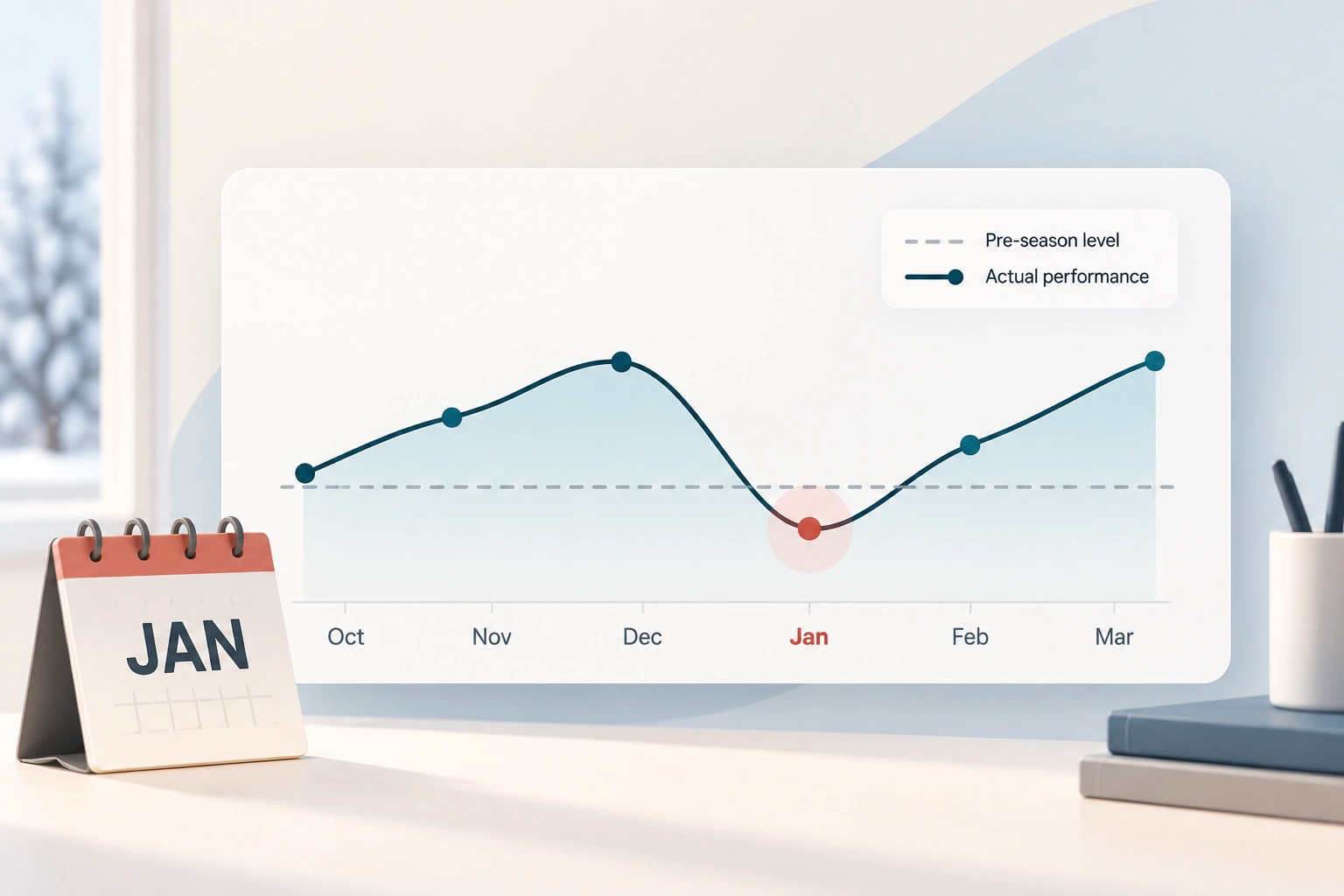
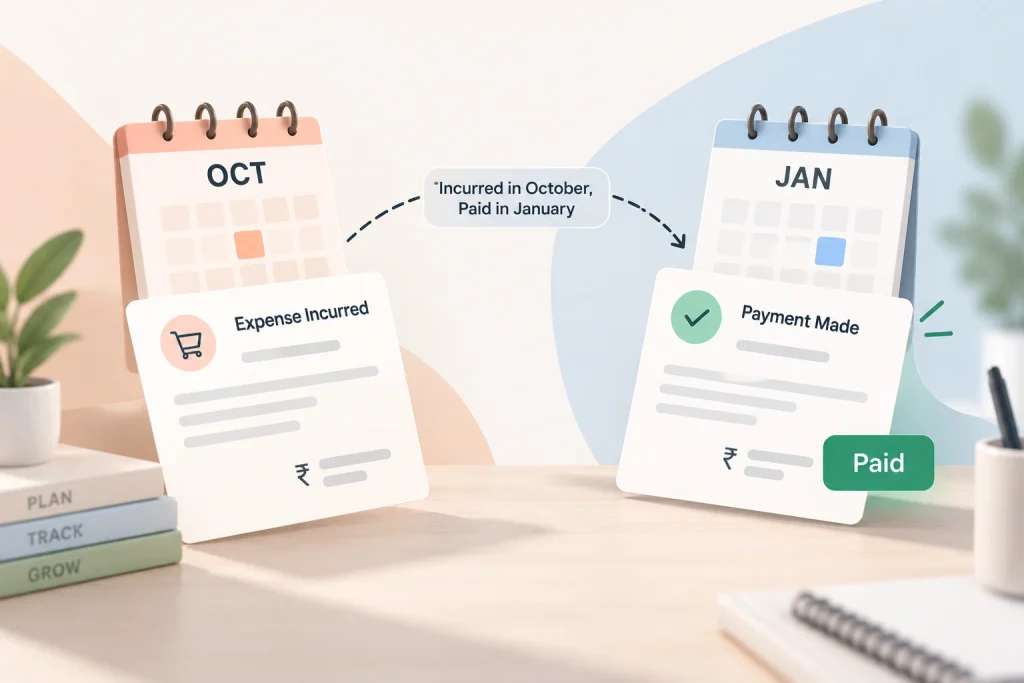
January demand falls below where it was before the festive season began, because the window pulled purchases forward rather than creating them. Businesses then compare January to December and conclude something has broken, or compare it to last January and miss that both months were hollowed out by the seasons preceding them. The honest comparison is October through January against the same four months last year. Three costs also arrive in January that were incurred in October — the discount that trained buyers to wait, the reviews from anything you oversold, and the restart cost for any account switched off during the window.
Every Indian business that runs a festive season has the same conversation in the second week of January.
The chart has fallen off a cliff. Somebody asks what happened to the marketing.
Nothing happened to the marketing. The season borrowed the demand and January is when the loan is repaid.
You are comparing the wrong two periods
The pull-forward is the mechanism and it is almost never named.
A festive window creates some purchases and merely relocates others. A meaningful share is buying that would have happened anyway, moved forward because of the occasion, the offer or the deadline. Somebody who would have replaced an appliance in January replaced it in October instead.
That purchase is not lost. It is spent.
So January is not merely quiet. It is below the pre-season baseline, because the customers who would ordinarily be buying in January already did.
Two comparisons are made and both mislead.
January against December shows a collapse that is entirely expected and tells you nothing about your business.
January against last January looks reasonable and is also wrong, because last January had been borrowed from too — so you are comparing two hollowed-out months and concluding they are comparable.
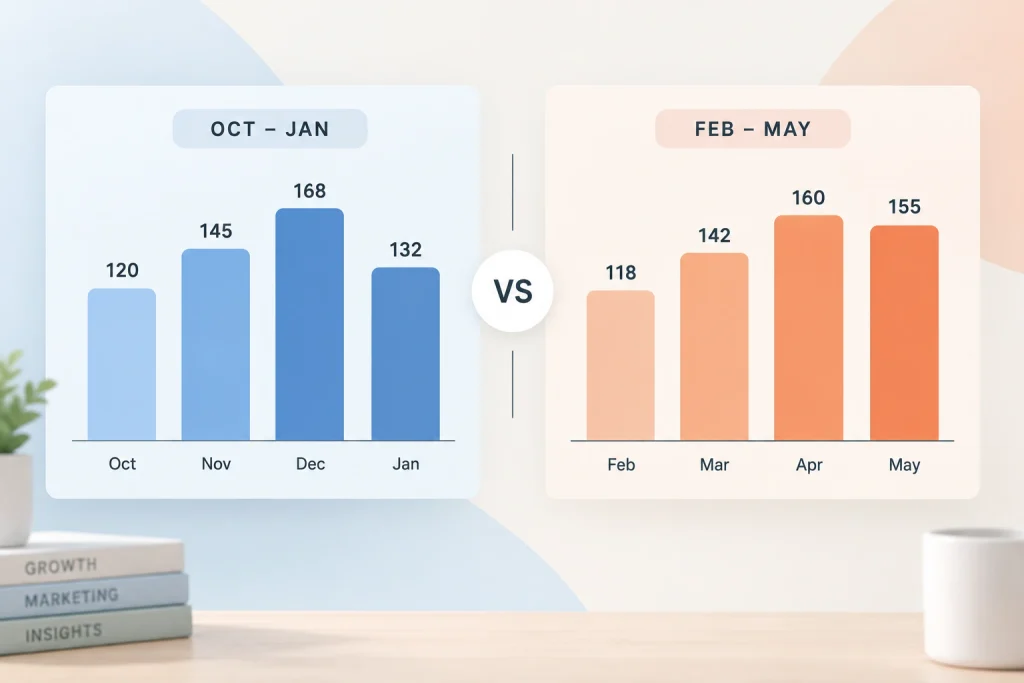
The honest measure is the whole period. October to January this year against October to January last year. That captures both the borrowing and the repayment, and it answers the only question worth asking: did the total grow, or did you spend a great deal of money moving the same revenue two months earlier?
A business that runs that comparison and finds the four-month total unchanged has learned something important about its festive strategy, and it will not learn it any other way.
Bill one: the discount arrives in January
Our discount article sets out why a festive discount is a price the buyer remembers. We are not going to re-argue it.
January is when that memory does its work.
The customer who bought at thirty per cent off in October is now aware of two things: what your product is actually worth to them, and that waiting produces a better price. A January offer at full price is being read against the October number, and it converts worse than the same offer converted before you ran the sale.
The deeper version is that this compounds annually. Each season adds a cohort to the group that knows to wait, so the January conversion problem is slightly worse every year, and it never presents itself as a discount problem. It presents as a January problem.
Bill two: the reviews arrive in January
The one nobody staffs for.
Everything sold at the peak is used, gifted, opened, fitted and returned in the weeks afterwards. So the customer experience of your busiest month is written down in the month you stopped paying attention to it.
If the season went well, this is a windfall — a large group of satisfied customers at exactly the moment you have time to ask them for something. Almost nobody does.
If the season went badly — if the capacity problem our demand planning article describes went unmanaged — this is when the record of it gets written. Late deliveries, cancellations and refunds become reviews in December and January, and they are permanent.
Either way, January is a review month and it should be staffed as one. Somebody answering, somebody asking, and somebody watching for the theme.
Bill three: the restart
Brief, because it is covered elsewhere.
An account switched off entirely during the window comes back in January with no recent data and no warm audiences. Our budget article describes what that costs, and our B2B article covers the version of it that affects businesses which correctly sat the season out.
The instruction is the same in both: reducing is not stopping, and an account that never went cold does not have to be restarted.
The trap that makes all three worse

Now the specific January mistake, and it is recommended everywhere.
The clearance sale.
Festive stock has not moved. Cash is needed. Demand has collapsed. So a January sale is announced, frequently deeper than the festive one because the stock is now a problem rather than an opportunity.
Consider what that teaches.
The buyer learned in October that your product goes on sale during the festival. They have now learned that if they wait past the festival, it goes cheaper still. Which moves the optimal purchase moment from your peak month to the month after it, permanently, and hollows out the season you spent the year planning.
That is a considerably worse lesson than the first one, and it is taught for a short-term cash reason.
If you have to clear, clear quietly. Private offers to existing customers, a marketplace channel, a bulk buyer, a bundle that does not reveal a unit price. All of those move stock without publishing a new reference price to the whole market.
The public January clearance is the most expensive cheap decision in the Indian retail calendar.
What January is actually good for
Three things, and they are not campaigns.
Cheap inventory, briefly. Competitive pressure has collapsed and costs have fallen. Our budget article covers the fortnight immediately after the peak; the wider point for January is that if you have anything worth advertising at full price, this is an unusually inexpensive month to do it.
The customers you just acquired. You have a cohort of first-time buyers who are currently reachable and currently well-disposed. What to do with them is the subject of the next article in this cluster, and the one thing not to do is nothing.
And next year’s plan. Our budget article argues that the festive budget conversation has to happen in April because a September approval makes the correct plan impossible. The evidence for that conversation is assembled in January, while the numbers are fresh and somebody still remembers what happened.
Write the four-month comparison, the cost per acquisition in the pre-window against the peak, and a plain note on what broke. In April it will be the only document in the room with facts in it.
What we cannot tell you
We cannot tell you how much of your festive demand was pulled forward rather than created. The four-month comparison gives you the answer over two years and nothing gives it to you in one.
We cannot tell you how far January falls. It depends entirely on your category and how deeply you discounted.
And we cannot tell you whether to clear stock. That is a cash decision rather than a marketing one, and the only marketing contribution is to insist it happens quietly.
Final thoughts
Before anybody concludes that January is a marketing failure, run the four-month comparison. It usually ends the conversation.
Then handle the three bills — expect the trained buyer, staff for the reviews, and do not restart an account you should never have stopped.
Clear stock privately if you must clear it at all.
And write next year’s evidence in January, because by April nobody will remember and the plan will be built on a feeling.
If you want the four-month comparison run properly on your own numbers, you can reach out to us on whatsapp at +91 7738844851 ,
More in Blog
Keep reading
All articles →


Ready to talk about your growth?
Tell us what's stuck and we'll tell you what we'd do first. Free, 30 minutes, no pitch.