
Two Indian businesses send 25,000 WhatsApp messages a month. One is billed about ₹1.03 lakh over the year. The other is billed about ₹2.62 lakh.
Same platform, same volume, same country. The difference is not negotiation and it is not scale. It is how each business is run.
Here is how to work out which of those two you are, before you commit to a number.
Start with the unit cost, because the published one is wrong
Every rate card you will find quotes Meta’s list price. In India that is ₹0.8631 for a marketing message and about ₹0.115 for utility and authentication. Those figures are accurate and they are not what you pay.
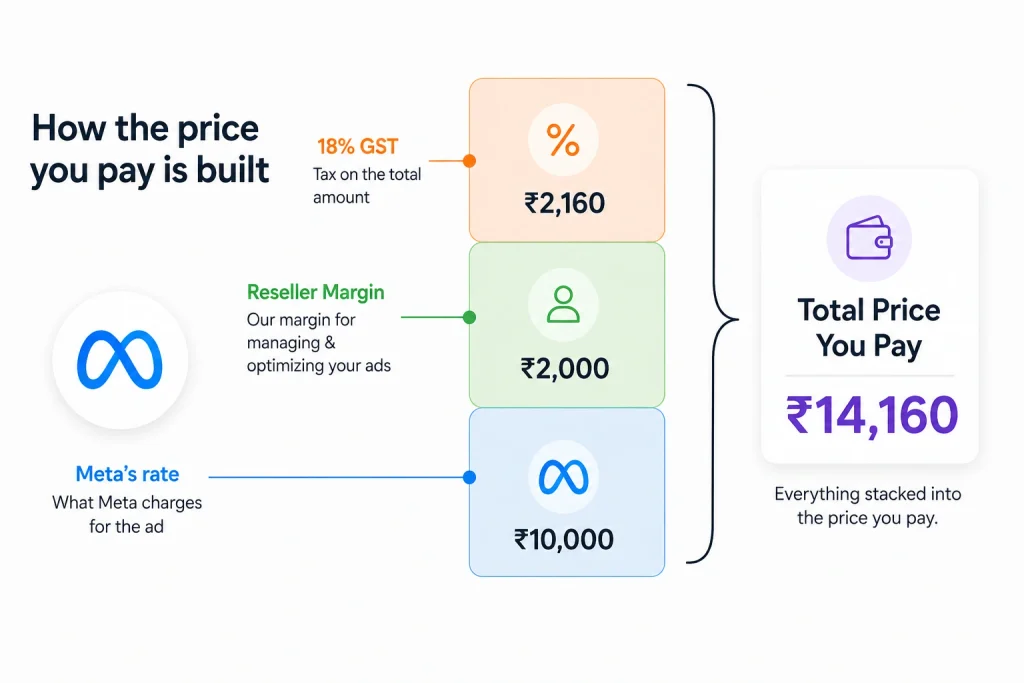
Two layers sit on top.
Your provider’s margin. Most businesses reach WhatsApp through a Business Service Provider, and Indian BSPs typically add 10–30% to Meta’s rate. It is rarely shown as a separate line.
Then 18% GST, applied to the invoice as a whole. This appears on none of the rate cards competing for your attention, and it is not optional.
Stack them and a marketing message costs:
- ₹1.0185 at Meta’s rate plus GST alone
- ₹1.1203 at a 10% margin
- ₹1.2221 at 20%
- ₹1.3240 at 30%
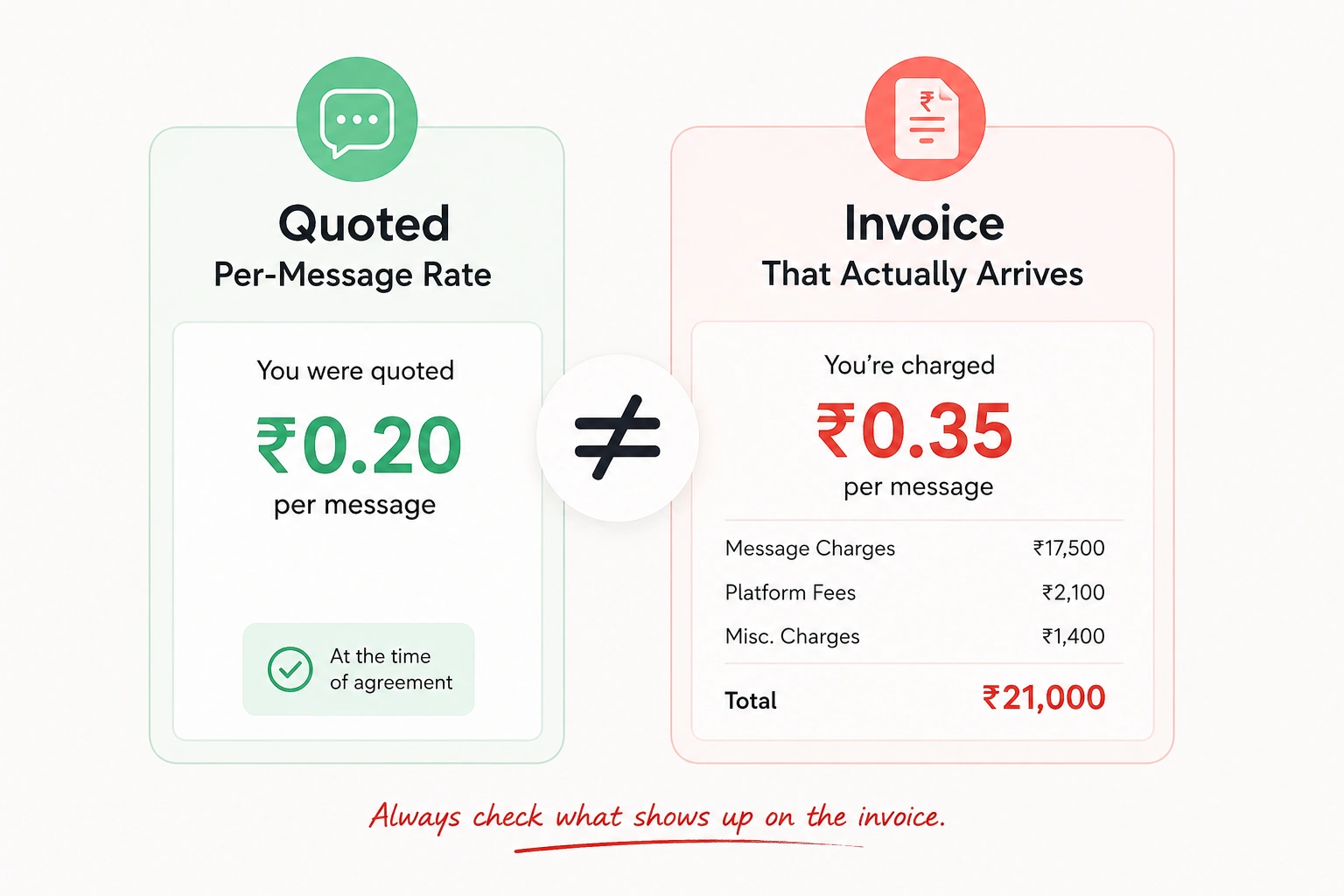
So the number on the page is between 30% and 53% below what you will be billed. At a 20% margin the gap is 41.6%.
Utility and authentication land at about ₹0.1628 on the same assumptions.
Use the landed figure for everything that follows. A budget built on list rates is short by roughly two fifths before you have made a single other error.
Then split your traffic three ways
Forecasts usually go wrong at this step, because people estimate total volume and multiply it by one rate.
You need three numbers, not one.
☐ Messages you will send as marketing templates — anything you initiate that is not tied to something the customer did
☐ Messages you will send as utility or authentication templates — order updates, confirmations, reminders, codes
☐ Messages that will fall inside a free window — replies within a customer-opened conversation, and anything inside a free entry point window
The third number is the one nobody forecasts, and it is the one that moves the total most. How those windows work — and why the price depends on who opened the conversation — is set out at what a WhatsApp message costs, and who decides.
Estimate it from last month rather than from ambition. Pull the actual split from your provider’s reporting. If you have not started yet, use the shape of your business: a company with genuine transactional events will run utility-heavy, a company without them will run marketing-heavy, and a company that answers quickly will land far more inside free windows than one that does not.
Ignore the volume tiers
They exist, they are real, and they will not apply to you.
Marketing messages carry no volume discount at any level. Whatever you send, the rate is the rate.
Utility holds the list rate up to 25 million messages a month. Authentication discounts begin around 750,000 a month.
Put that in proportion. A business sending 25,000 utility messages a month is at 0.10% of the first utility threshold. You would need a four-hundred-fold increase to see a discount.
Which matters because the tiers get quoted at you as a reason to consolidate volume with one provider. At the scale most Indian businesses operate, that argument is decoration.
Add the fees that are not per-message
Platform subscription. Your provider charges monthly for the software — dashboards, automation, team inboxes. Indian plans commonly run from a few hundred rupees to several thousand a month depending on seats and features.
Per-seat costs, where they apply.
Setup and number verification, usually one-off.
Integration work, if you are connecting a CRM or a website. This is real engineering time and it belongs in the first-year number even though it will not recur.
Model these separately from message costs. They behave differently — largely fixed against volume — which means at low volume they can be most of your bill, and at high volume they disappear into it.
What a year looks like
Three business shapes, all sending the same volumes, priced at a 20% provider margin with GST.
A lead generation business — 70% marketing, 10% utility, 20% inside free windows. Few transactional triggers, so most messages are business-initiated.
- 5,000 messages a month: about ₹52,300 a year
- 25,000 a month: about ₹2,61,500
- 100,000 a month: about ₹10,46,100
A transactional business — 20% marketing, 60% utility, 20% free. Orders, deliveries, bookings, renewals.
- 5,000 a month: about ₹20,500 a year
- 25,000 a month: about ₹1,02,600
- 100,000 a month: about ₹4,10,600
A fast-responding business — 40% marketing, 20% utility, 40% free. Answers quickly, so a large share of conversation happens inside windows it did not pay for.
- 5,000 a month: about ₹31,300 a year
- 25,000 a month: about ₹1,56,400
- 100,000 a month: about ₹6,25,700
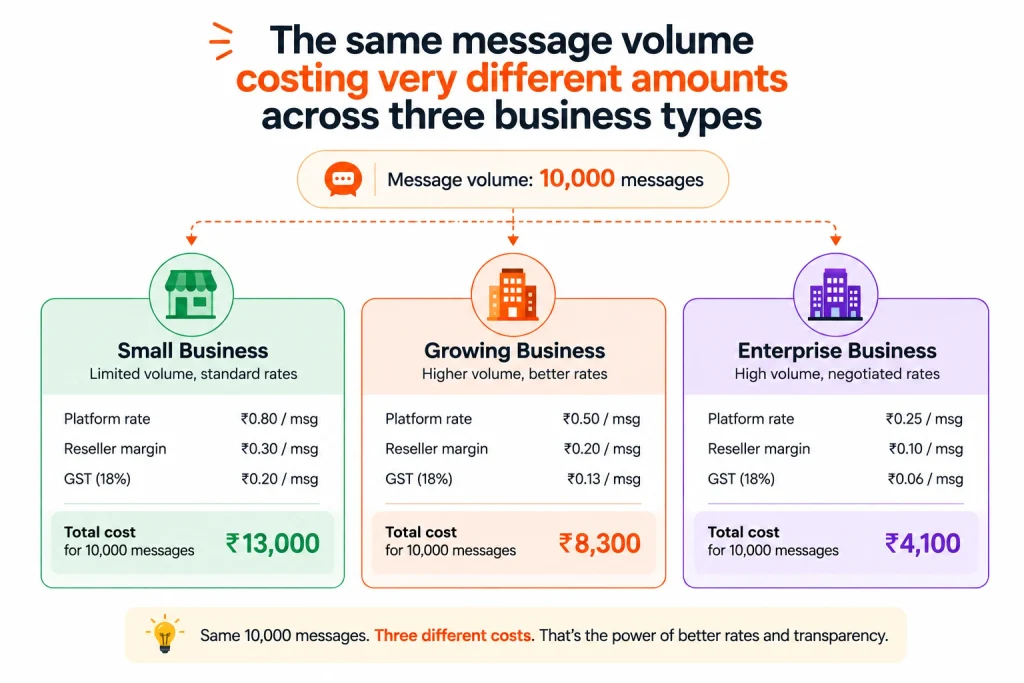
At 25,000 messages a month the annual spread is ₹1.03 lakh to ₹2.62 lakh — a two-and-a-half-fold difference on identical volume, driven entirely by what kind of messages the business has cause to send and how fast it replies.
Add platform fees on top of all three.
What actually moves the number
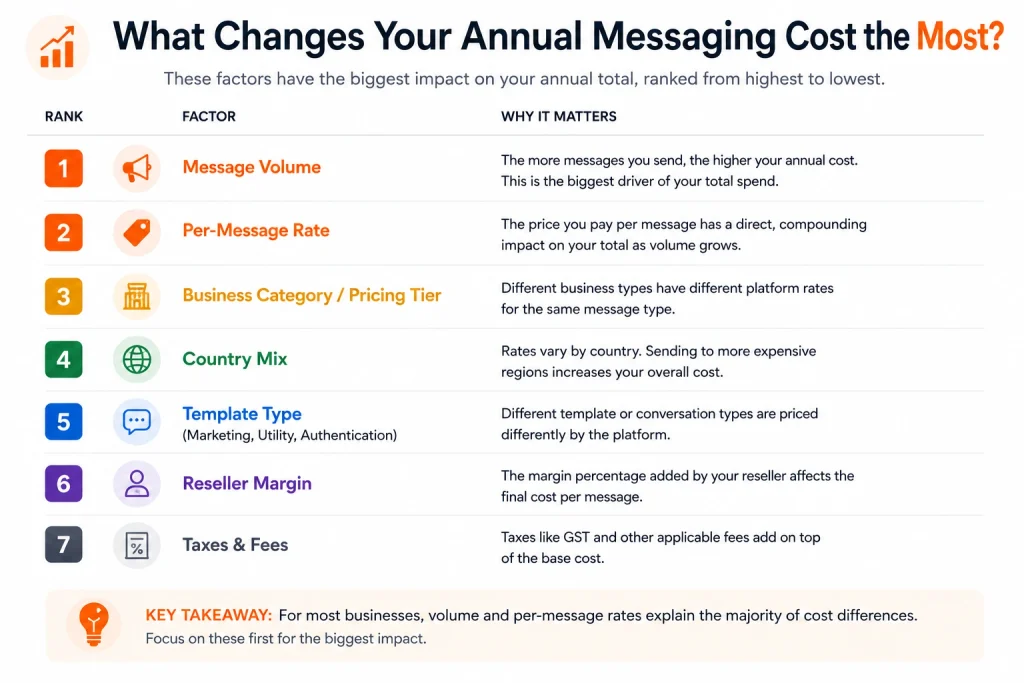
Worth ranking, because effort tends to go to the smallest lever.
Take the lead generation business at 25,000 messages a month, costing about ₹21,800 monthly.
Move a fifth of marketing messages inside free windows — mostly by replying faster — and it falls to about ₹15,700. A 28% reduction.
Convert a fifth of marketing messages into genuine utility messages — which requires having transactional events worth messaging about — and it falls to about ₹16,500. A 24% reduction.
Negotiate your provider margin from 30% down to 20% and it moves by about 8%.
Which is the useful finding. Most businesses spend their energy on the third lever because it feels like the commercial one. The first two are three times larger, and neither is a negotiation — one is an operations decision about response time, the other is a product decision about what you have to say.
Reply speed is a line item. That is not a metaphor. On these numbers, a business that answers within the hour rather than the next day saves more than any discount a provider will offer it.
What this model will not tell you
Whether the messages work. This is a cost forecast, not a return forecast. Judging the channel is a different exercise — which metric should govern your decisions covers that.
What your provider will actually quote. Margins vary, and some bundle platform fees into per-message rates in ways that make comparison difficult on purpose.
Whether rates hold. Meta may change pricing on the first day of any quarter, with a month’s notice for a rate change and six months for a change to the pricing model. Build one or two movements into an annual figure rather than assuming today’s rate for twelve months.
How much of your volume is avoidable. Some businesses discover, doing this exercise, that most of their marketing messages exist because nobody asked whether they should. That is a better finding than a cheaper rate.
Questions we get asked
How much does WhatsApp Business API cost per month in India?
For a business sending 25,000 messages, somewhere between about ₹8,500 and ₹22,000 a month before platform fees, depending on message mix and how much falls inside free windows.
Is GST charged on WhatsApp Business API?
Yes, 18% on Indian invoices. It appears on none of the rate cards ranking for this term, and it is a fixed addition to whatever you were quoted.
Do WhatsApp volume discounts apply to small businesses?
No. Marketing has no discount at any volume, and utility holds list rate to 25 million messages a month. Treat tiers as irrelevant unless you are an enterprise messaging platform.
How do you calculate a WhatsApp marketing budget?
Landed unit cost — Meta rate, plus provider margin, plus GST — multiplied by forecast volume in each category, minus everything inside free windows, plus platform and setup fees.
What are WhatsApp platform fees?
Your provider’s software charge, separate from per-message costs. Fixed against volume, which makes them a large share of a small programme and a small share of a large one.
Why is my bill higher than the rate card?
Almost always margin plus GST. Ask for both as separate lines and the arithmetic will reconcile.
Do this before you approve a number
Pull last month’s message log and split it four ways: marketing, utility, authentication, and everything inside a free window.
Price the first three at your landed rate — Meta’s figure, plus your provider’s margin, plus 18%. Multiply by twelve. Add platform fees.
Then look at the proportion sitting in the marketing column, because for most businesses that is nearly all of the bill and a good part of it did not have to be there.
If you want that split pulled from your own account and the annual figure built properly, you can reach out to us on whatsapp at +91 7738844851 .
More in Blog
Keep reading
All articles →
Ready to talk about your growth?
Tell us what's stuck and we'll tell you what we'd do first. Free, 30 minutes, no pitch.