
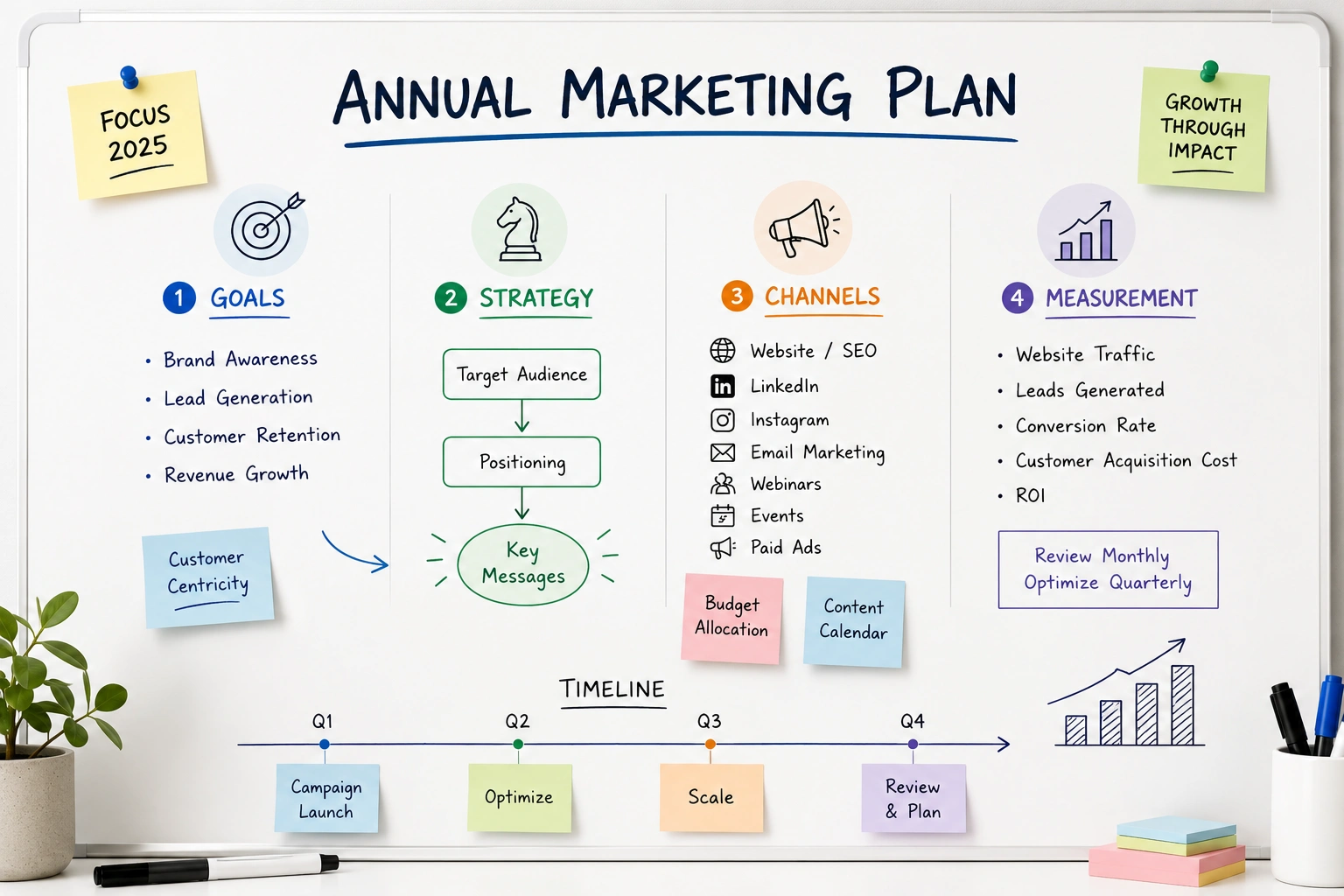
Most documents titled “marketing strategy” are budgets with adjectives.
They list what the company will do — SEO, content, LinkedIn, events, paid search, account-based marketing, a website refresh — with a number beside each line and a paragraph of intent above it. Every activity is defensible. Nothing has been decided.
You can tell within thirty seconds. Read the document and ask what it rules out. If the answer is nothing, it is a plan, and the strategy is still missing.
The short answer
A B2B marketing strategy is the small set of choices that determine where effort goes and, more importantly, where it does not. In a mid-market Indian business with constrained resources, the choices that matter are which buyers you will not serve, which problem you will not solve, which channels you will not run this year, which metric you will not optimise, and which competitor you will not try to beat. Everything after that is planning.
Key takeaways
- A strategy that excludes nothing cannot be executed. A ₹40 lakh annual marketing budget spread across nine channels funds nine experiments and no results.
- About 95% of your buyers are not in the market right now, per research by Professor John Dawes at the Ehrenberg-Bass Institute for the LinkedIn B2B Institute. That single fact should reshape how you split budget between capturing demand and creating it.
- The 60:40 guideline is an average, not a law. Binet and Field derived it from close to a thousand IPA Databank case studies, and Binet has been explicit that “60/40 is not an iron rule.”
- Answer the promoter’s question directly. “What will this return” is where most Indian B2B plans collapse. Different activities return on different timelines, and saying so up front is what protects the slow ones.
- Strategy and plan are different documents. The strategy is five decisions on one page. The plan is what follows, and it should be boring.
Why most B2B strategy documents are budgets
Because adding is easy and refusing is not.
Every activity in a marketing plan has an internal advocate. Sales wants case studies. The founder wants the website fixed. Somebody read that ABM is what serious B2B companies do. The head of marketing, wanting to be responsive, includes all of it — and by the time the document is finished, the annual budget is divided into eleven pieces, none large enough to work.
This is more damaging in India than in the markets these frameworks were written for. A US enterprise running nine channels at scale has nine functioning programmes. An Indian mid-market business with a ₹40 lakh annual budget running nine channels has nine underfunded experiments, each producing enough signal to argue about and not enough to decide anything.
The scale of the market makes it worse rather than better. India has 7.83 crore enterprises registered on the Udyam portal as of February 2026, and digital advertising reached ₹71,621 crore in 2025 to become the country’s largest medium. Enormous market, enormous noise, and a temptation to be present everywhere at an intensity that registers nowhere.
Strategy is how you stop doing that. Which is why it has to take things away.
The Five Refusals
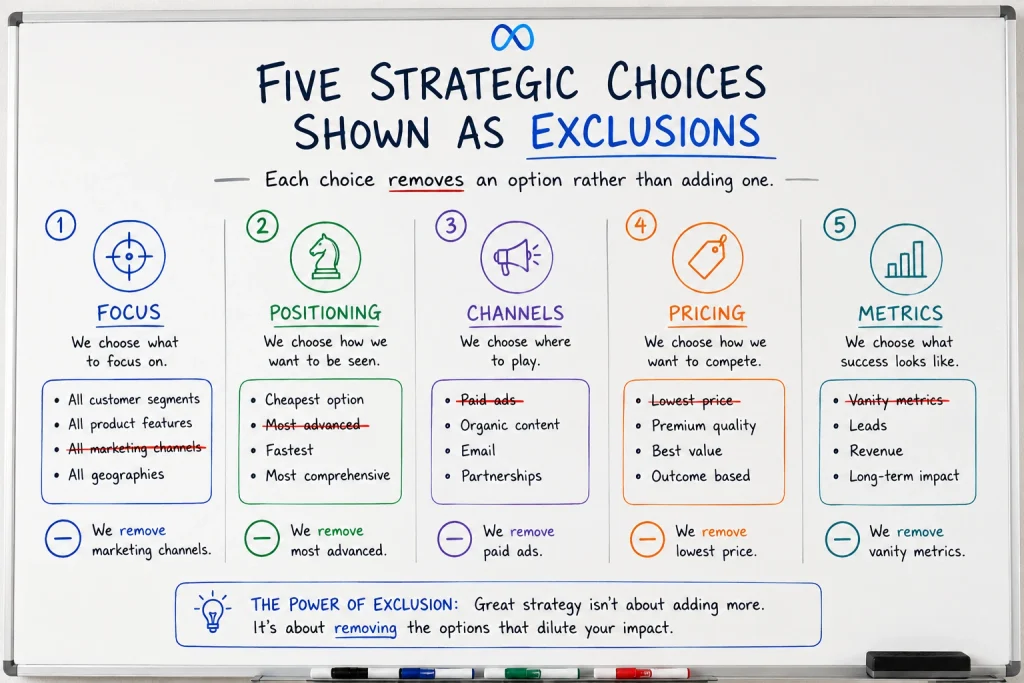
Five questions. Each answer must exclude something real — if it does not, the question has not been answered.
The rule: write the five refusals on one page before writing the plan. If any refusal is vague, or if the answer is “we’ll see”, the strategy is not finished and the plan built on it will spread until it is thin.
Refusal one — which buyers are we not serving?
The ideal customer profile, written as an exclusion rather than an aspiration.
Most Indian B2B companies answer this with a description so wide it excludes nobody: “manufacturers and service businesses across India.” That is a market, not a profile. A profile names who you are turning down.
The useful version reads like a rule. Under ₹10 crore revenue, we do not serve. Outside these four industries, we do not serve. Companies with no internal marketing owner, we do not serve. Each of those sentences costs you something real, which is how you know it is a decision.
Getting it wrong in India looks like: an agency or supplier taking every enquiry that arrives, then discovering that half the client base is unprofitable and none of the marketing speaks specifically to anyone.
How to write it: list your ten most profitable clients and your five worst. The pattern is usually visible without analysis, and the refusal writes itself.
Refusal two — which problem are we not solving?
Positioning, framed honestly.
Your buyers have several problems. You can be known for solving one. A firm that claims to fix pipeline, brand, systems and retention is asking a buyer to believe four things about a company they have just met, in a category where Gartner puts time spent with suppliers at around 17% of the buying process. There is not enough attention available to establish four claims.
Choose the problem you want to be called about. Then accept that you will hear about the others less, which is the point.
Getting it wrong in India looks like: a homepage listing eleven services, ranked by nothing, so the buyer forms no impression at all and remembers you as “a marketing company” alongside a hundred others.
How to write it: finish this sentence and put it on the website. When a company has [specific problem], they call us.
Refusal three — which channels are we not running this year?
The hardest refusal, and the one that saves the most money.
Every channel works for somebody. The question is not which are effective but which you can fund to a level where they produce results. Below that level, spend buys learning at best and noise at worst.
A working test: if a channel cannot have one identified owner and enough budget to run for two quarters without being questioned, do not start it this year. Write it on the “not this year” list, which should be a real list in the document, not an absence.
The order in which you add channels back matters, and we set that out separately in the order to build lead generation in.
Getting it wrong in India looks like: running search, LinkedIn, email, trade platforms, events and content simultaneously on a budget that would properly fund two, then concluding after a year that digital marketing does not work for B2B.
How to write it: name the two or three channels you are funding properly, and list explicitly the ones you are not running until next year.
Refusal four — which metric are we not optimising?
You cannot maximise lead volume and lead quality at the same time. You cannot minimise cost per lead and maximise deal size. Pick.
This refusal matters because unstated metric conflicts produce the arguments that consume marketing teams. Sales complains about quality; marketing points at volume; both are hitting the target they were actually given.
It also protects the slow work. Demand creation and brand building will lose any comparison against activation on a monthly lead count, which is why they need a different measure and a different review period — a point we cover in what demand generation actually produces, and when.
Getting it wrong in India looks like: a monthly review where every activity is judged on leads generated, so within two quarters only the activities that generate leads this month survive, and the pipeline stops growing.
How to write it: name one primary metric for the year and one metric you are explicitly not optimising, with the reason.
Refusal five — which competitor are we not trying to beat?
You cannot out-brand the market leader and undercut the cheapest supplier in the same year.
Most Indian B2B companies sit between a large well-known competitor and a cheaper local one, and try to compete with both. The result is a middle position defended on neither dimension — more expensive than the cheap option, less known than the big one.
Choose which comparison you are willing to lose. If you are competing on capability and service, accept losing the price-sensitive buyer and stop discounting to keep them. If you are competing on cost, stop investing in a premium brand you cannot substantiate.
Getting it wrong in India looks like: discounting to win against a smaller competitor while spending on brand to look credible against a larger one, and running out of margin doing both.
How to write it: name the competitor whose buyer you are content to lose, and the reason.
What the plan contains once the refusals are made
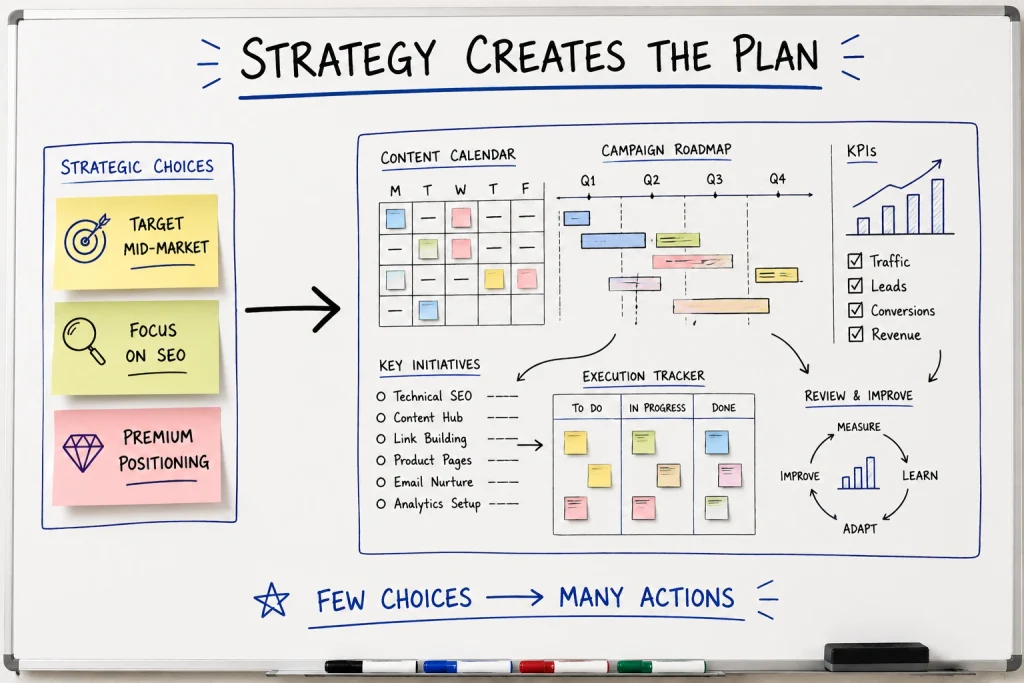
Now the ordinary parts, and they should be ordinary. A plan is meant to be boring — the interesting decisions have already happened.
Positioning and message. One problem, stated in the buyer’s language, on the homepage and in every proposal.
A defined ideal customer profile, with the exclusions written down so the sales team can decline work without asking.
Two or three funded channels, each with an owner, a budget that survives two quarters, and a stated role — capture, creation or proof.
A budget split with a stated logic. Binet and Field’s 60:40 average is a reasonable starting reference, adjusted for two Indian realities: below a certain absolute budget, split the time rather than the money, and weight toward capture if buyers in your category already search by name.
A measurement plan with different clocks. Paid capture reviewed monthly. Organic and content quarterly. Brand and demand creation at six and twelve months. One document, three review rhythms.
A single number for the year, agreed with the person who will judge it.
A stop-doing list. The refusals, restated as actions — accounts you will not chase, channels you will not run, discounts you will not offer.
The promoter’s question
At some point the person funding this will ask what it returns. Most marketing plans handle that badly, either by promising a number nobody believes or by retreating into language about brand and awareness.
Answer it directly, by horizon.
Within a quarter, paid capture returns measurable pipeline, and the honest number is a cost per qualified lead you can defend against deal value. If you cannot produce that arithmetic, that is the first thing to fix.
Within two to three quarters, conversion and follow-up improvements show up as more pipeline from the same spend. This is usually the largest available gain and the least exciting to present.
Within a year, organic search and content begin producing enquiries at a lower marginal cost than paid, provided the site had somewhere to build from.
Beyond a year, demand creation reduces what capture costs, because more of the people clicking already know who you are. That is a real financial effect and it is measurable in a channel you were already measuring.
Saying this out loud, in the plan, before anyone asks, is what stops the slow work being cancelled in month four.
Mistakes that cost real money
Writing a plan without refusals. Everything in this article follows from this one.
Copying an enterprise framework. ICP scoring, buying-committee mapping and nurture tracks are built for organisations with a marketing team of twelve. In a business with one marketing person and a promoter who decides, they are overhead that will not be maintained.
Setting one review rhythm for everything. Monthly review kills anything that takes longer than a month, which is most of what compounds.
Changing the strategy quarterly. Refusals only pay off if they hold. A strategy revisited every quarter is a series of experiments.
Confusing the plan with the strategy. A detailed activity calendar can sit on top of no decisions at all, and often does.
Budgeting from last year plus ten percent. That is not a strategy, it is an accounting habit, and it guarantees the same allocation regardless of what changed.
When strategy is not your problem
Your execution is the problem. If the plan is sound and nothing gets done, you have a resourcing or ownership problem, and a better document will not fix it.
Your product or pricing is uncompetitive. Marketing strategy can position a real advantage. It cannot manufacture one, and attempting it produces expensive noise.
You have not tried anything yet. A first-year business does not need a strategy document. It needs to run capture properly for two quarters and learn what buyers actually respond to, then write the strategy from evidence instead of assumption.
Leadership does not agree on what the company is. The refusals cannot be written by the marketing head alone. If the founder and the sales head describe the business differently, that conversation has to happen first, and it is free.
The strategy checklist
☐ Ideal customer profile written as exclusions, not aspirations
☐ One problem named that you want to be called about
☐ Channels funded properly, with the “not this year” list written down
☐ One primary metric named, and one metric explicitly not optimised
☐ The competitor whose buyer you are willing to lose, named
☐ All five refusals on a single page, agreed by founder and sales lead
☐ Budget split with a stated logic rather than last year plus ten percent
☐ Three review rhythms set — monthly, quarterly, half-yearly — by activity type
☐ The return-by-horizon answer written before anyone asks for it
☐ A stop-doing list circulated to sales as well as marketing
☐ The strategy fixed for twelve months, with the plan free to change
Questions we get asked
What is the difference between B2B marketing strategy and tactics?
Strategy is the set of choices about where you compete and what you exclude. Tactics are what you run inside those choices. If your document could be executed by a company with a different ideal customer and a different position, it contains no strategy.
How much should a B2B company spend on marketing?
There is no defensible universal percentage, and the ones quoted come from Western enterprise surveys. Work from the other end: what a customer is worth, how many you need, and what you can afford to pay to acquire one. That produces a number you can defend to a promoter, which a benchmark cannot.
How do you create a B2B marketing strategy from nothing?
Run capture channels for two quarters first. You will learn which messages convert, which buyers respond and what a lead costs. Writing the strategy from that evidence takes an afternoon; writing it from assumption takes a week and is usually wrong.
Should the strategy be different for B2B SaaS versus manufacturing?
The refusals are the same. The answers differ sharply. SaaS buyers self-educate online and the funnel is measurable end to end. Manufacturing buyers rely more on trade platforms, referrals and field relationships, and a strategy that ignores those in favour of digital-only channels will underperform regardless of execution.
How often should we revisit it?
Annually for the refusals, quarterly for the plan. A strategy changed every quarter was never a strategy, and the compounding activities never get long enough to compound.
Who should own the strategy?
Whoever will be held to the number, with the founder and sales lead signing the refusals. A strategy the sales team has not agreed to becomes a document marketing defends alone.
What to do this week
Take your current marketing plan and read it with one question: what does this rule out?
If nothing, you have found the work. Book ninety minutes with your founder and your sales lead, answer the five refusals, and write them on one page. That page is worth more than the plan it replaces, and it will make the plan shorter.
The uncomfortable part is that each refusal costs something. That is not a flaw in the method — a choice that costs nothing was not a choice.
If you would like the five refusals worked through against your category, your budget and what you are already running, you can reach out to us on whatsapp at +91 7738844851 .We will tell you if the honest answer is that your execution, not your strategy, is what needs the attention.
More in Blog
Keep reading
All articles →


Ready to talk about your growth?
Tell us what's stuck and we'll tell you what we'd do first. Free, 30 minutes, no pitch.