
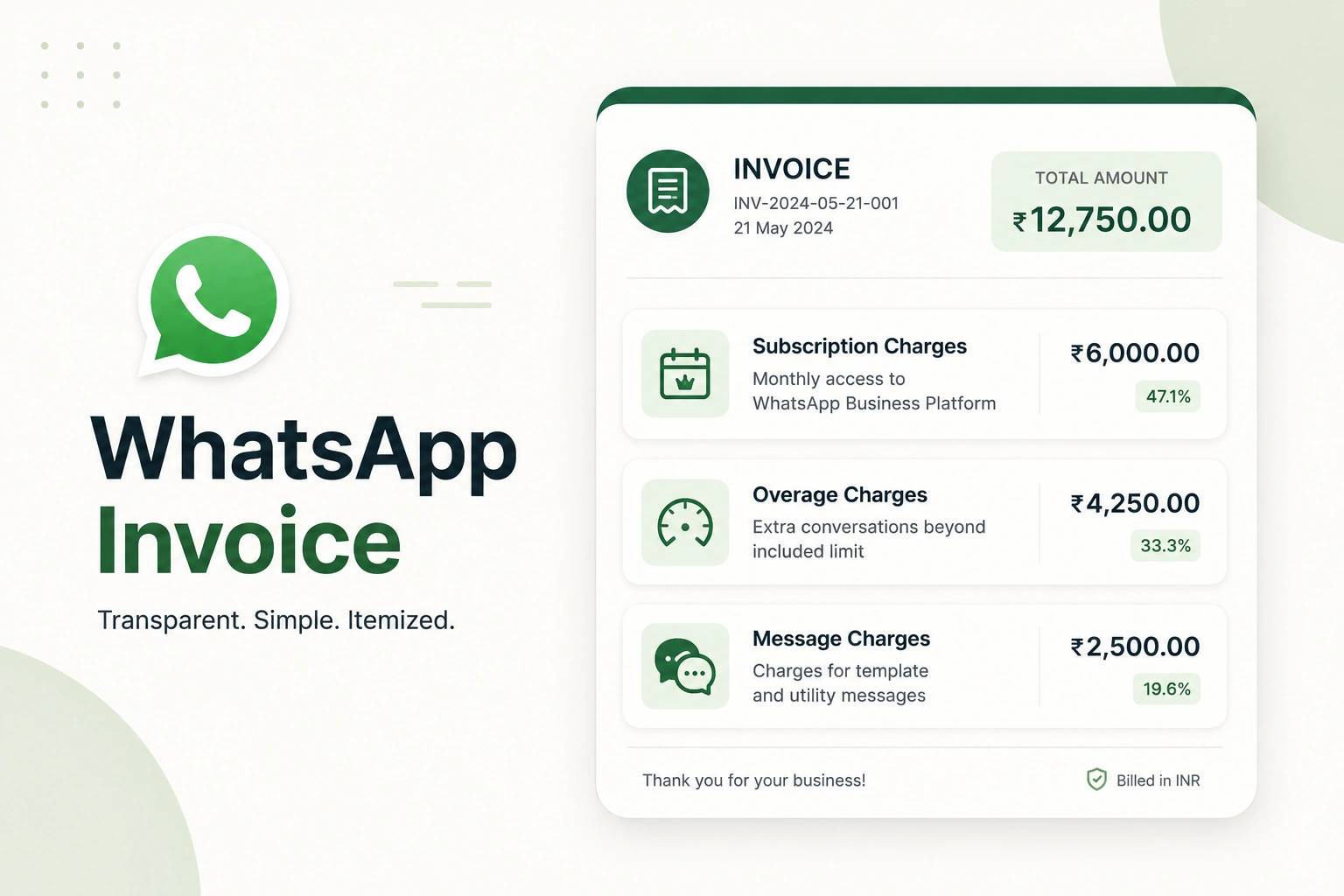
Here is a published breakdown for an Indian business running 80,000 WhatsApp conversations a month.
Base subscription ₹25,000. Conversation overage ₹15,000. Meta’s message charges ₹36,000. Total ₹76,000 a month, ₹9.12 lakh a year.
The software costs more than the messaging. ₹40,000 against ₹36,000 — and every provider comparison you will read is arguing about the ₹36,000.
The three charges, and who gets each
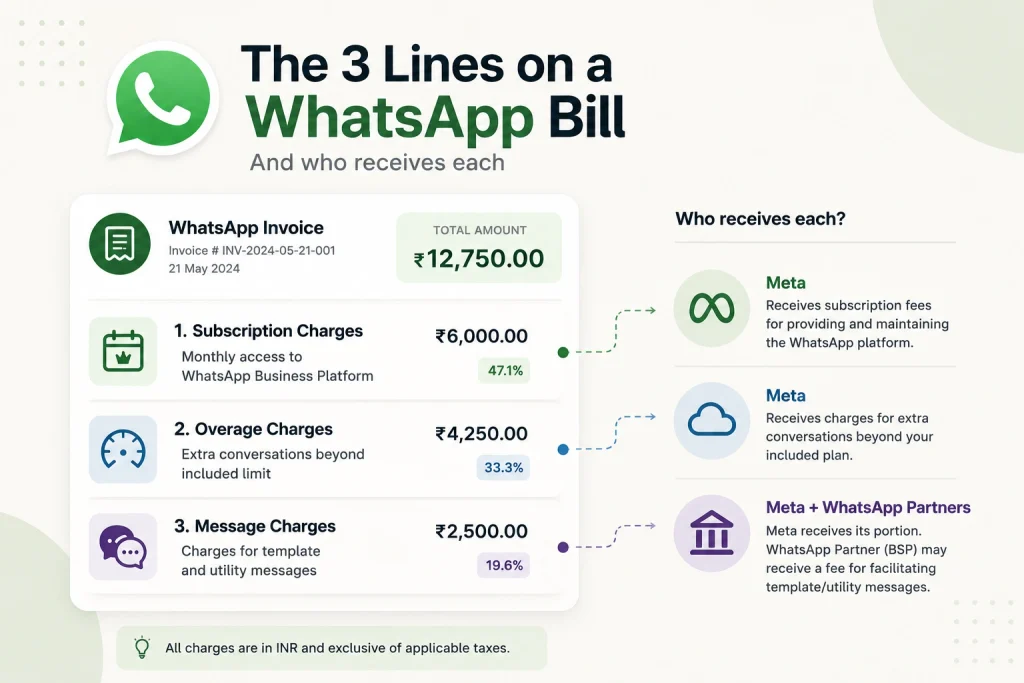
Open any WhatsApp quote and you are looking at three different things presented as one.
Meta’s rate. Roughly ₹0.8631 for a marketing message and ₹0.115 for utility. This goes to Meta and every provider pays the same.
The provider’s markup on that rate. Reported at 10–30% across the Indian market. Some providers add it, some do not — Interakt is described in published comparisons as one of the few that does not, while Wati and Gallabox are described as layering a per-message or per-conversation charge on top.
The platform fee. The subscription for the software itself — inbox, automation, dashboards, agents — plus overage when you exceed whatever the plan includes.
Most quotes blend at least two of these. Which is why comparing two providers on their headline price tells you almost nothing, and why the first thing to ask for is the three numbers separately.
And where the cost stack lands after tax is on a separate page: what a year of WhatsApp actually costs.
Which charge actually matters to you
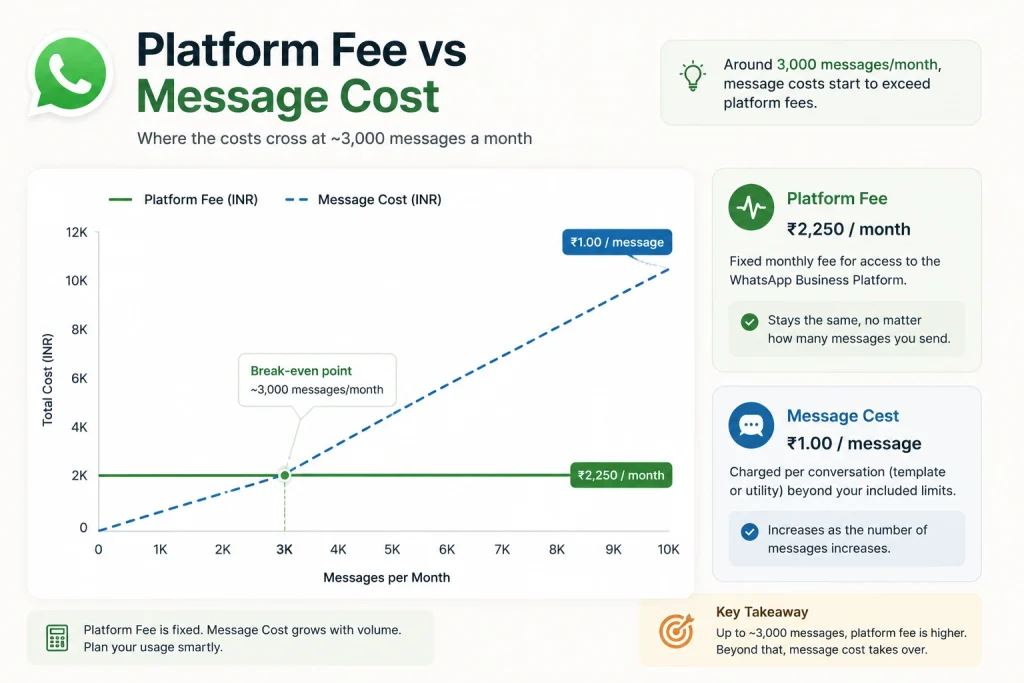
There is a volume at which the answer flips, and it is lower than most people expect.
A ₹2,499 monthly platform fee against marketing messages at ₹0.8631:
- At 1,000 messages a month, the platform fee is 74% of your bill
- At 5,000, it is 37%
- At 10,000, 22%
- At 25,000, 10%
- At 100,000, 3%
The crossover sits at roughly 2,900 messages a month. Below it the software is the expensive part. Above it the messages are.
So there are two different buyers here and they should negotiate opposite things.
If you send under about 3,000 messages a month, the markup is nearly irrelevant. A 20% markup on 2,000 marketing messages is about ₹345. Spend your attention on the subscription, the seat count and what is bundled — that is where your money is going.
If you send 25,000 or more, the subscription is a rounding error and the markup is real. A 20% markup on 25,000 marketing messages is about ₹4,316 a month, ₹52,000 a year, for nothing you can point at.
Most buyers negotiate whichever number the provider put in front of them. Providers with low subscriptions lead with the subscription. Providers with no markup lead with the markup. Both are telling you the truth about the number that suits them.
Six questions, and what each answer tells you
“What is your markup on Meta’s per-message rate, as a percentage?”
The answer you want is a number. Anything vague, or a blended per-message price that cannot be decomposed, means the markup is the part they would rather you did not see. A provider that says “none” is making a checkable claim — ask for a bill showing Meta’s rate as a separate line.
“What does the subscription include, and what triggers overage?”
Overage is where the ₹15,000 in that opening example came from. Find the included volume, the overage rate, and whether it is charged per message or per conversation — those are different units and the difference is large.
“How many agent seats, and what happens when we add one?”
Seat caps are the quiet escalator. A plan capped at three users looks cheap until your fourth person joins and the plan jumps a tier. Ask for the price of the tier above, not the tier you are buying.
“Which features are add-ons?”
Chatbots, AI features and analytics are frequently priced separately — reported add-ons run from about ₹2,000 to ₹10,000 a month. A ₹999 plan with a ₹10,000 add-on is not a ₹999 plan.
“If Meta changes its rates, does your markup percentage apply to the new number or the old one?”
Meta raised Indian marketing rates about 10% in January. This question tells you whether your provider treats markup as a fixed percentage of a moving number, and it tends to produce an interestingly slow answer.
“Can we take our number and our template library to another provider?”
The most important question and the one asked least. Ask it before you sign, not when you want to leave.
The seat cap, specifically
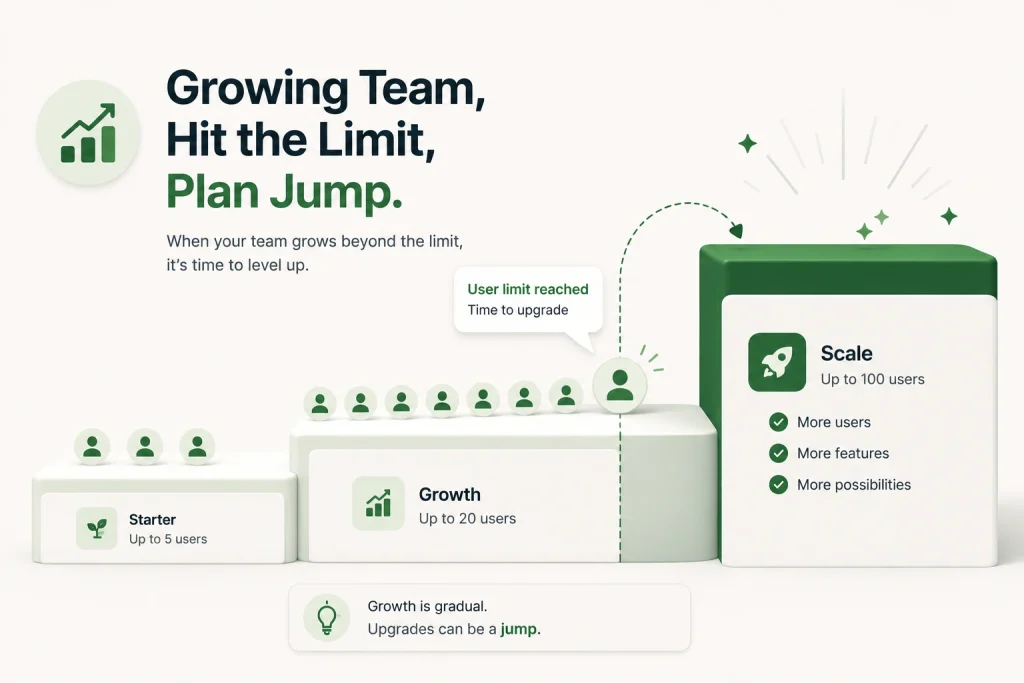
Worth its own note because it catches growing businesses reliably.
Reported Indian plans vary enormously on this. One provider includes five agents at around ₹1,500. Another caps its ₹2,499 tier at three users. A third offers unlimited agents at a similar price point.
Which means two quotes at the same monthly figure can differ by a factor of several the moment you hire, and the difference does not appear anywhere on the comparison table you were shown.
Count the people who will need access before you compare anything. Sales, support, whoever covers weekends. Then price the tier that holds all of them, not the tier that holds today’s team.
What a good quote looks like
Four lines, separated:
Meta’s list rate for each category you will use, unmarked.
Your provider’s markup, as a percentage, applied to that rate.
The platform subscription, with the included volume and seat count stated.
The overage rate, with its unit named — per message or per conversation.
If a provider will not give you those four lines, that is itself the answer. Nothing here is commercially sensitive; Meta publishes the rates, and the rest is what you are paying them for. A provider comfortable with its own pricing has no reason to blend it.
Before you switch
Switching providers is a real project rather than a settings change, and there are three things to check first.
Your number and Business Account. Migration between providers is possible, and the process and any downtime should be confirmed with both the current and prospective provider before you commit.
Your template library. Approved templates and their categories represent accumulated work. Ask specifically what transfers and what has to be resubmitted for review.
Your conversation history. Often the thing nobody asks about until it is gone.
And be honest about why you are switching. If the reason is the per-message markup and you send 4,000 messages a month, you are undertaking a migration to save a few hundred rupees. The cheaper answer is usually to send fewer marketing messages, which is a different exercise entirely — the test Meta actually applies covers where that saving comes from.
Questions we get asked
Which is the best WhatsApp Business API provider in India?
There is no single answer, and any page that gives one is usually selling something. The right provider depends on your message volume, your team size and whether you need the software at all.
Do all BSPs charge a markup on Meta’s rates?
No. Published comparisons describe some Indian providers as charging no markup and others as layering a per-message or per-conversation charge. Ask directly and ask for it as a separate line.
How much does a WhatsApp platform subscription cost?
Reported Indian plans run from a free tier and about ₹999 through to ₹2,999 and beyond at entry level, with add-ons and higher tiers well above that. Check the seat count attached to each figure.
Can you switch WhatsApp BSP without losing your number?
Migration is possible. Confirm the process, the downtime and what happens to your templates with both providers before signing anything.
What is a conversation overage charge?
A platform charge for exceeding the volume your plan includes, separate from anything Meta bills. In the example at the top of this page it was ₹15,000 a month — more than a third of the platform cost.
Is the cheapest provider the right one?
At low volume, often yes, because you are mostly buying software. At high volume the markup matters more than the subscription, and the cheapest headline plan can be the most expensive arrangement.
The one calculation to run first
Take your monthly message volume and multiply by ₹0.8631 if it is mostly marketing, or ₹0.115 if it is mostly utility.
Compare that number to the subscription you are being quoted.
Whichever is larger is the conversation worth having. For most businesses under 3,000 messages a month that is the subscription and the seat count. Above 25,000 it is the markup, and it is worth asking for in writing.
If you want your quotes decomposed into the four lines and compared properly, you can reach out to us on whatsapp at +91 7738844851 .
More in Blog
Keep reading
All articles →
Ready to talk about your growth?
Tell us what's stuck and we'll tell you what we'd do first. Free, 30 minutes, no pitch.