
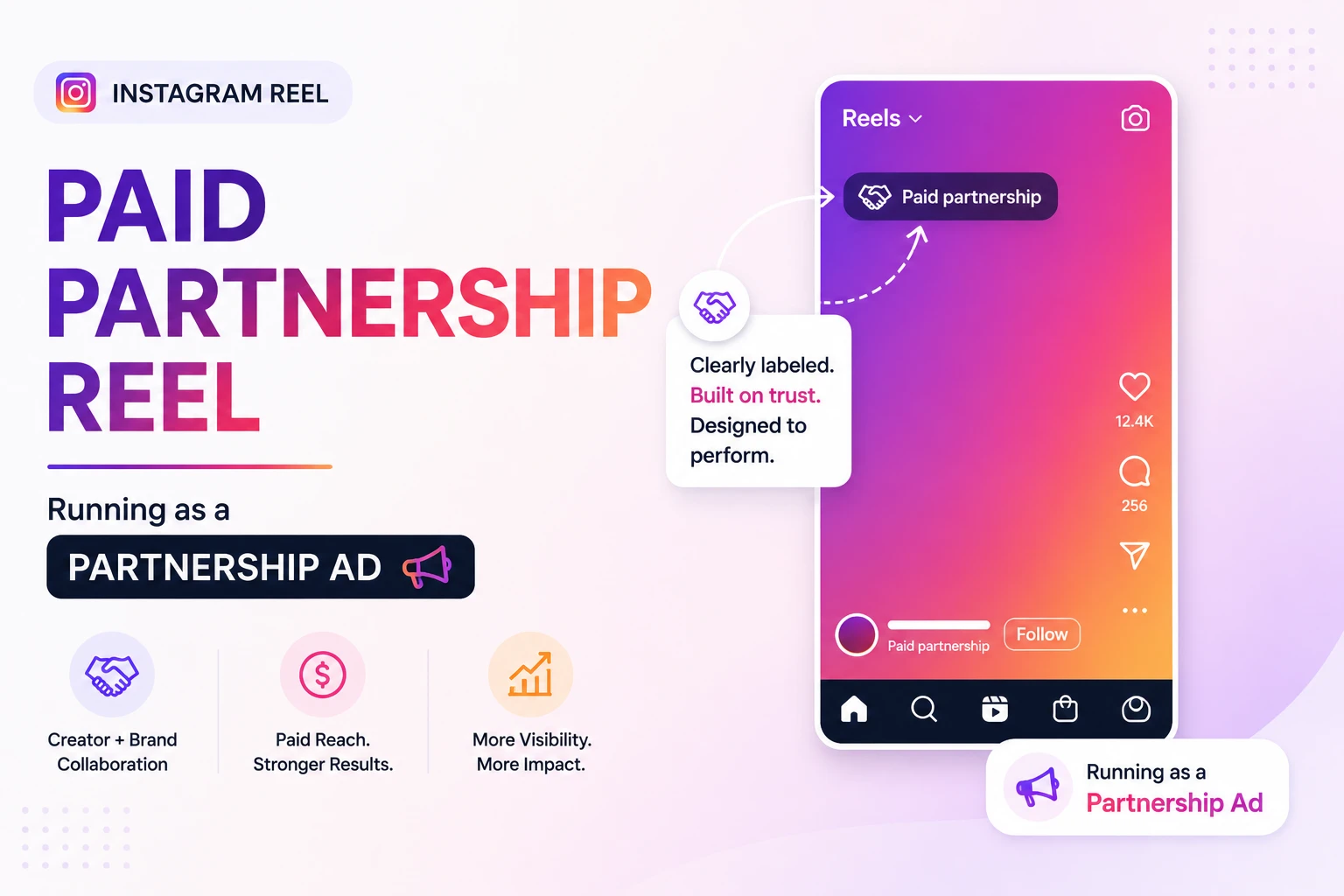
A creator posts a Reel about your product. It performs well organically. You want to put media behind it.
There are now two separate approvals standing between that thought and a live ad, and they answer to different authorities. Meta decides whether the ad runs. ASCI decides whether it was lawful advertising in India. Clearing one does not clear the other, and most brands only know about the first.
The short answer
Partnership Ads let a brand run paid ads using a creator’s post, from the creator’s handle, with targeting and budget controlled in Meta Ads Manager. Meta has consolidated branded content advertising into the Partnership Ads Hub, and reported policy updates through 2026 require creator content promoting a brand in paid campaigns to use this format. Separately, ASCI requires disclosure that is upfront and prominent — for videos up to fifteen seconds, the label must be visible for at least three seconds. Indian brands must satisfy both.
Key takeaways
- Boosting a creator’s post is not the same as a Partnership Ad. Partnership Ads give you targeting, budget control and proper reporting; boosting gives you very little.
- The ad runs from the creator’s handle, carrying their name, their followers’ familiarity and their social proof — which is the entire point.
- ASCI’s video timings map directly onto Reels. Three seconds minimum on a fifteen-second Reel; a third of the duration between fifteen seconds and two minutes.
- Material connection is broader than payment. Gifted product, a hotel stay or a discount all trigger disclosure obligations.
- The performance figures circulating online do not trace to Meta. Treat direction as plausible and magnitude as unproven.
What a Partnership Ad actually is
A Partnership Ad is a paid ad built from a creator’s post, served from the creator’s account, with the brand controlling targeting, budget, placement and optimisation inside Ads Manager.
Three things distinguish it from what most brands do instead.
It is not boosting. Boosting a post from the creator’s app gives you a promoted post with limited targeting and limited reporting. A Partnership Ad is a real campaign object with full controls.
It is not reposting the creator’s video from your own handle. That version loses the creator’s name, their follower relationship and the social proof of their comment section — which is most of what you paid for.
It requires the creator’s permission, granted through Meta’s tools. The creator authorises the brand to run the content; the brand does the rest.
Whitelisting, sometimes called allowlisting, is the broader version: a creator grants a brand standing permission to run ads from their handle, including new creatives the creator did not post organically. Partnership Ads are the format; whitelisting is the permission arrangement.
Gate one: Meta’s platform requirements
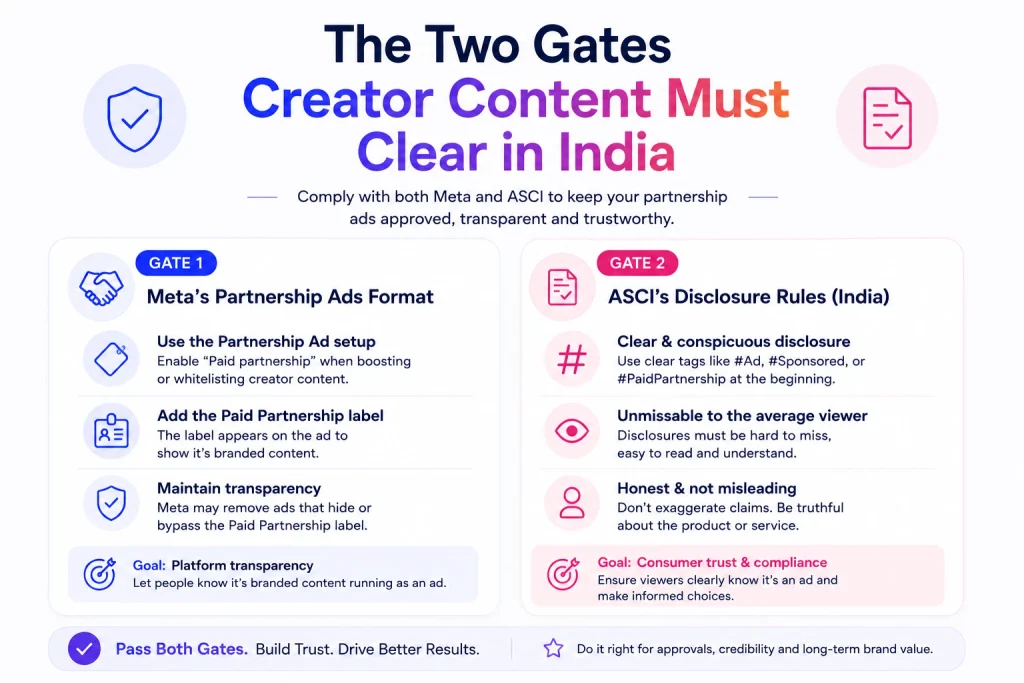
Meta has consolidated this area substantially. The older branded content ads workflow has been replaced by the Partnership Ads Hub inside Ads Manager, and on 11 December 2025 Meta expanded the Hub to show organic performance metrics alongside paid, and launched a Facebook Partnership Ads API for programmatic discovery and activation.
Reported policy updates across March to May 2026 formalised the direction: creator content promoting a brand in a paid campaign is expected to run through the Partnership Ads format rather than being reposted or boosted, with rejection and account health consequences for content that does not.
What this means practically.
The creator must tag the brand using the branded content tool and apply the paid partnership label. Both the creator’s account and the content must meet Meta’s eligibility requirements, which Meta publishes and updates. The brand then accesses the post through the Partnership Ads Hub with the creator’s authorisation.
Verify the current rules before every campaign, not once a year. This area has changed three times in under eighteen months, and the penalty for being out of date is a rejected ad at launch — or worse, an account health flag that affects everything else you run.
Gate two: what ASCI requires in India
This is the gate foreign guidance ignores entirely, and it is the one with legal weight in India.
The Advertising Standards Council of India’s influencer guidelines require that any advertisement carry a disclosure making clear to consumers that they are seeing an advertisement. The standard is that it must be upfront, prominent and easily understood.
Specifically ruled out: disclosures buried in hashtags, hidden at the end of a post, or visible only after tapping “more.” All three are common practice and none of them comply.
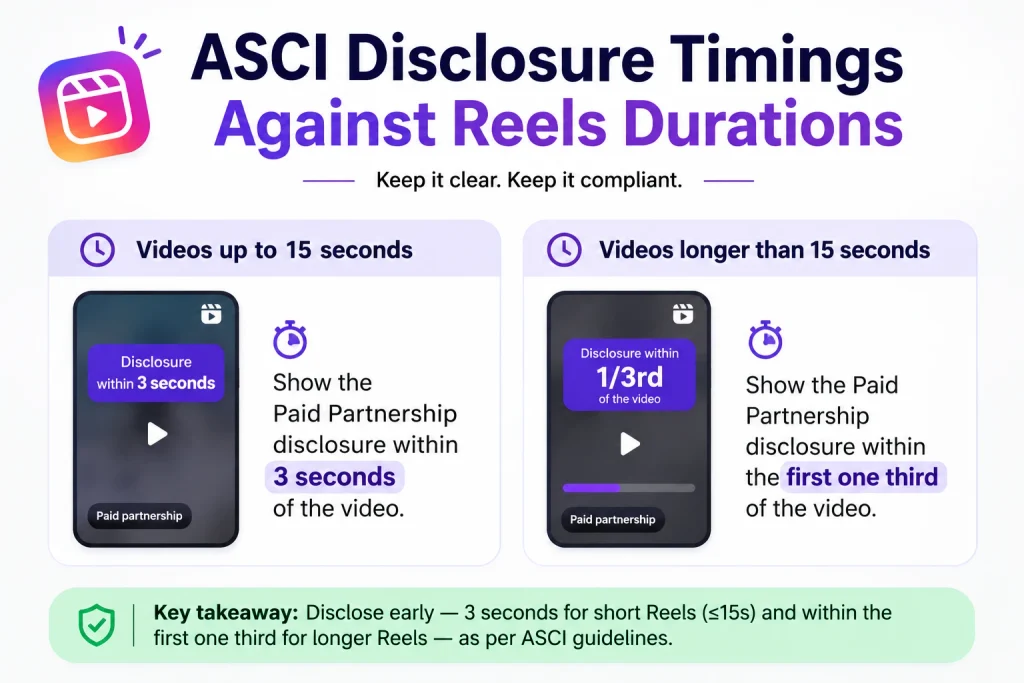
The video timings, which matter most for Reels. For videos up to fifteen seconds, the disclosure label must remain visible for at least three seconds. For videos longer than fifteen seconds but under two minutes, it must appear for one-third of the duration.
Read that against a typical Reel. A fifteen-second Reel needs the label on screen for a full three seconds — a meaningful proportion of the video, and considerably more than a label flashed in the first frame.
Material connection is defined broadly. It is any benefit or incentive from the advertiser: money, free product, discounts, gifts, trips, hotel stays, awards, media coverage, even an offer of employment. Gifted product with no cash payment still requires disclosure, which surprises brands running seeding campaigns. Our guide to what influencer marketing costs in India covers the commercial side of those arrangements.
Sector rules are stricter. Influencers giving technical advice in banking, financial services, insurance, health or nutrition are required to hold and disclose relevant qualifications.
Virtual and AI influencers must be disclosed as not being real people, prominently and persistently rather than once in a profile bio, and every promotional post needs both that disclosure and the standard paid-content one.
The Two-Gate Model
Creator content in India must clear two independent approvals before it can be amplified. Meta’s gate decides whether the ad runs. ASCI’s gate decides whether it was lawful advertising. Passing one tells you nothing about the other, and the second is the one with consequences beyond the platform.
Run every piece of creator content through both, in this order.
Gate one — will Meta serve it? Creator eligible, branded content tool used, paid partnership label applied, content accessed through the Partnership Ads Hub with authorisation in place. Failure here is visible immediately: the ad is rejected.
Gate two — is it compliant advertising in India? Disclosure upfront and prominent, video timings met, material connection disclosed even where no money changed hands, sector qualifications stated where required. Failure here is invisible at launch and surfaces later.
The asymmetry is the point. Gate one fails loudly and gets fixed. Gate two fails silently, which is why so much non-compliant creator advertising runs in India without anyone noticing until someone does.
Build both into the creator brief, not into a review at the end. A Reel that needs the disclosure on screen for three seconds has to be shot that way.
What the performance data actually shows
Two figures circulate widely: 19% lower cost per acquisition and 53% higher click-through for Partnership Ads against standard Meta ads.
They appear across vendor and agency pages and we could not trace either to Meta or to any independent study. Treat them as directionally plausible and numerically unproven — and be careful about quoting them to a client as though they were platform data.
What is defensible without them. An ad from a creator’s handle carries a name the viewer may recognise, a follower relationship, and a comment section with real social proof attached. Those are structural advantages over the same video posted by a brand nobody follows. Whether they produce 19% or 5% in your category is a question your own testing answers and nobody else’s benchmark can.
Test it properly. Run the same creative from the creator’s handle and from your brand handle, to the same audience, and measure cost per qualified outcome rather than click-through. Working out what a lead or sale is actually worth covers the arithmetic for judging the result.
The commercial terms nobody writes down
Whitelisting fails commercially more often than it fails technically. Agree these before the shoot.
Usage duration. How long can you run ads from the creator’s handle? Thirty days, ninety, a year? Open-ended permission is rarely what the creator thinks they agreed to.
Whether you can create new ads or only amplify the post they published. These are very different rights and priced differently.
Whether the creator’s handle appears on ads shown to audiences they have never reached. Some creators care about this considerably.
What happens if performance is poor and you want to stop, or excellent and you want to extend.
Who owns the raw footage. Often the most valuable asset and frequently unaddressed.
Nano and micro creators are usually more flexible on all of this than established names — one of several reasons brands are backing 1K–10K creators.
Mistakes that cost real money
Reposting the creator’s video from the brand handle to avoid the paperwork. You discard the social proof you paid for and create a compliance problem.
Treating gifted product as unpaid. Material connection covers gifts. Seeding campaigns need disclosure.
Putting the disclosure in hashtags. Explicitly non-compliant, and extremely common.
Flashing the label in frame one of a Reel. Fails the three-second requirement on a short video.
Agreeing usage rights verbally. The dispute arrives when the campaign works and you want to extend.
Assuming a global agency’s guidance covers India. ASCI’s requirements are specific and they are not in anyone’s international playbook.
When Partnership Ads are the wrong approach
When the creator content is weak. Amplification multiplies what exists. A Reel nobody engaged with organically will not improve with budget behind it.
When you need message control. Regulated categories with mandatory disclaimers are often better served by brand-produced creative where every word is yours.
When the creator’s audience is not your buyer. Paid targeting can reach beyond their followers, at which point their handle is decoration rather than social proof.
When you cannot clear gate two. If the content cannot be made compliant — no qualifications where required, disclosure impossible within the format — do not run it. The exposure is not worth the reach.
Pre-launch checklist
☐ Creator meets Meta’s published eligibility requirements
☐ Branded content tool used and paid partnership label applied
☐ Content accessible through the Partnership Ads Hub with authorisation confirmed
☐ Disclosure upfront and prominent, not in hashtags or behind “more”
☐ Video disclosure timing met — three seconds minimum on a fifteen-second Reel
☐ Material connection disclosed, including gifted product
☐ Sector qualifications stated where BFSI, health or nutrition advice is given
☐ AI or virtual influencer disclosed persistently, if applicable
☐ Usage duration agreed in writing
☐ New-creative rights agreed separately from amplification rights
☐ Raw footage ownership settled
☐ Brand-handle control test planned against the creator-handle ad
Questions we get asked
Can I just boost a creator’s post?
You can, and you will get limited targeting, limited reporting and a weaker campaign object. Partnership Ads exist because boosting was never a serious advertising tool.
Do I need the creator’s permission?
Yes. It is granted through Meta’s tools and it is the mechanism that makes the ad possible.
What is the difference between whitelisting and Partnership Ads?
Partnership Ads are the ad format. Whitelisting is the permission arrangement, usually broader — standing access to run ads from the handle, including creative the creator never posted.
Does ASCI apply if the creator was only gifted product?
Yes. Material connection includes gifts, trips, discounts and hotel stays. No money needs to change hands.
What happens if we get the disclosure wrong?
ASCI can require the advertisement to be withdrawn or modified and publishes complaint outcomes. Beyond ASCI, misleading advertising carries consumer-protection exposure in India, which is a matter for your legal advisers rather than your agency.
Can we run Partnership Ads for a product launch?
Yes, and creator content usually works better than brand creative in the awareness phase. Running an influencer campaign around a product launch covers the sequencing.
Before your next creator brief
Add two lines to it.
The first covers Meta: the creator will use the branded content tool, apply the paid partnership label, and grant Partnership Ads access for an agreed period.
The second covers ASCI: the disclosure will be on screen, upfront, and visible for at least three seconds on any Reel of fifteen seconds or less.
Both are easier to specify before filming than to fix afterwards, and the second one cannot be fixed afterwards at all without reshooting.
If you would like the compliance and the amplification handled together, you can reach out to us on whatsapp at +91 7738844851 .
More in Blog
Keep reading
All articles →
Ready to talk about your growth?
Tell us what's stuck and we'll tell you what we'd do first. Free, 30 minutes, no pitch.