

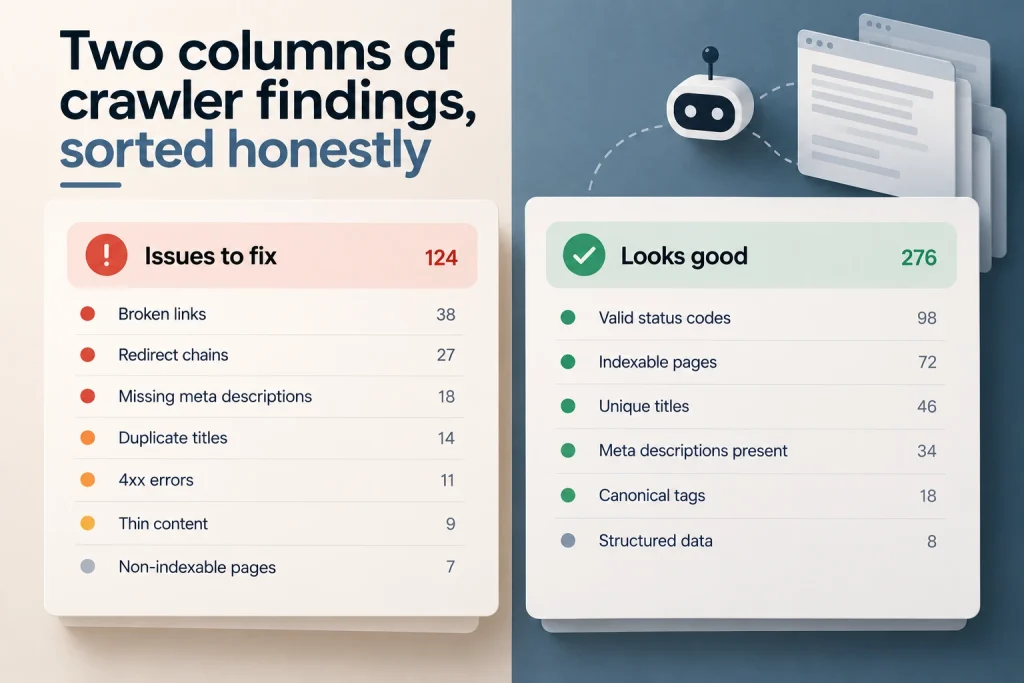
A crawler produces four hundred findings coloured by severity, and the severity is the tool’s opinion, formed without knowing which of your pages earn money. Detection is automated and close to free; the value of an audit lies in deciding which three findings to act on. The findings also have an order — a page that is not indexed cannot rank — so almost everything a crawler reports sits below the line at which it could matter.
Somebody sends you a PDF. Four hundred findings, sorted into red, amber and green. A site health score at the top, out of a hundred. Thirty pages of tables.
You read the first three rows, feel vaguely alarmed, and put it in a folder.
Here is the thing about that document. The colour coding was applied by a crawler that has never seen your sales pipeline. It does not know which pages generate enquiries, which exist only for legal reasons, and which you were planning to delete anyway.
So “347 pages missing meta descriptions” arrives in red, while the reason your enquiries dropped is not in the report at all — because no crawler can detect it.
Detection is the free part
The reframe worth making before commissioning anything.
Finding problems on a website is automated and close to free. Anyone can run a crawler and produce four hundred rows in twenty minutes.
Deciding which three of the four hundred to act on is the entire value, and it requires knowing which pages matter commercially. That is a business question, and most audits never ask it.
If nobody has asked you which pages you would be upset to lose, you are buying an export.
While we are here: the site health score at the top is a vendor invention, computed by the tool from its own weightings. It is the same category of number as the authority scores we describe in our article on measurement — comparable to itself, meaningless outside its own product, and not something Google publishes or uses.
The audit has an order

The second problem with the flat list is that findings are not independent. Some of them make the others irrelevant.
A page that is not in the index cannot rank, so nothing about its headings matters. A page aimed at a query the site was never going to reach will not be rescued by markup. A page nothing links to will not be lifted by a rewritten title.
So the audit is a chain of gates. Work down it, and stop at the first one that fails, because everything below it is noise until that is fixed.
Gate one: is it in the index at all. The most common answer on Indian SME sites is partially, and the reasons are specific — we cover them in pages Google read and declined to keep. If a page is not indexed, stop. Nothing else on this page is worth an hour.
Gate two: was the query ever reachable. A perfectly built page aimed at something far beyond the site’s standing is a perfectly built page on page four, and no audit finding will change that. Whether the query was reachable is a question that has to be settled before any on-page work is worth doing.
Gate three: does anything point at it. From outside, and from your own site. Both are covered in counting what points at the pages that win, and a page with nothing pointing at it is not going to move regardless of its markup.
Gate four: is the page the right object. Format, coverage, a title a person would click. What on-page work still does sets the boundary, and it is a narrower boundary than most audits assume.
Almost everything a crawler reports sits at gate four or below it. Which is not to say it is worthless — it is to say it is fourth.
The findings that are usually noise
Some flags recur in every Indian SEO audit and are almost never the problem.
Missing meta descriptions. Not a ranking factor, and Google frequently writes its own anyway. Worth having on pages that matter for the click. Not worth a red flag against 347 URLs.
Low word count. No threshold exists. A 300-word page that answers a question completely is finished.
Multiple H1 tags, or a missing one. Tidy it when you are in there. It is not why you are invisible.
“Too many internal links on this page.” The tool has a number in it. Google does not publish one.
Missing alt text, flagged as an SEO issue. It is an accessibility issue, it matters, and it is not the reason your traffic fell.
Duplicate titles across paginated archives. Normal, expected, and usually fine.
The common feature is that these are all things a crawler can measure. Measurability is why they are on the list, not importance.
The findings that are usually real
A shorter list, and worth acting on the same day.
A noindex tag in production. Usually inherited from a staging site.
Broken or wrong canonical tags, telling Google to keep a different page instead of yours.
Internal links to 404s, which waste the standing you were trying to pass and irritate readers.
Redirect chains — a URL redirecting to a URL redirecting to a URL, typically the residue of two site rebuilds.
Pages returning 200 that should not exist, such as old campaign URLs and test pages that are live and indexable.
A robots file blocking something important, which happens more often than anyone expects after a migration.
These are worth fixing because they are unambiguous faults with clear causes, not because a tool coloured them red.
The check that is in no audit
Now the part that is not technical at all, and which we have found matters more than everything above it combined.
Fill in your own enquiry form. From a phone, on mobile data, as an ordinary visitor.
Does it submit. Does an email arrive. Does it arrive somewhere a person reads. Does anybody reply.
Then call your own listed number during business hours, and message the profile if you have one.
We have done this on client sites and found forms delivering to a mailbox nobody had opened in two years, numbers that rang in an empty office, and messages sitting unanswered since the previous marketing manager left.
None of that appears in a crawl. All of it is more urgent than four hundred meta descriptions.
The same applies to the content itself. A crawler cannot tell you that a page is dull, says nothing the reader could not find elsewhere, or is written for a query your business cannot win. Those are the reasons most pages underperform and no tool will ever flag them.
The audit that actually needs doing: after a rebuild
If there is one moment when this work pays for itself, it is the fortnight after a website relaunch.
Indian SMEs rebuild sites reasonably often — a new agency, a new brand, a platform change. The rebuild is scoped as a design project, signed off on how it looks, and nobody is given responsibility for what happens to two hundred existing URLs.
What goes wrong is consistent. Old URLs are dropped rather than redirected, so every link earned over five years arrives at a 404. Pages that ranked are consolidated into a new structure without anyone recording where they went. The staging site’s blocking directives ship to production. Tracking is reinstalled incorrectly or not at all, so the drop is invisible until somebody notices the phone is quieter.
The check is narrow and it should happen within days. Take a list of every URL that existed before, and confirm each one either still exists or redirects to the closest equivalent page — not to the homepage, which is the lazy fix and loses most of the value. Then confirm the new pages are being indexed, which is gate one and covered separately.
A rebuild is the only event that reliably destroys years of search work in a weekend. It is also the one moment when an audit is unarguably worth commissioning, and it is when almost nobody commissions one.
Who should not audit your site

One conflict worth naming.
An agency auditing a site it built and maintains is being asked to publish a list of its own errors. Some will do it honestly. Many will produce a report where the significant findings sit outside their own scope of work.
The reverse conflict is just as real. An agency auditing a rival’s work has an obvious incentive to find the site alarming, and a four-hundred-row export is an excellent instrument for producing alarm.
The protection is not to find a neutral party, because there is not one. It is to ask, of every finding, the same question: which page does this affect, and what is that page supposed to earn? A finding that cannot answer that goes to the bottom.
What a useful audit produces
Not a PDF of four hundred rows.
Three things to do, in order, each with a named page it affects, an expected consequence, an owner and a date. Then a second list of everything else, marked explicitly as not urgent, so nobody has to worry about it.
And a paragraph saying what the auditor could not determine, which is the section that tells you whether the work was honest.
As for frequency: annually is enough for most Indian SMEs, plus once after any site rebuild or migration, which is where the genuinely damaging faults are created.
What we cannot tell you
We cannot give you a target site health score, because the number is the tool’s and means nothing outside it.
We cannot tell you an audit price. The range in India runs from a few thousand rupees for an export to several lakh for a genuine review, and the price tells you almost nothing about which you are getting. The question that does tell you is whether anyone asked which of your pages earn.
Final thoughts
An audit is a prioritisation exercise wearing the clothes of a detection exercise.
Run the checks in order. Stop at the first gate that fails. Fix the six things that are unambiguously broken. Then go and fill in your own form, which will take five minutes and may be the most valuable thing you do this quarter.
If you would like an audit that arrives as three things to do rather than four hundred things to worry about, you can reach out to us on whatsapp at +91 7738844851 .
More in Blog
Keep reading
All articles →

Ready to talk about your growth?
Tell us what's stuck and we'll tell you what we'd do first. Free, 30 minutes, no pitch.