
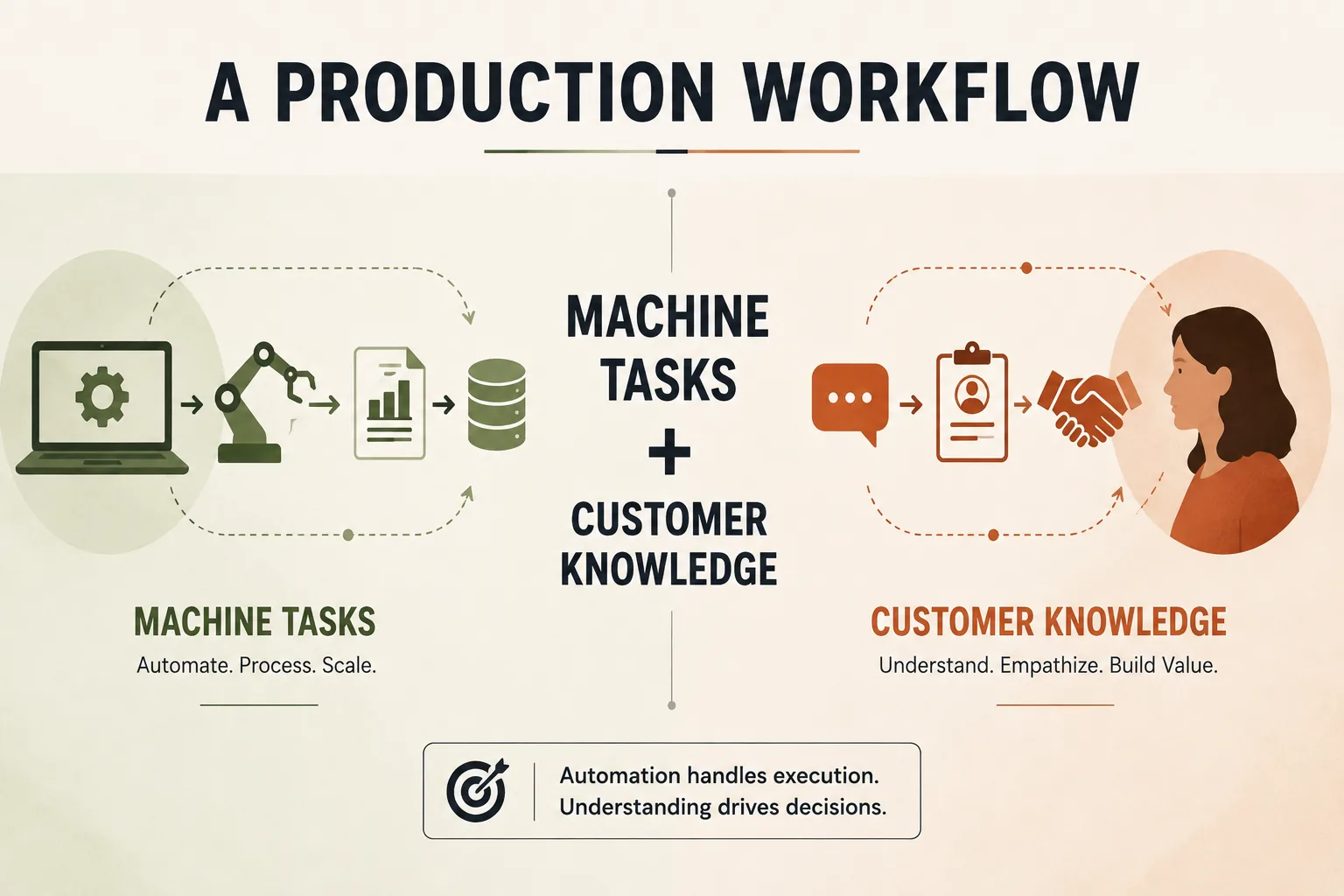
Most writing about AI in advertising is either a compliance guide or a tool list. Neither answers the question a marketing team actually has on a Tuesday, which is: of the twenty things we do to get an ad made, which ones should a machine be doing?
There is a clean answer, and it has nothing to do with which tool you use.
The short answer
AI is good at the parts of ad production that take time and require no knowledge of your buyer — resizing, background generation, variant production, first-draft translation, voice, rough cuts, transcription. It is bad at the parts that require knowing exactly who you are talking to and why they have not bought: the claim, the objection, the proof. Draw the line there and AI reliably removes production hours without touching the thing that decides whether the ad works. One hard boundary: generating photorealistic people carries a labelling cost that undoes the credibility you were trying to buy.
Key takeaways
- Automate what needs no knowledge of the buyer. That is the whole rule.
- The savings are real and they are in time, not talent — variants, formats, first drafts.
- AI cannot write your claim, because it has never sat in your sales calls.
- Generating people is the expensive exception. Meta labels it, and prominently where the person is photorealistic.
- Cheap permutations make an old problem worse. Twenty AI variants of one argument is still one argument.
- This article is not a compliance reference. Check Meta’s own pages before you rely on anything.
The Judgement Line
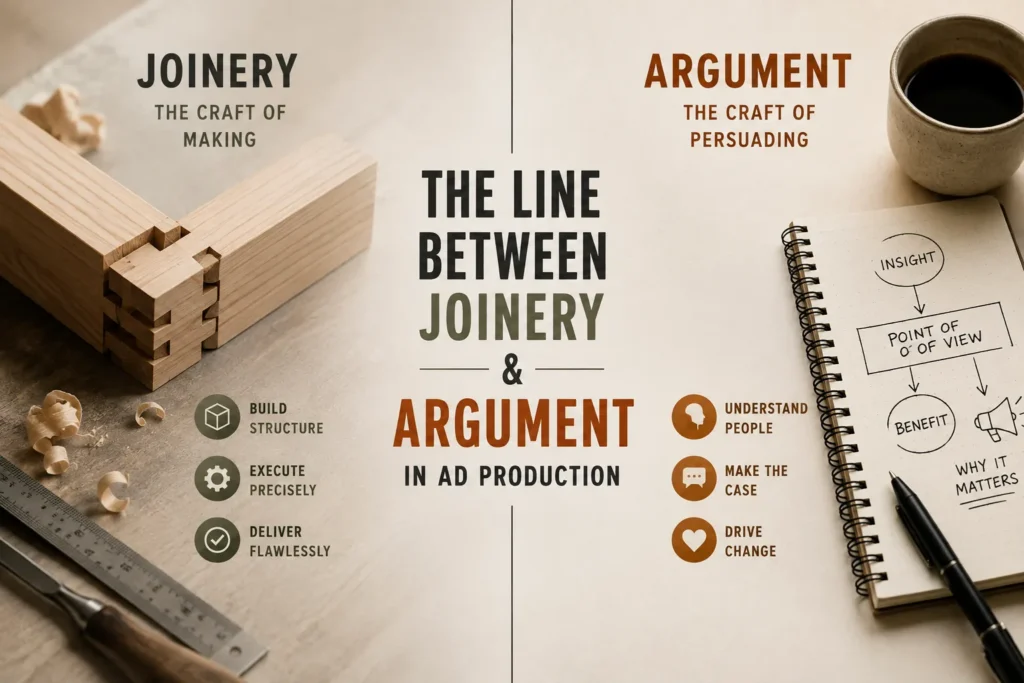
Every task in ad production sits on one side of a line: does doing it well require knowing who your buyer is and why they have not bought? If no, automate it without hesitation. If yes, do not — the machine has never spoken to your customers and it shows immediately.
Below the line — automate freely.
Resizing and reframing. One master asset into every aspect ratio, safe zones respected. Tedious, mechanical, and a genuine hour-eater for small teams.
Background generation and object removal. Replacing a cluttered background, cleaning a product shot, placing an object in a new setting. No judgement about the buyer is involved.
Variant production. Colour, layout, text placement, order of scenes. The machine is faster and just as good.
First-draft translation and transcription. Getting a Hindi or Tamil version to a point where a human can fix it, and pulling captions out of audio. Both save real time.
Voice generation for scratch tracks. Not for the finished ad in most cases, but excellent for testing a script before booking a voice artist.
Rough cuts and asset organisation. Sorting footage, tagging clips, assembling a first assembly to react to.
Above the line — do not automate.
The claim. What this ad is trying to make someone believe. The machine has your website and your competitors’ websites, which is precisely why what it produces sounds like everyone’s website — how to brief creative that works first time covers where a real claim comes from.
The objection. The specific reason your buyer does not buy. It lives in your sales calls, your churn conversations and your WhatsApp enquiries, and no model has access to those.
The proof. Which customer said what, and which number is defensible. Inventing proof is the one failure mode with legal consequences attached.
The final language. First-draft translation is fine; shipped copy in a language nobody on the team reads is not — advertising in Indian languages argues for writing natively rather than translating, and that does not change because the translation is faster.
What it actually saves, in rupees
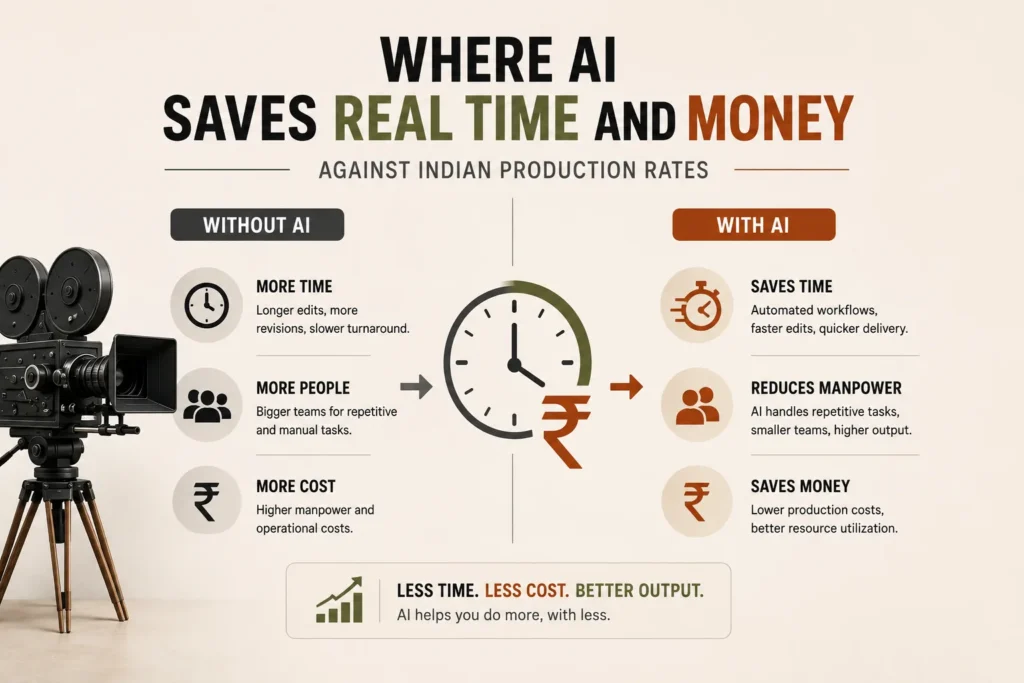
The saving is worth stating precisely, because the discourse oscillates between “AI changes everything” and “AI slop.”
AI does not replace a creator. Indian creator video runs roughly ₹1,000 to ₹15,000 an asset — what UGC costs in India, and what the rights cost has the bands. That is already cheap by global standards, which is exactly why the Indian case for generating people is weaker than the American one.
AI replaces the hours around the creator. Take one shoot that yields a master video. Producing five aspect ratios, three text treatments, two language versions and a set of stills used to be a day of somebody’s week. It is now an afternoon.
That matters more than it sounds for a small team, because production capacity — not budget — is usually what caps how much creative an Indian SME can sustain. Removing the mechanical hours raises the ceiling without raising the bill.
And it changes what is affordable at the margins. A language variant that previously needed a designer’s half-day now needs twenty minutes, which moves it from “later” to “this week.”
The trap that AI makes worse
Cheap generation makes permutations nearly free. That is not obviously good.
Twenty AI variants of one argument is still one argument — dressed twenty ways, going into an account that can serve three or four concepts at a time. The reasoning is at getting more than one ad out of a shoot, and AI makes the mistake easier rather than the outcome better.
The discipline holds regardless of how cheap production becomes. Coverage — different arguments, different formats, different languages — is what multiplies reach. Volume of files does not, and the machine is extremely good at producing volume of files.
A useful rule for teams adopting these tools: if a generated variant could persuade the same person for the same reason as an existing one, it does not count as a new concept, no matter how different it looks.
The people problem
This is the boundary worth understanding properly, because it is where most of the temptation sits.
Meta identifies and labels AI-generated content. For most AI-assisted creative, the notation appears in the menu attached to the ad — present, discoverable, and seen by almost nobody.
Photorealistic synthetic humans are reported to be handled differently, with a more prominent label on the creative itself. Verify the current position on Meta’s own pages before planning around it, because this is exactly the kind of policy detail that moves.
But note what the incentive structure does even without the policy. The reason to generate a person is to avoid paying a creator. The reason creator content works is that a real person in a real room reads as credible in a feed full of advertising. A label announcing the person is synthetic removes the property you were buying.
So the honest position: generate backgrounds, generate product renders, generate scenes, generate variants. Hire the human. At ₹1,000 to ₹15,000, the human is not the expensive part of your production anyway.
What Meta’s own documentation says
Kept short deliberately, and pointed at the source.
Meta publishes how AI-generated images are identified and labelled in its help centre, and its advertising standards govern what may run. Those two pages are the authority. Read them before making decisions, not a summary of them.
Reported and worth verifying yourself: that disclosure obligations for AI-generated or AI-modified creative tightened during 2026; that AI used for correction and optimisation is treated differently from AI used to generate the subject of an ad; that Meta’s own Advantage+ Creative tools are handled internally rather than requiring manual disclosure; and that third-party AI content can be detected through embedded provenance metadata rather than relying on advertisers to declare it.
That last point deserves attention if it holds. Detection through file metadata means disclosure is not entirely a choice you make — it can travel with the asset.
In India, ASCI’s digital advertising guidelines apply alongside platform policy. As with any disclosure question, get it checked rather than inferred.
And to be plain about what this page is: a practitioner’s guide to where AI helps, not a compliance reference. Anyone telling you the rules with total confidence in a blog post is describing a moving target.
Mistakes worth the money they cost
Asking AI for the idea. It returns the average of your category, which is the one thing that cannot differentiate you.
Generating people to save ₹5,000. The cheapest saving in production and the most expensive in credibility.
Shipping machine translation unread. Fluent, plausible, and occasionally wrong in ways that are memorable for the wrong reasons.
Confusing more files with more attempts. The oldest mistake in this cluster, now available at scale.
Inventing proof. A generated statistic or a fabricated testimonial is a legal problem, not a creative shortcut.
Treating a blog post as policy. Including this one. Read Meta’s pages.
Removing the human review step. The tools produce plausible output at high volume, which is precisely why someone has to look.
When not to reach for it
When the problem is the argument. Faster production of the wrong claim.
When the brand depends on craft. Some categories sell partly on evident care, and generated work reads as the opposite.
When you cannot check the output. Any language, claim or visual you cannot personally verify should not ship.
When the account cannot serve more assets. Production speed is not your constraint if delivery is.
When the saving is trivial. Twenty minutes of generation to replace a ₹1,500 asset is not a workflow improvement, it is a hobby.
The AI-in-production checklist
☐ Task list split by whether it needs knowledge of the buyer
☐ Resizing, reframing and format variants automated
☐ Background and object work automated
☐ Transcription and caption generation automated
☐ First-draft translation automated, final copy written or checked by a speaker
☐ Claim, objection and proof written by a human with access to sales conversations
☐ No generated photorealistic people without checking current Meta policy
☐ No generated statistics, testimonials or customer names, ever
☐ Generated variants counted as concepts only if they argue something different
☐ Human review before anything ships
☐ Meta’s own help and policy pages read directly, not summarised
☐ Indian disclosure obligations checked with someone qualified
Questions we get asked
Can you use AI-generated images in Facebook ads?
Generally yes, with disclosure obligations that depend on what was generated. Meta’s help centre is the authority and it is worth reading directly.
Does Meta require you to disclose AI content?
Meta identifies and labels AI-generated content, and disclosure expectations have tightened. The specifics move, so check the current pages rather than a summary.
Is AI ad creative any good?
At joinery, yes and improving quickly. At deciding what an ad should argue, no — it has never spoken to your customers.
What can AI actually do for ad production?
Resize, reframe, generate backgrounds, produce variants, draft translations, transcribe, cut rough assemblies and read footage. It removes hours rather than talent.
Will AI replace creative teams?
It is replacing the mechanical half of what creative teams do. The half that decides what to say has become more valuable, not less, because everyone now has the same production speed and only the argument differentiates.
Should I use AI to make UGC-style ads?
Generate the setting if you like. Hire the person. Indian creator rates are low enough that the saving is small and the credibility cost is not.
The sorting exercise
Write down every step between deciding to make an ad and having it live in the account.
Then mark each one: does doing this well require knowing who our buyer is and why they have not bought?
Most teams find that two or three steps are marked yes and a dozen are not. The dozen are where AI belongs, and handing them over usually frees the person who understands the customer to spend more time on the two or three that decide everything.
If you want that sorting done against your own production process, and an honest view of which tools are worth paying for, you can reach out to us on whatsapp at +91 7738844851.
More in Blog
Keep reading
All articles →

Ready to talk about your growth?
Tell us what's stuck and we'll tell you what we'd do first. Free, 30 minutes, no pitch.