
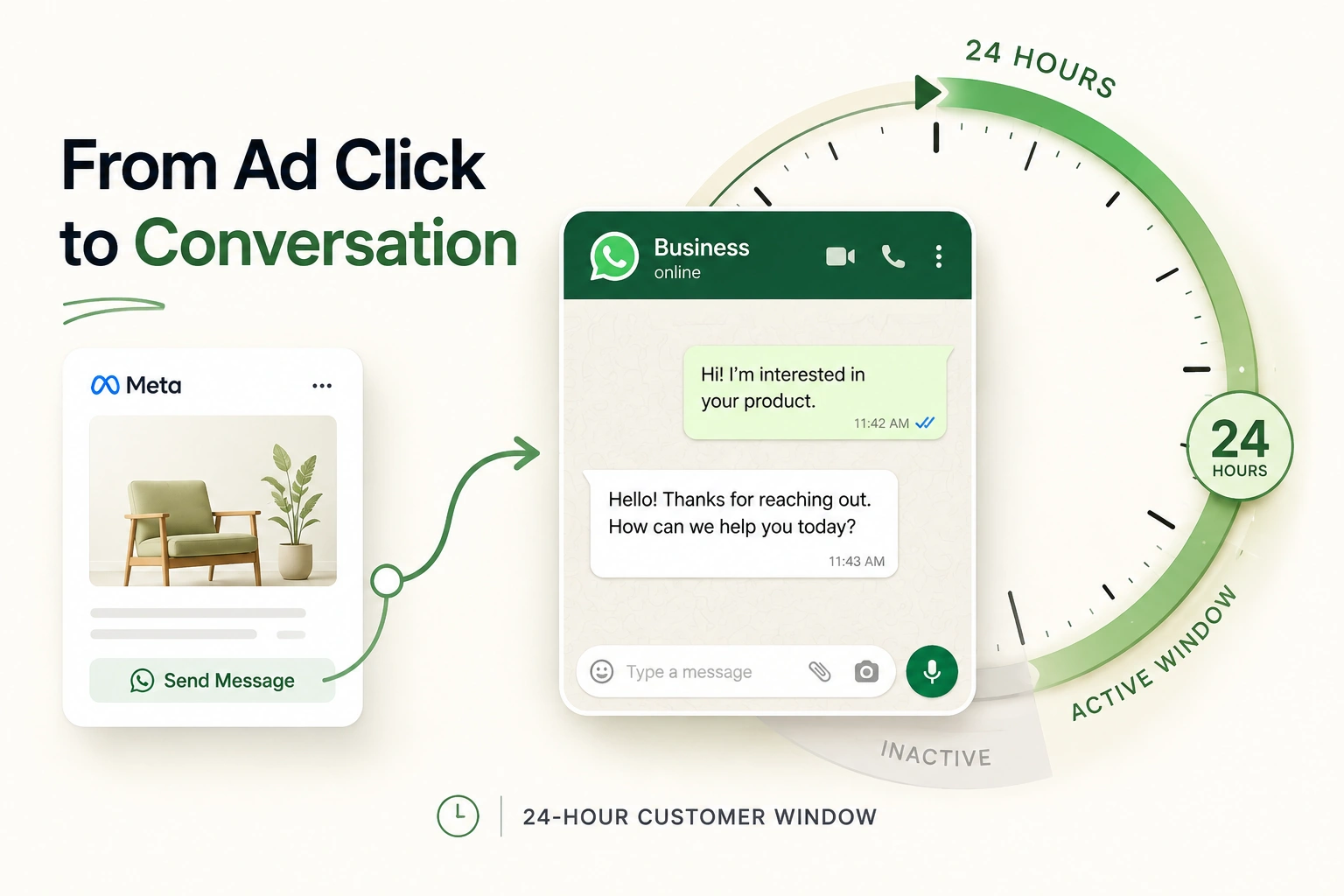
The case for these ads, everywhere you read it, includes a free 72-hour messaging window. It is real. It is also worth about twenty-four rupees.
That is not an argument against running them. It is an argument against running them for the reason most people give, because once you price the benefit properly the decision turns on something else entirely — and on one operational condition that decides whether the format works for you at all.
What the window is actually worth
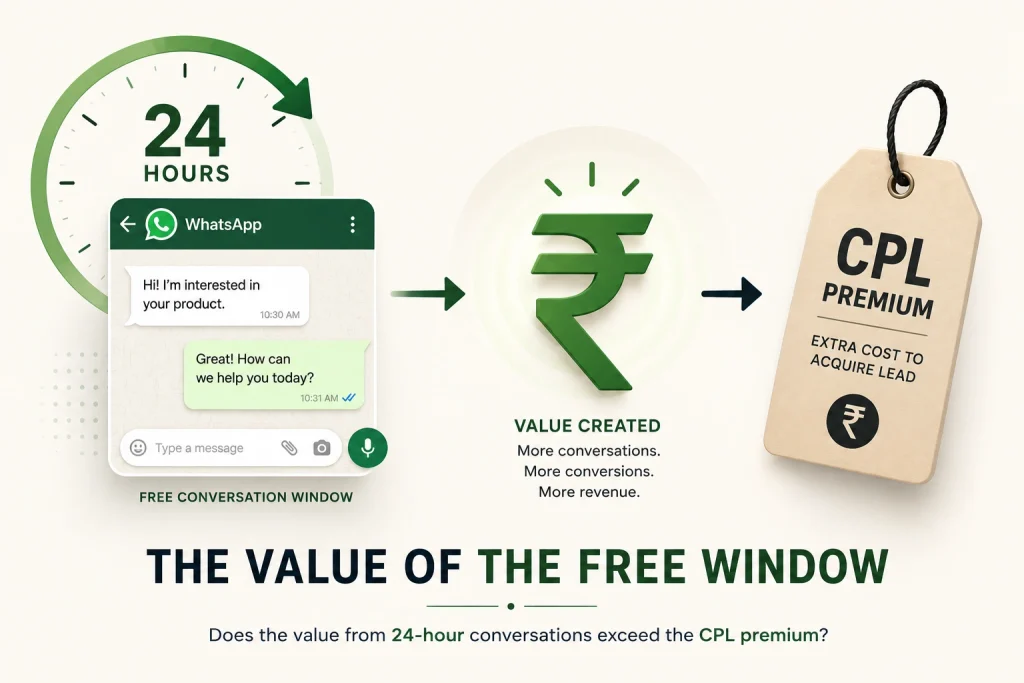
A landed marketing message in India costs about ₹1.2221 — Meta’s rate, plus your provider’s margin, plus GST. The arithmetic behind that is at what a year of WhatsApp actually costs.
So the free window saves you ₹1.2221 for every message you would otherwise have paid to send.
Work a lead with twenty messages and the window has saved you ₹24.44. Forty messages, ₹48.88.
Now set that against the cost-per-lead difference. If click-to-WhatsApp costs ₹50 more per lead than a form campaign, you need forty-one messages of chasing before the free window pays for the premium. At a ₹20 premium, sixteen messages.
Which is a real threshold and it is not where the marketing puts it. The free window is a rounding error on most campaigns. Choose the format for what it does to your pipeline, not for what it saves on messaging.
The SERP cannot decide either
Worth noticing, because it tells you something.
One set of pages reports click-to-WhatsApp delivering cost per lead 40 to 60% lower than form campaigns for Indian audiences, with opt-ins at ₹8 to ₹22 on cold traffic.
Another page on the same results — sometimes the same publisher — says WhatsApp ads generate fewer leads for the same budget, because starting a conversation asks more of a person than filling a form, and that lead forms are better if volume is the goal.
Both are true and they describe a trade, not a discount. Higher friction filters. You get fewer people and they are further along. Whether that is cheaper depends entirely on what happens next, which is the part nobody models.
So what are you actually buying
Two different products, priced as if they were one.
A lead form gives you a phone number. Someone tapped twice inside Meta, their details were pre-filled, and now the contact is yours to initiate — which means paying for it, and hoping they respond to a business they have half-forgotten. The friction problem that creates is covered at why frictionless forms produce unqualified leads.
A click-to-WhatsApp ad gives you a conversation somebody chose to start. They left the feed, opened another app, and typed something. That is a meaningfully different level of intent, and the conversation is already live rather than waiting to be initiated.
That is the purchase. Not free templates — a warmer contact in an open thread.
And it is worth paying more for, up to the point where the premium exceeds what the better intent is worth to you. Which is a judgement about your close rate, not a messaging cost calculation.
The condition that decides everything
Here is the part that appears on almost no page and it is not optional.
The 72-hour free window does not open when someone taps your ad. It opens when you reply, and only if you reply inside the first 24 hours. The tap opens a normal customer service window; your response is what triggers the free period, timed from the response. It also requires the user to be on the Android or iOS app.
So a business that answers within the hour gets the whole benefit. A business that answers on day two gets none of it — and has paid a higher cost per lead for the privilege.
Run that through the numbers. Take a form at ₹100 per lead, click-to-WhatsApp at ₹150, and twenty messages to work a lead.
- Capture every window: CTWA costs ₹150 against the form’s ₹124
- Capture half: ₹162
- Capture none: ₹174
The form wins in all three on cost alone, and the gap widens the slower you are. The only thing that justifies the premium is that the CTWA contact converts better — and a contact you answered two days late does not.
Which makes this a media decision that depends on an operations fact. Before buying the objective, find out honestly how fast your team replies on WhatsApp. If the answer is “within the hour, always,” the format is available to you. If it is “usually the same day,” it is not, and fixing that comes first.
When each one wins
Run click-to-WhatsApp when your sales process is genuinely conversational, your team answers within the hour, your product needs questions answered before purchase, and your buyers are consumer or small-business rather than enterprise procurement.
Run lead forms when you need volume for a threshold, your follow-up is a scheduled call rather than a chat, your CRM is the system of record, or nobody is watching WhatsApp during working hours.
Run both when you can afford to feed two objectives above their learning thresholds, and compare them on cost per qualified conversation rather than cost per lead.
Run neither when the offer is the problem. Both formats deliver the same proposition to the same people, faster.
Building the campaign, briefly
The mechanics are not the hard part, so this section is short on purpose.
Objective and destination. Choose the messaging objective with WhatsApp as the destination. Your number must be connected to the ad account.
Creative should ask a question. The best-performing click-to-WhatsApp creative in Indian accounts tends to pose something the viewer wants answered, rather than announcing an offer. You are asking for a conversation, so give them a reason to open one.
Pre-fill the first message with something specific enough to identify the campaign and short enough that people do not delete it.
Decide who answers, and by when, before launch. Not after the first day of leads.
Then leave it alone long enough to learn. Messaging campaigns are subject to the same volume requirements as everything else on Meta — what drives your CPM and cost per result covers the inputs.
Measure the conversation, not the click
Cost per lead is the wrong headline for this format and it is what everyone reports.
Track instead: the share of conversations you answered within an hour, the share that reached a qualifying question, cost per qualified conversation, and how many progressed past the first exchange.
A cheap opt-in that nobody replied to is not a lead. It is a notification you paid for.
And compare formats on the same basis. If you judge click-to-WhatsApp on cost per lead against a form, the form usually wins, because volume is what forms are for. The comparison only means something at the qualified-conversation stage — which metric should govern your decisions sets out how to choose one.
Questions we get asked
Are click to WhatsApp ads cheaper than lead forms?
Usually not on cost per lead. They produce fewer, more engaged contacts, and the free messaging window saves around ₹1.22 per message — too little to close a meaningful cost-per-lead gap.
How do click to WhatsApp ads work?
The ad opens WhatsApp with a pre-filled message. When the person sends it, a 24-hour window opens. If you reply inside that window, your reply is free and a 72-hour free period begins from your reply.
What is a good cost per lead on click to WhatsApp ads?
Reported Indian figures run from about ₹8 to ₹22 per opt-in on cold traffic, though these come from providers and vary enormously by category. Your own comparison against a form campaign is worth more than any benchmark.
Do I need WhatsApp Business API for click to WhatsApp ads?
Not for the ad itself, which can point at a WhatsApp Business app number. You need the API for automation, team inboxes, template sending and reporting at any volume.
Which is better, WhatsApp ads or lead form ads?
Whichever matches how you actually sell. Conversational sales with fast replies favours WhatsApp; scheduled calling and CRM-led follow-up favours forms.
Does the free window work on desktop?
No. Meta’s documentation specifies the Android and iOS apps for free entry point conversations.
Before you switch objective
Ask one question of the people who will answer these conversations: what is the longest a WhatsApp message has waited for a reply in the last month?
If the honest answer is measured in hours, this format is available to you and worth testing against your current lead forms on cost per qualified conversation.
If it is measured in days, the format will cost you more per lead and deliver less, and the free window will not rescue it — twenty-four rupees does not cover a fifty-rupee premium.
If you want the comparison run properly against your own account, you can reach out to us on whatsapp at +91 7738844851 .
More in Blog
Keep reading
All articles →
Ready to talk about your growth?
Tell us what's stuck and we'll tell you what we'd do first. Free, 30 minutes, no pitch.