
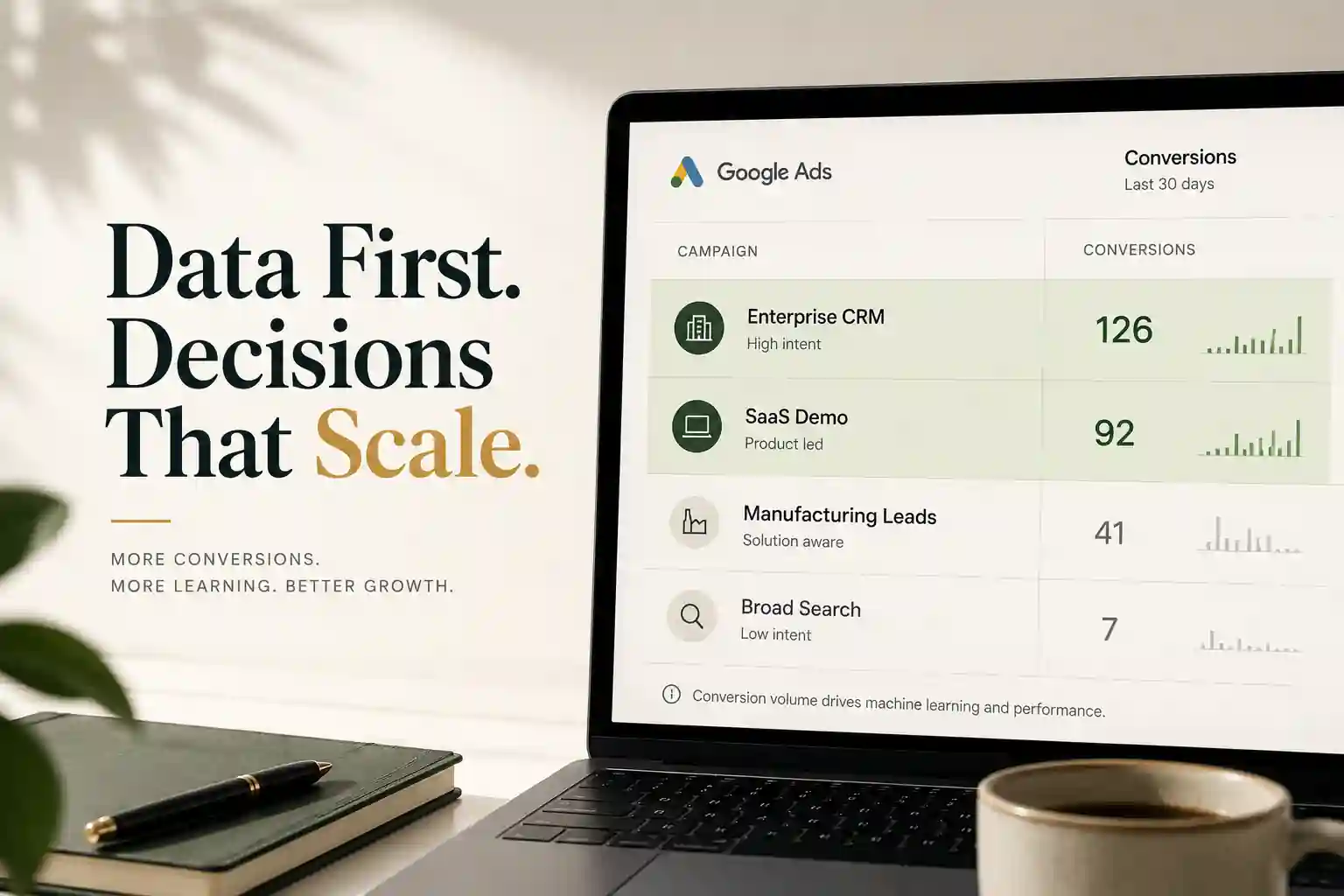
Before you change a keyword, open your account and do one sum.
Count the conversions your campaigns produced last month. Divide by the number of campaigns you are running. If the answer is under thirty, most of the advice you have read about Google Ads does not apply to you, and the reason your account behaves erratically has nothing to do with your keywords.
Google’s own documentation recommends at least thirty conversions in the past thirty days before Target CPA bidding works properly, and fifty for Target ROAS. A B2B account producing fifteen enquiries a month, split across six campaigns, is running at roughly two and a half.
The machine is not underperforming. It has nothing to learn from.
The short answer
Modern Google Ads runs on machine learning that needs conversion volume. Google recommends thirty conversions per campaign per thirty days for Target CPA and fifty for Target ROAS. Most B2B accounts produce far fewer, and then divide what they have across campaigns segmented by product, region and persona. The fix is to concentrate data rather than split it, use less demanding bid strategies until volume exists, and only then worry about signal quality.
Key takeaways
- Google publishes the thresholds. At least 30 conversions in the past 30 days for Target CPA, 50 for Target ROAS, measured at campaign level. Practitioners report needing considerably more for stability.
- Standard advice makes it worse. Segmenting by product, geography and persona feels like control and divides thin data into portions too small to learn from.
- B2B is structurally data-poor, for four reasons that no amount of optimisation changes: small addressable market, long sales cycle, buying committees, and low volume at high value.
- Manual bidding is defensible in B2B, which is close to heresy in 2026 and is true below the data floor.
- Fix quantity before quality. Feeding qualified outcomes back is powerful, and it needs a base of conversions to improve.
The number that decides everything
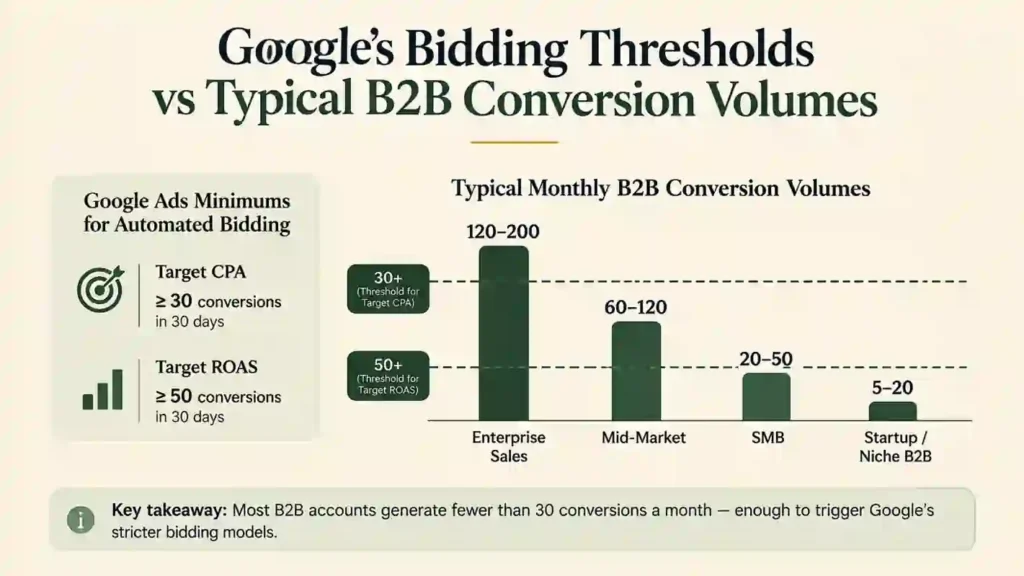
Google’s bid strategies are machine learning models. They observe which auctions produced conversions and bid accordingly. Below a certain volume of examples, they cannot form a reliable picture, and what you experience is a campaign that swings — cheap leads one week, nothing the next, then a spike in cost per conversion nobody can explain.
The published guidance is specific. Target CPA recommends at least thirty conversions in the past thirty days at campaign level. Target ROAS recommends fifty. Practitioners working in lead generation commonly report that real stability takes rather more than that, because lead quality varies in ways the model cannot see.
Now hold that against a typical Indian B2B account. A manufacturer selling capital equipment might generate twelve enquiries in a month. A professional services firm, twenty. A B2B SaaS company at early stage, perhaps forty across everything.
Twelve is not near thirty. And that is the account total, before anyone splits it.
Why B2B is structurally data-poor
Four reasons, and none of them is fixable by better campaign management.
The addressable market is small. Research by Professor John Dawes at the Ehrenberg-Bass Institute for the LinkedIn B2B Institute found roughly 5% of B2B buyers are in the market at any moment. Narrow that to your category, your geography and your size band and the pool of people searching this month is genuinely small — a point we cover as the capture ceiling.
The sales cycle is long. A click in March becomes an enquiry in April and a deal in September. By the time the outcome is known, the auction that produced it is ancient history, and the feedback loop that machine learning depends on has stretched past usefulness.
Buying committees confuse attribution. Gartner’s research puts six to ten stakeholders on a typical B2B decision, each researching independently and revisiting six buying jobs an average of 1.7 times. Several people from the same company may click your ads. You see one deal; the algorithm sees several unrelated users, most of whom did not convert.
Value is high and volume is low. A single B2B deal can be worth more than a month of ecommerce revenue, which is why the business is viable and why the account is data-starved. Ecommerce accounts get a thousand conversions to learn from. You get twelve.
Brent Adamson, then a distinguished vice president in Gartner’s sales practice, described the buyer’s side of this — customers “reaching an information saturation point, where each new idea reduces the value derived from information and turns sound decision making into ‘best guesses’ or ‘gut feeling’ choices.” The algorithm bidding for those buyers is working with a similar shortage of usable signal.
The Consolidation Rule
Here is the practical consequence, and it inverts what most guides recommend.
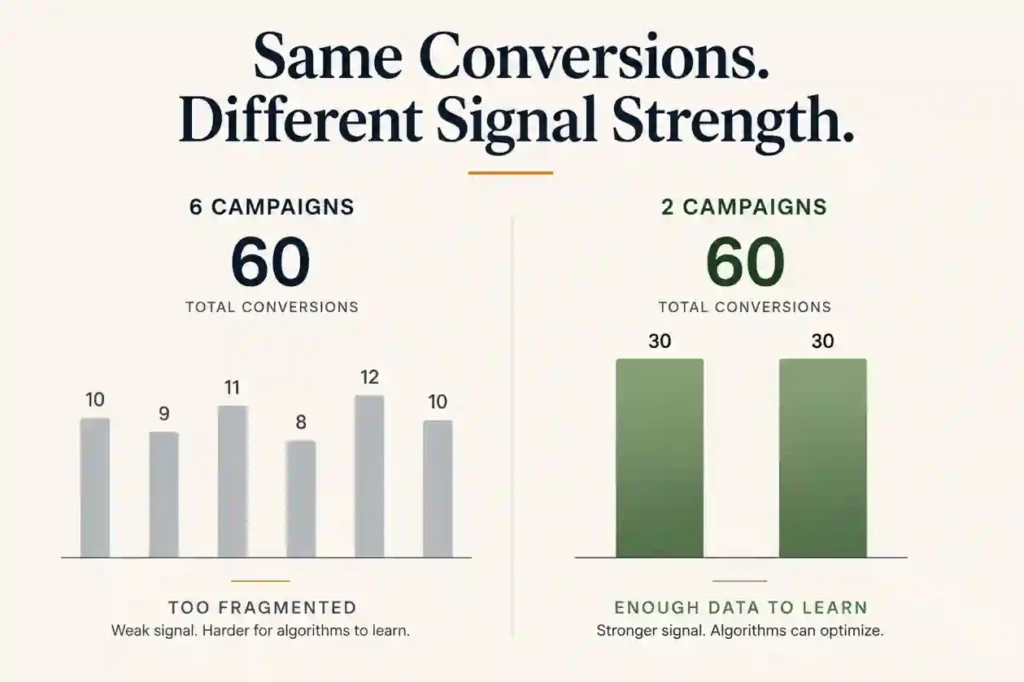
Divide last month’s total conversions by your number of campaigns. If any campaign sits below thirty, you have too many campaigns. Concentrate the data until each campaign has enough to learn from — control is worth less than learning.
Most B2B accounts are built for reporting rather than for performance. One campaign per product line, one per city, one per persona, because that structure produces a tidy spreadsheet. Each of those campaigns then bids independently on a handful of conversions, and none of them gets good at anything.
Consolidation feels like losing control. What you actually lose is the ability to set a separate budget per segment, and what you gain is a model that has seen enough to be useful.
How to consolidate without losing visibility. Use ad groups and labels for reporting rather than separate campaigns. Segment reports by geography, device and audience after the fact. You can see everything you could see before; you are simply not forcing the bidding algorithm to learn six times over.
Where separate campaigns still earn their place. When budgets genuinely must be ring-fenced, when a product has a completely different conversion action, or when geography changes the offer rather than just the targeting. Those are real reasons. “So we can see it separately” is not.
What to do while you are below the floor
Five moves, roughly in order.
Consolidate first. It costs nothing and it is usually the largest single improvement available on a fragmented B2B account.
Step down the bid strategy. Maximize Conversions asks less of the data than Target CPA does. Start there and graduate once volume supports it. Setting a Target CPA on eight conversions a month produces a number that looks authoritative and means very little.
Consider manual CPC honestly. This is close to heresy in 2026, and below the data floor it is defensible. A competent person managing bids on a small, tightly-built account can outperform an algorithm with nothing to learn from. It costs management time, which is the real trade-off, and it should be a stated decision rather than a default.
Add earlier conversion actions deliberately — with care. Counting a pricing page visit or a brochure download gives the model more to work with. Do this only if the earlier action genuinely correlates with real enquiries, and keep your primary bidding goal clean. Otherwise you have solved a volume problem by creating a quality problem, and we have written separately about the four levels of conversion signal and why that matters.
Tighten before you broaden. Broad match with audience signals works when the algorithm has data to steer with. Below the floor it is expensive exploration. Exact and phrase match, with a negative list reviewed weekly, is the right starting posture for a data-poor B2B account.
Once you are above the floor
Volume changes what is available to you.
At thirty-plus conversions a campaign, Target CPA becomes meaningful and Smart Bidding starts doing work you cannot do manually. At that point the question shifts from quantity to quality — from “does the model have enough examples” to “are the examples the right ones”.
That is where feeding qualified and closed outcomes back into the account earns its return, and it is a different article. The sequence matters though: quantity first, then quality. Improving the signal on an account with eight conversions a month gives the model a better view of almost nothing.
Mistakes that cost real money
Building for the report rather than the algorithm. Six campaigns because six is how the business is organised.
Setting Target CPA on thin data. It produces confident-looking targets the model cannot hit, and the resulting volatility gets blamed on the market.
Chasing volume to satisfy the algorithm. Loosening match types to generate more conversions gets you more of the wrong ones. Rising costs make this worse — reported CPC inflation of around 12.88% year on year means volume-led approaches get more expensive every quarter.
Ignoring conversion lag. If deals take four months, a thirty-day performance window is measuring the wrong period. Check the conversion lag report before judging anything.
Treating LinkedIn and Google as substitutes. They do different jobs. Google captures people searching; LinkedIn reaches people who are not. Budget them separately and judge them on different clocks.
Optimising the account while enquiries go unanswered. Harvard Business Review’s audit of 2,241 companies found the average first response took 42 hours and 23% never responded at all. No bidding strategy survives that.
When Google Ads is the wrong channel for a B2B business
Nobody searches for what you sell. New categories have no query volume to capture. Paid search cannot create demand, and spending there while the category is unnamed is expensive patience.
Your addressable market is a few hundred companies. If you can name every potential buyer, targeted outbound and account-based work reach them more directly than an auction will.
Your deal size cannot carry the cost per acquisition. Paid search in competitive B2B categories is expensive per click and slow to convert. Do the arithmetic on deal value, margin and close rate before committing a budget.
You have no follow-up capacity. Covered above, and it remains the most common reason B2B paid search fails in India.
Your conversion volume will never reach the floor. Some businesses genuinely close six deals a year at high value. Paid search can still work for them, run manually and modestly, but the automated machinery this article describes will never engage — and knowing that saves a lot of frustrated optimisation.
The B2B account checklist
☐ Total conversions last month counted, and divided by number of campaigns
☐ Any campaign below 30 conversions a month identified for consolidation
☐ Campaign count reduced to what the data can support
☐ Reporting moved to ad groups, labels and segments rather than separate campaigns
☐ Bid strategy matched to actual volume — Maximize Conversions before Target CPA
☐ Manual CPC considered honestly if volume is very low, as a stated decision
☐ Conversion lag report checked before judging any performance window
☐ Match types kept tight until data supports broadening
☐ Negative keyword list reviewed weekly, not quarterly
☐ Primary conversion action clean, with secondary actions set to observation
☐ Enquiry response time measured before any budget increase
☐ One number agreed for the account, reviewed monthly
Questions we get asked
Does Google Ads actually work for B2B?
Yes, where buyers search for what you sell by name. It works differently from ecommerce because the data volumes are smaller, and most disappointment traces to running an ecommerce playbook on a B2B account. India’s paid search market reached ₹16,581 crore in 2025 per dentsu India, around 23% of digital spend, so it is far from a niche channel.
Should B2B use Smart Bidding or manual CPC?
Depends entirely on volume. Above thirty conversions per campaign per month, Smart Bidding does things a human cannot. Below it, manual bidding on a tightly-built account is genuinely defensible, and anyone telling you automation is always superior is not looking at your conversion count.
How much should a B2B company spend on Google Ads?
Enough to reach meaningful conversion volume in your category, which is a different calculation for every business. Work backwards from what a customer is worth rather than from a percentage of revenue, and expect the number to be higher than it feels because B2B clicks cost more than consumer ones.
Why are my B2B leads so expensive?
Usually a combination of a small in-market pool, competitive commercial terms, and a bid strategy operating on too little data. Check the conversion count per campaign before assuming the problem is the market.
Is LinkedIn better than Google Ads for B2B?
They are not competing. Google captures existing demand; LinkedIn reaches people who are not yet looking. If buyers search for your category, Google is cheaper per acquisition. If they do not, LinkedIn is where the audience is.
How do I handle a long sales cycle in reporting?
Look at the conversion lag report and set your evaluation window beyond it. Judging a ninety-day sales cycle on thirty-day performance data produces decisions based on incomplete outcomes, every time.
What to do this week
One sum, ten minutes. Conversions last month, divided by campaigns.
If that number is under thirty, do not touch your keywords, your copy or your bids. Consolidate first, step the bid strategy down to something the data can support, and give it a month. Most fragmented B2B accounts improve on that change alone, without a rupee of extra budget.
If the number is comfortably above thirty, you have a different and better problem — the quality of the signal rather than its quantity — and that is where the real gains sit.
If you would like the account read against your actual conversion volume and sales cycle before anything changes, you can reach out to us on whatsapp at +91 7738844851.
More in Blog
Keep reading
All articles →


Ready to talk about your growth?
Tell us what's stuck and we'll tell you what we'd do first. Free, 30 minutes, no pitch.