
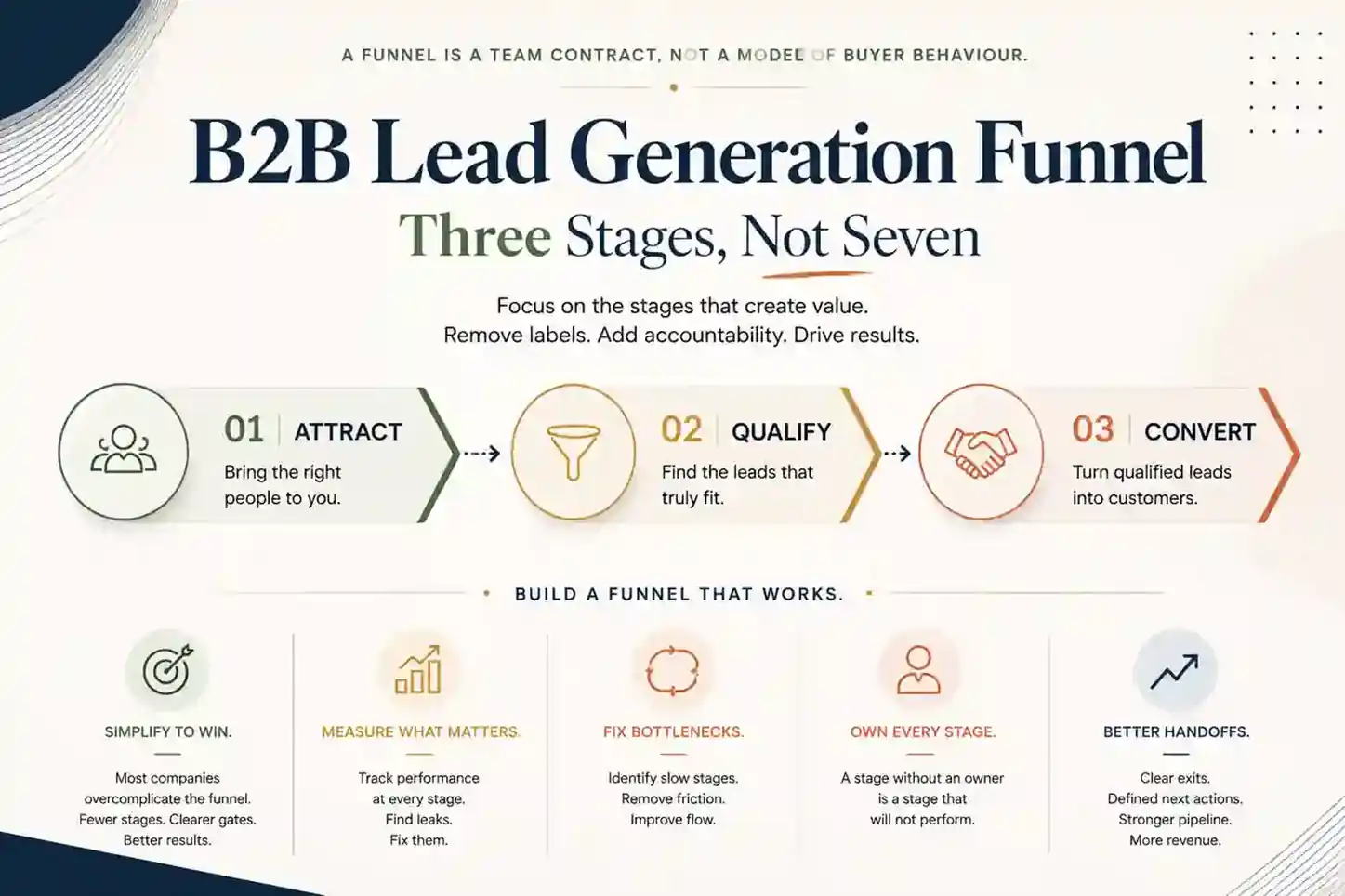
Every funnel diagram makes the same promise: buyers enter at the top, move down in order, and emerge as customers.
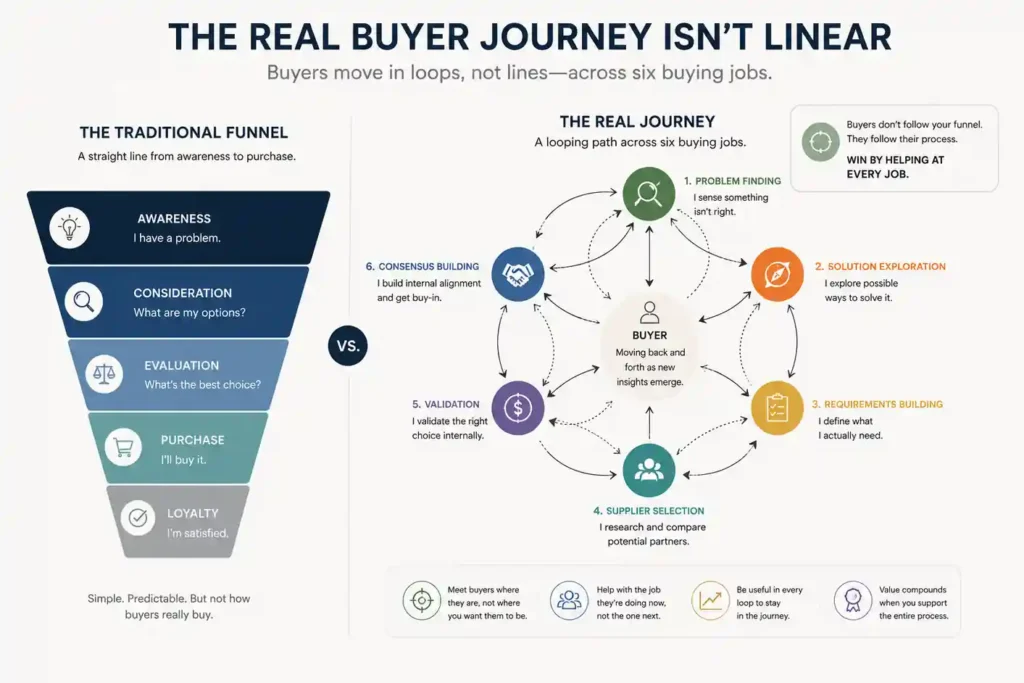
They do not. Gartner’s research into B2B buying found that customers loop — revisiting each of six buying jobs an average of 1.7 times during a single purchase, in no reliable sequence. Somebody who looked like a qualified opportunity in March goes quiet, reopens the requirements question in May, and returns in July with two new stakeholders and a different specification.
Which raises an obvious question. If buyers do not move through stages, why have stages at all?
Because the funnel was never a description of the buyer. It is a contract about what your team does next.
The short answer
A B2B lead generation funnel is an internal agreement: what has to be true for a lead to move forward, who owns it at each point, and what happens when it arrives. It is not a map of the buyer’s mind, and treating it as one produces stages that describe feelings rather than trigger actions. Most Indian mid-market businesses need three stages, not the seven imported from American enterprise software.
Key takeaways
- Buying is non-linear. Gartner identifies six buying jobs — problem identification, solution exploration, requirements building, supplier selection, validation and consensus creation — revisited an average of 1.7 times each. Any funnel claiming to track that sequentially is describing fiction.
- A stage is real only if something changes when a lead crosses it. Entry criterion, owner, action, exit criterion. Fewer than four and it is a label.
- MQL and SQL exist to govern a handoff between two teams. If you have one team, importing them adds reporting and removes nothing.
- Published conversion benchmarks are global SaaS figures. Lead to MQL around 39%, MQL to SQL around 38%, SQL to opportunity around 42% — useful as a shape, misleading as a target for an Indian manufacturer.
- The gate that matters most is qualification, and almost nobody has written its definition down.
Buyers do not move in a line
Start with the research, because it changes what the rest of the article can honestly claim.
Gartner’s work on B2B buying describes six jobs a buying group must complete: identifying the problem, exploring solutions, building requirements, selecting a supplier, validating the choice, and creating consensus internally. Buyers do not complete these in order. They loop, revisiting each one an average of 1.7 times, often working several simultaneously.
Add the other two numbers from the same body of research. Buyers spend roughly 17% of their total buying time with potential suppliers, and six to ten stakeholders typically shape a decision, each researching independently.
So the picture is a buying group, mostly invisible to you, working several questions at once, in an order you cannot see, for a period you cannot predict.
Brent Adamson, then a distinguished vice president in Gartner’s sales practice, described the effect of all that information on the buyer: they are “reaching an information saturation point, where each new idea reduces the value derived from information and turns sound decision making into ‘best guesses’ or ‘gut feeling’ choices.”
None of this means funnels are useless. It means a funnel that claims to model this is lying, and one that organises your own response to it is not.
What a funnel is actually for
Three jobs, all internal.
It decides who acts next. At any moment, someone owns each live opportunity. The stage says who.
It triggers a specific action. Crossing a stage boundary should cause something to happen — a call, a proposal, a site visit, a follow-up sequence. If nothing happens, nothing was crossed.
It makes the pipeline countable. You cannot forecast what you cannot count, and you cannot count what has no agreed definition.
Notice what is absent from that list. Nowhere does the funnel need to describe how the buyer feels, what they are thinking, or where they are in their journey. You cannot see any of that, and building stages around it produces a CRM full of guesses.
The practical version: your funnel should be legible to a new salesperson on day one, and every stage should answer the question “what do I do with this now?”
The Gate Test
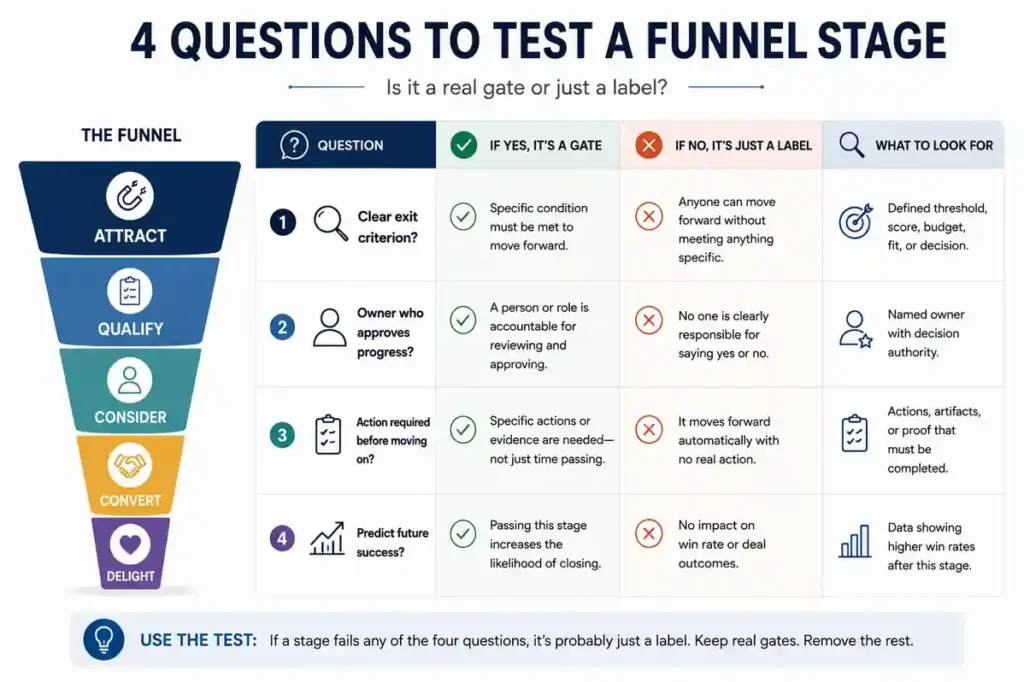
Four questions for every stage in your funnel.
The rule: a stage is a gate only if it has an entry criterion, an owner, an action and an exit criterion. If it cannot answer all four, it is a label. Delete it.
One — what must be true for a lead to enter?
A criterion someone else could apply without asking you. “Showed interest” is not a criterion. “Asked for a price, or requested a site visit” is.
Two — who owns it while it sits here?
One name, not a team. Ownership that belongs to everyone belongs to nobody, and leads die quietly in stages with no owner.
Three — what happens here that does not happen elsewhere?
The action the stage exists to trigger. If a lead in this stage gets treated exactly like a lead in the previous stage, you have added reporting and changed nothing.
Four — what must be true for it to leave?
Both ways. What moves it forward, and what moves it out. Stages without exit criteria accumulate dead leads and inflate every forecast built on them.
Run this against your current pipeline. Most companies find two or three stages fail the test immediately — usually the ones with names like “nurturing”, “engaged” or “warm”, where nothing is triggered and nobody is accountable.
Those stages are not harmless. They give the team somewhere to put leads they do not want to act on, which is exactly what a funnel should prevent.
The three stages most Indian businesses need
Start here and add only when a fourth passes the Gate Test.
Stage one — enquiry
Enters when: any contact arrives from any channel — form, phone, WhatsApp, IndiaMART, referral, event.
Owner: one named person, not a shared inbox.
Action: first human response, fast. Harvard Business Review’s audit of 2,241 companies found the average first response took 42 hours and 23% never responded at all. On shared-lead channels the effect is sharper still, which we cover in how shared leads change response speed.
Exits when: contact is made and qualification is attempted, or three documented attempts fail.
This stage exists to stop enquiries dying in someone’s personal WhatsApp. In most Indian mid-market businesses, fixing this one stage produces more pipeline than any campaign.
Stage two — qualified
Enters when: the lead meets a written definition your sales team agreed to. Not “seems interested.”
Owner: the salesperson who will carry it.
Action: a real conversation about requirement, budget indication and timeframe, and a decision to pursue or decline.
Exits when: a proposal or quotation is issued, or the lead is declined with a reason recorded.
This is the gate that matters and the one almost nobody defines. Article five in this series is entirely about writing that definition, because it is the single most common source of arguments between sales, marketing and any agency you hire.
Stage three — opportunity
Enters when: a proposal or quotation has gone out.
Owner: the same salesperson.
Action: structured follow-up on an agreed rhythm, with a next step always scheduled.
Exits when: won, lost with a reason, or formally closed as dormant after a stated period.
That last clause is the one people skip. A pipeline with no dormancy rule fills with opportunities from eighteen months ago, and every forecast built on it is fiction.
When to add a fourth stage. When a genuinely different action becomes necessary between two of these — a technical evaluation, a site visit, a compliance approval, a pilot. If the new stage triggers work that would not otherwise happen and someone owns it, add it. Otherwise resist.
What to measure, and a caveat about benchmarks
Four numbers, and they are more useful than a dashboard of twenty.
Enquiry to qualified. The clearest signal of traffic quality. If this rate is low, the problem is upstream in targeting, not in sales.
Time to first response. Measured, not estimated. Most businesses discover their real number is several times what they assumed.
Qualified to proposal. How well your team converts a conversation into a documented offer.
Proposal to won. Your actual win rate, which is usually lower than the number people quote from memory.
On benchmarks, a caution worth stating plainly. Published B2B funnel conversion figures — lead to MQL around 39%, MQL to SQL around 38%, SQL to opportunity around 42% — come from global B2B SaaS datasets. They are useful for understanding the shape of a funnel and close to useless as targets for an Indian manufacturer, distributor or professional services firm with a different deal size, sales cycle and buying culture.
No credible India-specific B2B funnel benchmarks have been published. Anyone quoting one precisely is estimating. Measure your own for ninety days and use that as your baseline; it will be more useful than any published figure.
Mistakes that cost real money
Importing seven stages because a template had seven. Every unused stage is a field someone has to update and an argument waiting to happen.
Building MQL and SQL without two teams. These stages exist to govern a handoff. In a business where the same person generates and closes, they add process and remove nothing.
Stages that describe feelings. “Warm”, “interested”, “nurturing”. Nobody can apply them consistently, so the pipeline stops being countable.
No dormancy rule. Old opportunities never leave, the pipeline looks healthy, and the forecast is wrong every quarter.
Measuring stage counts instead of stage conversion. Two hundred leads in the funnel tells you nothing. The rate at which they cross each gate tells you everything.
Treating the funnel as marketing’s document. If sales did not agree the qualification definition, they will not use the funnel, and you will have two versions of the truth.
When you do not need a funnel
You close fewer than five deals a year. A spreadsheet and a calendar reminder will serve you better than a CRM configuration, and the migration later is trivial.
One person does everything. If the founder generates, qualifies and closes, the funnel exists in their head and formalising it adds admin without adding clarity. Revisit when the second salesperson joins — that is the real trigger.
Your enquiry volume is tiny and your deals are large. Ten enquiries a year for ₹2 crore contracts is an account plan, not a funnel. Manage them individually.
Nothing happens after the enquiry anyway. If leads are not followed up, adding stages formalises the neglect. Fix response first — it is free and it improves everything downstream.
The funnel checklist
☐ Every stage tested against the four Gate Test questions
☐ Any stage failing the test deleted, not renamed
☐ One named owner per stage, not a team
☐ Qualification definition written in one sentence and agreed by sales
☐ Entry and exit criteria written for every stage
☐ A dormancy rule agreed — how long before an opportunity closes automatically
☐ Every channel routed into stage one, including WhatsApp and phone
☐ Time to first response measured for thirty days before changing anything
☐ Four conversion rates tracked, not twenty metrics
☐ Your own baseline recorded before comparing to any published benchmark
☐ Loss reasons captured as a required field
☐ The whole funnel explainable to a new salesperson in ten minutes
Questions we get asked
What is the difference between an MQL and an SQL?
A marketing qualified lead has shown enough engagement for marketing to pass it on; a sales qualified lead has been spoken to and confirmed as genuine. The distinction is a handoff contract between two functions. If your business has one function doing both jobs, you do not need the distinction — you need one qualification definition that everybody uses.
What is a good B2B funnel conversion rate?
Yours, measured over ninety days, compared with yours from the previous ninety. Published figures come from global SaaS companies with different deal sizes and cycles. Use them to sanity-check the shape of your funnel, never as a target.
How many stages should a B2B funnel have?
As few as pass the Gate Test. Three works for most Indian mid-market businesses. Add a fourth when a genuinely different action becomes necessary and someone owns it.
Is the marketing funnel still relevant given buyers loop?
As an internal operating agreement, yes. As a description of buyer behaviour, no — and it never really was. Gartner’s finding that buyers revisit each buying job around 1.7 times is a reason to stop modelling the buyer, not a reason to abandon process.
Should the funnel live in a CRM or a spreadsheet?
Whichever your team will actually update. A spreadsheet that gets filled in beats a CRM that does not. Move to a CRM when the spreadsheet starts failing you, not before.
Who should own the funnel definition?
Sales and marketing jointly, with sales holding the pen on the qualification criterion. A definition sales did not write is a definition sales will not apply.
What to do this week
Open your pipeline and run the Gate Test against each stage. Four questions: what gets a lead in, who owns it, what happens here, what gets it out.
You will probably find at least one stage where the honest answer to “what happens here” is nothing. That stage is where your leads are going to sit while everyone assumes someone else is handling them.
Delete it, and see whether anything breaks. Usually the pipeline gets shorter, the forecast gets more accurate, and the team stops arguing about definitions they never agreed.
If you would like the funnel designed against your actual sales process and the systems it needs to run in, you can reach out to us on whatsapp at +91 7738844851. We will tell you honestly if a spreadsheet is enough for now.
More in Blog
Keep reading
All articles →
Ready to talk about your growth?
Tell us what's stuck and we'll tell you what we'd do first. Free, 30 minutes, no pitch.