
Google Search Console has carried dedicated generative AI performance reports since 3 June 2026, isolating impressions and clicks from AI Overviews and AI Mode. Those figures were already inside the overall performance totals, so adding them to organic double-counts the same events. No equivalent reporting exists for ChatGPT, Perplexity or the standalone assistants, and AI Overview clicks cannot be separated from ordinary Google clicks in analytics at all.
We should correct something we published.
Our pillar on AI search says there is no Search Console for AI answers. For Google, that is no longer true. Since 3 June 2026, Search Console has carried dedicated generative AI performance reports, isolating impressions and clicks from AI Overviews and AI Mode.
The claim still holds for ChatGPT, Perplexity, Claude and the standalone assistants, none of which report anything to the sites they cite. So the position has changed on the largest surface and nowhere else.
We are correcting the pillar rather than quietly editing it, and this article is where the corrected version lives.
The trap inside the new report
Before anything else, because somebody is going to make this mistake in a board pack this quarter.
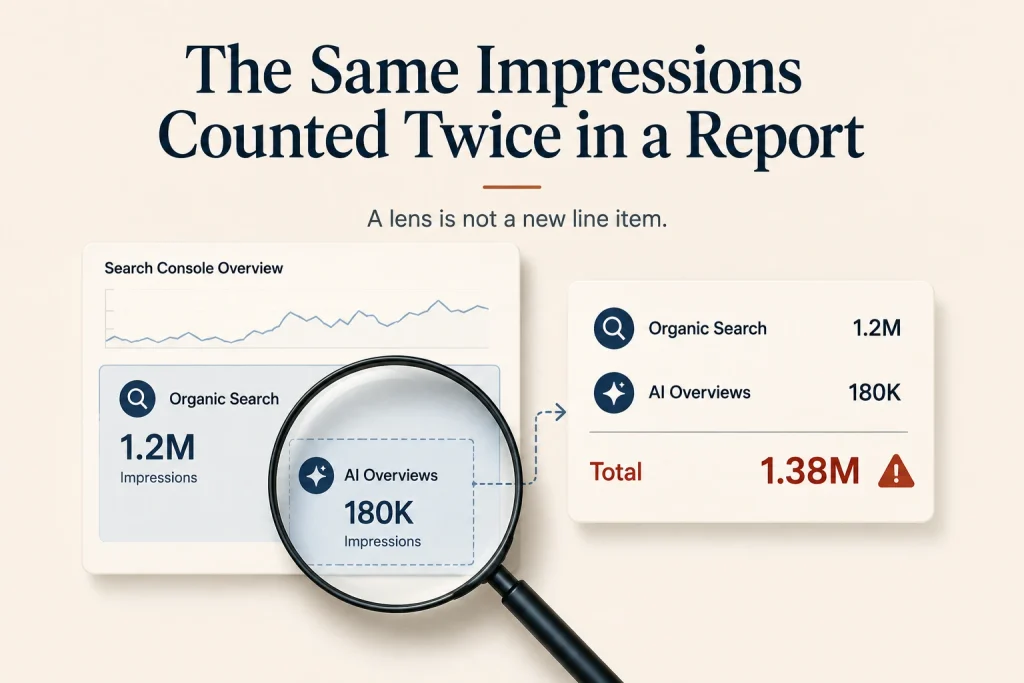
The generative AI figures were already inside your overall Search Console totals before the dedicated report existed. The new view isolates them. It does not add them.
So if you open the AI report, take its impressions, and add them to your organic impressions, you have counted the same events twice and produced a number that overstates your visibility.
The correct reading is that the dedicated report is a lens. It tells you what proportion of the visibility you already had is coming through generative surfaces. That proportion is genuinely useful and it is a different quantity from a total.
Anyone presenting AI visibility as a new line item on top of organic should be asked how they separated them.
Three layers, and only one of them is solved
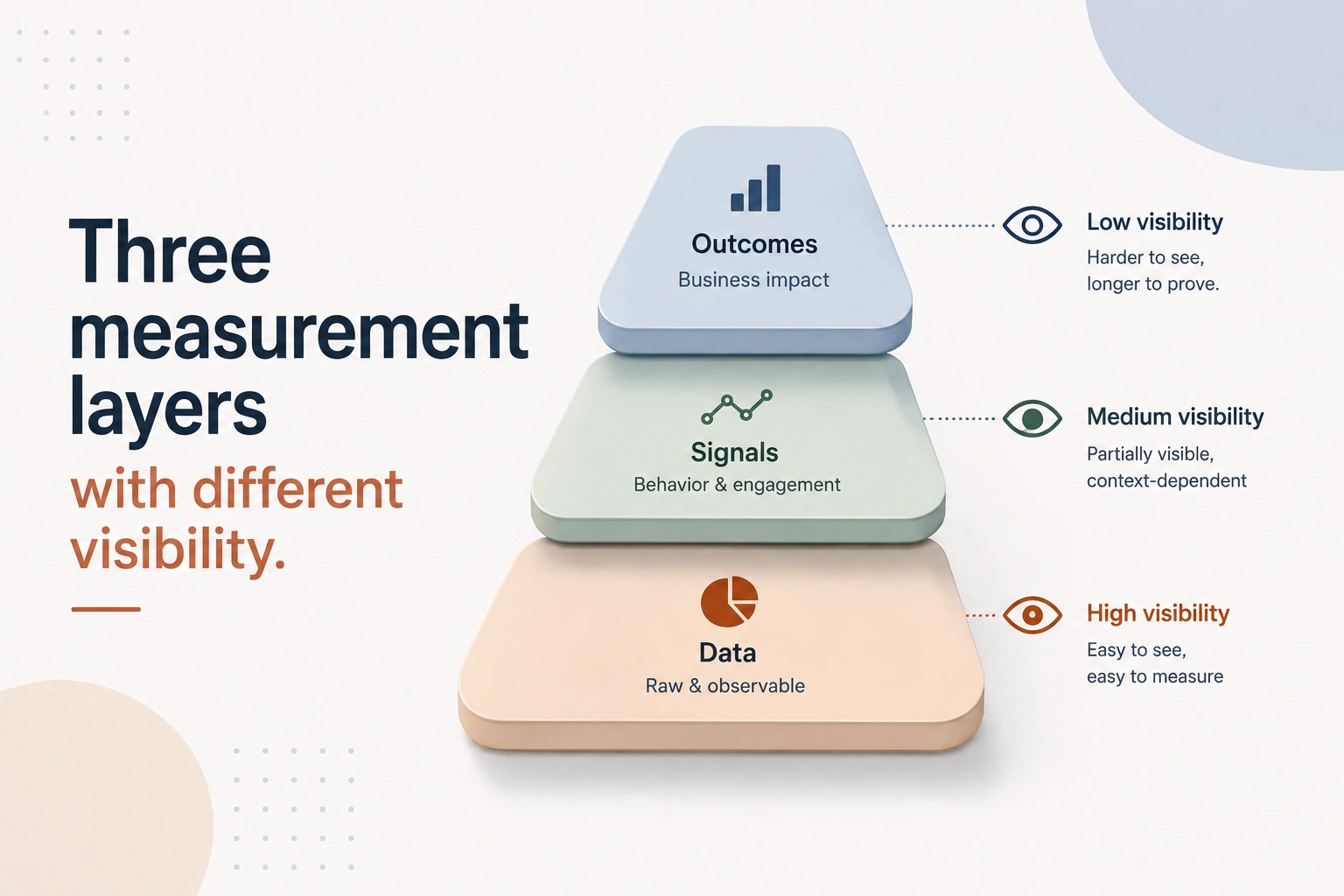
Measurement here is not a single question, and treating it as one is why the answers feel unsatisfying. There are three layers, each with different instrumentation.
Layer one is presence. Are you being cited at all, and for which questions. Layer two is referral. Are people arriving because of it. Layer three is consequence. Is any of it producing enquiries.
Google’s new report sits partly in layer one and partly in layer two, for one surface. Everything else needs different treatment.
Layer one: presence

For Google, open the generative AI reports in Search Console and read them as you would the ordinary performance data — with the caution about position that we set out in our measurement article.
For everything else, there is nothing to open. Which leaves the manual method described in our pillar — a fixed set of real buyer questions, run monthly, with the cited sources recorded.
Keep doing that for the non-Google systems even now that Google reports. They behave differently, they draw on different sources, and one of them holds a large share of the queries your buyers actually ask.
Layer two: referral, and the part that cannot be separated
Now the technical detail that decides how much of this you can automate.
Traffic from the standalone assistants is identifiable. A visitor arriving from a chat interface carries a referrer from that service, and you can build a segment or a channel group from those domains in your analytics. It takes twenty minutes and it is worth doing, because otherwise those visits sit in an undifferentiated pile and nobody notices them growing.
Traffic from AI Overviews is not identifiable in analytics. A click from an AI Overview arrives from Google, looking exactly like a click from an ordinary search result. There is no referrer distinguishing them.
So the ceiling on analytics-side measurement is fixed. You can see the assistants and you cannot separate the overviews, and no amount of tag configuration changes that. Anyone selling you a setup that claims to isolate AI Overview clicks in your analytics is selling something that does not work the way they say.
Expect the assistant referral numbers to look small. They usually are, and that is the point our pillar makes about most exposure producing no click at all.
Why the referral number is smaller than the truth
Two things suppress it, and both are worth knowing before you conclude that nobody is coming.
Assistant apps often open links in their own in-app browser, and depending on how that is implemented the referrer may not survive. And a meaningful share of people copy the address rather than tapping it, particularly on desktop, which strips the referrer entirely.
Both cases land in your direct traffic, mixed with people typing your name and people arriving from an email.
So the assistant referral figure is a floor rather than a measurement. If it is rising, something real is happening and it is larger than the number shows. If direct traffic is also rising with no other explanation, some of that is probably the same thing.
This is not fixable with configuration. It is a property of how the interfaces work, and the honest response is to read the number as directional and to lean harder on layer three.
The most useful output is who else was named
The presence check produces something more valuable than your own hit rate, and it gets overlooked because it is not a number about you.
Record who is named instead of you.
Do that for a few months and a picture appears that will not match your assumptions. In most Indian markets, the sources named alongside a question are not the commercial competitors you track. They are trade publications, community threads, a government or association page, a comparison site, and occasionally a firm you had never heard of because it is small and writes clearly.
That list is more actionable than a visibility percentage, for three reasons.
It tells you which publications are being drawn on in your subject, which is a media list built from evidence rather than from a directory — and it is exactly the input the pitching work in our digital PR article needs.
It shows you what those pages have that yours does not. Usually a specific figure, a plainly stated rule, or an account of what actually happened.
And it identifies the questions where nobody credible is being named at all, which are the ones worth writing for.
Keep the raw answers, not a summary. The interesting part is usually the sentence that got quoted rather than the domain it came from.
Layer three: consequence
The layer that matters commercially, and the one where the instruments are worst and cheapest.
Branded search is the cleanest available proxy for demand you created but cannot trace — an argument set out at length in our B2B article, which we will not repeat here.
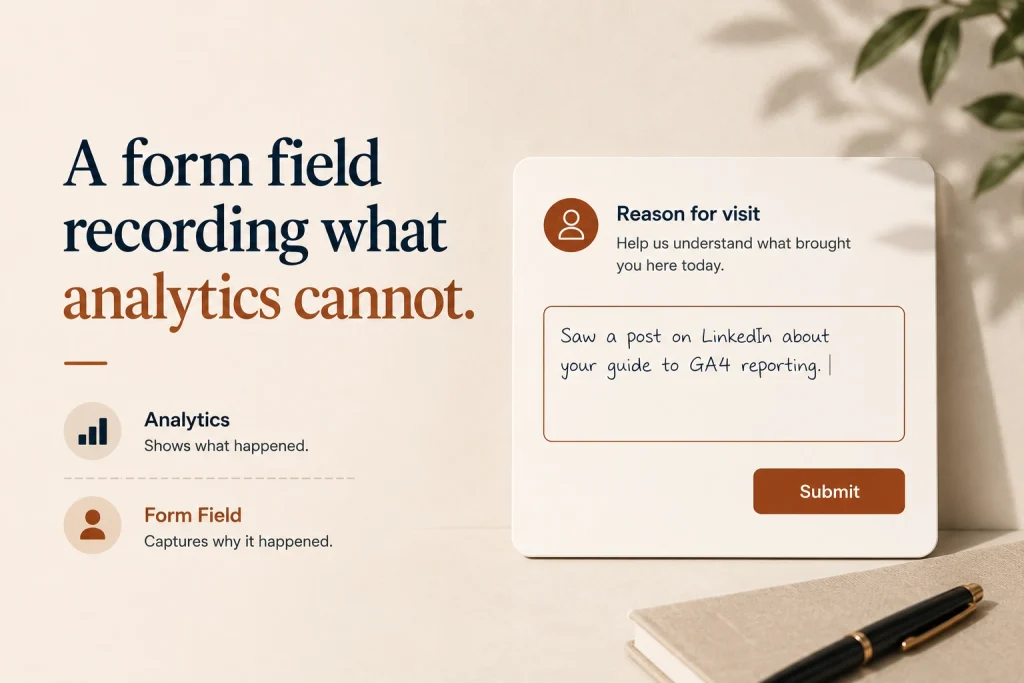
And the enquiry form’s “how did you hear about us” field has quietly become the best instrument you have. It is the only place in your entire measurement stack where somebody can write “ChatGPT recommended you”, and people do write it.
That field has always been useful. It is now the single most valuable thing on your form, because it captures the one journey no analytics platform can see. If yours is a dropdown, add a free-text option. If you do not have one, add one this week.
Read it as a sample rather than a count. Not everybody answers, and the ones who do skew toward the talkative. It is still the only direct evidence available.
The vendor question that exposes a weak platform
A market of AI visibility platforms now exists. They query the systems repeatedly and report how often you appear against competitors.
The capability is real and for some businesses it is worth paying for — a brand tracking many products across several markets cannot do that by hand.
But there is one property of these systems that decides whether a platform’s numbers mean anything, and it is rarely discussed.
These systems are non-deterministic. The same question, asked twice, can return different sources.
Which means a single figure — “you appear in 34 per cent of queries” — is meaningless without knowing how many runs it came from and how much the answer moved between them. A platform sampling once per query per week is reporting a coin flip with a decimal point attached.
So ask five questions before buying.
What is the query set, and who chose it. How many runs per query per period. Signed in or signed out. Which geography, and can it be set to India. And what is the run-to-run variance, reported alongside the figure.
A vendor that answers the last one clearly is doing real work. A vendor that treats it as a strange question is selling a dashboard.
What a report should actually say
For most Indian businesses, monthly, one page.
The proportion of Search Console impressions coming through generative surfaces, and its direction over three months. Assistant referral sessions, as a raw number. The manual check for the non-Google systems — how many of your fifteen questions named you, and who was named instead. And anything the enquiry form field surfaced.
Then a sentence saying what changed and what you are doing about it.
Label the whole thing reconnaissance rather than performance. It tells you where you stand relative to competitors and it does not yet connect to revenue, and pretending otherwise sets up a conversation that will go badly in six months.
What we cannot tell you
We cannot tell you what proportion of AI exposure converts to anything, because the largest surface produces no traceable click and the assistants report nothing.
We cannot tell you a benchmark for appearing in a given share of queries. No credible one exists, and the vendor figures are drawn from query sets the vendors chose.
And we cannot promise this article stays accurate. Google shipped a reporting change in June that made a claim in our own pillar wrong within weeks. We would expect at least one more change of that size in the next year, and we would rather set that expectation than be caught by it twice.
Final thoughts
Open the generative AI reports in Search Console today. Do not add them to your organic totals. Build the assistant referral segment. Add a free-text option to your enquiry form.
Then keep running the fifteen questions by hand for everything Google does not report, which is most of it.
If you want the three layers set up properly and reported in one page a month, you can reach out to us on whatsapp at +91 7738844851 .
More in Blog
Keep reading
All articles →


Ready to talk about your growth?
Tell us what's stuck and we'll tell you what we'd do first. Free, 30 minutes, no pitch.