
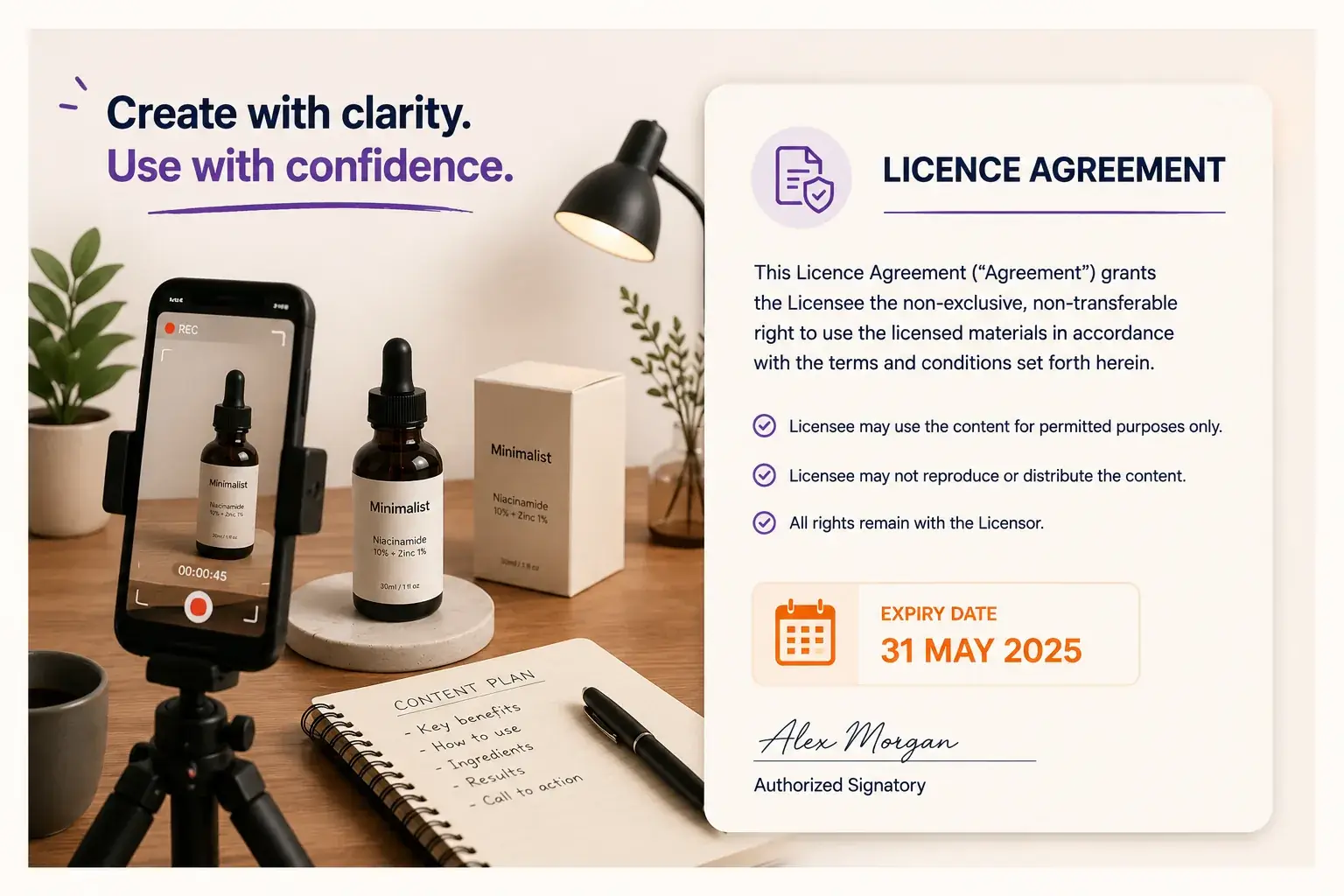
The standard starter package on every Indian creator marketplace is three videos for somewhere between five and fifteen thousand rupees. Organic usage.
Organic usage means you may post it. It does not mean you may advertise with it.
So the most commonly bought UGC package in India is one you are not permitted to use for the only reason you bought it.
The short answer
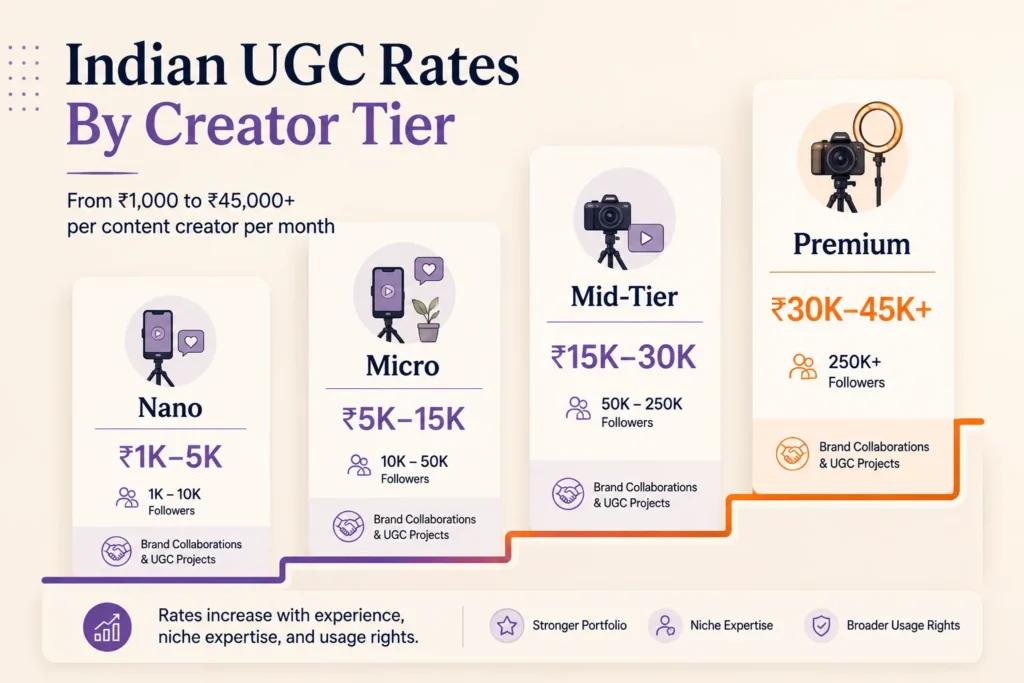
UGC creators in India charge roughly ₹1,000 to ₹45,000 per video depending on experience, with ad-ready creative usually landing between ₹5,000 and ₹15,000. Those prices almost always cover organic posting only. Paid advertising rights add 20 to 75 percent, whitelisting costs more, and perpetual rights run to double the base fee or beyond. Buy the rights before you buy the video — because a 30 or 60 day licence means the ad that finally works is the one you will be forced to switch off.
Key takeaways
- Indian rates run ₹1,000 to ₹45,000+ per video. A 45x spread on the same nominal deliverable.
- The spread tracks direct-response understanding, not production quality. Better cameras do not sell more.
- Organic usage is the default. Paid rights cost extra and nobody leads with that.
- Short licences punish success. Your winner is the asset with the most spend behind it and the least time left.
- Buy perpetual rights on anything you intend to scale. It is the cheapest insurance in creative.
- You are not buying authenticity. You are buying a format — one person, one phone, one real room.
What the 45x spread actually buys
A beginner charges ₹1,500. A specialist charges ₹45,000. Both deliver a vertical video of a person talking about your product.
Brands assume the gap is production quality. Lighting, camera, editing. It is not, or not mostly.
What the expensive creator is actually selling is an understanding of direct response. They know the first frame has to move. They know the claim goes in the first sentence because nobody hears the second. They will shoot four different openings without being asked. They have watched enough of their own content run as ads to know which of their instincts are wrong.
The cheap creator is selling footage. Often lovely footage. Frequently unusable, because the opening is a slow pan and the product appears at second nine.
Which produces an uncomfortable rule. A ₹3,000 creator who has run ads beats a ₹20,000 creator who has not, every time. And you cannot tell them apart from a portfolio, because portfolios are edited to look good rather than to perform.
How to actually tell. Ask what their content did as an ad. Not “have you worked with brands” — what the hook rate was, whether it scaled, why it stopped. A creator who cannot answer has never seen their work in an ad account, whatever the rate card says.
The rates, since you came for them
By experience. Beginner ₹1,000–5,000. Intermediate ₹5,000–15,000. Experienced ₹15,000–45,000. Premium and niche specialists ₹45,000 and up.
By content type. Unboxing ₹1,000–5,000. Testimonial ₹1,500–5,000. Product review ₹1,500–8,000. Lifestyle ₹3,000–12,000+. Ad-specific creative ₹5,000–15,000+.
Bundles. Three videos with basic editing, ₹5,000–15,000. Five videos with multiple hooks and ad variations, ₹15,000–40,000. Ten or more with ongoing production, ₹40,000 to ₹1,50,000+.
Read those numbers with one eye open. Every source publishing them is a marketplace or agency that takes a margin on the transaction. They are the going rate, and they are also a quoted price from an interested party.
The Rights Clock
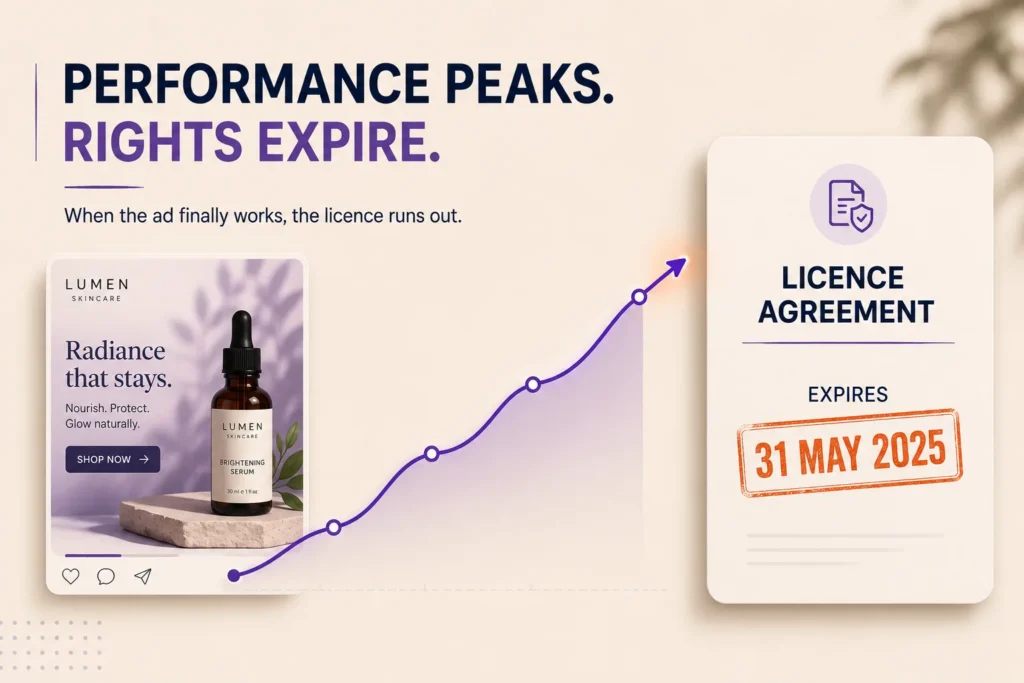
You are buying permission to run something for a period. The period matters more than the footage — because the asset you most need to keep is always the one that has been running longest.
Here is the sequence that catches people.
You buy five videos with a 60-day paid licence. Four do nothing. One works. You scale it, it carries the account for six weeks, and then the licence expires.
Now you have a choice. Pay a renewal fee to a creator who knows exactly how well the ad is doing. Or switch off your best-performing asset and go back to the four that failed.
That is not a hypothetical. It is the normal outcome of a short licence meeting a successful ad, and it happens because rights are negotiated when the content is worthless — before anyone knows which one wins.
What the rights tiers cost
Organic social. Usually included in the base fee. You may post it on your own channels. You may not run it as an ad.
Paid advertising, 30 to 90 days. Typically +20% to +75% on the base fee. The default upgrade, and the one that creates the expiry problem.
Whitelisting or Partnership Ads — running the ad from the creator’s own handle — costs more again and is a different arrangement entirely. Running creator content as paid ads covers the mechanics.
Perpetual rights. +100% or more. Which sounds expensive on a ₹8,000 video and is not: ₹8,000 more to never have this conversation again, on an asset that might carry your account for a year.
The rule
Negotiate perpetual rights up front, before anyone knows what works. At the point of purchase you are a brand buying five unproven videos. At renewal you are a brand begging for the one that prints money. Those are very different negotiating positions, and the price difference between them is far more than the uplift.
If the budget will not stretch to perpetual on everything, buy it on the two concepts you believe in most and take short licences on the rest.
What you are actually buying
The premise of UGC is that it does not look like an ad. Then you put it in an ad account, where it appears with a Sponsored label above it.
So the authenticity is mostly gone before anyone watches. What survives is the format: one person, one phone, one room that has not been art-directed. That format works — not because viewers are fooled, but because it looks like the rest of the feed and it carries information faster than a produced spot.
Which reframes the purchase honestly. You are buying a production style with a low cost per asset and high native fit. Not truth. Not trust. A style.
And that matters practically, because it means the usual instincts are wrong. Do not brief a creator to be more authentic. Brief them to be clearer, faster and more specific. The format is already doing the authenticity work.
Sourcing without wasting a month
Start with your own customers. The cheapest and most convincing UGC in India is a real customer with a phone, paid ₹2,000 and a clear brief. They know the product, they use the actual words your buyers use, and nobody has to fake familiarity.
Then marketplaces, which are fast and expensive relative to what they deliver, and useful for volume.
Then direct outreach to small creators in your category. Under 20,000 followers, posting consistently, replying to comments. They are usually cheaper, more responsive, and more willing to reshoot.
A creator is not an influencer. You are paying for content you will run, not for a post to their audience — if you are buying reach rather than footage, what influencers actually cost in India is the relevant pricing.
Test with volume, not with commitment. Five creators at ₹3,000 tells you more than one at ₹15,000, and it tells you who to work with again.
The brief is the whole job
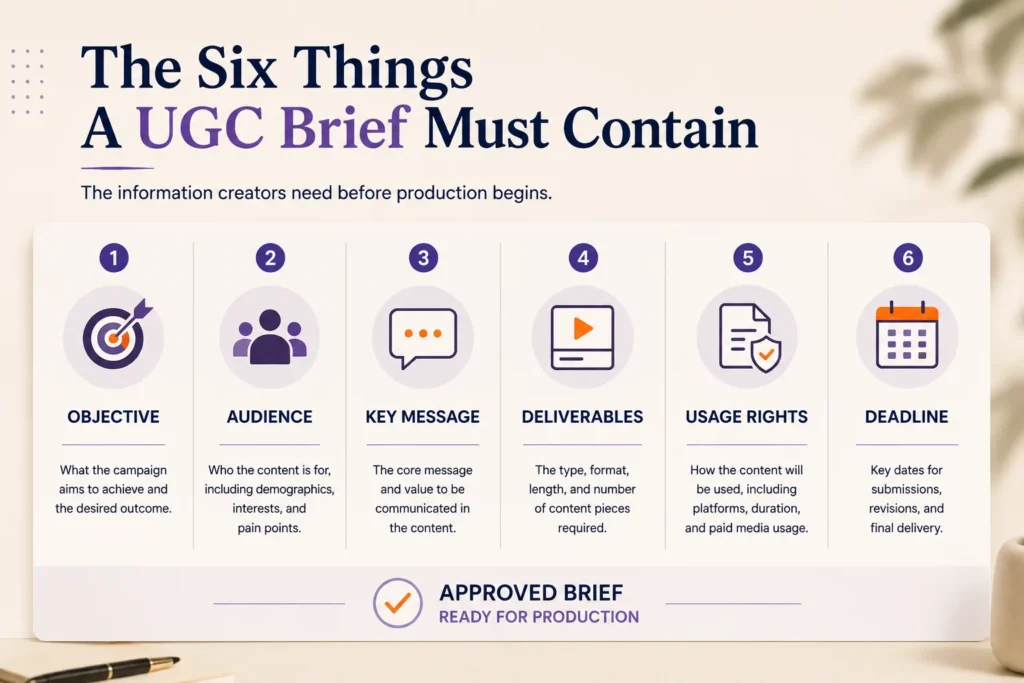
The brief decides more of the outcome than the creator does, and most briefs are a product description with a deadline.
Six things it must contain.
The one argument. What this video is trying to make someone believe. One sentence. If it has three, you have briefed three videos.
The opening. Say explicitly that the first second must contain motion and the claim must land inside three seconds — what actually moves the first three seconds covers why.
Sound-off comprehension. State that the video must make sense muted, because most of it will be watched that way.
Three different openings, same body. Ask for them up front. It costs the creator ten minutes and gives you three ads instead of one.
The words your customers use. Send actual review text and enquiry messages. Creators invent language when you do not supply it, and invented language does not convert.
The rights, in writing. Duration, platforms, whether paid usage is included, and what renewal costs. Agree it before the shoot, not after.
Disclosure, briefly and carefully
Content made by a creator and run from your own ad account is a different thing from a creator posting a paid endorsement to their followers, and the disclosure obligations differ.
Both ASCI’s digital advertising guidelines and Meta’s own branded content policies apply, and the details change. Get this checked rather than inferred — it is one of the few areas in performance marketing where being wrong is a regulatory problem rather than an expensive one.
Mistakes that cost real money
Buying organic-only rights and running ads anyway. Common, and it is a contract breach waiting to be noticed by a creator who has since seen your ad.
Negotiating renewal after the ad works. You have told the other side exactly how much you need it.
Judging creators on portfolio. Portfolios show taste. Ad accounts show performance.
Briefing “be authentic”. Meaningless as an instruction and it produces rambling.
One video per creator. Ask for three openings from the same shoot and triple the output for almost nothing.
Paying premium rates for production polish. The polish is frequently what makes it stop looking like UGC.
Skipping the customer route entirely. Your happiest customer with a phone often outperforms the ₹20,000 professional, and they cost ₹2,000.
When UGC is the wrong buy
When the product needs demonstration you cannot fake. Machinery, software interfaces, anything requiring access or expertise.
When the audience buys on credibility rather than relatability. Enterprise B2B does not respond to someone in a bedroom.
When you cannot brief properly. Money spent on creators without a brief buys footage, not ads.
When the account cannot run the volume. Producing twelve videos for an account that can only serve three concepts is inventory — how to plan a quarter of creative production covers sizing.
When the offer is the problem. No amount of relatability fixes an uncompetitive proposition.
Before you commission anything
☐ Rights duration agreed in writing, before the shoot
☐ Paid advertising usage confirmed as included, not assumed
☐ Perpetual rights priced on at least your two strongest concepts
☐ Renewal cost agreed at purchase, not at expiry
☐ Whitelisting handled separately if you intend to run from creator handles
☐ Creator asked what their content did as an ad, not who they have worked with
☐ Own customers approached before marketplaces
☐ One argument per video, written as a single sentence
☐ Three different openings requested from every shoot
☐ Sound-off comprehension stated in the brief
☐ Real customer language supplied rather than left to invention
☐ Disclosure obligations checked against ASCI and Meta policy
Questions we get asked
How much do UGC creators charge in India?
₹1,000 to ₹45,000+ per video by experience. Ad-ready creative usually sits at ₹5,000 to ₹15,000. Add 20 to 75 percent if you want to run it as an ad, which you do.
What are usage rights in UGC?
Permission to use the content, for a stated purpose and period. Organic posting is usually included; paid advertising almost never is. This is the single most expensive detail in the transaction.
Is UGC better than professional ads?
Often, on Meta, for considered consumer purchases — because it matches the feed and delivers information quickly. Not universally, and not for products that need demonstrating properly.
How do you find UGC creators in India?
Your own customers first, then small category creators by direct outreach, then marketplaces for volume. In that order, because that is also cheapest to most expensive.
What should a UGC brief include?
One argument, an opening instruction, sound-off comprehension, three hook variations, your customers’ real language, and the rights terms.
Can I use a customer’s Instagram post as an ad?
Not without written permission covering paid usage. A comment saying “sure, go ahead” is not a licence, and screenshots of positive reviews are a separate rights question again.
The one thing to change on Monday
Look at whatever creator content you are currently running and find the licence end date.
If you cannot find one, you either have perpetual rights or you have a problem, and it is worth knowing which before somebody else works it out.
Then, on the next thing you commission, pay the extra for perpetual usage before anybody knows which video wins. It is a small amount of money spent at the only moment you hold the better hand.
If you want your creator contracts reviewed and a briefing template built around what actually performs in Indian accounts, you can reach out to us on whatsapp at +91 7738844851 .
More in Blog
Keep reading
All articles →
Ready to talk about your growth?
Tell us what's stuck and we'll tell you what we'd do first. Free, 30 minutes, no pitch.