
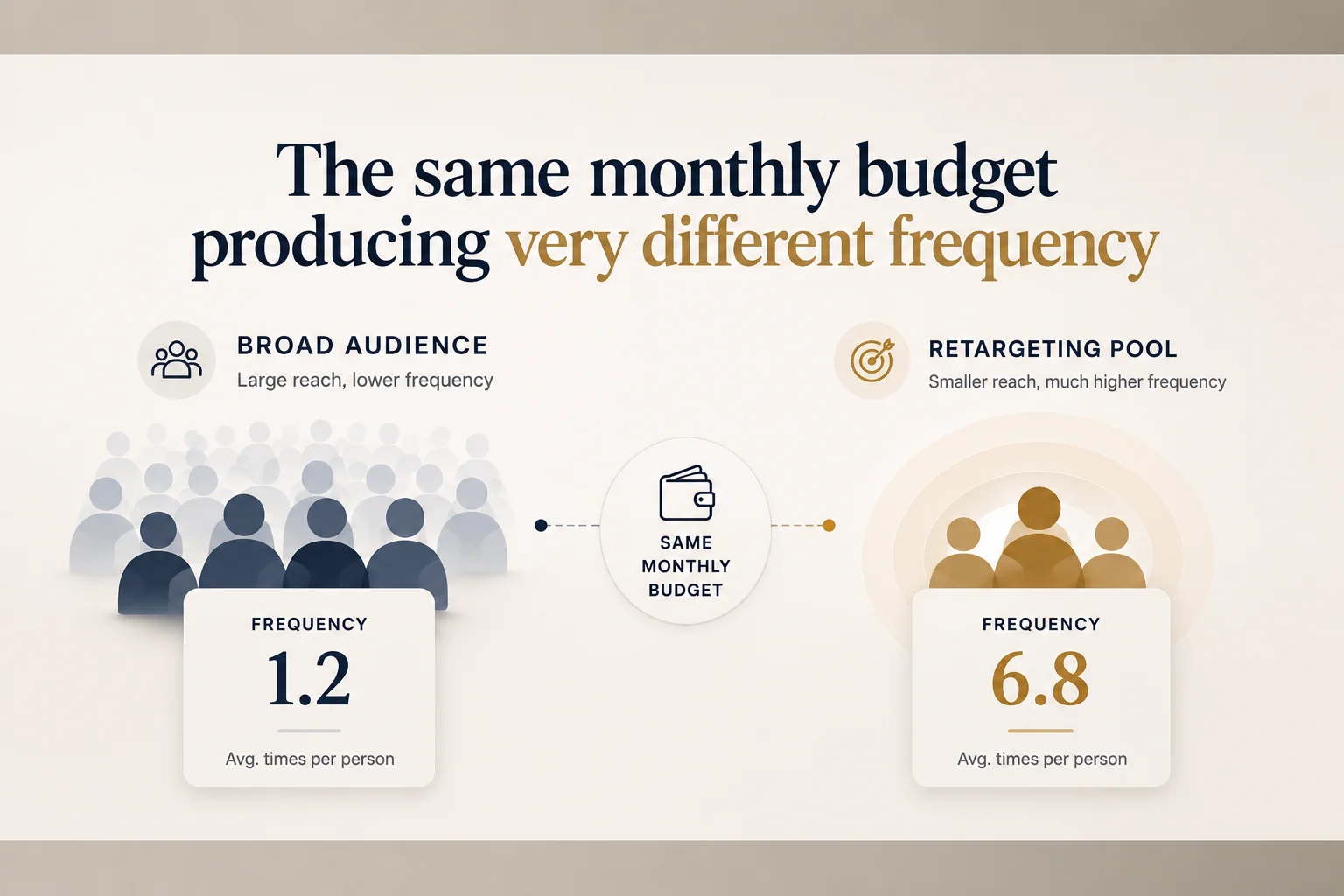
Performance has slipped and somebody has said the creative is tired. It might be. It might also be that your ads have barely been seen twice by anyone.
The difference is a calculation, and almost nobody does it before commissioning a new shoot.
The short answer
Creative fatigue is performance decay caused by the same people seeing the same ad too often. How fast it arrives depends on spend divided by audience size — the number of impressions you buy against the number of people available to receive them. At ₹200 CPM, a ₹2 lakh monthly budget on a two-crore broad audience would take years to reach a frequency that matters. The same budget against a 1.5 lakh retargeting pool passes it inside a month. Most Indian accounts contain both situations at once, which is why a single refresh calendar is the wrong instrument.
Key takeaways
- Fatigue speed is roughly spend ÷ audience size. Everyone watches the spend and ignores the audience.
- Broad audiences at Indian SME budgets fatigue very slowly. ₹2 lakh a month against two crore people is not a frequency problem.
- Retargeting pools fatigue almost immediately. The same ₹2 lakh against 1.5 lakh people passes frequency 6 in a month.
- Meta’s own fatigue status is a lagging signal. It fires when cost per result reaches roughly twice your past ads — after the damage.
- Refreshing creative that is not fatigued costs twice — the production, and the learning you reset.
- Repetition helps before it hurts. A meta-analysis of 3,406 observations found effectiveness rises with repetition up to a threshold before it declines.
What fatigue actually is
The same people see the same ad. Novelty falls, they scroll past something they have already filed mentally, engagement drops — and Meta’s auction responds by charging more to reach them, because falling engagement lowers effective quality.
Which is why it compounds. Click-through rate falls and cost per thousand impressions rises at the same time, so cost per result can double while click-through has only fallen a quarter.
Repetition is not the enemy, though. Schmidt and Eisend’s meta-analysis in the Journal of Advertising, covering 3,406 observations, found that repeated exposure improves effectiveness up to a threshold and only then produces diminishing and eventually negative returns. Some repetition is how advertising works. The question is where your threshold sits.
The Fatigue Denominator
Fatigue speed is impressions divided by the people available to receive them. The industry publishes refresh calendars based on the numerator alone. Compute the denominator and the calendar usually turns out to be wrong for your account in one direction or the other.
Work it in two steps.
Step one — how many impressions you buy. Monthly spend divided by CPM, times a thousand. At ₹200 CPM, ₹2 lakh buys roughly one million impressions a month. What drives that CPM is a separate subject — what drives your CPM in India covers it.
Step two — how many people are available. The audience size Meta reports for that ad set.
Divide, and you have the average number of times each available person could be shown your ad.
What that produces at real Indian budgets
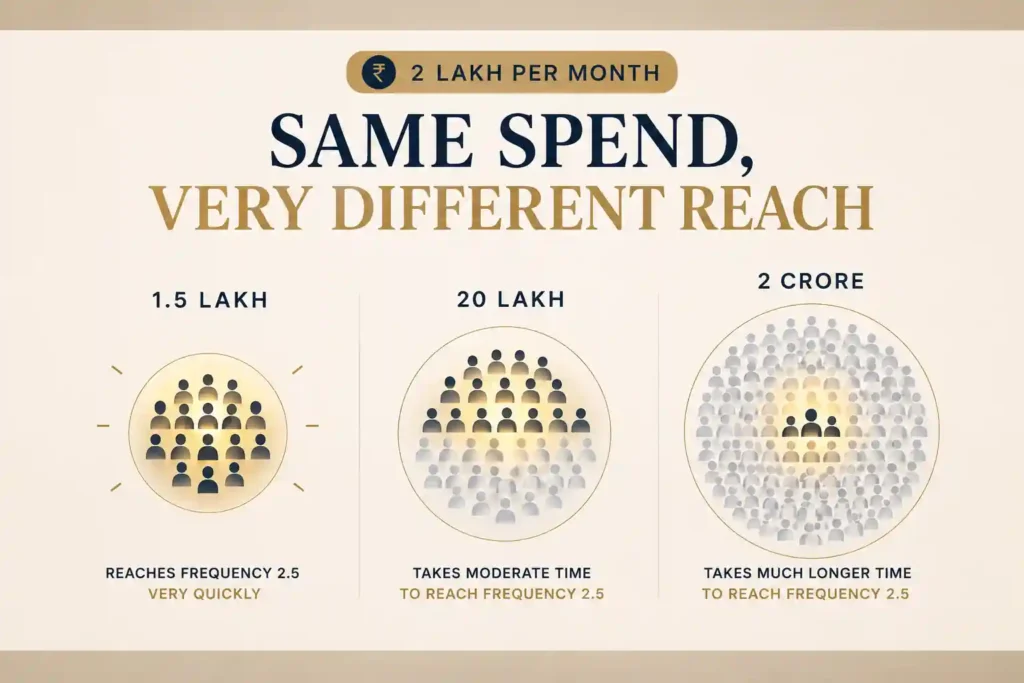
All at ₹200 CPM and ₹2 lakh a month — roughly a million impressions.
Against a broad audience of two crore. Reaching an average frequency of 2.5 would take about fifty months. Fatigue is not your problem and will not be this year.
Against an interest-targeted audience of twenty lakh. About five months to the same point. Refreshing every three weeks means replacing creative roughly seven times before frequency becomes an issue at all.
Against a retargeting pool of one and a half lakh. Frequency passes 6.6 within a single month. You are deep into fatigue territory in under three weeks.
Same budget, same creative, same month. The advice that fits one of those audiences actively harms the other two.
The honest caveat
Meta does not spread impressions evenly across an audience. It concentrates on the people most likely to respond, so real frequency against the responsive core is higher than these figures — sometimes much higher.
Treat the calculation as a floor rather than a forecast. If the arithmetic says fifty months, you are certainly not fatigued. If it says five, check the actual reported frequency before deciding. If it says three weeks, believe it.
Case one: the denominator is large
Broad targeting, a normal SME budget, frequency reported under 2. The creative is almost certainly not the problem, and replacing it will cost you production money and reset the learning phase for nothing.
So look at what usually is the problem.
The offer. Nothing decays faster than a promise the market has stopped finding attractive, and it looks exactly like fatigue on a dashboard.
Seasonality and auction pressure. Festival periods, competitor launches and quarter-end budget dumping all raise CPM without anybody’s creative changing.
Tracking. A broken pixel or a consent change reduces recorded conversions while actual performance is unchanged.
The landing page. Stable click-through with falling conversions is a page problem, not a creative one.
Audience overlap. Several ad sets bidding for the same people raises your own costs — the same accounting problem described in why platforms count the same sale twice, one level down.
What to do instead of refreshing. Check reported frequency directly in Ads Manager, rule out the five items above, and only then commission production.
Case two: the denominator is small
Retargeting pools, narrow firmographic targeting, single-city campaigns with a specific interest layer. Here fatigue is real, fast and expensive, and the standard playbook applies properly.
Detect it early
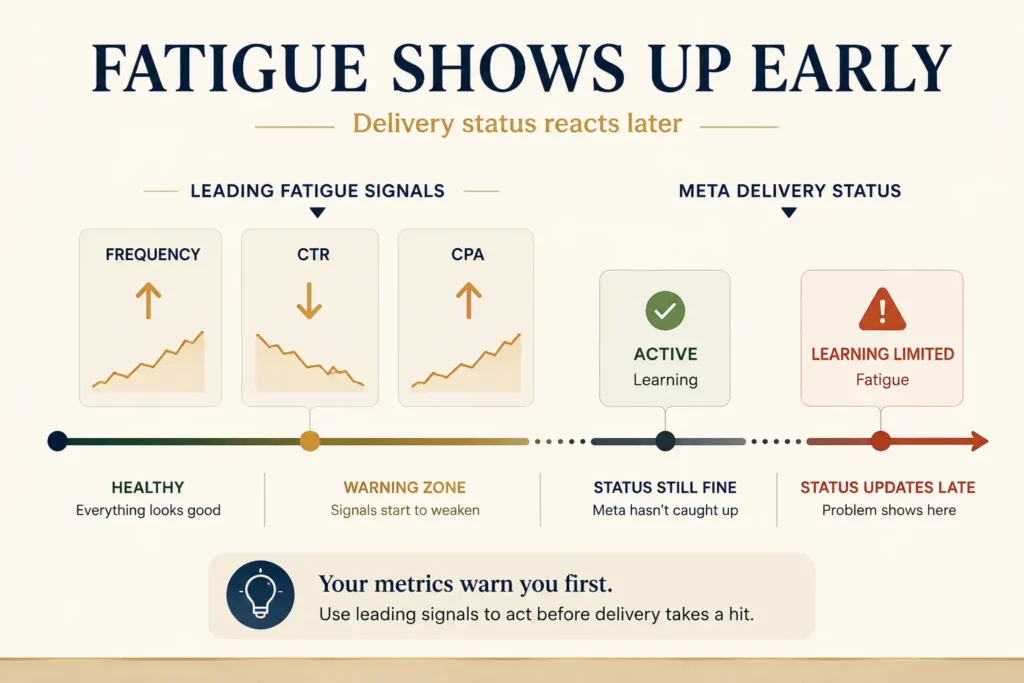
Meta assigns a Creative fatigue delivery status when an ad’s cost per result reaches roughly twice that of your past ads for the same optimisation event, and a Creative limited status at a smaller increase. Both are useful — and both are lagging. By the time the label appears you have already paid for the decline.
The leading signals fire a week or two earlier.
Frequency, on a seven-day window. For prospecting, performance risk rises noticeably past roughly 2 to 2.5, and Meta’s own analytics research places the typical onset of decline at frequency 3 to 4 for direct response. Retargeting audiences tolerate considerably more — practitioner bands sit around 5 to 8 — because the audience already knows you.
Click-through rate against its own fourteen-day baseline. A sustained fall of 20 to 25% over three days or more is the most reliable single early warning. Use a three-day moving average; single days are noise.
Cost per thousand impressions rising 15 to 20% with no auction event to explain it, while engagement falls at the same time.
Hook rate on video — the share of impressions reaching three seconds — measured against that creative’s own baseline. It decays first, because saturated viewers scroll on sight.
Require two signals before acting. One metric moving is a hypothesis. Exposure and reaction moving together is a diagnosis.
Replace by overlap, not by pausing
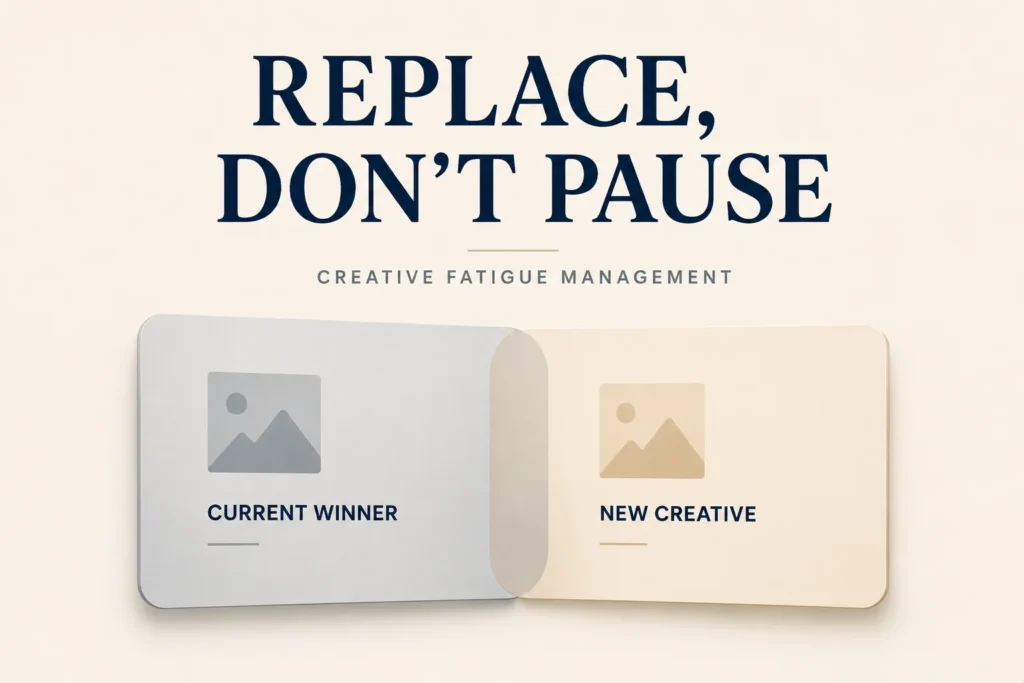
Do not switch a fatigued winner off. That forces the whole budget into unproven ads still in learning, and you get a performance vacuum on top of the fatigue.
Run the substitution. Launch two to four new options alongside the fatigued ad while it still carries the ad set. Let them clear learning. Compare on post-learning data rather than day-one numbers. Then shift spend gradually as a challenger sustains equal or better performance.
Try cheap iterations before net-new concepts. A new opening frame, a different hook, a format swap. Reserve genuinely new concepts for when iterations stop working — how many to have in play at once is covered at how many ad creatives to test.
Use audience levers too. Broadening targeting enlarges the denominator, which is a fatigue fix that costs nothing to produce. Capping frequency where the campaign type allows it does the same.
Mistakes that cost money in both directions
Refreshing on a calendar without checking frequency. The commonest and most expensive error. You pay for production and reset learning to solve a problem you did not have.
Ignoring the retargeting pool because the broad audience looks fine. One account, two situations. Account-level frequency averages hide it.
Waiting for Meta’s fatigue status. It is confirmation, not an alarm.
Pausing the fatigued winner. Removes the only stable performer and pushes spend into learning.
Reading single-day metric swings as fatigue. Use moving averages and require two signals.
Fixing fatigue with a new colourway. If the argument is exhausted, a fresh coat of paint on the same argument fatigues immediately.
Treating a rising CPM as automatic proof. Auction conditions move for reasons that have nothing to do with your ads.
When to refresh anyway
When the creative is more than a quarter old and untouched, regardless of frequency. Cultural context moves, and so do competitors.
Before a period you need to perform — festival season, a launch. Do not enter it on ads already at frequency 3.
When the message is factually out of date. Old pricing, expired offers, discontinued products.
When you are about to increase spend materially. More budget against the same audience raises frequency proportionally, so refresh before the increase rather than after the decline.
When you have never tested a genuinely different argument. Not fatigue, but the same production budget spent better.
The fatigue check, in order
☐ Reported seven-day frequency read per ad set, not at account level
☐ Audience size recorded for each ad set
☐ Monthly impressions calculated — spend ÷ CPM × 1,000
☐ Impressions divided by audience size to get the exposure floor
☐ Retargeting and narrow ad sets checked separately from broad ones
☐ Click-through rate compared against its own 14-day baseline on a 3-day moving average
☐ CPM trend checked against seasonality and known auction events
☐ Hook rate checked separately on video
☐ Two signals confirmed before any decision
☐ Offer, tracking and landing page ruled out before blaming creative
☐ Replacement run as an overlap, never as a pause
☐ Audience broadening considered as a fatigue fix before production is commissioned
Questions we get asked
What is creative fatigue?
Performance decay from repeated exposure. Engagement falls, CPM rises, and cost per result compounds upward faster than either moves alone.
At what frequency do Meta ads fatigue?
There is no universal number. For prospecting, risk rises past roughly 2 to 2.5 on a seven-day window, with Meta’s research placing typical decline onset at 3 to 4. Retargeting tolerates roughly 5 to 8. Read frequency alongside click-through rate — 3.5 with stable engagement is less urgent than 2.8 with engagement down a quarter.
How often should you refresh Meta ad creative?
As often as your exposure arithmetic requires, which for a broad Indian audience at SME spend may be considerably less often than the published advice. Compute impressions against audience size rather than working to a calendar.
How do you know if your ad is fatigued?
Two signals moving together — one exposure signal like frequency, one reaction signal like click-through or hook rate — measured against baselines rather than against other ads.
Should you pause a fatigued ad?
Not abruptly. Overlap the replacement, let it clear learning, then move spend across.
Does running the same ad longer damage the account?
Only through the fatigue mechanism itself. There is no separate penalty for age, and restarting ads unnecessarily does real harm by resetting learning.
Before you commission anything
Open Ads Manager and note two numbers for each ad set: reported seven-day frequency, and audience size.
If frequency is under two on a broad audience, your creative is not the problem and a new shoot will not fix whatever is. If it is over three on a small pool, you are already paying for the decline and should start the substitution this week.
Most accounts we look at contain both, which is the actual answer to how often you should refresh: separately, per ad set, based on exposure rather than on the calendar.
If you want that calculation run across your account, with an honest answer on whether production is even the right spend, book a consultation.
More in Blog
Keep reading
All articles →

Ready to talk about your growth?
Tell us what's stuck and we'll tell you what we'd do first. Free, 30 minutes, no pitch.