
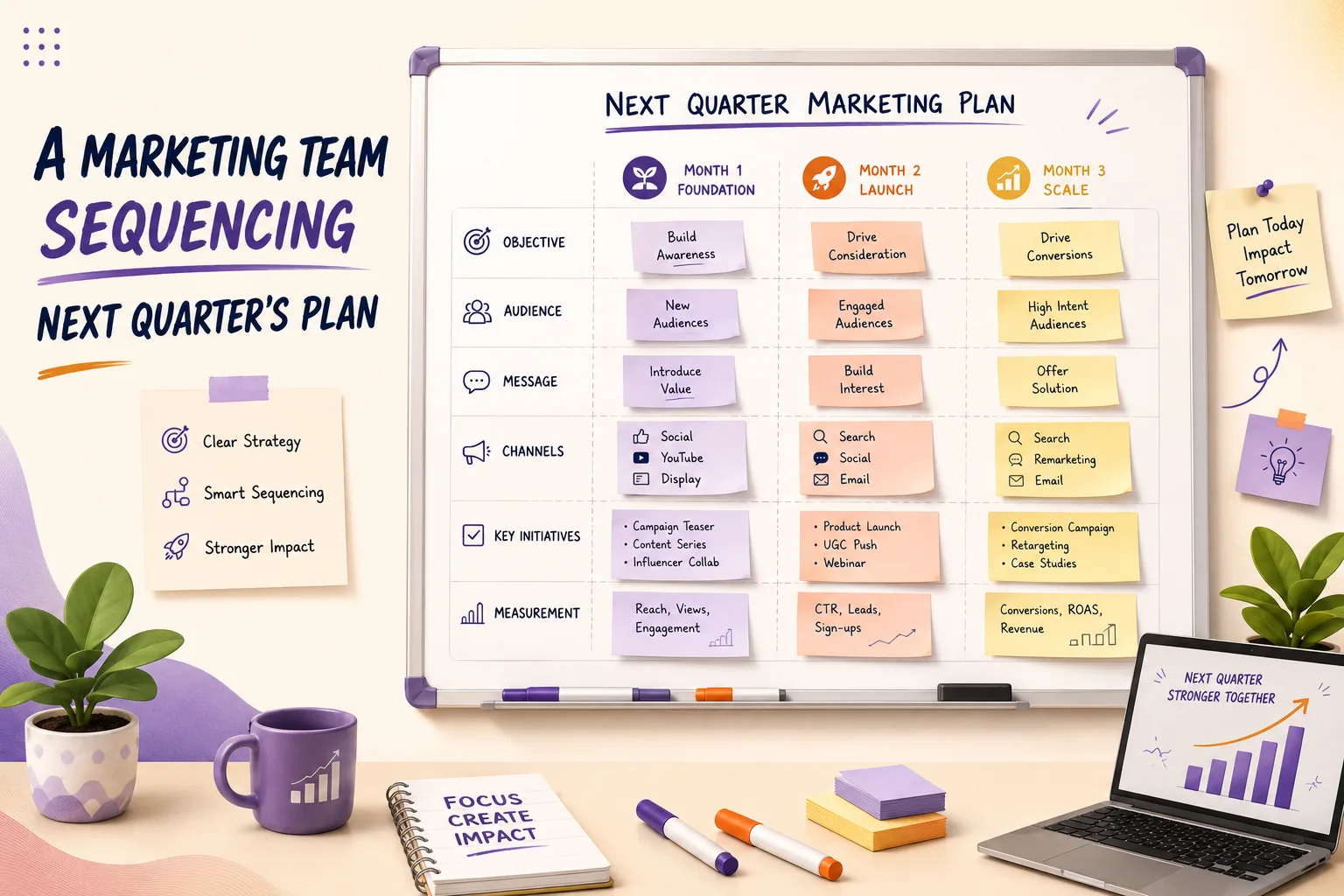
You have read the list. SEO, content, LinkedIn, paid search, email, webinars, account-based marketing, events, referrals. Every guide gives you the same nine, presented as a menu.
The list is not wrong. The framing is.
Presenting these as options you choose between is why a ₹30 crore manufacturer in Pune ends up buying account-based marketing before anyone has written down who the ideal customer is. The tactic was sophisticated. The prerequisite was missing. Six months and a retainer later, the conclusion is that ABM does not work in India.
These strategies have dependencies. Run them in the wrong order and you are guessing with money.
The short answer
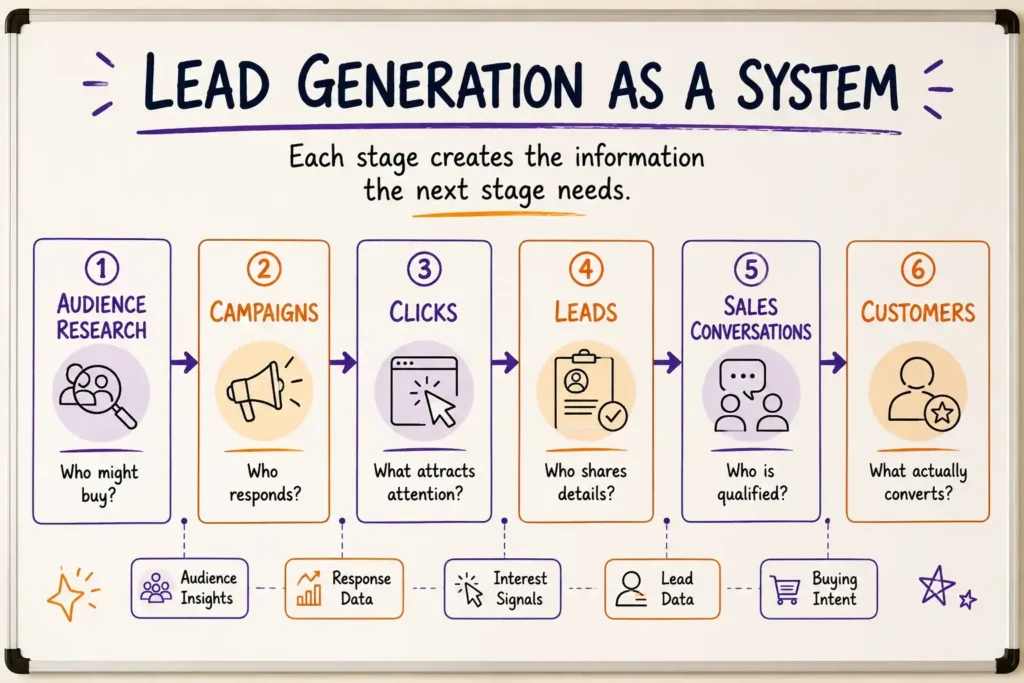
The strategies that work in Indian B2B are the same ones that work everywhere — search, content, outbound, events, referrals. What decides the outcome is sequence. Each stage produces information the next stage needs: harvesting existing demand tells you which messages convert, which tells you what content to create, which tells you which accounts to target. Companies that start at the sophisticated end skip the learning and pay for it twice.
Key takeaways
- Buyers do most of the work without you. Gartner’s research puts the share of buying time spent with potential suppliers at just 17%, with six to ten stakeholders each gathering information independently. Being findable and legible beats being clever.
- Start where demand already exists. India has 7.83 crore registered enterprises, and IndiaMART alone logged 27 million business enquiries in a single quarter. Harvesting is cheaper than creating, and it teaches you things creating cannot.
- The stage nobody budgets for is the one after the click. Harvard Business Review’s audit of 2,241 companies found 23% never replied to a web enquiry and the average reply took 42 hours.
- ABM is the most over-sold tactic in Indian B2B. It is stage five of six, and most companies buying it have not completed stage zero.
- You cannot skip forward, but you can skip sideways. Some businesses genuinely do not need stages three and four. Knowing which is the point of the sequence.
Why order matters more than the list
Start with what your buyer is actually doing while you plan campaigns.
Gartner’s research on B2B buying found that customers spend roughly 17% of their total buying time meeting with potential suppliers. Spread that across three or four vendors under consideration and any single supplier gets somewhere near 5% of the buyer’s attention. The remaining 83% is spent researching independently — reading, comparing, asking peers, forming a view before anyone from your company is in the room.
Gartner also found that six to ten stakeholders typically shape a single purchase, each gathering several pieces of information on their own before a supplier meeting happens.
Two caveats before that gets applied wholesale to India. This research skews enterprise, and in Indian mid-market B2B the decision frequently rests with a promoter or owner with an advisory circle rather than a formal committee of eight. The direction still holds — buyers arrive informed and late — but the machinery built for a ten-person committee is usually overkill for a ₹20 crore business.
Brent Adamson, then a distinguished vice president in Gartner’s sales practice, described the consequence sharply: customers are “reaching an information saturation point, where each new idea reduces the value derived from information and turns sound decision making into ‘best guesses’ or ‘gut feeling’ choices.”
That is the environment your strategies operate in. A buyer drowning in undifferentiated information, deciding mostly without you, and reaching you late.
Which changes what to do first. Not the cleverest tactic. The one that makes you findable and legible to someone already looking — and then, in order, the ones that widen who is looking at all.
The Build Order
Six stages. Each produces something the next one needs.
The rule: you can pause at any stage, but you cannot skip one. A stage you skip becomes a guess you pay for later.
Stage zero — the prerequisites
Nothing here costs media budget, and skipping it is the most expensive decision in the sequence.
Write down who buys. Not “SMEs in manufacturing”. Company size, role of the person who signs, the trigger that makes them look, and the three alternatives they consider. If you cannot name the trigger, you do not yet know your buyer.
Write down what they ask. Get the ten questions your sales team hears most often, in the buyer’s own words. This single document becomes your keyword list, your content plan, your FAQ and your objection handling. Most companies never make it.
Decide where enquiries land, and who owns them. One place. One named owner. A stated response window.
Define “qualified” in one sentence. Written down, agreed by sales, before you buy a single lead. Without it, month two of any agency relationship becomes an argument about whether a lead counted.
You will know stage zero is done when your sales head and your marketing head give the same answer to “who is our best customer and why do they buy”.
Stage one — harvest what already exists
Now spend, but only where buyers are already looking.
Search advertising on the terms people use when they know what they need. Service pages and city-plus-service pages built for those same terms. Trade platforms, which Indian B2B content routinely ignores despite IndiaMART reporting 27 million unique business enquiries in the fourth quarter of FY26 alone across 8.7 million supplier storefronts. And referrals, which almost nobody engineers deliberately even though they convert better than anything else you run.
This stage is cheap, fast and diagnostic. Inside six weeks you learn which messages get clicked, which get enquiries, and whether anyone is looking for you at all. That last answer is worth the spend on its own.
What it produces for the next stage: real search terms, real objections, and a conversion rate you can improve.
Stage two — convert what you already get
Before buying more traffic, fix what happens to the traffic you have.
A page converting at 1.5% that could convert at 3% doubles your leads without another rupee of media. This is nearly always the cheapest available gain and nearly always attempted last, because media spend feels like action and conversion work feels like admin.
Two parts, and the second is the one everyone forgets.
The page itself — speed on a mid-range Android, proof a buyer believes, a form short enough to finish, and a way to reach you that suits how Indian buyers actually behave. Our 21-point landing page checklist for Indian pages covers this properly.
And the follow-up. Harvard Business Review’s audit of 2,241 companies found 37% responded to a web enquiry within an hour, 24% took more than a day, and 23% never responded at all. The average, among those that eventually replied, was 42 hours. Separate research from MIT’s Sloan School with InsideSales.com found the odds of qualifying a lead fall roughly 21-fold between a five-minute reply and a thirty-minute one.
No strategy in this article survives a 42-hour response time.
What it produces: a conversion rate worth scaling, and a sales team that trusts the leads.
Stage three — widen the harvest
Only now does more budget make sense, and only in specific directions.
More search terms, including the ones buyers use when they describe the problem rather than the product. More geographies. Adjacent categories you can credibly serve. Additional trade platforms and directories.
There is a limit to this, and it is measurable. Every category has a finite number of businesses actively searching in a given quarter, and once you hold most of that, additional spend raises cost per lead without raising lead count. We explain the capture ceiling and how to measure yours in detail — check yours before signing off a budget increase.
What it produces: the knowledge that you have exhausted existing demand, which is the only honest trigger for stage four.
Stage four — create demand
Everything so far harvests people already looking. This stage grows the number of people looking.
Founder-led visibility on LinkedIn, sustained over months rather than posted in bursts. Content that answers the questions from stage zero — how to specify the thing, what it should cost, what goes wrong, how to compare suppliers. Events and trade shows, still among the highest-quality sources in Indian manufacturing and industrial B2B, and still treated as a cost centre instead of a channel with a measurable cost per lead. Trade press and industry PR.
This stage pays back in quarters, not weeks, and that is not a flaw. It is the definition. India’s digital advertising market reached ₹71,621 crore in 2025 and became the country’s largest medium for the first time, per dentsu India — which means more money chasing the same in-market buyers every year, and a steadily better return on being the company buyers already know.
The discipline required: fund it separately and judge it on a different clock. A creation budget assessed on this month’s lead count gets cancelled in week six, every time.
What it produces: a larger pool for stage one to harvest next year, and enough market feedback to know which accounts are worth naming.
Stage five — target named accounts
Account-based marketing, targeted outbound, and the tactics most agencies pitch first.
These work. They work when you already know precisely who converts, what they respond to, and what your close rate looks like by segment — all of which are outputs of stages one through four. Run ABM before that and you are personalising a message you have not yet tested to accounts you have guessed at.
The commercial arrangement matters here more than anywhere else, because outbound agencies are usually paid per lead or per appointment, and each model shapes what they deliver. We cover how B2B agencies charge, and what that predicts separately.
What it produces: the highest-value pipeline available, and the reason to go back to stage zero with better information.
Where most Indian companies actually start
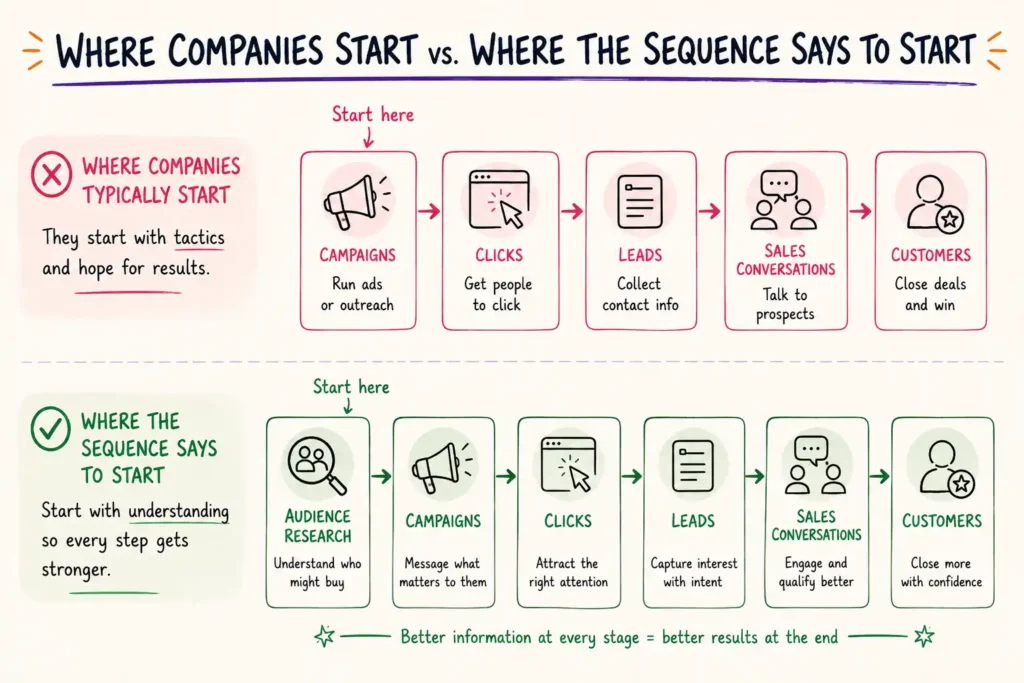
At stage five. Sometimes stage four.
The reason is not stupidity. It is that stages four and five are what agencies sell, what conference talks are about, and what sounds like a strategy when a founder asks the marketing head what the plan is. “We are running account-based marketing into 200 target accounts” is a better sentence in a board meeting than “we have written down what our buyers ask and fixed our response time.”
The second sentence describes work that will produce more pipeline.
Here is the diagnostic. Ask your team four questions and listen for hesitation.
Can two people independently describe our ideal customer and give the same answer? If not, you are at stage zero regardless of what you are currently spending on.
Do we know our search impression share on our commercial terms? If nobody knows, you have not finished stage one.
How long does it take us to respond to an enquiry, measured rather than estimated? If the answer is a guess, stage two is unfinished.
Which of our last five closed deals came from which channel? If sales and marketing give different answers, you are not ready for stage five.
Most companies we look at are running stage four or five spend on stage one or two foundations. The fix costs less than the campaign does.
Mistakes that cost real money
Buying the tactic that sounds most advanced. ABM, intent data and automation all work at the right stage and waste money at the wrong one.
Treating demand creation as a lead source. LinkedIn content does not have a bad month. It has a slow first two quarters, by design, and cancelling it in month two guarantees you never find out.
Adding budget before checking the ceiling. More spend against a pool you already dominate raises cost per lead and nothing else.
Skipping the qualification definition. Every dispute with every lead supplier traces back to this one sentence not existing.
Letting enquiries live in personal WhatsApp. Untracked, unowned, invisible above the salesperson, and increasingly where Indian B2B enquiry actually arrives.
Judging every channel on the same timeline. Search shows signal in weeks, content in quarters, reputation in years. One reporting cadence for all three produces bad decisions about the slow ones.
Building for a ten-person buying committee you do not have. Lead scoring, nurture tracks and multi-stakeholder content are enterprise machinery. In a business selling to promoters, they are overhead nobody maintains.
When to skip a stage honestly
The sequence has exceptions, and pretending otherwise would be its own kind of dishonesty.
Skip stage one if nobody is searching. Genuinely new categories have no existing demand to harvest. If your product solves a problem buyers have not named yet, start at stage four and accept the longer timeline. Verify this properly first — most companies who believe nobody searches for them have simply not looked at the right terms.
Skip stage three if your market is small and known. If there are 400 companies in India who could buy from you and you can name them, widening the harvest is meaningless. Go from stage two to stage five.
Skip stage four if your deal cycle is short and your category is well established. A business selling a known product to buyers who search for it by name can live at stages one to three for years, profitably.
Do not skip stage zero or stage two. These are the two that cost nothing and decide everything, and they are the two most often skipped.
The sequence checklist
☐ Ideal customer written down, including the trigger that makes them look
☐ The ten questions sales hears most, captured in the buyer’s words
☐ One destination for every enquiry, with a named owner
☐ “Qualified” defined in one sentence and agreed by sales
☐ Response window stated and measured, not estimated
☐ Search and trade platform presence live on high-intent terms
☐ Referral asks built into your delivery process, not left to chance
☐ Landing page conversion rate measured against traffic quality
☐ Search impression share checked before any budget increase
☐ Demand creation funded on a separate line with a separate timeline
☐ Close rate known by channel and by segment before any ABM spend
☐ One number the whole programme is judged on next quarter
Questions we get asked
What is the difference between lead generation and demand generation?
Lead generation captures people already looking. Demand generation increases how many people are looking. Most agencies sell the first and describe it as the second, because the first pays back inside a quarter and is therefore easier to sell. You need both, funded separately and judged on different clocks.
How do you generate qualified leads rather than just leads?
Qualification is a definition problem before it is a targeting problem. Write one sentence describing what qualified means for your business — company size, role, budget indication, timeframe, whatever genuinely predicts a close — and agree it with sales before you spend. Then filter at the form, at the first response, and in the CRM. Most “lead quality” complaints are really “nobody wrote the definition” complaints.
Which strategy produces results fastest?
Search advertising, in two to four weeks, provided people are already searching for what you sell. Nothing else is close on speed. Nothing else is as tightly capped, either.
Is account-based marketing worth it for a small Indian company?
Usually not yet. ABM suits businesses with large deal sizes, a nameable target list and a sales team that can work long cycles. Below that, the same money spent on stages one and two produces more pipeline. It is the most over-recommended tactic in Indian B2B by a distance.
How much should we spend to start?
Enough to learn something within six weeks at stage one, which for most Indian mid-market categories is a modest monthly figure rather than a large one. The mistake is committing a large annual budget before you know whether demand exists in the form you assumed.
Should marketing or sales own lead generation?
Marketing owns generating them and sales owns what happens next — but the qualification definition and the response window must be agreed jointly, in writing. Almost every dysfunction between the two functions traces back to those two things being assumed rather than agreed.
What to do first
Do not start with a channel. Start with the four diagnostic questions above, asked out loud in a room with your sales lead.
If two people cannot describe your ideal customer the same way, or nobody can state your real response time, you have found next month’s work — and it costs almost nothing compared with the campaign you were about to approve.
If those answers come back clean and you are already harvesting existing demand well, then the honest next move is stage three or four, and the decision hinges on one number: whether you have already reached the buyers who are looking.
If you want that sequence mapped against your category, your headcount and what you are already spending, you can reach out to us on whatsapp at +91 7738844851 . We sell these services and we run them for ourselves, so we will also tell you when the answer is that you are two stages ahead of yourself.
More in Blog
Keep reading
All articles →
Ready to talk about your growth?
Tell us what's stuck and we'll tell you what we'd do first. Free, 30 minutes, no pitch.