
Every guide on planning creative production is written from the same premise: making ads is expensive and slow, so choose carefully.
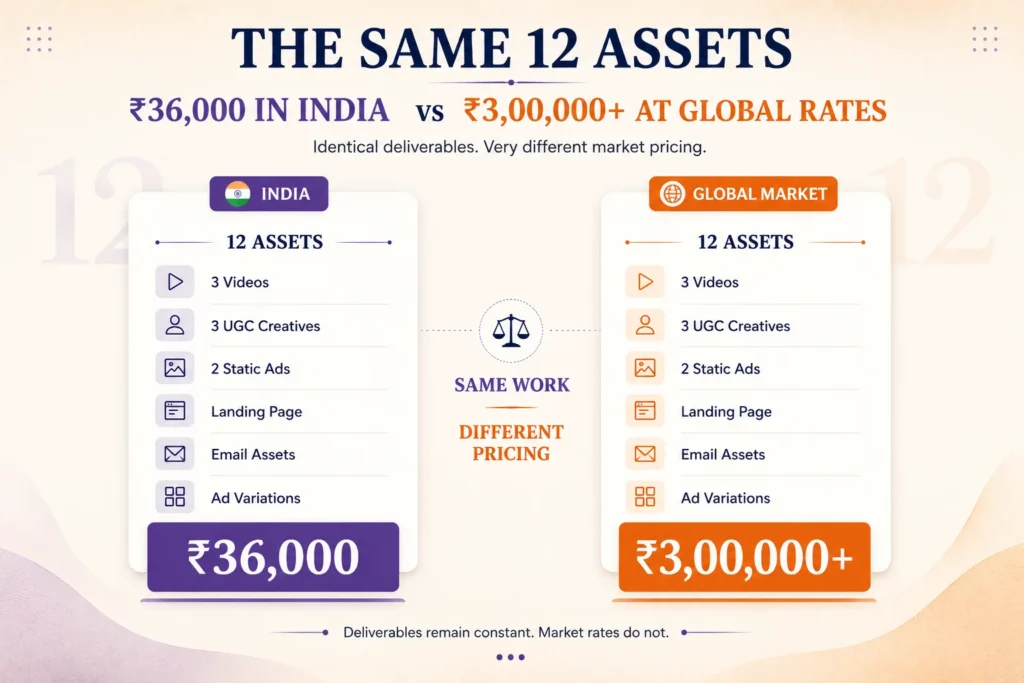
At global rates that premise holds. A creator video runs $150 to $500, and premium creators charge more than $800. Twelve assets costs somewhere north of ₹3 lakh.
In India the same twelve assets cost about ₹36,000. Which means the constraint that shapes creative strategy everywhere else does not shape yours, and a plan built on that assumption will be the wrong plan.
The short answer
A creative production plan sets what you will make, in what combination, and at what rate. Build it in two steps: find how many concepts your account can actually deliver — usually three or four for a Meta account under ₹3 lakh a month — then size production to fill that with coverage rather than volume. Because Indian production runs a fraction of global rates, the surplus capacity should buy more arguments, more formats and more languages from the same budget, not more variations of one idea.
Key takeaways
- Plan against your delivery ceiling first. Producing what the account cannot serve is money spent to sit unused.
- Indian production is roughly a tenth of global benchmarks. Twelve assets at about ₹36,000, against more than ₹3 lakh at $300 a video.
- So the constraint is delivery, not production — the reverse of every creative-ops guide you will read.
- Spend the surplus on coverage: arguments × formats × languages.
- The language axis is free capacity in India and appears in no Western planning framework.
- Batch production, ship on a rhythm. Irregular production is what actually kills small accounts.
Start from what the account can serve
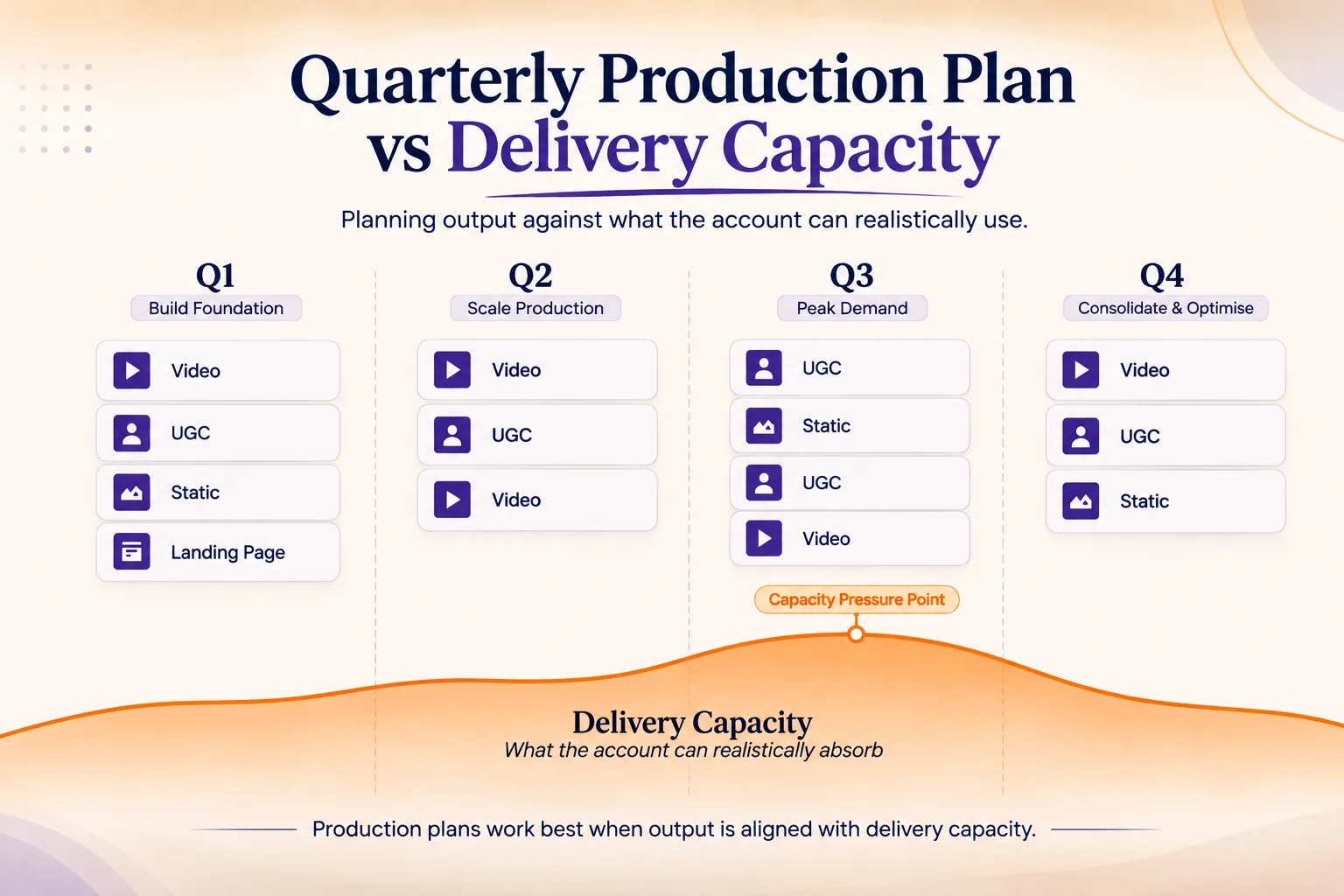
The plan does not start with a budget. It starts with a ceiling.
A Meta ad set needs a certain volume of optimisation events to deliver stably, and every additional ad divides that volume further. Which puts a hard cap on how many concepts can be live and assessed at once — for most accounts under ₹3 lakh a month, that is three or four. The arithmetic is at how many ad creatives your account can carry.
Anything produced beyond that ceiling is inventory, not activity. It may be useful later. It is not working now.
So the first line of the plan is a number, taken from the account rather than from a template: how many concepts can run at once, and how often they will be replaced — which depends on audience size rather than the calendar, covered at how to tell whether creative is actually fatigued.
Multiply those two and you have your monthly requirement. For a typical ₹2 lakh Meta account: four concepts live, replaced on roughly a three-week cycle, so about four new concepts a month.
Then look at what four concepts actually costs
Here is where Indian advertisers get an advantage nobody writes about.
Published rates put creator video production in India at roughly ₹1,000 to ₹15,000 per asset depending on length, creator tier, editing and usage rights. Global benchmarks for the same work sit at $150 to $500, with proven creators above $800.
Take a plan of twelve assets a month. At ₹3,000 each in India, that is ₹36,000. At $300 each, it is roughly ₹3,17,000 — more than most Findise clients spend on media.
The Western planning literature is therefore solving a problem you do not have. Its advice to prioritise ruthlessly, batch quarterly and reserve production for proven winners exists because production is genuinely scarce at those prices.
Your problem is the opposite. You can afford to make twelve assets and your account can only meaningfully run four concepts. The interesting question is what to do with the difference.
The Coverage Grid
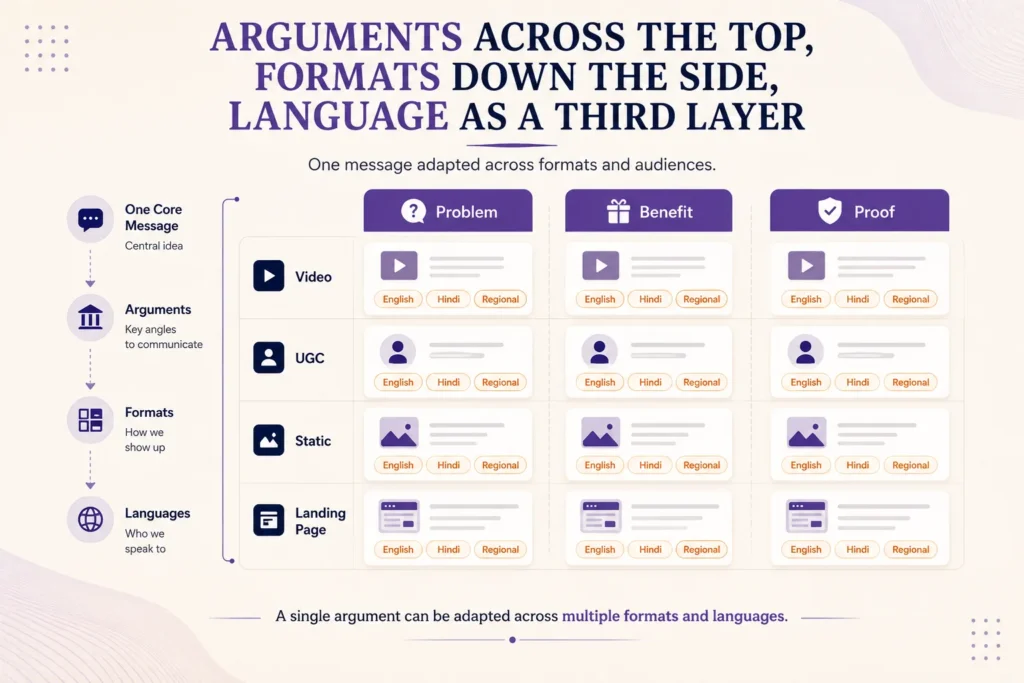
Do not spend surplus production capacity on more assets. Spend it on coverage — the same concepts running across more formats and more languages, so a small number of arguments reaches a much wider set of people.
Three axes.
Arguments — how many different reasons to buy. This is the axis that matters most and the one most accounts under-fill. Four concepts should mean four genuinely different arguments: price, outcome, trust, objection. Two versions of the same claim is one argument, whatever the file count says.
Formats — how each argument is expressed. Short video, static, carousel. The same argument performs differently by format and placement, and format is the cheapest axis to widen because the thinking is already done.
Languages — who can receive it. Almost absent from Western frameworks because it barely applies there. In India it is the highest-return axis available and it is nearly free once the concept exists.
Sizing the grid
Three arguments × two formats × two languages is twelve assets. At ₹3,000 each that is ₹36,000 a month — a realistic production budget for a ₹2 lakh media account.
Four arguments × two formats × one language is eight assets, around ₹24,000 — a sensible starting grid before adding the language layer.
Four arguments × three formats × two languages is twenty-four assets, roughly ₹72,000 — appropriate at ₹5 lakh media and above.
Read the grid as a plan, not a target. Not every cell needs filling. Fill the argument axis first, then formats, then languages — and stop when the budget runs out rather than thinning every cell to fit.
Why coverage beats volume. Twelve variations of one argument gives your account one attempt at working. Twelve assets across three arguments gives it three, in the places and languages where they can be received.
What actually fills the grid
Fill the argument axis from evidence, not from a brainstorm. Sales objections, enquiry messages, review text, the reasons people gave for not buying. Four arguments taken from real conversations beat twelve invented in a meeting.
Fill the format axis from placement data. If Reels and Stories take most of your delivery, vertical video is not optional. Check where impressions actually land before deciding what to shoot.
Fill the language axis by audience, not by assumption. Which cities and states does your delivery come from, and does your buyer read English comfortably? The execution matters — translation is not the same as writing in the language — and that is a subject of its own.
Extract more from each session. One planned shoot yields far more than most teams take from it, and getting that right changes the arithmetic more than any negotiation on rates.
The production rhythm
Irregular production is what kills small accounts. Not budget — rhythm.
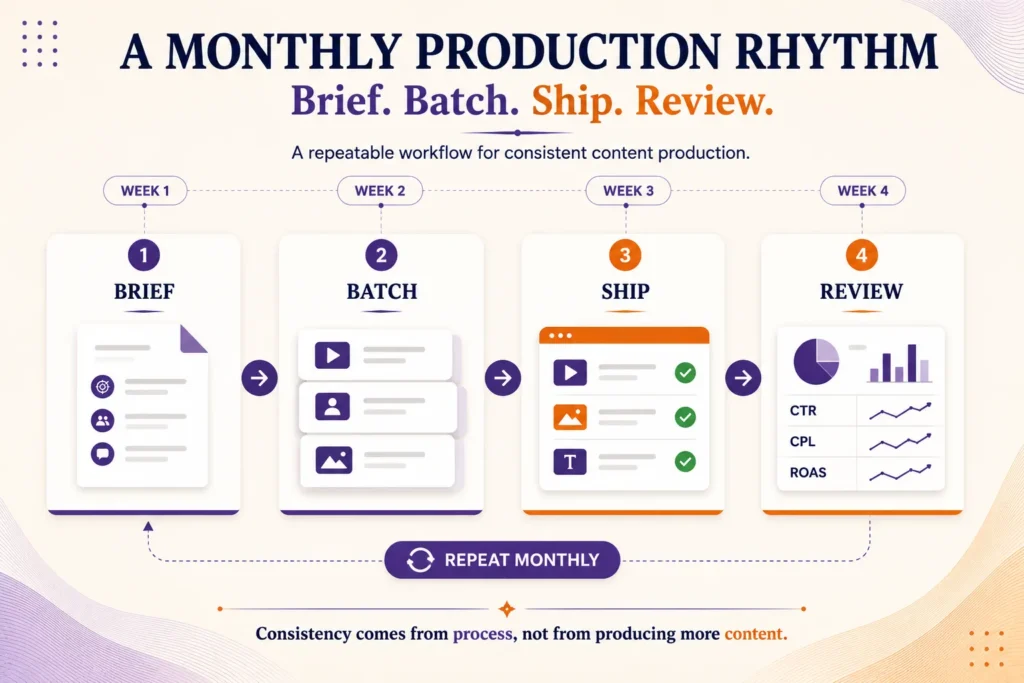
A monthly cycle works for most Indian SME accounts.
Week one — brief. Write the arguments and the grid before anyone opens a camera. One sentence per concept, decided in advance.
Week two — produce. Batch everything in as few sessions as possible. Two shoots a month at half the scale costs more than one shoot at full scale and produces less.
Week three — ship. New concepts go live alongside the current ones rather than replacing them outright, so nothing is switched off into a performance gap.
Week four — review and re-brief. What earned delivery, what did not, and what that says about the arguments rather than the executions.
Then repeat. The rhythm matters more than the individual month. An account fed unevenly spends half its life in learning.
Mistakes worth the money they cost
Producing to a Western volume benchmark. Fifteen new concepts a fortnight is correct at ₹26 lakh media. At ₹2 lakh it produces a library your account cannot serve.
Producing more variations because production is cheap. Cheap production is an opportunity to widen coverage, not to make the same ad twelve times.
Planning production without checking the delivery ceiling. The commonest error, and it is why so many accounts have a folder of unused assets.
One big shoot a quarter. It looks efficient and it starves the account for eight weeks out of twelve.
Briefing after the shoot. Deciding what an asset argues once it exists guarantees a library of executions in search of a strategy.
Ignoring language until performance drops. It is the cheapest axis on the grid and the one most likely to reach people your competitors are not talking to.
When to plan less, not more
When the offer has not been tested. Producing a quarter of creative for an unproven proposition is an expensive way to learn something a month of ads would have told you.
When the account is below its learning threshold. Fix delivery volume before production volume.
When the current concepts have never been given a fair run. Replacing creative that has not had enough delivery to be judged is not a production problem.
When nobody owns the rhythm. A plan with no named owner becomes a plan for the first month only.
Building the plan
☐ Concepts your account can deliver at once, taken from the account
☐ Replacement cycle set from audience size, not from a calendar
☐ Monthly concept requirement calculated from those two numbers
☐ Production budget set as a share of media spend
☐ Cost per asset established from real quotes, not assumption
☐ Assets affordable per month calculated
☐ Argument axis filled first, from real objections and enquiries
☐ Each argument written in one sentence before production begins
☐ Format axis matched to where delivery actually lands
☐ Language axis decided from delivery geography
☐ Grid sized to budget, with cells left empty rather than thinned
☐ Monthly rhythm agreed — brief, produce, ship, review
☐ One named owner of the cycle
☐ Unused assets tracked, so overproduction is visible
Questions we get asked
How do you plan ad creative production?
Start with how many concepts the account can deliver, multiply by the replacement rate, then size a coverage grid to your production budget. Most plans are built the other way round and fail at the delivery step.
How much creative do I need per month?
For a Meta account under ₹3 lakh a month, roughly four new concepts, expressed across enough formats and languages to fill your production budget. That is often eight to twelve assets.
What should a creative production calendar look like?
A monthly cycle — brief, produce, ship, review — with production batched into as few sessions as possible. Consistency matters more than volume.
How many ad variations should I make?
Fewer variations and more arguments. A variation is a second version of the same reason to buy; it adds files rather than chances.
Is cheap production worse production?
Not in India, where the rate difference against global benchmarks reflects local cost structures rather than quality. The thing that makes creative work is the argument, and the argument costs nothing.
Can we use AI to hit these numbers?
For iteration and format variants, increasingly yes. Both major platforms have disclosure requirements for synthetic media and revise them regularly, so check current policy before running anything photoreal.
The plan on one page
Write down four numbers: concepts your account can run at once, weeks between replacements, production budget per month, and cost per asset.
Those four give you the size of your grid. Then decide three or four arguments worth making, pick the formats your delivery actually uses, and add a language layer if your buyers are not all reading English.
That is the whole plan. It fits on one page, and it will be more useful than any calendar template, because it is built from your account rather than from somebody else’s.
If you want the grid built against your own numbers and a quarter of production planned from it, you can reach out to us on whatsapp at +91 7738844851 .
More in Blog
Keep reading
All articles →

Ready to talk about your growth?
Tell us what's stuck and we'll tell you what we'd do first. Free, 30 minutes, no pitch.