
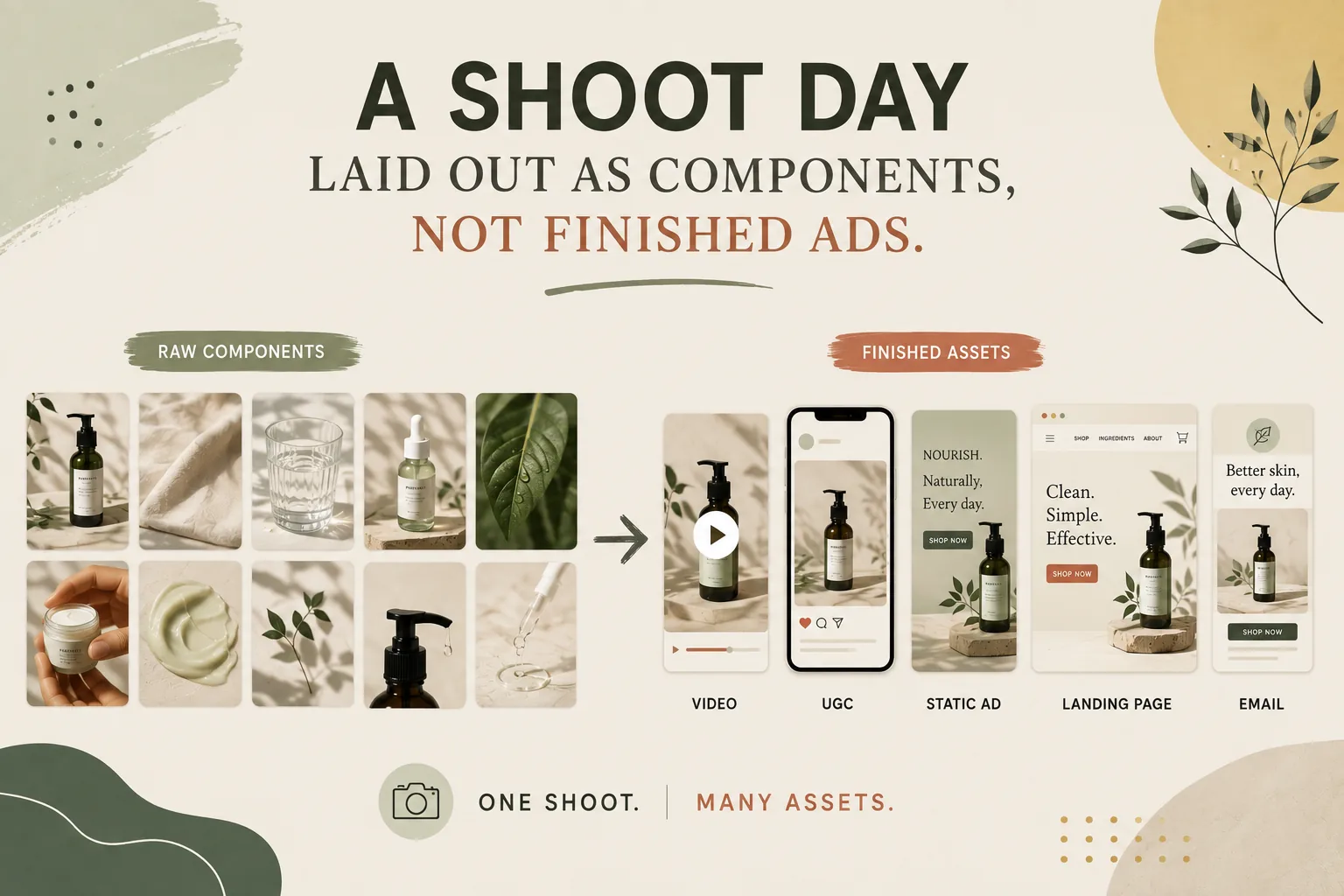
There is a method going around called 3×3×3. Three hooks, three body scripts, three calls to action, shot in one session. Twenty-seven unique videos from one afternoon.
The maths is correct. The capture technique is sound. And the output is twenty-seven files that all say the same thing.
Meanwhile the account they are going into can run about four.
The short answer
Modular production means shooting interchangeable components — openings, bodies, proof, endings — instead of finished ads, so one session yields many combinations. The technique works. The usual application does not, because permuting a hook against a CTA multiplies files rather than arguments, and most Indian accounts can only deliver three or four concepts at a time anyway. Plan the shoot around coverage instead: capture the parts you need to say genuinely different things, in more than one format, and in more than one language.
Key takeaways
- Files are not arguments. Twenty-seven permutations of one claim is one attempt saved twenty-seven times.
- Check the output against the account. Producing seven times what you can deliver is inventory.
- Shoot components, not ads. Openings, bodies, proof and endings, captured separately.
- Language is the highest-return module in India and it appears in no international version of this method.
- Frame wide and clean. Crops, captions and reframes are free later only if you shot for them.
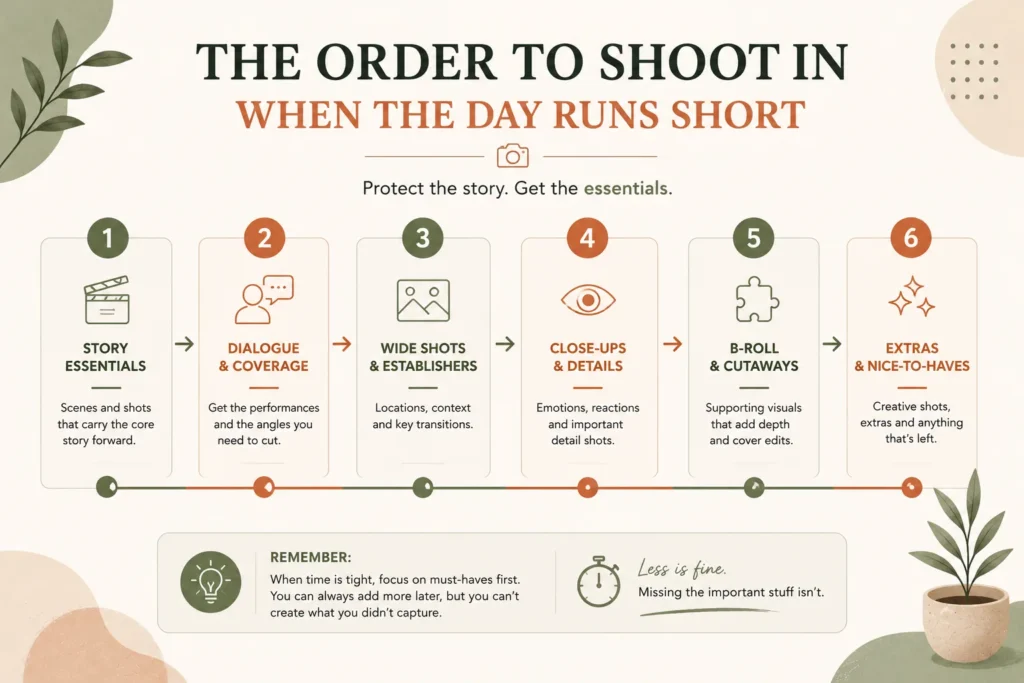
- Capture order matters — shoot the irreplaceable things first, because the day always runs short.
Where 3×3×3 goes wrong
The permutation arithmetic hides something.
A hook and a call to action are not arguments. They are the entrance and the exit. Swap them around all you like — the thing in the middle, the reason someone should buy, has not changed.
So three hooks by three bodies by three CTAs is not twenty-seven attempts at persuading someone. It is three attempts at most, and often one, dressed in twenty-seven files.
Then compare it to what your account can serve. A Meta account under about ₹3 lakh a month can properly deliver three or four concepts at a time — the arithmetic is at how many ad creatives your account can carry. Twenty-seven assets into a four-concept account means twenty-three sit unused, or worse, get uploaded and split delivery until nothing learns.
None of which makes modular shooting wrong. It makes the target wrong. You are pointing a very efficient production method at file count when you should be pointing it at coverage.
The Useful Multiple
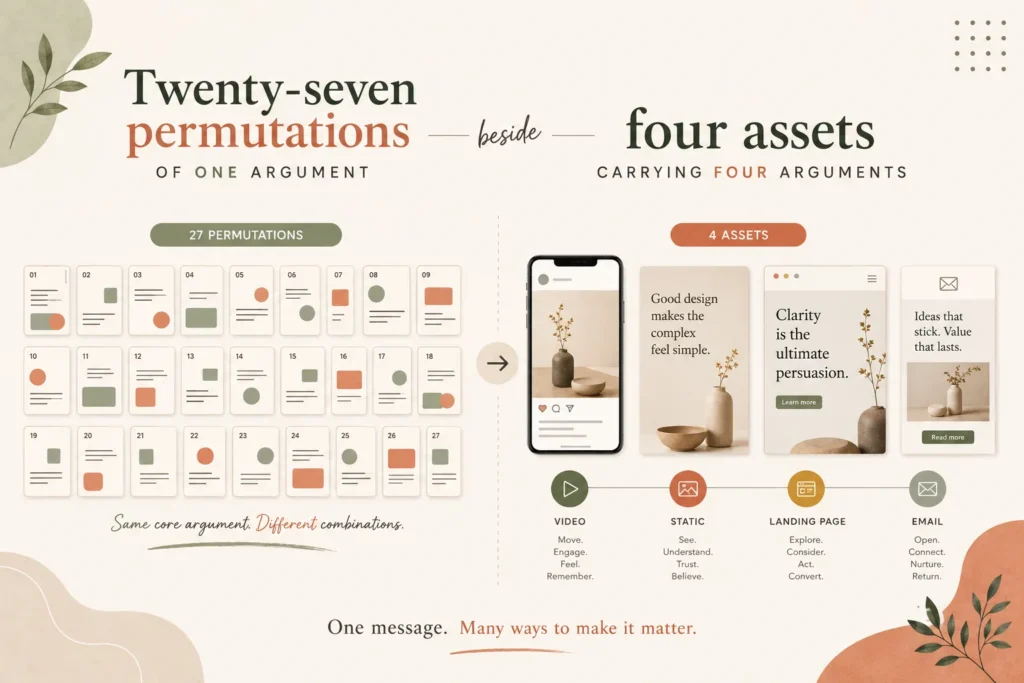
The only multiplication worth having is one your account can deliver and your audience can tell apart. Shoot the components that let you argue different things, in different formats, in different languages — not every permutation of the same script.
Different arguments. Price, outcome, trust, the specific objection that kills your deals. Each needs its own body, and the body is the expensive part — which is exactly why teams avoid shooting more than one and reach for hook permutations instead.
Different formats. The same argument as vertical video, as a static, as a carousel. Cheap, because the thinking is already done and the footage already exists.
Different languages. Almost free once you have clean footage and unburned text, and in India it reaches people your competitors are not speaking to.
Which is the grid your production plan should already be built around — sizing it is covered at how to plan a quarter of creative production. This page is about the shoot that fills it.
What to actually capture
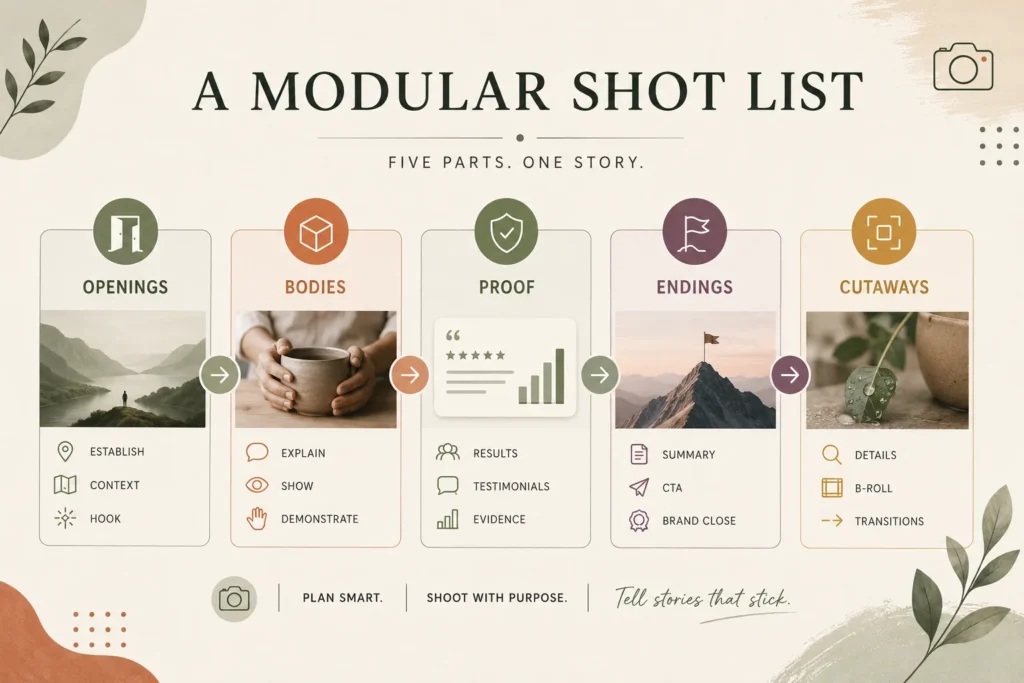
Stop thinking in finished ads. Think in parts.
Openings. Several per body, captured back to back while the setup is live. The craft of what makes one work is a subject of its own — what actually moves the first three seconds — but the capture instruction is simple: shoot more of them than you think you need, because they are the cheapest module and the one you will replace most often.
Bodies. One per argument. This is the module people under-shoot and the one that actually multiplies your reach. If you have four arguments, you need four bodies, and no amount of hook variation substitutes.
Proof. The demonstration, the before and after, the number on screen, the customer saying the thing. Proof modules are interchangeable across bodies and they age slowly.
Endings. Two or three, kept short. Offer-led, urgency-led, plain. Low value individually, useful for compliance and offer changes later.
Cutaways and B-roll. Hands, product detail, environment, packaging. These are the joints of the edit and the reason a rough cut looks finished. Shoot far more than seems reasonable — they cost minutes and they save reshoots.
Silent-legible moments. Frames that carry the message with no audio at all, because most of this will be watched muted.
The shoot, planned so extraction is possible
Most of what makes a session extractable is decided before anyone arrives.
Frame for crops. Shoot in the widest ratio you will need and keep the subject centred with headroom, so a 9:16 vertical, a 4:5 feed and a 1:1 square all come out of the same take. Nothing wastes a shoot faster than footage that only works in one aspect.
Do not burn in text. Titles, captions and offers go on in the edit. Burned-in text kills every language variant and every offer change, and it turns a reusable module into a single-use file.
Keep the audio clean and separate. One clear voice, no music bed on the source. Music added later can be changed; music baked in cannot.
Grab room tone and clean plates. Thirty seconds of silence and a few seconds of empty frame. They cost nothing and rescue edits later.
Shoot the same line more than one way. Faster, slower, warmer, blunter. The delivery that works is rarely the one that felt best in the room.
Log as you go. A shoot that produces two hundred clips and no notes produces two hundred clips nobody opens. Name the take, name the module, name the argument.
And shoot in the right order, because the day always runs short: bodies first, because they are irreplaceable. Then proof. Then openings. Then cutaways. Endings last — you can always shoot those on a phone next week.
Assembly, and how not to drown
You now have parts. Two rules stop the edit becoming a landfill.
Assemble to the grid, not to the maximum. Build the assets your plan actually calls for. The remaining combinations stay as parts, ready when a concept fatigues or an offer changes — that is the point of shooting modularly, and it only works if you resist assembling everything on day one.
Version deliberately. One argument, one format, one language per asset, named so that anyone can tell what it is six weeks later. If the file name does not say which argument it carries, the whole system collapses the first time someone else opens the folder.
Hold the surplus as inventory, not as ads. Assets you have not uploaded cost nothing. Assets you have uploaded split delivery — and every structural change resets learning, which is a real cost paid for an imaginary benefit.
The India layer nobody includes
Every international treatment of modular production stops at hooks, bodies and CTAs.
Add language and the same shoot covers substantially more people. Clean footage with no burned-in text supports a Hindi text version, a Marathi one, a Tamil one, without returning to set. The voiceover can be replaced. The captions are typed, not filmed.
That is genuine reach, not another permutation — a different set of humans, reached by the same day’s work.
It has to be done properly rather than run through a translator, which is a craft question of its own. But the capture decision is made on the shoot day, and it is a small one: leave the frame clean.
Mistakes worth the money they cost
Shooting one finished ad. The single most expensive way to use a production day.
Shooting nine hooks and one body. Nine entrances into the same room.
Burning text into the footage. Kills every language variant and every offer update at once.
Assembling all twenty-seven combinations. You have made a folder, not a campaign.
Uploading everything you made. Split delivery, nothing learns, and the account is worse than before the shoot.
No shot list. The day fills with whatever is easiest to film, which is never the bodies.
Shooting tight. Beautiful in one ratio, unusable in the other three.
No logging. Footage nobody can find is footage nobody used.
When modular is the wrong approach
When you have one argument and know it works. Shoot it properly instead of fragmenting it.
When the product needs continuous demonstration. Some things cannot be told in interchangeable parts.
When the account cannot serve the output. Fix delivery volume before production volume.
When there is no plan to shoot against. Modular capture without a target produces the largest possible pile of unusable material.
When you are working with a creator rather than running your own shoot. The brief is the instrument then, and rights matter more than shot lists — what UGC costs in India, and what the rights cost covers that side.
The shoot-day checklist
☐ Coverage target agreed before booking — how many arguments, formats and languages
☐ One body scripted per argument, not one script with variations
☐ Shot list written by module, not by finished ad
☐ Widest required aspect ratio confirmed, subject framed with crop room
☐ No text burned into any footage
☐ Audio captured clean, with no music bed on the source
☐ Room tone and clean plates recorded
☐ Every line shot at least two ways
☐ Proof modules captured separately from bodies
☐ Cutaways over-shot deliberately
☐ Capture order set — bodies, proof, openings, cutaways, endings
☐ Clips logged and named by module and argument as you go
☐ Assembly limited to what the plan calls for
☐ Surplus held as parts, not uploaded
Questions we get asked
How do you make multiple ads from one video?
Shoot it as parts rather than as a video. Separate openings, bodies, proof and endings, framed wide and free of burned-in text, then assemble the combinations your plan calls for.
What is modular video production?
Treating a shoot day as a component factory rather than as the making of one finished ad. The output is interchangeable parts, not a film.
How many ads can you make from one shoot?
More than you can run. The useful question is how many your account can deliver — usually three or four concepts at a time on an Indian SME budget — and how many genuinely different arguments you captured.
How do you plan a creative shoot for ads?
Start from the coverage you need: arguments, formats, languages. Turn each argument into a body, then list the modules around it. Book the day against that list.
What should be on an ad shot list?
Bodies by argument, several openings each, proof modules, two or three endings, generous cutaways, and clean plates. Ordered so the irreplaceable things are shot first.
Is 3×3×3 wrong?
The technique is right. The target is usually wrong. Use the same capture discipline to cover more arguments and more languages rather than more permutations of one script.
Before you book the day
Write down the arguments you want to make. Not hooks — reasons to buy.
If the list has one item, you do not need a modular shoot. You need a better argument, and a day of filming will not supply it.
If it has four, you need four bodies, and every hour spent shooting a ninth opening for the first one is an hour stolen from the fourth.
That is the entire method. Everything else on the shot list is joinery.
If you want a shoot planned against your account’s actual delivery capacity, with a shot list built from the arguments that matter, you can reach out to us on whatsapp at +91 7738844851 .
More in Blog
Keep reading
All articles →
Ready to talk about your growth?
Tell us what's stuck and we'll tell you what we'd do first. Free, 30 minutes, no pitch.