
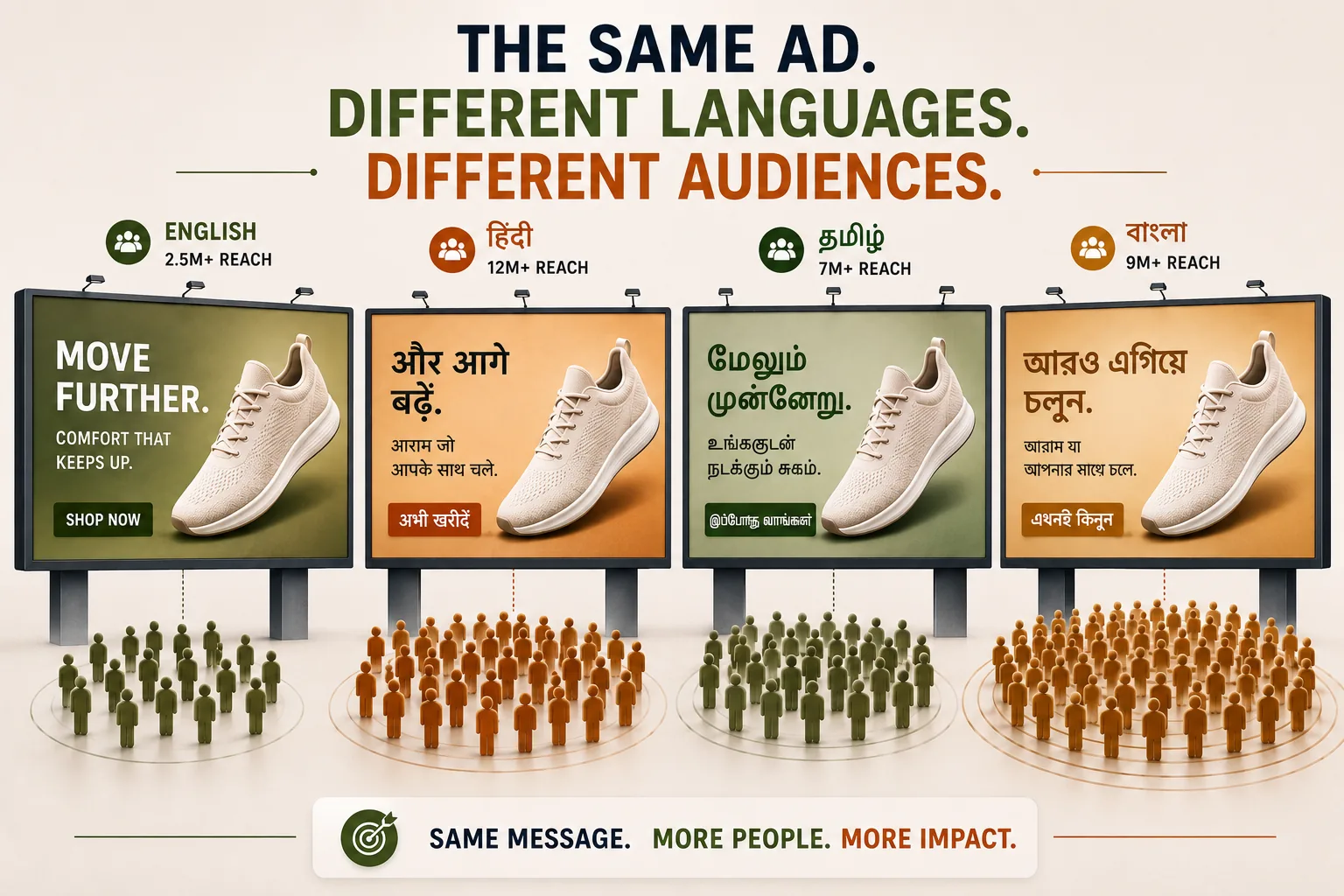
Every article written about vernacular advertising in India says the same three things. Five hundred and forty million regional-language internet users. Engagement several times higher. A market worth lakhs of crores. Go now.
The opportunity is real. The explanation is wrong, and the omission is expensive.
Regional CPMs are lower because fewer advertisers are bidding for that inventory — not because Tamil is more persuasive than English. It is an auction arbitrage. And like every arbitrage, it comes with terms: the same budget buys far more impressions against a far smaller audience, which means the creative you saved money on stops working much sooner.
The short answer
Advertising in Indian languages works, and the mechanism is competition rather than emotion. Fewer advertisers bid for regional-language inventory, so impressions cost less. That saving is real and worth taking. The catch is arithmetic: at roughly ₹80 CPM against a fifteen-lakh audience, a ₹2 lakh monthly budget reaches average frequency 2.5 in about six weeks. The same budget in English at ₹200 CPM against a two-crore pool takes years. Take the arbitrage, and budget the faster creative refresh that comes with it.
Key takeaways
- The saving is auction competition, not persuasion. Understanding that changes how you plan for it.
- Facebook India reports regional content at 1.5–2x engagement. The 3–5x figures circulating are agency-published without methodology.
- Over 95% of YouTube consumed in India is in regional languages, per Google — the platform behaviour is not in doubt.
- Cheap impressions against a small pool exhaust it fast. Roughly thirty-three times faster in the worked example below.
- Localisation is a ladder, not a reshoot. The first two rungs cost almost nothing.
- Roman-script Hindi often beats Devanagari for urban audiences, and nobody tells you that.
What the evidence actually supports
Worth separating, because this SERP mixes platform data with agency marketing.
From the platforms. Facebook India has reported regional-language content achieving 1.5 to 2 times higher engagement than English, particularly in video and voice formats. Google reports that more than 95% of YouTube content consumed in India is in regional languages. ShareChat operates across 15 Indian languages with over 350 million active users, around 90% of whom consume in a local language.
From agencies. Claims of 3–5x engagement, 20–36% lower cost per acquisition and 40–60% lower CPM. No sample sizes, no methodology, no category breakdowns, published by companies selling vernacular campaign services.
Treat the first group as evidence and the second as an upper bound. The direction is consistent across both, which is the useful part. The magnitude is not established.
And the underlying demand is not seriously disputed. Around 540 million Indians use the internet primarily in a regional language, and roughly three quarters of Indian subscribers consume content that way. Whatever the multiplier is, the audience is there and most advertisers are not addressing it.
The Language Arbitrage
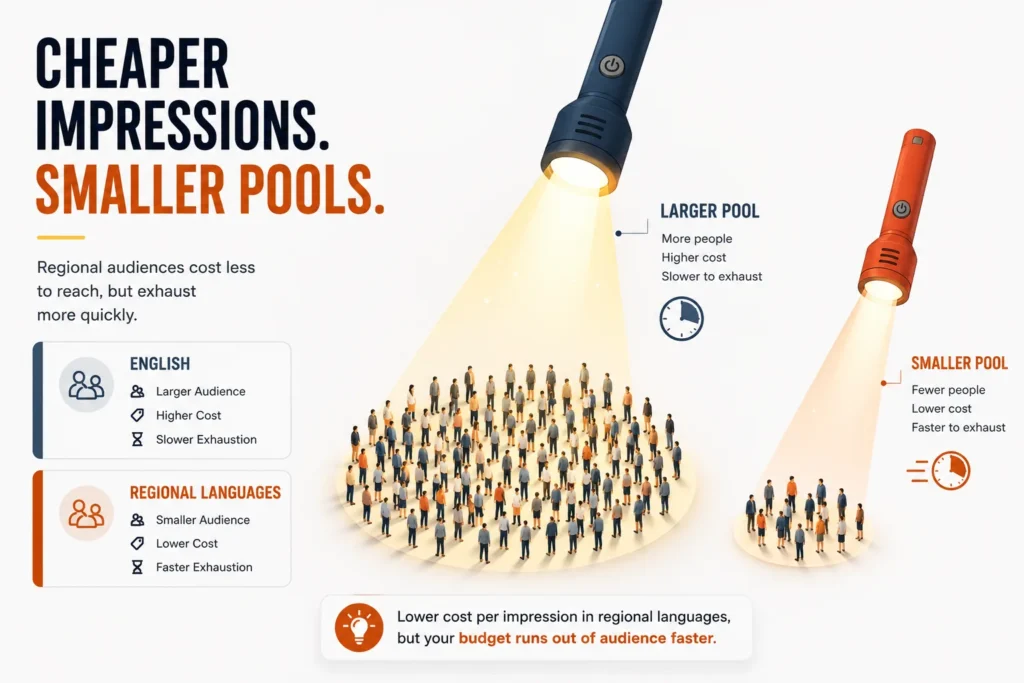
Regional inventory is cheaper because fewer advertisers want it, not because the language works harder. That makes it a real and bookable saving — and one that will close as competitors arrive.
Think about who you are bidding against.
In English, in a metro, you compete with everyone. Every national brand, every app, every D2C business, every other agency’s client. The auction is crowded and CPMs reflect it.
In Marathi, in Nashik, you compete with far fewer people. Not because the audience is worth less — often it is worth more, because purchase intent in smaller cities is frequently higher and competition for attention is lower. Simply because most advertisers have not made the creative.
That is the whole mechanism. It is not mysterious and it is not permanent.
The catch, in numbers
Take a ₹2 lakh monthly Meta budget.
In English at ₹200 CPM: one million impressions a month. Against a broad audience of around two crore, reaching an average frequency of 2.5 would take roughly fifty months.
In a regional language at ₹80 CPM: two and a half million impressions. Against a language-specific pool of around fifteen lakh, you reach the same point in about 1.5 months.
Two and a half times the impressions, into a pool thirteen times smaller. The exposure rate is roughly thirty-three times higher.
Which is why regional campaigns so often work brilliantly and then stop. The creative was not bad. The audience was small, and you bought it cheaply enough to exhaust it in six weeks. The mechanism behind that is at how to tell whether creative is actually fatigued — this is that arithmetic with a much smaller denominator.
So budget for it. The media saving is real. Spend part of it on the faster refresh cycle the smaller audience demands, and the arbitrage holds. Spend all of it and you get six good weeks.
The localisation ladder
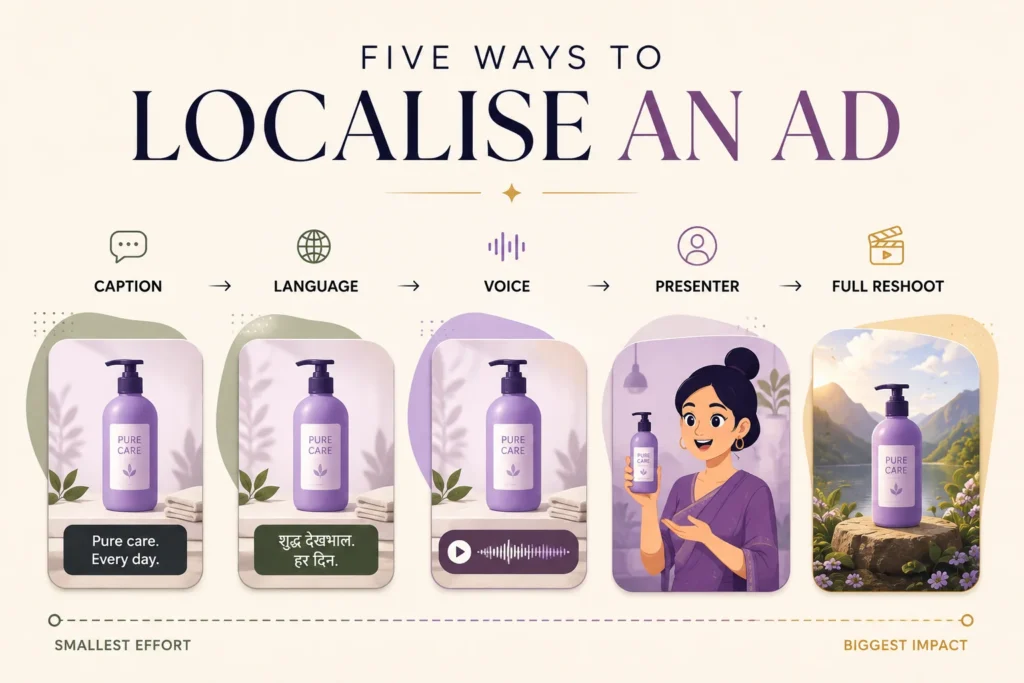
Brands assume advertising in another language means shooting again. It almost never does. Five rungs, cheapest first.
One — swap the on-screen text. Same footage, new captions. Near-free, and it is the entire reason not to burn text into your video at the shoot — the capture decision behind it is covered at getting more than one ad out of a shoot. Since most feed video is watched muted, the text is doing most of the language work anyway.
Two — change the script the text is written in. Costs nothing and matters more than people expect. See below.
Three — write the copy natively rather than translating it. A translated headline reads like a translated headline. The objection that stops a buyer in Coimbatore is not the same objection phrased differently, and the words they use for it are their own. This costs a writer’s time and it is the rung with the largest return.
Four — replace the voiceover. Real cost, but modest, and it only matters for the minority who watch with sound. Do it after the text rungs, not before.
Five — reshoot with a native speaker on camera. The expensive option, and worth it only where the speaker’s presence is the persuasion — testimonials, founder-led, anything where the face carries trust.
Most brands skip to rung five, conclude it is expensive, and do nothing. The first three cost a few thousand rupees and capture most of the available gain.
The script decision nobody mentions
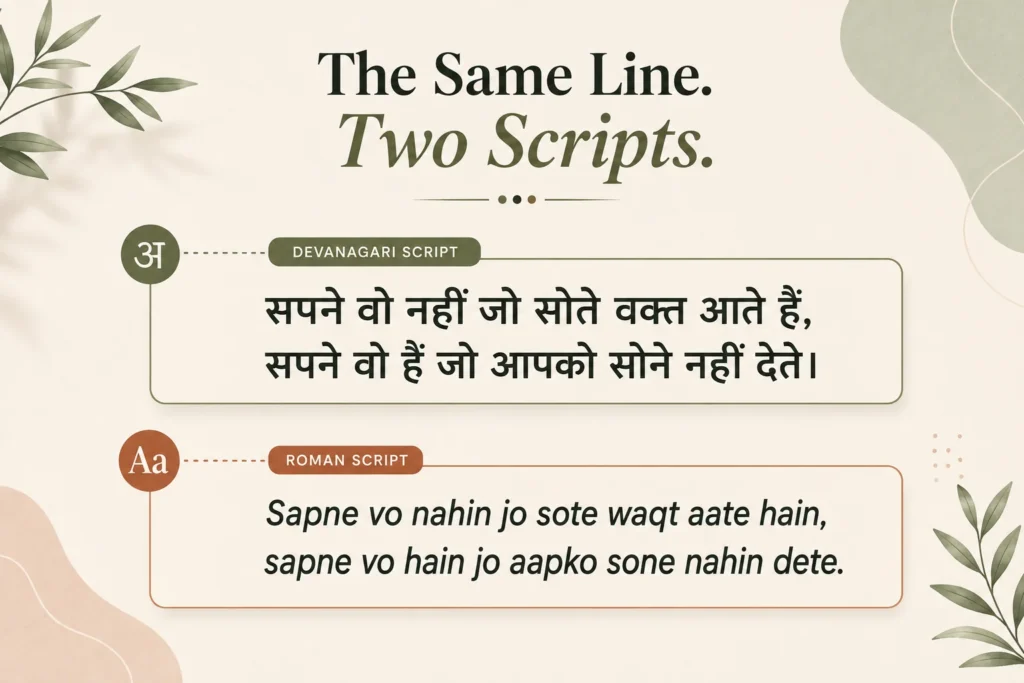
Hindi can be written in Devanagari or in Roman characters. The choice is not cosmetic.
A large share of urban Indian readers — particularly younger, English-schooled audiences — read Roman-script Hindi faster than Devanagari, because that is how they type, message and search. Setting an ad in Devanagari can reduce comprehension among exactly the audience with the money.
And the reverse is also true. In smaller cities and among older audiences, Devanagari reads as native and Roman script reads as an outsider’s compromise.
So it is an audience decision, not a language decision, and it is cheap enough to test both. Run the same claim in both scripts to the same geography for two weeks and read the difference. It costs nothing but a caption swap, which is rung one.
Two practical notes. Devanagari and most Indian scripts need more vertical space and larger type to stay legible at feed size — a line that fits in English will not fit unchanged. And auto-generated captions remain unreliable across Indian languages, so burn your text in deliberately rather than relying on the platform.
Which languages, and how to target them
Do not start from a language list. Start from where your delivery already is. Open your placement and geography reports. If a third of your impressions are landing in Maharashtra and Gujarat, that is your answer, and it did not require research.
Geography is a proxy, not a mapping. Mumbai is not monolingually Marathi — it is Hindi, Marathi, Gujarati and English at once. A state is a rough guide to language, never a definition, and a city like Mumbai or Bengaluru is a poor guide indeed.
Meta’s language targeting is weaker than people assume. It reflects interface and inferred preference rather than reliable reading ability, and narrowing on it shrinks an already-small pool further — which, given the arithmetic above, is usually the wrong move.
The practical approach for most Indian SMEs: run language variants into the same broad geography and let delivery sort them. The system will find the people each version resonates with, and you avoid cutting your own audience in half before you start.
Start with two, not six. English plus the one language your delivery data points at. Six variants across four ad sets on a ₹2 lakh budget starves everything.
Mistakes worth the money they cost
Translating instead of writing. The commonest and most visible. Readers can tell instantly, and it signals that the brand is talking at them rather than to them.
Treating the CPM saving as free money. It is a saving with a refresh bill attached.
Layering language targeting onto an already-narrow audience. You take a small pool and make it unservable.
Choosing Devanagari by default. For urban buyers it can cost you comprehension.
Running six languages at once on a small budget. Every ad set below threshold, nothing learns.
Assuming regional means rural, and rural means cheap. Purchase intent in tier-two cities is frequently higher than in metros, which is part of why the arbitrage works at all.
Relying on platform auto-captions. Accuracy across Indian languages is inconsistent enough to embarrass you.
When to skip the language layer
When your product is genuinely English-first. Enterprise software, professional services sold to English-speaking buyers, premium categories where English signals the positioning.
When your delivery is concentrated in one metro and the data shows English engagement holding.
When you cannot write the language properly. A bad Tamil ad is worse than a good English one, and it is remembered.
When your audience is already too small. Adding a language axis to a fifty-thousand-person pool makes nothing servable.
When your account has no clean footage to caption. Fix the production decision first — the language axis is only cheap if the source material allows it.
The language checklist
☐ Delivery geography reviewed before choosing any language
☐ Two languages to start, not six
☐ Language-specific audience size checked, and the exhaustion rate calculated
☐ Refresh budget increased to match the smaller pool
☐ Footage confirmed free of burned-in text
☐ Copy written natively, never translated
☐ Both scripts tested where the language allows it
☐ Type size and line length adjusted for the script
☐ Captions burned in rather than auto-generated
☐ Language targeting left off unless the pool can carry it
☐ Performance read per language variant, never blended
☐ Results reviewed at six weeks, when the small-pool effect appears
Questions we get asked
Do regional language ads perform better in India?
On the platform evidence, yes — Facebook India reports 1.5 to 2 times higher engagement for regional content. The larger multiples circulating come from agencies without published methodology.
Should I run ads in Hindi or English?
Both, into the same geography, and read them separately. Your delivery data will answer within a fortnight for the cost of a caption swap.
How do you target by language on Meta?
You can, and for most Indian SMEs you should not. It narrows an already-small pool and reflects interface preference rather than reading ability. Run variants broadly instead.
Is Hinglish better than Hindi for ads?
Roman-script Hindi often reads faster for urban, English-schooled audiences. Devanagari reads as native in smaller cities and among older buyers. Test rather than assume — it costs a caption change.
Which Indian languages should I advertise in?
The one your delivery report already points at. Start with a single addition to English, prove it, then extend.
Does regional creative cost more to produce?
Not at the rungs that matter. Text swaps and native copywriting are cheap. Only reshoots are expensive, and they are rarely necessary.
What to do this week
Open your geography report and find the top two states by impressions.
Then take your best-performing ad, swap the on-screen text into the language those states actually read, and run it alongside the original into the same audience. No new footage, no new shoot, no targeting change.
Two weeks later you will know something almost none of your competitors know about their own accounts. And if it works, put the calendar reminder in now for week six — because that is when the pool starts to thin, and the brands that get caught out are the ones who thought they had found free money rather than a cheaper auction.
If you want the language opportunity sized against your own delivery data and a refresh plan built for the smaller pool, you can reach out to us on whatsapp at +91 7738844851 .
More in Blog
Keep reading
All articles →
Ready to talk about your growth?
Tell us what's stuck and we'll tell you what we'd do first. Free, 30 minutes, no pitch.