
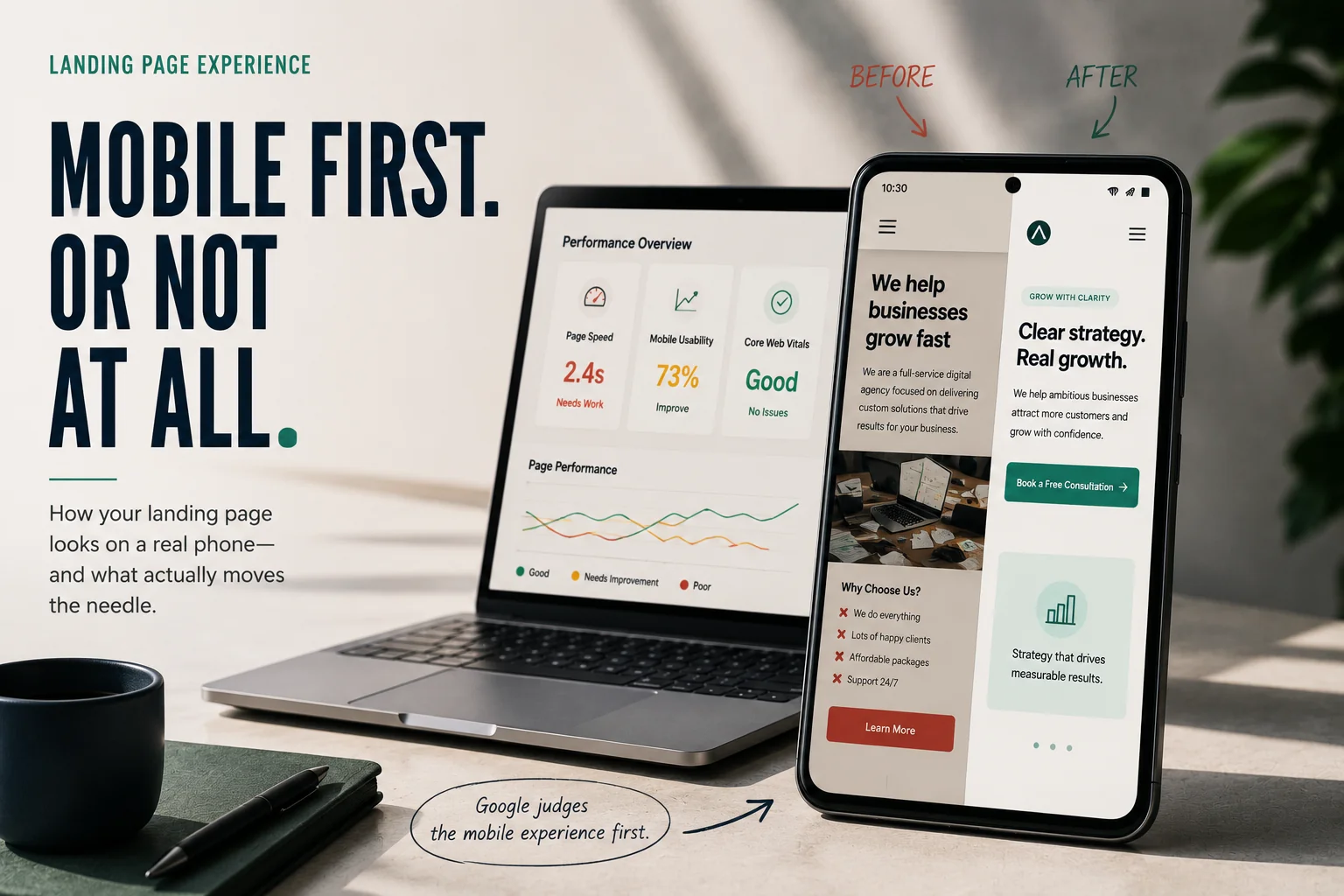
Almost every landing page checklist you will find was written for a visitor who does not exist in India.
That visitor is on a desktop or a recent iPhone, on fast broadband, willing to give an email address, and paying by card. Your visitor is on a mid-range Android, on a connection that varies enormously by neighbourhood, identifies themselves by phone number, and may well want to finish the conversation on WhatsApp.
Same tactics, wrong assumptions. Here are twenty-one points that assume the visitor you actually have.
The short answer
Landing page optimisation is the work of raising the share of visitors who take the intended action. For Indian traffic the order matters more than the list: get the page loading on a mid-range phone first, then make it believable, then make the action easy on a thumb, then make sure the lead reaches a human. Fixing a headline on a page that takes six seconds to load changes nothing.
Key takeaways
- India is a mobile-first market by a wide margin. StatCounter’s platform data puts India’s mobile share of web traffic around 80%, among the highest in the world. Design for the phone and let desktop inherit.
- Connection speed varies enormously. India’s median 4G performance has sat near 19 Mbps while median 5G runs above 300 Mbps, per Ookla data. The same page is comfortable for one visitor and unusable for another.
- Phone number is the identifier, not email. WhatsApp passed 500 million monthly users in India, and UPI recorded 21.7 billion transactions in January 2026 alone. Indian digital life is organised around a mobile number.
- Core Web Vitals thresholds are specific: LCP under 2.5 seconds, INP under 200 milliseconds, CLS under 0.1, all at the 75th percentile of real users. INP replaced FID on 12 March 2024.
- Speed is a ranking factor, but a modest one. Google’s John Mueller: “it is a ranking factor, and it’s more than a tie-breaker, but it also doesn’t replace relevance.”
What landing page optimisation is, and is not
It is the process of changing a page so that a larger share of the people arriving on it do the thing you wanted — enquire, buy, book, message.
It is not redesign. A prettier page that converts worse is a failure, and it happens often, usually because the redesign optimised for what the founder liked rather than what the visitor needed.
It is also not A/B testing. Testing is how you verify a change on pages with enough traffic to reach significance. Most Indian SME landing pages get a few hundred visits a month, which is nowhere near enough. On low traffic you fix known problems and measure the direction, which is less rigorous and considerably more useful than waiting eight months for a result.
The order that matters: Load → Believe → Act → Reach
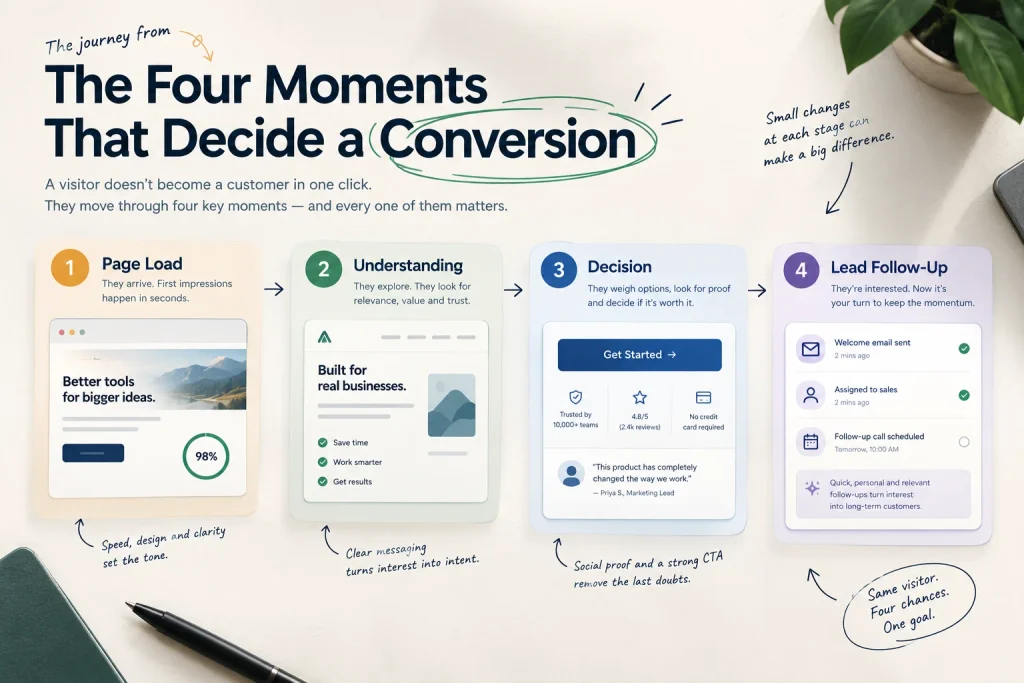
A visitor passes through four stages, and they are strictly sequential.
Load — the page has to render on their device and connection.
Believe — they have to understand the offer and trust you enough to continue.
Act — the action has to be easy on a phone, with a thumb, in one hand.
Reach — the lead has to arrive somewhere a human will act on it.
The rule that comes out of this is the useful part.
Work in order. A fix at a later stage cannot pay off until the earlier stages work.
Rewriting a headline on a page that takes six seconds to render is not optimisation. It is redecorating a room nobody has walked into.
Most audits we see start at Believe, because copy and design are the visible parts. The measurable wins are usually at Load and Reach, which nobody looks at.
Stage one: Load — points 1 to 6
1. Hit the Core Web Vitals thresholds on field data, not lab data.
LCP under 2.5 seconds, INP under 200 milliseconds, CLS under 0.1, at the 75th percentile. Lab scores from a test tool on office wifi tell you almost nothing. Use the Chrome UX Report data in Search Console, which reflects your actual visitors.
2. Test on a mid-range Android, on mobile data.
Not your iPhone. Not office wifi. Borrow a ₹12,000–15,000 phone, turn wifi off, and load the page in the afternoon when the network is busy. This single test finds more problems than any tool.
3. Get the above-the-fold payload down.
Hero images in WebP, sized for a phone screen rather than a desktop monitor. A 2MB hero on a variable connection is the most common single cause of a slow first paint.
4. Put the content in the raw HTML.
Check view-source, not the rendered page. Content injected by JavaScript is invisible to AI crawlers — GPTBot, ClaudeBot and PerplexityBot fetch JS files and never execute them — and it delays the first meaningful paint for humans too.
5. Defer every third-party script until after first paint.
Chat widgets, heatmap tools, remarketing pixels, review embeds. Each one is a request queued ahead of your content. Barry Pollard of Google’s Chrome team put the underlying point well: INP exists to surface “frozen, glitchy, poor experiences” that users are living through right now, whether or not anyone is measuring them.
6. Keep fonts to one family and two weights.
Devanagari and other Indic font files are heavy. If the page uses a regional language, subset the font or accept a system fallback.
Stage two: Believe — points 7 to 12
7. Name the outcome and the audience in the first screen.
“Performance marketing for Mumbai D2C brands” beats “Growth, reimagined.” The visitor decides in seconds whether this page is about them.
8. Show the price, or explain plainly why you cannot.
Price is the top unanswered question on almost every Indian service page. A range with the variables named — “₹75,000 to ₹2.5 lakh a month, depending on ad spend and channel count” — outperforms silence and outperforms “contact us for pricing.”
9. Publish the trust block.
Registered address, GST number, a phone number that a human answers. These carry real weight in India, where the visitor’s live question is often whether the business is genuine. A landing page with no address and a form-only contact route reads as a risk.
10. Use real faces and real client names.
Stock photography of a Western office is a negative trust signal to an Indian buyer. A photograph of your actual team in your actual office does more than any testimonial slider.
11. Carry one proof point with a number, a date and a source.
“Reduced cost per lead from ₹840 to ₹310 for a Navi Mumbai developer between April and September 2025” is proof. “Trusted by hundreds of businesses” is decoration.
12. Answer the biggest objection above the fold.
Usually price, sometimes “are you real”, sometimes “how long does this take”. If the objection lives below three screens of benefits, most visitors leave before reaching it.
Stage three: Act — points 13 to 17
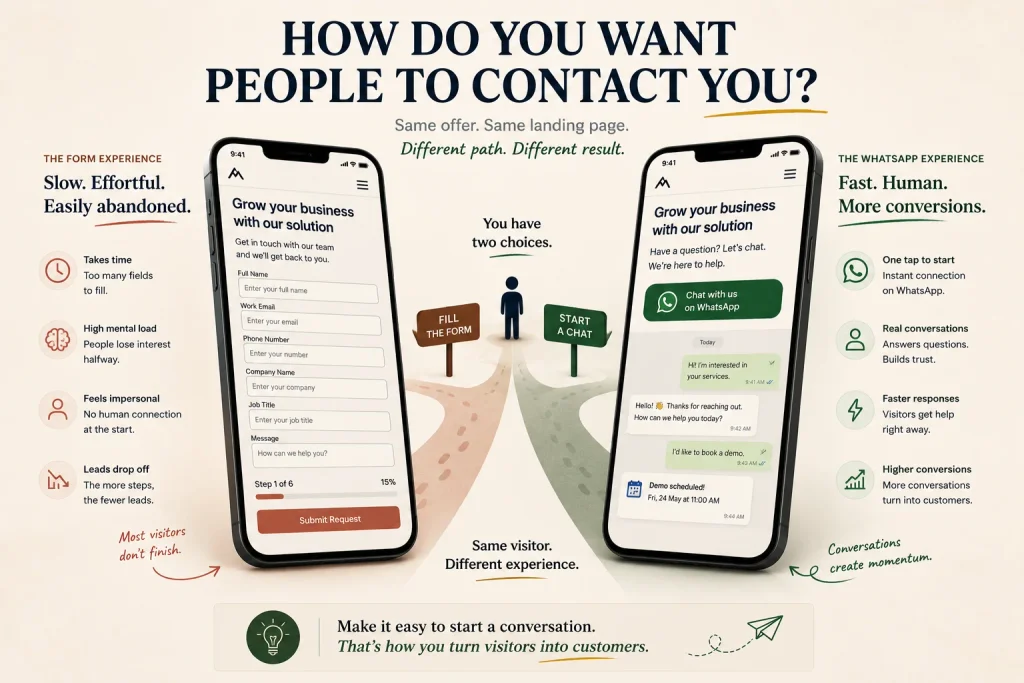
13. One call to action, repeated — not four competing ones.
A page offering a call, a download, a newsletter and a WhatsApp chat has no call to action. It has a menu, and menus produce hesitation.
14. Make the phone number the primary field and email optional.
India identifies people by mobile number. WhatsApp is past 500 million monthly users here, and UPI ran 21.7 billion transactions in January 2026 alone — the number, not the inbox, is the anchor of Indian digital life. Asking for email first adds friction for no gain.
15. Keep the form under four fields.
Name, phone, and one qualifying question is usually enough. Every additional field costs conversions, and the fields marketers add — company size, budget range, job title — are exactly the ones visitors abandon on.
16. Treat WhatsApp as a first-class CTA, not a floating icon.
A proper button, in the flow of the page, with a prefilled message that identifies the page and the offer. The prefill matters: it tells your team what the person was reading, which is context a form field would have had to ask for.
17. Build for one thumb.
Tap targets at least 48 pixels. Primary action within thumb reach at the bottom of the screen, not stranded at the top. Nothing that depends on hover, because there is no hover on a phone.
Stage four: Reach — points 18 to 21
This is the stage nobody audits, and it is where the most conversions are actually lost.
18. The lead must land in the CRM within seconds, with source and campaign attached.
An enquiry that arrives as an email to a shared inbox is not a lead. It is a message that will be found on Thursday.
19. Set a response window and enforce it.
Decide the number — fifteen minutes, an hour, same working day — then measure against it. A landing page cannot fix a two-day callback, and no amount of headline testing compensates for one.
20. Track conversions server-side, and count the WhatsApp click.
Browser-side tracking loses conversions to ad blockers and iOS restrictions. And a WhatsApp click is a conversion event — if it is not fired, the page will look worse than it is and get optimised in the wrong direction.
21. Report one number weekly: cost per qualified lead.
Not form fills. Qualified means someone your sales team would call. A page producing forty cheap unqualified leads is worse than one producing eight good ones, and only this number shows it.
Mistakes we see
Auditing the copy first. It is the visible part, so it gets the attention. The unglamorous stages — load and follow-up — carry more of the loss.
Testing on the wrong device. A page reviewed on a MacBook and an iPhone 15 on office wifi will pass a review it should have failed.
Asking for email on a page whose visitors think in phone numbers. An avoidable friction that costs conversions silently.
Adding a chat widget for conversion and paying for it in load time. Sometimes worth it, often not, and almost never measured either way.
Treating a form fill as the conversion. It is a step. The conversion is a qualified conversation.
A/B testing at 300 visits a month. You will not reach significance this year. Fix the known problems and measure the direction instead.
When the landing page is not the problem
Your traffic is wrong. A page converting at 0.4% on broad-match search terms does not need a new headline. It needs better keywords. No page converts a visitor who wanted something else.
Your offer is uncompetitive. If three competitors offer the same thing cheaper and say so on their pages, optimisation is not the lever. Pricing is.
Nobody follows up. Fix stage four before touching stages one to three. It is usually free and it is usually the largest single gain available.
You have no traffic yet. Below a few hundred visits a month, there is nothing to optimise. Spend on getting qualified traffic first, then come back.
The 21 points, as a working checklist
☐ 1. LCP under 2.5s, INP under 200ms, CLS under 0.1 on field data
☐ 2. Tested on a mid-range Android over mobile data
☐ 3. Above-the-fold images in WebP, sized for a phone
☐ 4. Page content present in view-source, not JS-injected
☐ 5. Third-party scripts deferred until after first paint
☐ 6. One font family, two weights, Indic fonts subset
☐ 7. Outcome and audience named in the first screen
☐ 8. Price or price range shown, or its absence explained
☐ 9. Registered address, GST number and a working phone number published
☐ 10. Real team photographs and named clients
☐ 11. One proof point with a number, a date and a source
☐ 12. The biggest objection answered above the fold
☐ 13. One call to action, repeated
☐ 14. Phone number as the primary field, email optional
☐ 15. Form under four fields
☐ 16. WhatsApp CTA as a real button, with a prefilled message
☐ 17. Tap targets 48px, primary action in the thumb zone
☐ 18. Lead in the CRM within seconds, with source and campaign
☐ 19. Response window defined and measured
☐ 20. Server-side conversion tracking, WhatsApp clicks counted
☐ 21. Cost per qualified lead reported weekly
Questions we get asked
What is a good landing page conversion rate in India?
It depends far more on traffic quality and offer than on the page. Branded search converts several times better than cold interest targeting on the identical page. Rather than chasing a published benchmark, measure your own rate for thirty days, then judge every change against that.
Should I use WhatsApp instead of a form?
Use both, and let the visitor choose. WhatsApp usually wins for high-consideration services where people have questions, and forms hold up better where you need structured qualifying data. The mistake is offering WhatsApp only as a floating icon nobody registers as a CTA.
Does page speed actually affect rankings?
Yes, modestly. John Mueller has been direct about it: “it is a ranking factor, and it’s more than a tie-breaker, but it also doesn’t replace relevance.” The stronger argument for speed is that slow pages lose visitors before ranking becomes relevant at all.
How long before I see results?
Load and form changes show up within days on paid traffic, because volume arrives immediately. Follow-up changes show up within a fortnight. Anything requiring organic traffic to build takes months.
Do I need a separate page per campaign?
For paid traffic, usually yes. One page trying to serve four ad groups matches none of them well, and message match between ad and page is among the cheapest gains available.
What to fix this week
Pick up a mid-range Android, turn off wifi, and load your main landing page. Time it. Then check when the last lead from that page was contacted, and how long it took.
Those two checks take fifteen minutes and they will usually identify a bigger problem than any copy review. Load and Reach are where the losses hide, and they are the two stages nobody audits.
If the page loads fine and the follow-up is quick and the number still is not moving, the problem is likely upstream in traffic or offer you can reach out to us on whatsapp at +91 7738844851 and we will look at all three before recommending a rebuild — which, more often than clients expect, turns out not to be the answer.
More in Blog
Keep reading
All articles →
Ready to talk about your growth?
Tell us what's stuck and we'll tell you what we'd do first. Free, 30 minutes, no pitch.