

Most marketing advice for small businesses is written as though a small business is a large business with less money.
It is not. A ₹5 crore manufacturer in Rajkot does not have a marketing team with a reduced budget. It has an owner who is also the head of sales, the delivery lead and the person who signs cheques, and who can give marketing perhaps four hours a week before something else fails.
Which means the usual advice — build a content programme, run a nurture sequence, subscribe to a data platform — is not too expensive. It is impossible. Not because of the money, but because of the hours.
Get the constraint right and the correct order changes completely.
The short answer
For an Indian SME, marketing activities should be ranked by return per owner-hour rather than per rupee. On that measure the order is almost the reverse of standard advice: answer enquiries faster, ask for referrals deliberately, claim your Google Business Profile, work trade platforms properly, run a small number of exact-match search terms, and build one good service page. Content programmes, nurture sequences and account-based marketing come much later, if ever.
Key takeaways
- Hours are the binding constraint, not rupees. Content marketing is cheap in money and among the most expensive things you can do in owner time.
- The highest-return hour is free. Harvard Business Review’s audit of 2,241 companies found the average business takes 42 hours to respond to an enquiry and 23% never respond at all. Fixing that costs nothing and beats any campaign.
- India has 7.83 crore registered enterprises on the Udyam portal as of February 2026 — 42.89% trading, 36.22% services and 20.89% manufacturing. Your buyers are mostly other SMEs, and they behave differently from the enterprise buyers Western frameworks describe.
- The 60:40 brand-to-activation guideline does not scale down. Binet has said plainly that “60/40 is not an iron rule”, and at SME budgets splitting money that way leaves too little of either to work.
- There is a specific trigger for hiring, and it is not revenue. It is when you have a repeatable process and no hours left to run it.
Why the standard advice fails
Look at what gets recommended to small businesses and count the hours.
A content programme — planning, writing, publishing, distributing — is commonly estimated at four to six hours a week for a single marketer. LinkedIn engagement and outreach, another two to three. That is most of an SME owner’s available marketing time consumed by two activities that will produce nothing measurable for six months.
Then there are the tools. One of the pages ranking for this topic recommends that small businesses adopt a CRM, a B2B data platform and marketing automation. Another names ZoomInfo, a US enterprise data subscription, as a core requirement. For an Indian SME turning over a few crore, buying a US contact database is not a modest version of enterprise marketing. It is a purchase with no plausible payback.
The advice is not dishonest. It is written by companies whose customers have marketing departments, for readers who mostly do not.
The real constraint

Every hour you spend on marketing is an hour not spent quoting, delivering or collecting payment.
That is the difference between an SME and a larger company, and it changes the arithmetic completely. A ₹20,000 monthly spend that takes thirty minutes a week to manage may be worth more than a free tactic that takes six hours, even if the free tactic produces more leads. The second one costs you delivery capacity, and in a business where the owner is the bottleneck, that is a real cost that never appears in a marketing budget.
So the question is not “what is cheapest” or even “what works best”. It is:
The Hour Test: for each marketing activity, how many hours of your time does it need each month, and what does it return? Rank by that, and start at the top.
Run this honestly and several things that dominate marketing advice fall a long way down the list.
The ranking, by return per hour
Roughly in order. Hours are indicative for a business handling twenty to eighty enquiries a month.
Answer faster — about two hours a week, highest return of anything
Not a campaign. A rule.
Every enquiry — form, phone, WhatsApp, trade platform, referral — goes to one place with one named owner and a stated response time. Then measure it for a month.
Most SMEs discover their real response time is a day or more, and that a meaningful share of enquiries were never answered at all. Harvard Business Review’s audit found 23% of companies never responded and the average took 42 hours. Separate MIT research with InsideSales.com found the odds of qualifying a lead fall roughly 21-fold between a five-minute reply and a thirty-minute one.
This costs nothing, takes a fortnight to fix, and produces more pipeline than the next three items combined.
Ask for referrals, deliberately — about one hour a week
Referrals are the highest-converting source in Indian B2B and almost nobody engineers them. Not because they are hard, but because asking feels awkward and there is no system.
The system is small. At the point a client is happiest — delivery completed, problem solved — ask one specific question: who else do you know with this problem. Then record the answer and follow it up. One hour a week, no budget, and the best conversion rate you will get anywhere.
Claim and maintain your Google Business Profile — about thirty minutes a month
Free, fast, and it puts you in local search and on Maps. For businesses whose buyers search locally, this is the single cheapest visibility available in India. Photographs, categories, working hours, and a reply to every review.
Work one trade platform properly — two hours setup, three hours a week
IndiaMART reported 27 million unique business enquiries in a single quarter of FY26. For specifiable products, Indian buyers go there, and most agencies never mention it.
The hours matter here because the platform rewards speed and punishes neglect. We cover how to actually get leads from IndiaMART in detail, including why leads are shared and why your credit allocation is the real budget.
Run a handful of exact search terms — about one hour a week once set up
Not a broad campaign. Five to fifteen terms that describe exactly what you sell, sent to a page about that thing, with a small daily budget.
Setting it up properly is a day’s work or a small one-off fee. Running it is fifteen minutes a week of checking search terms and adding negatives. This is the cheapest paid channel in hours, which is why it belongs above anything organic for a time-poor owner.
Build one good service page — a one-off day, then almost nothing
One page that names what you do, who you do it for, what it costs or how pricing works, and how to contact you. Real photographs, your GST number, an address and a phone number that gets answered.
This is not a website project. It is one page, and it makes every other channel work better.
Publish under your own name — two hours a week, slow payback
Founder-led posting works and it compounds, but it is a two-hour weekly commitment that shows nothing for two to three months. Worth starting once the items above are running, and worth being honest that it is the first thing to fall away in a busy quarter.
Around 95% of your potential buyers are not in the market at any moment, per research by Professor John Dawes at the Ehrenberg-Bass Institute for the LinkedIn B2B Institute. This is how you reach them — but only after you are converting the 5% properly, which is what reaching buyers who are not searching yet covers in full.
What to leave until later
A content programme. Four to six hours a week for results in six to twelve months. Correct for a company with a marketing hire. Wrong as an SME’s first move.
Marketing automation. Nurture sequences solve a problem you do not have yet. Below a few hundred leads a month, a spreadsheet and a calendar reminder do the same job in a tenth of the time.
A B2B data platform. Enterprise contact databases are priced for enterprises. An Indian SME building a list of two hundred target companies by hand will get better data in less time than an annual subscription would provide.
Account-based marketing. It requires knowing precisely who converts, which you learn from doing everything above for two quarters first.
A website rebuild. Almost always premature. One page that converts beats eight pages that look modern.
LinkedIn advertising. Expensive per lead in India relative to search, and it demands creative work an SME does not have hours for.
None of these are bad. They are all later.
Mistakes that cost real money
Buying tools before building habits. A CRM nobody updates is worse than a notebook somebody does.
Starting with the slowest channel. Content and SEO are correct eventually and wrong first, because an SME needs something working inside a quarter to justify continuing.
Splitting a small budget across five channels. At ₹30,000 a month, one channel funded properly beats five underfunded. The 60:40 brand-to-activation guideline comes from analysis of close to a thousand large-advertiser case studies, and Binet himself has said “60/40 is not an iron rule” — at SME budgets, split your time rather than your money.
Hiring an agency to fix a response problem. If enquiries wait a day, buying more of them wastes money faster.
Letting enquiries live in a personal WhatsApp. Invisible to everyone else in the business, and the most common leak in Indian SMEs.
Judging everything monthly. Search shows signal in weeks; referral compounds over quarters; visibility over years. One review rhythm kills the slow things first.
When to hire someone
Not at a revenue figure. At a specific moment.
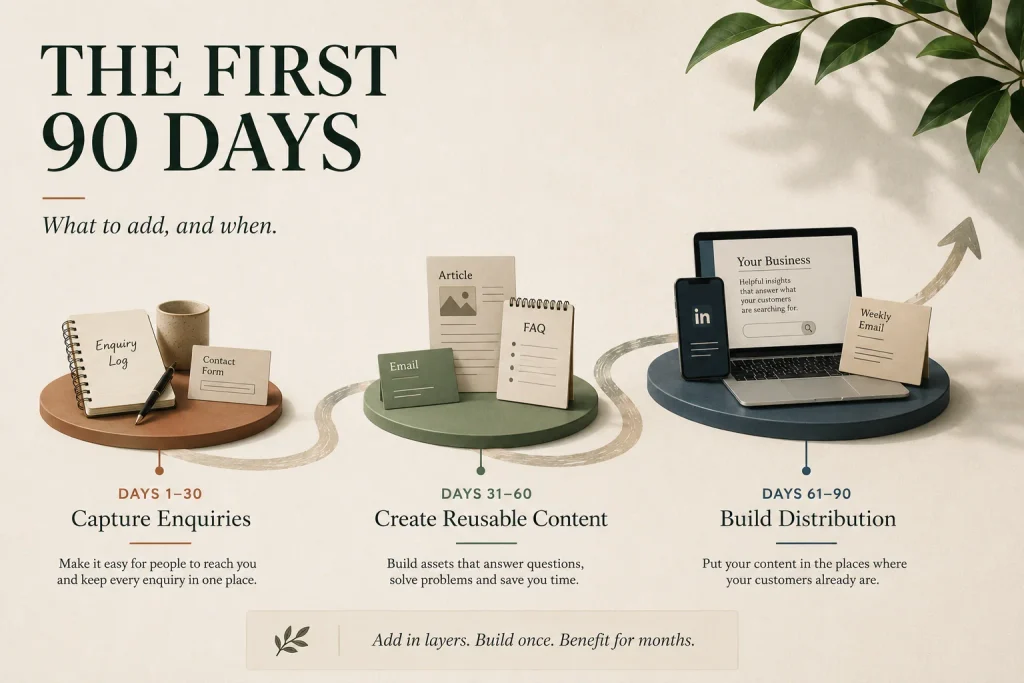
Hire when you have a repeatable process and no hours to run it. If you know which channel produces enquiries, what a qualified one looks like, and what happens next — and you cannot personally do it any more — that is the trigger. You are hiring execution capacity for something proven.
Do not hire to discover what works. That is expensive research, and you will not be able to judge the output because you have no baseline.
A first hire beats a first agency, usually. Someone in-house at ₹35,000 a month who owns response, trade platforms, the Google profile and basic search will outperform a small agency retainer, because most of the work is operational rather than strategic.
Bring in outside help for one-off builds. The service page, the search campaign setup, the trade platform configuration, the response system. These are projects with an end, not retainers.
We sell these services, and that last paragraph is what we actually recommend to businesses of this size.
The SME checklist
☐ Every enquiry channel routed to one place with one named owner
☐ Response time measured for thirty days before changing anything
☐ A response target agreed and enforced — within the hour, during working hours
☐ Referral ask built into your delivery process, with answers recorded
☐ Google Business Profile claimed, complete and with photographs
☐ One trade platform set up properly, if your product is specifiable
☐ Five to fifteen exact search terms live, with negatives reviewed weekly
☐ One service page published with pricing logic, GST number and a working phone number
☐ Qualification definition written in one sentence and agreed with whoever sells
☐ Total marketing hours per week written down and capped honestly
☐ One number reviewed monthly — enquiries answered within target
☐ Everything else deliberately postponed, in writing
Questions we get asked
How much should an SME spend on marketing?
Less than the published percentages suggest, and more carefully. Rather than a share of revenue, work out what a customer is worth and what you can afford to pay to win one. For most Indian SMEs the first useful budget is small — enough to run one paid channel properly — and the bigger investment is the hours.
What is the cheapest way to get B2B leads?
Answering the ones you already get, and asking for referrals. Both are free in rupees. Neither is free in attention, which is why they get skipped.
Should a small business hire a marketing agency?
For one-off builds, often yes. For an ongoing retainer, usually not until you have a process worth scaling. An agency multiplies whatever you already have — including a broken follow-up.
How long before lead generation works for an SME?
Paid search and trade platforms show something within two to four weeks. Referral compounds over a quarter. Content and organic search take six to twelve months, which is why they are not where a time-poor owner should start.
What tools do I actually need?
A phone that gets answered, a shared place where enquiries land, and a way to record what happened. That can be a CRM and often does not need to be. Add tools when a manual process starts failing, not in anticipation of it.
We are a small manufacturer. Does any of this apply?
Most of it, and the trade platform and search items apply strongly. Manufacturing accounts for 20.89% of India’s registered enterprises and manufacturing buyers are among the most likely to search by product name — which makes exact-match search and trade platforms unusually effective.
What to do this week
Two things, and neither costs money.
Write down how many hours a week you can genuinely give marketing. Be honest — most owners say five and have three. That number, not your budget, is what determines your plan.
Then measure your response time for the next thirty days. Every enquiry, from every channel, timed from arrival to first human reply. Most Indian SMEs are shocked by their own number, and fixing it is the highest-return work available to them.
If after both of those you have a process that works and no hours left to run it, that is the moment to get help. you can reach out to us on whatsapp at +91 7738844851 and we will tell you whether a one-off build, a first hire or an agency is the right answer — and it is frequently one of the first two.
More in Blog
Keep reading
All articles →
Ready to talk about your growth?
Tell us what's stuck and we'll tell you what we'd do first. Free, 30 minutes, no pitch.