
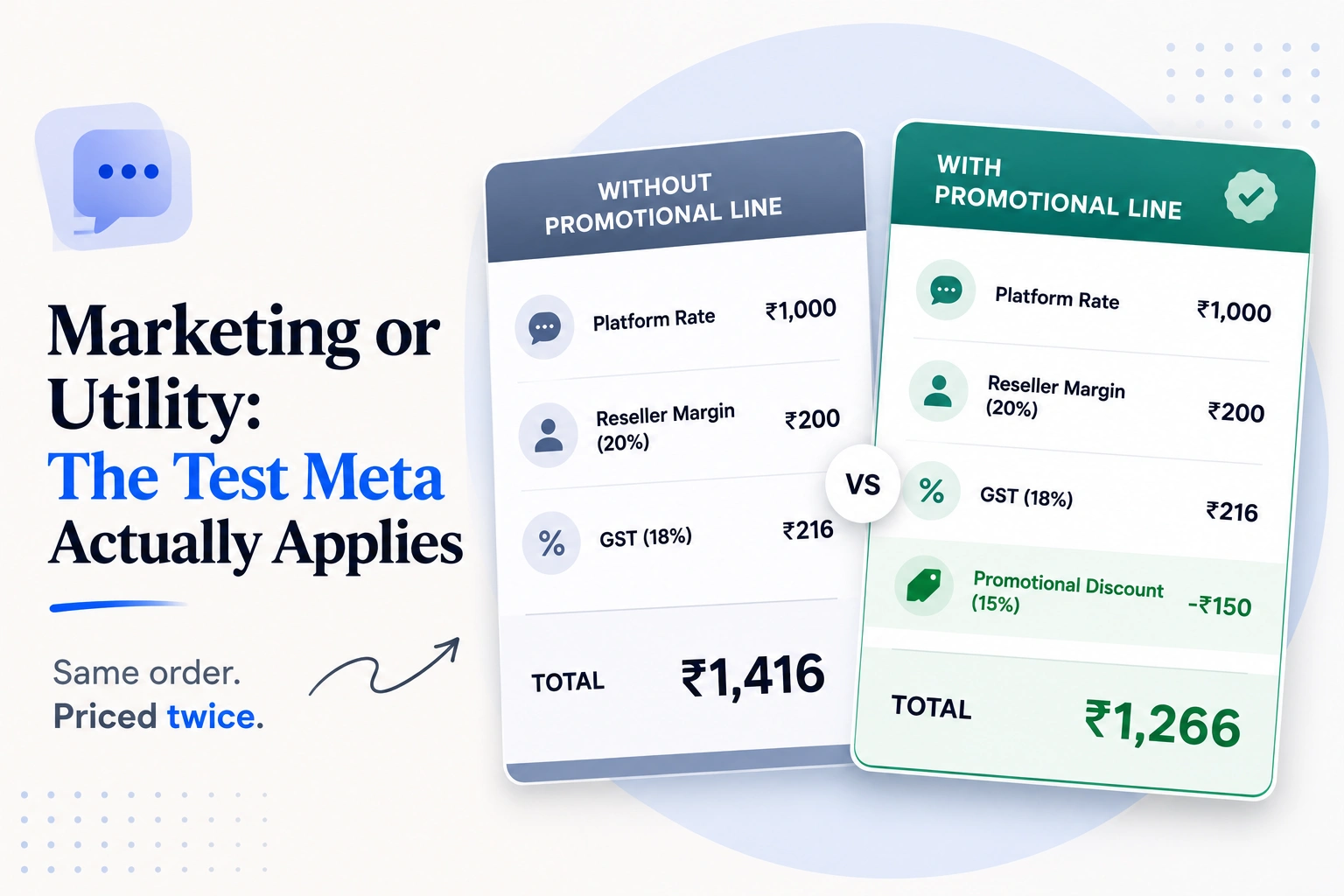
Add one promotional sentence to an order confirmation and its price rises from about ₹0.115 to about ₹0.8631.
Seven and a half times, for a line of text. Which makes template categorisation the most consequential formatting decision in the channel, and it is governed by a two-part test that Meta publishes plainly and almost nobody quotes.
Here it is.
The two gates
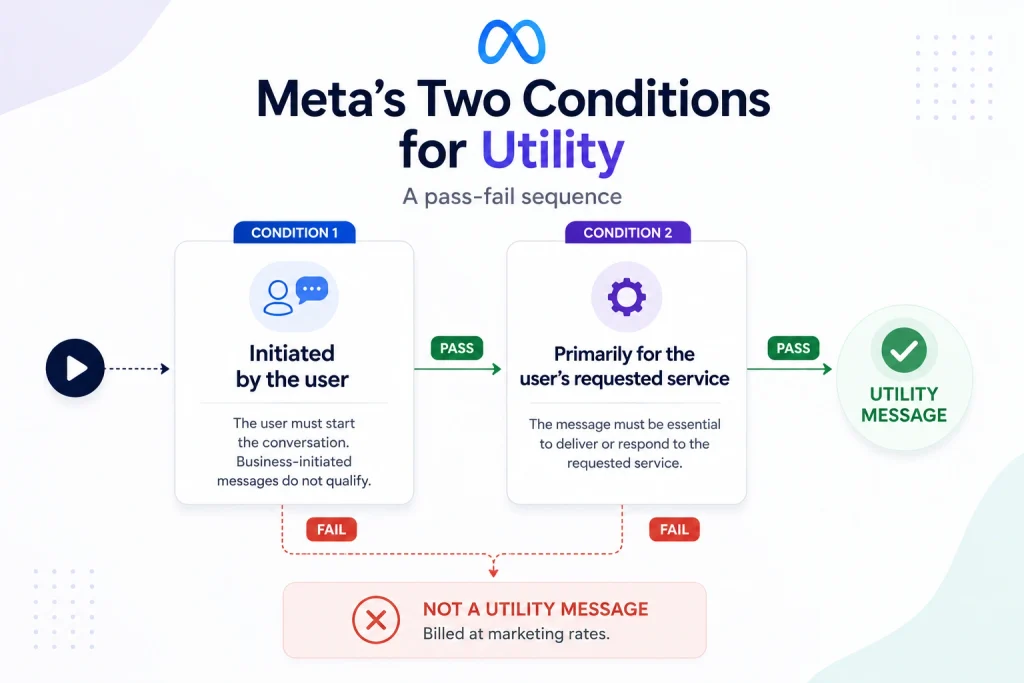
Meta’s own wording, from its template categorisation guidelines:
For a template to be categorized as utility, it needs to meet both criteria below: Must be non-promotional, not containing any promotional or persuasive intent. Must ALSO be either specific to or requested by the user (clearly related to their order, account, services, or transactions) OR essential or critical to the user (for example, to ensure user safety).
Gate one is absolute. Any promotional or persuasive intent and the template is marketing, whatever else is true about it.
Gate two offers a choice. The message must be about this person’s order, account, service or transaction — or it must be genuinely essential to them.
Both gates, not either. A non-promotional message that is not user-specific fails. A user-specific message with a promotional line fails.
Marketing, by contrast, is defined by breadth. Meta describes marketing templates as the most flexible, covering everything from generating awareness to driving sales and retargeting. Marketing is the residual category — it is where a template lands when it does not qualify as anything cheaper.
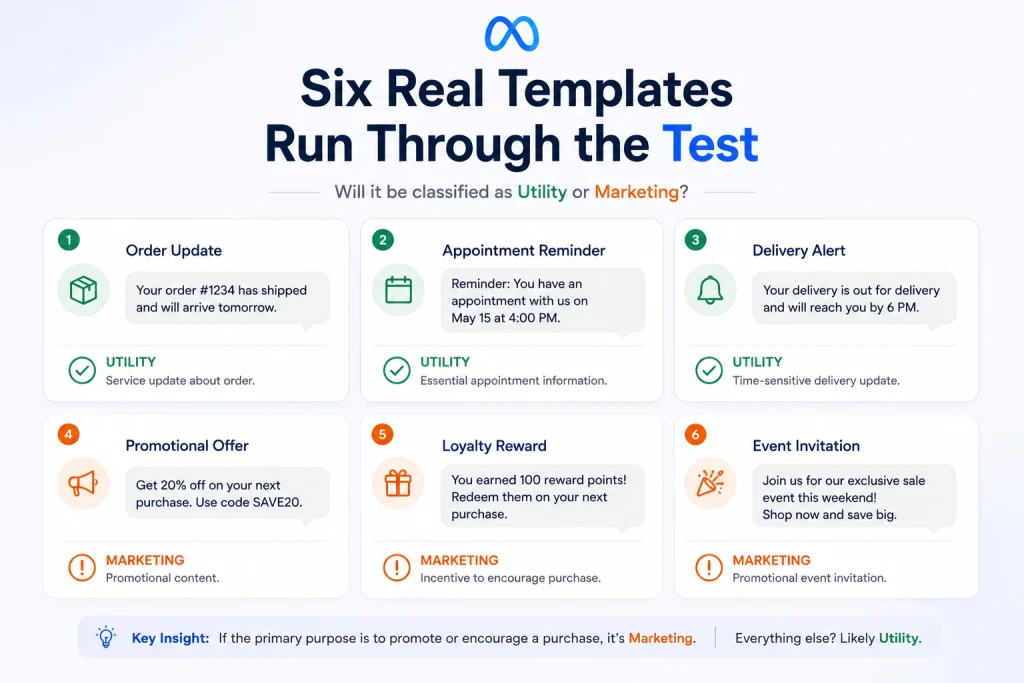
Six templates, run through the test
“Your order #4821 has been dispatched and will arrive on Thursday.”
Non-promotional: yes. User-specific: yes. Utility.
“Your order #4821 has been dispatched. Use DIWALI20 for 20% off your next order.”
Non-promotional: no. Marketing — and now costs seven and a half times more than the version above.
“Your appointment with Dr Shah is confirmed for Saturday at 11am.”
Non-promotional and user-specific. Utility.
“We have slots available this Saturday — book now.”
Not tied to anything this person did. Persuasive. Marketing.
“Your subscription renews on 12 September. Reply STOP to cancel.”
Non-promotional and account-specific. Utility.
“Congratulations!”
Meta names this pattern explicitly. Contents unclear. Marketing.
The pattern is consistent. The question is never how the message is worded. It is whether the message exists because of something the customer did.
The mixed-content trap
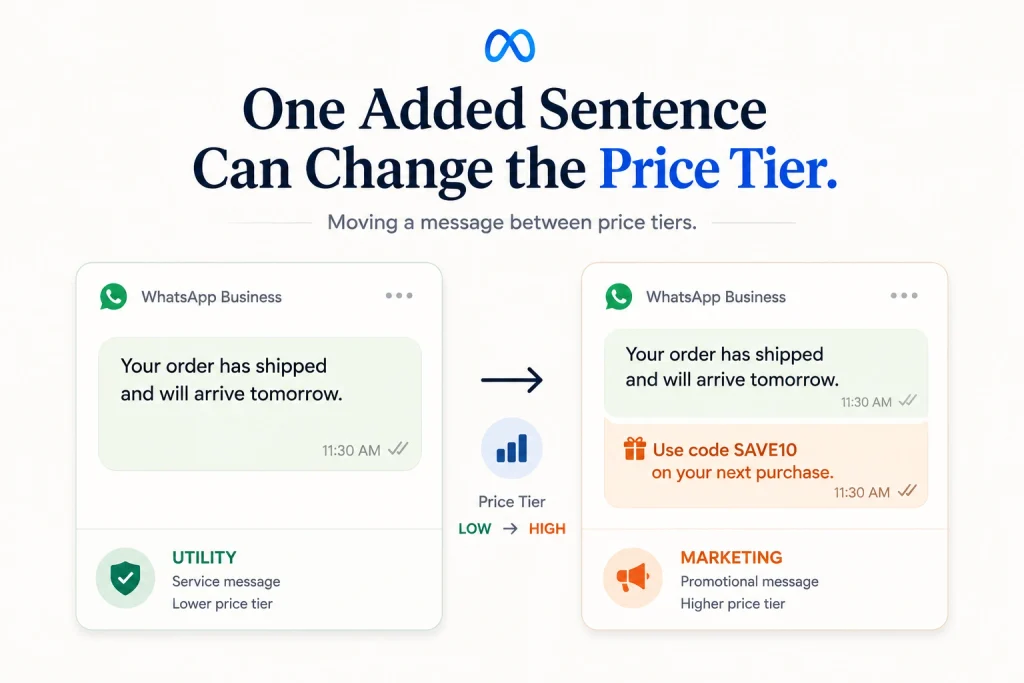
Money leaks here more than anywhere else in the channel, and Meta is specific about it.
Templates with mixed content are categorised as marketing — Meta’s own examples being an order update with a promo, and a feedback survey with promotional content.
So the cross-sell you added to the delivery notification did not get you a free promotion. It moved the entire message from ₹0.115 to ₹0.8631 and you are now paying the marketing rate on every delivery notification you send.
Run the arithmetic on a real volume. A business sending 20,000 order updates a month pays about ₹2,300 at the utility rate before margin and tax. Add a promotional line to the template and the same 20,000 messages cost about ₹17,262. The landed figures are higher again — what a year of WhatsApp actually costs has the full stack.
Roughly ₹15,000 a month for a discount code nobody asked for.
Send them separately if you must send them at all. The utility message stays cheap; the promotion goes out as marketing, to people who opted in, at a volume you chose. Which is a better campaign anyway.
Unclear templates are expensive too
Meta’s second listed trap: templates “where contents are unclear — for example, where contents are only a single variable, or ‘Congratulations!'”.
Which catches a common engineering habit. Templates built almost entirely from variables, so one approved template can serve many purposes, get read as unclear and land in marketing.
Write templates that are legible without their variables filled in. If a reviewer cannot tell what the message says, the cheap rate is not available to you.
You can appeal, and hardly anyone does
Since 9 April 2025, if you submit a template as utility and Meta determines it should be marketing, the template is approved as marketing rather than rejected. You get the higher rate, not an error message.
But the documentation also says this: “You can request a review up to 60 days from the date the category was updated.”
Sixty days. Most businesses discover the recategorisation on an invoice, assume it is final, and never ask.
Appeal when you have a real case — the template is genuinely non-promotional and genuinely tied to a user action, and you can say why in a sentence. Do not appeal a promotional message and hope.
And know that persistent gaming has a penalty. Since 16 April 2025, a business detected abusing the categorisation system stops receiving the 24-hour advance notice before a category is changed. The change simply happens.
The part that is not a writing problem
Here is the uncomfortable conclusion, and it is worth reaching honestly.
Whether you can use the cheap rate is mostly decided by what kind of business you run.
A business with genuine transactional events — orders, bookings, deliveries, renewals, appointments, account changes — has a constant supply of messages that pass both gates. Most of its WhatsApp programme can run at roughly a seventh of the marketing rate.
A business without them cannot manufacture that. A lead generation business, a consultancy, most professional services: the events that would justify a utility message do not occur, and no amount of careful phrasing invents them.
So there are only two honest routes to affordable WhatsApp, and this is one of them. The other is the free windows, which depend on the customer opening the conversation — what the free window is really worth covers what that costs to buy.
If neither is available to you, WhatsApp is a ₹0.8631-a-message channel, and it should be budgeted and judged as one rather than hoped into being cheaper.
Which is occasionally a product insight rather than a marketing one. Businesses that introduce genuine transactional touchpoints — a booking confirmation, a status update, a renewal notice — get a cheaper channel as a side effect of a better customer experience. That is a real reason to build them, and a poor reason on its own.
Questions we get asked
What is the difference between marketing and utility templates?
Utility follows up on something the user did and contains no promotional intent. Marketing is everything else, including anything mixed or unclear. The price difference is roughly seven and a half times.
Why was my utility template changed to marketing?
Almost always promotional content inside a transactional message, or a template too vague to categorise. Since April 2025 Meta approves it as marketing rather than rejecting it, so the first sign is usually the bill.
Can you appeal a WhatsApp template category?
Yes — Meta’s documentation allows a review request up to 60 days from the date the category was updated. Very few businesses use it.
What counts as a utility message on WhatsApp?
It must be non-promotional, and either specific to that user’s order, account, service or transaction, or genuinely essential to them. Both conditions.
Can a utility template include an offer?
No. Mixed content is categorised as marketing, and the whole template is then charged at the marketing rate.
Is authentication the same price as utility?
Broadly similar in India, and only authentication templates may carry one-time passcodes. Marketing and utility templates cannot be used for that.
What to do with your existing templates
Export every approved template and put two columns beside each one: does it contain any promotional or persuasive language, and does it exist because of something that specific customer did.
Anything failing the first column is costing you the marketing rate, and the fix is usually deleting a sentence.
Anything failing the second is marketing whatever you call it, and belongs in a separate opt-in programme rather than dressed as a notification.
Then check when each was last recategorised. Anything inside sixty days is still appealable, and the appeal costs nothing but the time it takes to write one honest sentence.
If you want your template library audited against Meta’s test and the recategorisation history checked, you can reach out to us on whatsapp at +91 7738844851 .
More in Blog
Keep reading
All articles →
Ready to talk about your growth?
Tell us what's stuck and we'll tell you what we'd do first. Free, 30 minutes, no pitch.