
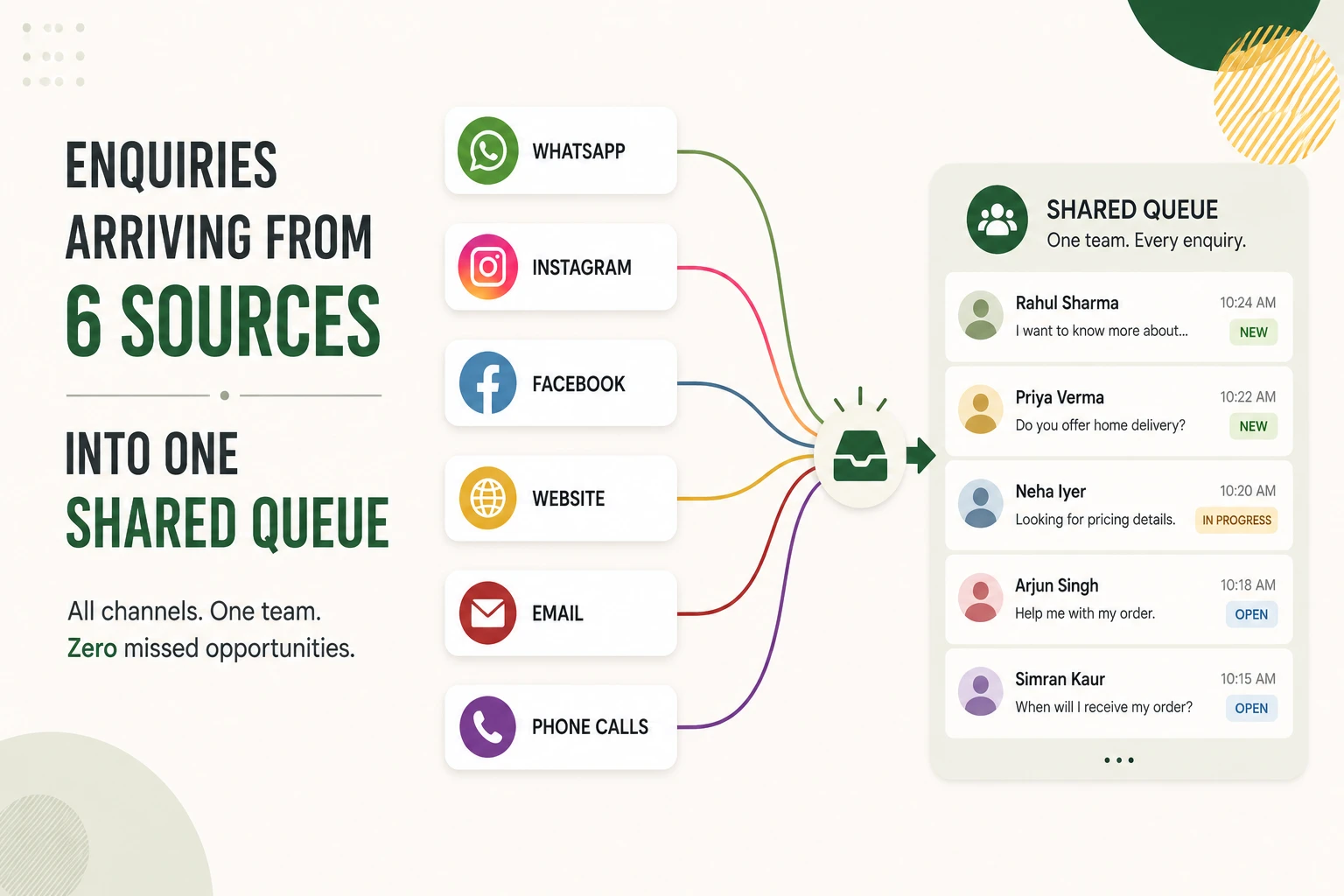
Every published guide on this subject assumes your leads arrive through a web form.
Yours do not. They arrive through IndiaMART. Through JustDial. Through WhatsApp, on a number that belongs to whoever set it up. Through Meta lead forms that download as a CSV nobody remembers to download. Through calls and messages on your Google Business Profile. And, occasionally, through the website form.
Six front doors. Six notification systems. No shared clock, and usually nobody watching all of them at once.
That is the actual problem, and no amount of CRM licensing fixes it on its own.
The short answer
Lead management is the process that runs from the moment an enquiry arrives to the moment it becomes a customer or is honestly closed off. Six stages: capture every enquiry into one place, route it to one owner, respond inside a stated time, qualify it, nurture the ones that are not ready, and feed the outcome back to whatever generated it. Software supports that process. It does not create it — a business with a clear queue and a shared spreadsheet outperforms a business with an expensive CRM and six unwatched inboxes.
Key takeaways
- The Indian problem is fragmentation, not tooling. Six enquiry sources, none of which talk to each other.
- Speed dominates every other variable. Harvard Business Review’s audit of 2,241 companies found an average first response of 42 hours and 23% never responding at all.
- The five-minute research is real and it has caveats. MIT and Kellogg work found 21x higher qualification odds at five minutes versus thirty — from 2007, in the US, published with a vendor. Directionally sound, not a law of physics.
- One queue, one owner, one clock. That sentence is the whole framework.
- Buy software after the process exists, not as a substitute for it.
- Close the loop. If closed-won outcomes never reach your ad platforms, you are optimising toward form fills rather than revenue.
The six front doors
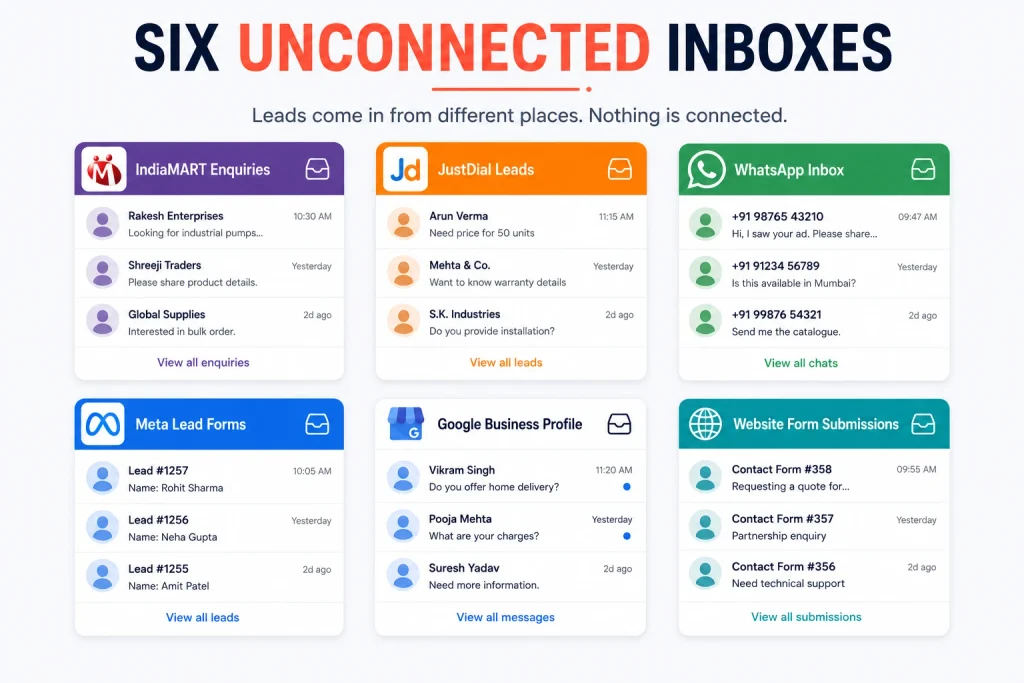
Worth being specific, because the specificity is the point.
IndiaMART. Enquiries arrive in a portal, are shared with competitors simultaneously, and go stale within hours. Speed matters here more than anywhere — getting enquiries out of IndiaMART properly covers the mechanics.
JustDial and directory listings. Usually calls. Frequently to a mobile that belongs to one person, whose availability becomes your response time.
WhatsApp. The default channel for Indian buyers, and the least governed. Messages sit in a personal app, unlogged, unassignable, invisible to anyone else.
Meta lead forms. Fast to fill, high volume, variable quality. They accumulate inside the platform unless something pulls them out.
Google Business Profile. Calls, direction requests and messages. Messages in particular go unanswered for days because nobody thinks of the profile as an inbox.
The website form. The only door the international guides discuss, and often the smallest of the six.
The failure is structural. Each door has its own notification, its own owner-by-accident, and its own clock. An enquiry can sit for four days without anybody being wrong, because nobody was responsible.
What lead management is, and what a CRM is not
Lead management is a process. Capture, route, respond, qualify, nurture, close the loop. It exists whether or not you have software, and in most Indian SMEs it exists badly.
A CRM is a database with workflow attached. It records what your process does. It cannot decide who owns an enquiry, how fast you answer, or what qualifies. Those are decisions, and buying software before making them produces an expensive record of a broken process.
The honest test. If you cannot describe, out loud, what happens in the first thirty minutes after an enquiry arrives, no system will help yet.
The Single Queue
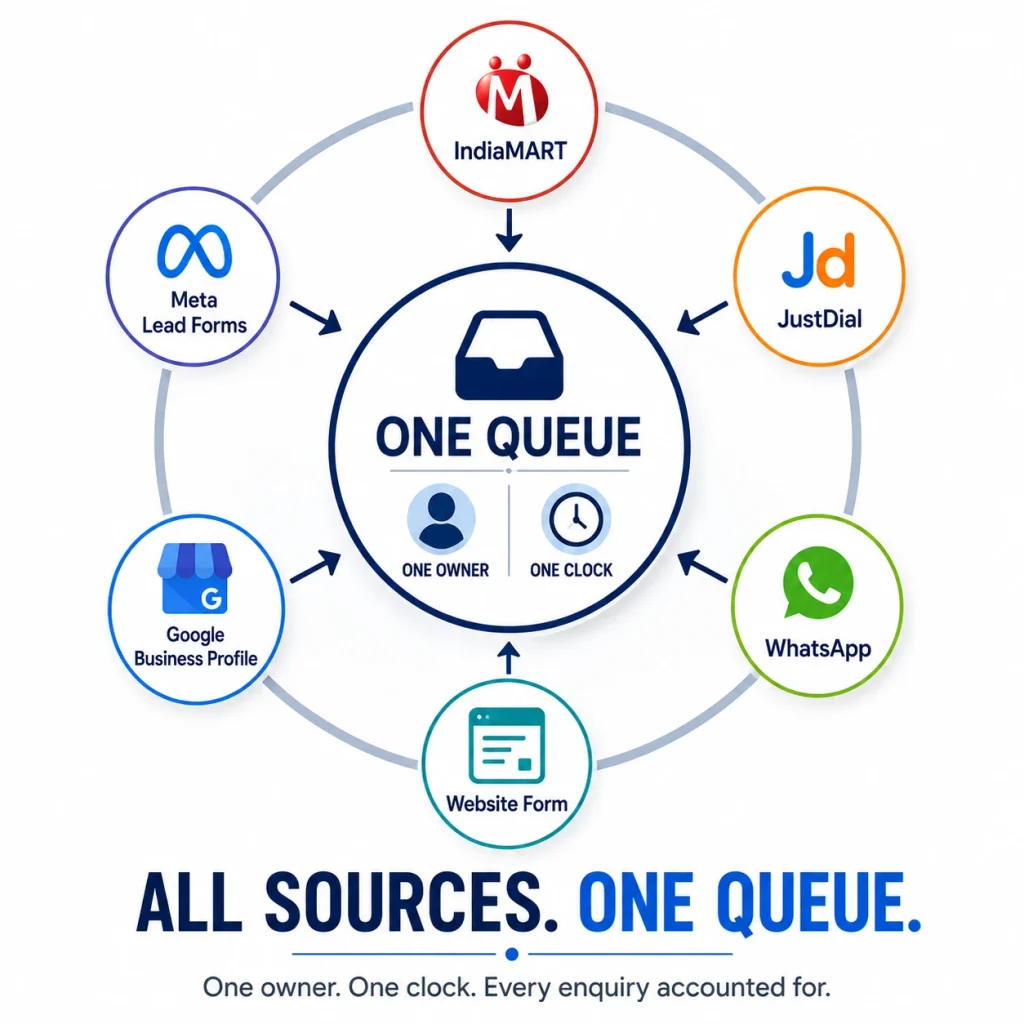
Every enquiry, whatever door it came through, lands in one queue with one named owner and one clock running. Everything else in lead management is detail hanging off that sentence.
Three components, and all three are non-negotiable.
One queue. A single place where every enquiry from every source appears. This can be a CRM, a shared inbox, a WhatsApp Business shared account, or a spreadsheet somebody actually watches. The technology matters far less than the singularity.
One owner. A named person responsible for the queue, not a team. “Sales handles it” is how enquiries die. Rotation is fine; ambiguity is not.
One clock. A response target measured in minutes or hours, visible to everyone, and reviewed weekly. Without a clock there is no way to tell a good day from a bad one.
Why this beats better tooling. A queue makes leakage visible. Six inboxes hide it — nobody can see the enquiry that nobody answered, because nobody was looking at that door.
The six stages
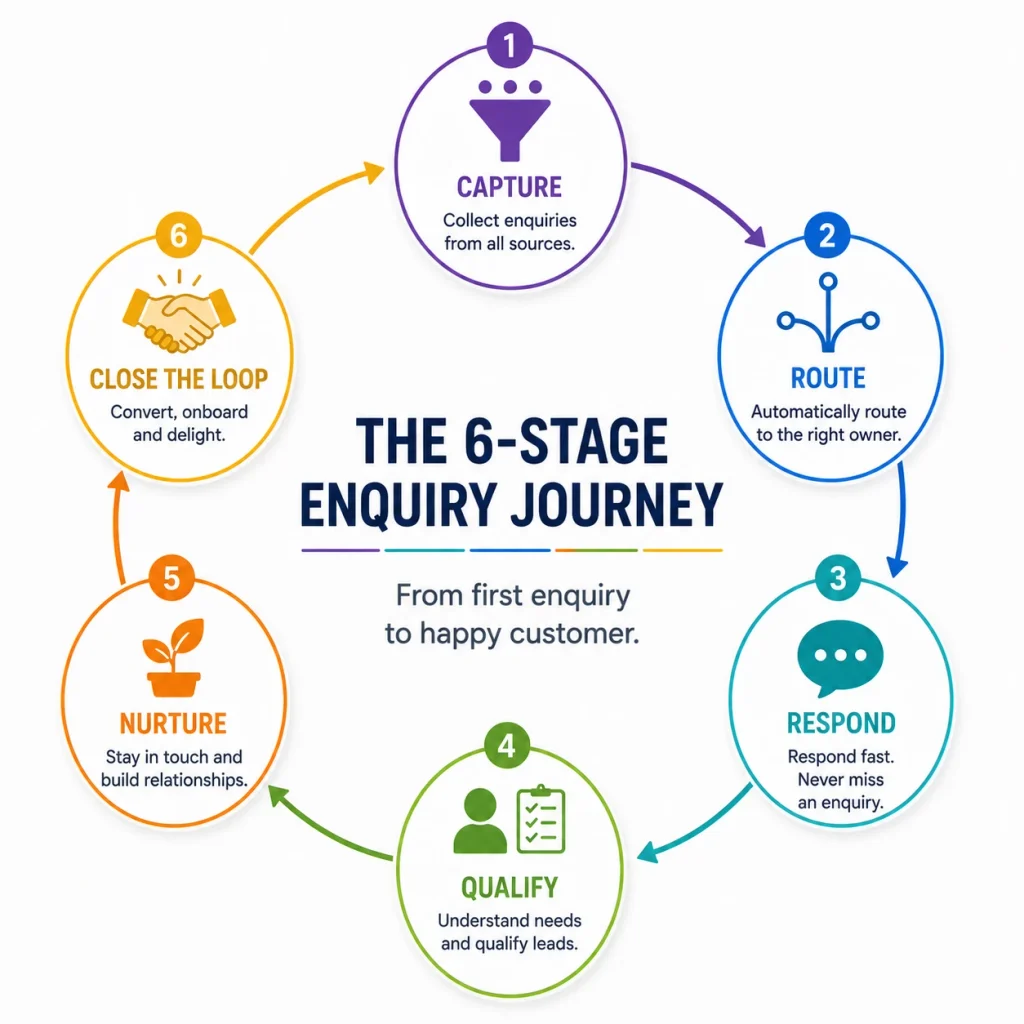
Each stage has one job. Get the job wrong and every stage after it inherits the error.
One — capture
The job. Every enquiry from every source arrives in the queue, with its source recorded.
What to do. Connect what can be connected — website forms, Meta lead forms and Google messages can all be routed automatically. Then handle the rest by discipline: a shared WhatsApp Business account rather than a personal one, and a named person who checks IndiaMART and JustDial on a schedule.
What breaks. Source attribution. If you cannot tell which door a lead came through, you cannot tell which advertising works, and every budget decision after that is guesswork.
Two — route
The job. The enquiry reaches a specific human within minutes.
What to do. Write the routing rules down. By territory, by product, by size, by language — whatever fits. Then write down what happens when that person is unavailable, because that is the rule that actually gets used.
What breaks. Silent handoffs. An enquiry passed verbally between two people is an enquiry with no owner.
Three — respond
The job. Make contact fast enough to matter.
The evidence, with its provenance. Research by Dr James Oldroyd at MIT Sloan with Kellogg, published with InsideSales.com in 2007, surveyed 495 companies and analysed over 15,000 leads and 100,000 call attempts. It found the odds of qualifying a lead were 21 times higher when contact happened within five minutes rather than thirty.
Read that carefully. It is 2007 data, from the US, published in partnership with a company selling speed-to-lead software. The direction is corroborated by everything we see in client accounts. The precise multiple should be treated as indicative rather than exact — and we would rather tell you that than quote it as gospel the way most agency pages do.
The more damning number is newer and cleaner. Harvard Business Review’s audit of 2,241 companies found an average first response time of 42 hours, with 23% never responding at all. Those were firms with sales teams and budgets.
What to do. Set a target in minutes for hot sources like IndiaMART and Meta forms. Acknowledge instantly, even automatically, and follow with a human contact. Measure the gap weekly, per source.
Four — qualify
The job. Decide, on stated criteria, whether this lead is worth sales time.
What to do. Write down what qualified means for your business before you score anything — what actually makes a lead qualified covers the criteria in depth.
What breaks. Qualification by feel, which drifts. Two salespeople with different standards produce a pipeline nobody can forecast from.
Five — nurture
The job. Keep the not-yet-ready in contact until they are ready.
Why it matters more in India than the guides suggest. With six enquiry sources, a large share of arrivals are early — people comparing, price-checking, or sent by a colleague. Closing them now is not possible. Losing them is optional.
What to do. Something useful on a schedule you can sustain. Email works. So does a WhatsApp broadcast, used sparingly. The mistake is discounting, which trains buyers to wait.
Six — close the loop
The job. Push the outcome back to whatever generated the lead.
The most-skipped stage, and the most valuable. If your ad platforms never learn which leads became customers, they optimise toward whatever is easiest to generate — which is usually the cheapest and worst leads. Google’s offline conversion import exists exactly for this.
What to do. Record closed-won and closed-lost against the original source. Feed closed-won values back into Google and Meta. Then judge campaigns on revenue rather than form fills — which metric should govern your decisions sets out how to choose.
Where leads actually disappear
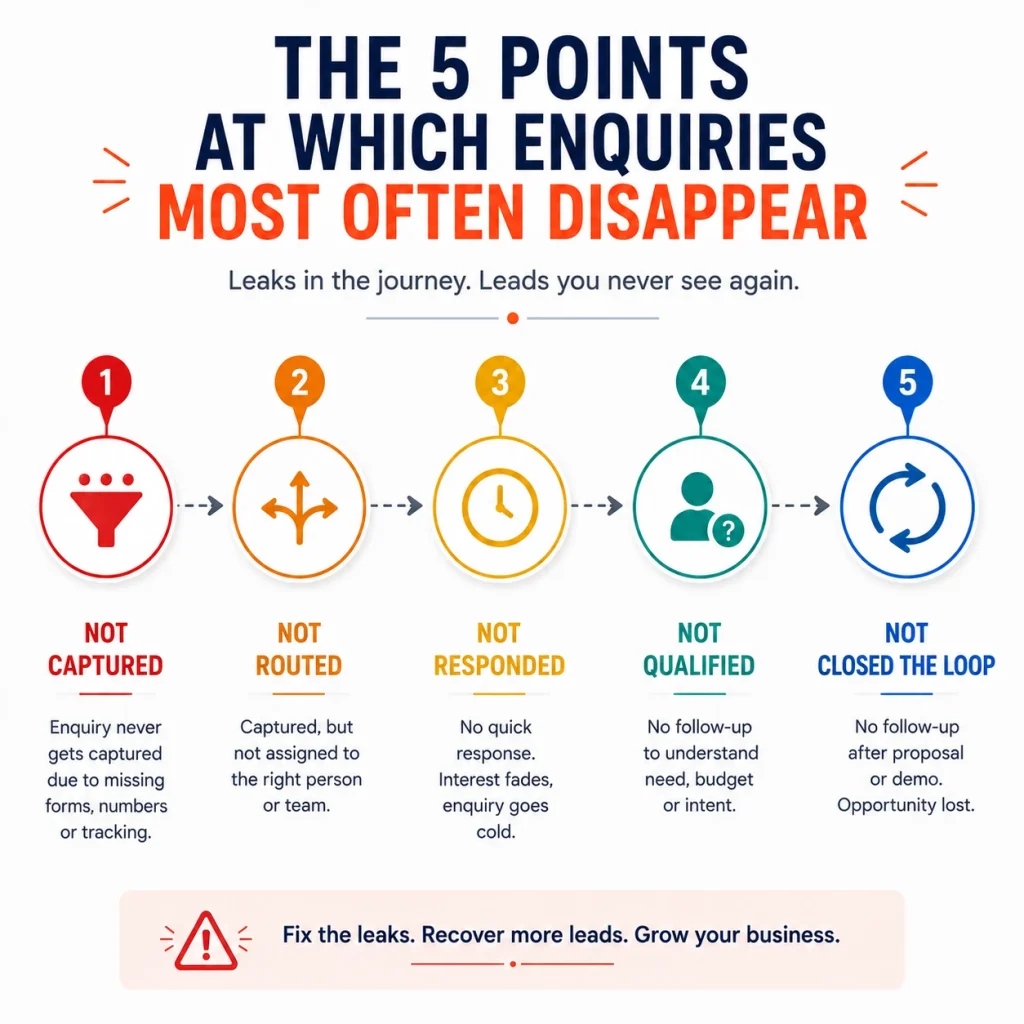
Five points, in the order we most often find them.
Between the door and the queue. Nobody moved the enquiry from the platform to the place work happens.
Between the queue and a person. In the queue, unassigned, technically visible, practically invisible.
In the first hour. Assigned but not contacted while the buyer talks to three competitors.
After one attempt. One call, unanswered, marked as dead. Most enquiries need several attempts across more than one channel.
In the nurture gap. Correctly identified as not-ready, then never contacted again.
A quick way to size the problem. Take last month’s enquiries. Count how many got a reply within one hour. Multiply the shortfall by your close rate and average order value. For most businesses we assess, that figure exceeds the entire monthly advertising budget — which makes fixing it the cheapest growth available.
Tooling — what to buy, and when
Nothing, until the process exists. A queue in a spreadsheet with a named owner and a one-hour target beats a CRM implementation with neither.
Then the smallest thing that holds the queue. For most Indian SMEs that means an entry-tier CRM with WhatsApp integration and web-form capture. Zoho dominates this segment on price and local support; HubSpot’s free tier is genuinely usable; Freshsales sits between them.
We have written the comparisons rather than repeating them here — Zoho CRM against HubSpot for Indian teams, Zoho CRM against Freshsales, and whether Zoho One is worth it if you are considering the wider suite.
Then automation, narrowly. Automate acknowledgement, routing and reminders. Do not automate the first human contact; buyers can tell.
A note on where Indian businesses actually are. SIDBI’s 2025 survey of over 2,000 MSMEs across 19 industries found more than 90% now accept digital payments while only 13% actively use digital marketing or e-commerce. The gap between “we took the money digitally” and “we managed the enquiry digitally” is wide, and it is where most of the available growth sits.
Mistakes that cost the most
Buying the CRM first. It records a broken process in higher resolution.
Leaving WhatsApp personal. The highest-volume channel in India, running on somebody’s private phone, unlogged and unassignable. When they leave, the history leaves.
Treating one call as follow-up. Most enquiries need several attempts, and the second attempt closes more than the first.
No source attribution. Without it, every budget decision is a guess, and the loop in stage six cannot be closed at all.
Advertising harder while the queue leaks. Paying to generate enquiries you will not answer is the most expensive line item any business can run.
Measuring form fills as the outcome. They are the beginning of the process, not the end of it.
When this is not your problem
When enquiry volume is genuinely tiny. Under about twenty a month, a disciplined spreadsheet is the correct answer and any consultant recommending a platform is selling.
When the constraint is capacity, not follow-up. If you are turning work away, better lead management makes the problem louder.
When the offer is not competitive. Faster responses to an uncompetitive proposal produce faster rejections.
When the real gap is upstream. If enquiry volume itself is too low, start with which audience to spend on first instead.
Implementation checklist
☐ Every enquiry source listed, including the ones nobody officially owns
☐ One queue chosen — CRM, shared inbox or spreadsheet
☐ One named owner of that queue, with a stated deputy
☐ Response target set in minutes or hours, per source
☐ WhatsApp moved from a personal number to a shared business account
☐ Website and Meta lead forms routed into the queue automatically
☐ Google Business Profile messages checked daily by a named person
☐ IndiaMART and JustDial checked on a written schedule
☐ Source recorded on every enquiry, without exception
☐ Qualification criteria written down and agreed with sales
☐ Minimum follow-up attempts defined, across more than one channel
☐ Nurture sequence running for the not-yet-ready
☐ Closed-won and closed-lost recorded against original source
☐ Closed-won values fed back to Google and Meta
☐ Response time and leak points reviewed weekly
Questions we get asked
What is the lead management process?
Capture, route, respond, qualify, nurture, close the loop. Six stages from enquiry to outcome, with the outcome fed back to whatever generated the enquiry.
What is the difference between a CRM and a lead management system?
A CRM is software that stores and moves records. Lead management is the process it records. You can run the process without the software; you cannot get value from the software without the process.
What are the stages of lead management?
The six above. Most published models list four or seven, and most omit the last one, which is the one that improves your advertising.
How do you manage leads without a CRM?
One shared spreadsheet, one named owner, one response target, source recorded on every row. Under twenty enquiries a month this is not a compromise — it is the right tool.
What is a good lead response time?
Under an hour for most businesses, under fifteen minutes for shared-enquiry platforms like IndiaMART where competitors receive the same lead simultaneously. The research suggests five minutes is materially better than thirty; the realistic target is whatever you can sustain every day rather than a number you hit occasionally.
We already have a CRM and leads still get lost. Why?
Almost always because some of the six doors do not feed it. WhatsApp and directory calls are the usual culprits.
Where to go next
This page is the survey. The detail lives in the articles below, which go deeper on each stage.
On speed — lead response time and what the five-minute research actually supports.
On diagnosis — how to run a lead leakage audit on your own business.
On tooling — choosing a CRM for a small Indian business, and implementing one without a six-month project.
On WhatsApp — using the Business API for follow-up rather than broadcast.
On the loop — importing offline conversions into Google Ads so bidding optimises toward revenue.
Start with one number
Before changing any system, measure one thing: the share of last month’s enquiries that received a human reply within one hour.
Most businesses guess high. The measured figure is usually under a third, and it is nearly always the largest single constraint on revenue in the business — larger than the advertising budget, larger than the website, larger than the pricing.
If you would like that measured properly across all six of your enquiry sources, you can reach out to us on whatsapp at +91 7738844851 .
More in Blog
Keep reading
All articles →
Ready to talk about your growth?
Tell us what's stuck and we'll tell you what we'd do first. Free, 30 minutes, no pitch.