
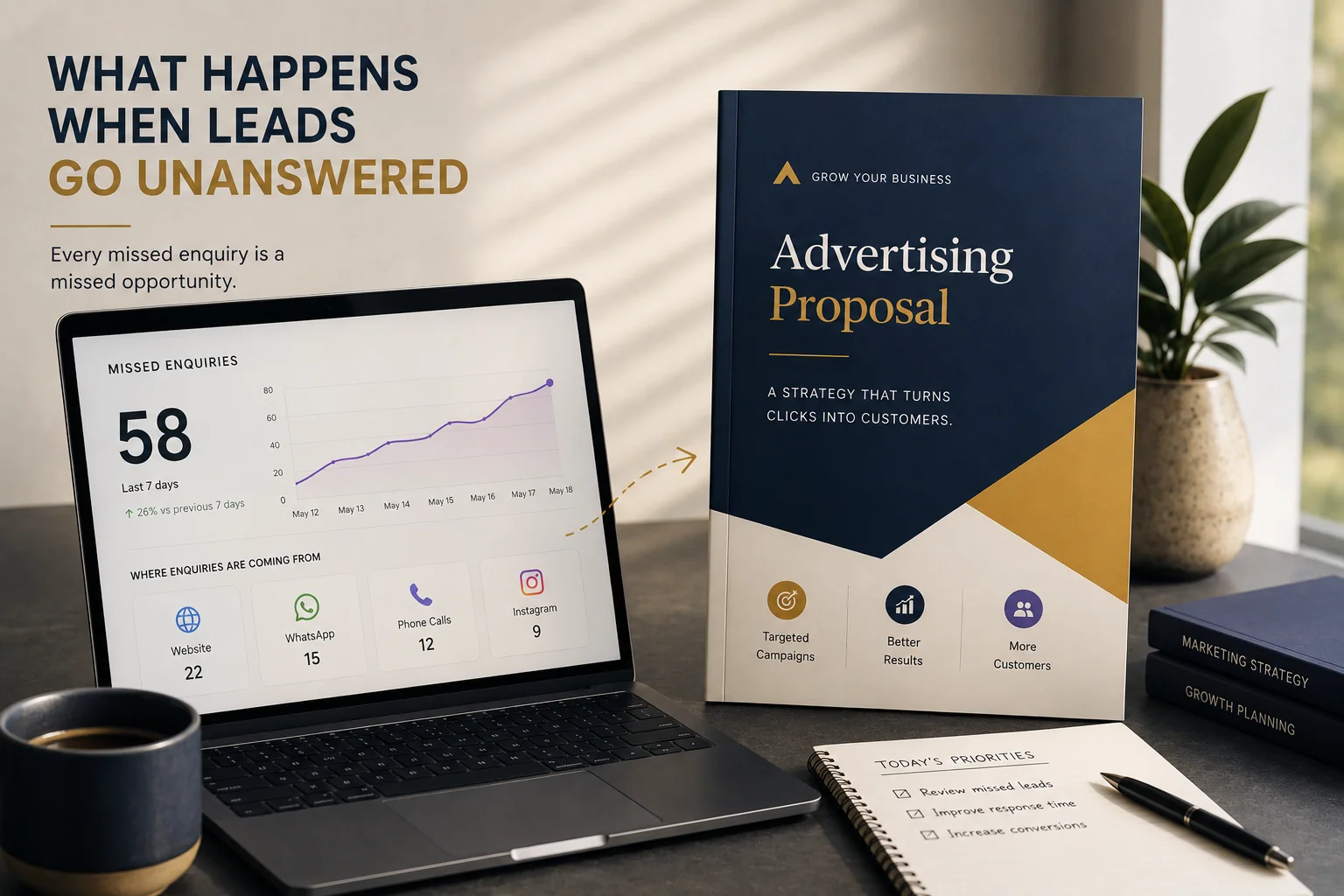
Most advice written for smaller businesses lists ten things to do and puts them in no particular order. SEO, Reels, WhatsApp, influencers, email, paid ads. All defensible. None of it tells an owner with ₹80,000 a month and no marketing team what to do on Monday.
So here is the order, and the reasoning behind it.
The short answer
An established smaller business already generates demand — enquiries, referrals, people searching its name, customers who bought before. That demand is nearly always under-captured. Spend outward from it: unanswered enquiries first, then people searching your name, then past customers, then people searching your category, then strangers. Each ring costs more per customer than the one inside it. Most SME budgets are told to start at the outermost ring, which is both the most expensive and the least likely to work first.
Key takeaways
- SIDBI’s 2025 survey of over 2,000 MSMEs found more than 90% accept digital payments while only 13% actively use digital marketing — and close to 70% still run on referrals, print and trade events.
- That describes a business with demand, not a business without it. The problem is capture, not awareness.
- Rings get more expensive outward. Answering an existing enquiry costs nothing in media. Converting a stranger on paid social costs the most of anything you can buy.
- Follow-up speed is usually worth more than the ad budget. Harvard Business Review’s audit of 2,241 companies found an average first response of 42 hours and 23% never responding at all.
- We sell paid media, and we are telling you it comes fourth. That is not modesty — it is what the arithmetic says.
Why the listicle fails an SME specifically
A large company can run ten things at once badly and still see results, because volume covers the errors.
An SME running ten things at once is one person doing all of them for two hours a week. Nothing gets the attention to work, and the owner concludes that digital marketing does not work for their kind of business.
The missing ingredient is sequence. Not more tactics — an order, with a rule for when to move to the next one.
The Nearest Rupee
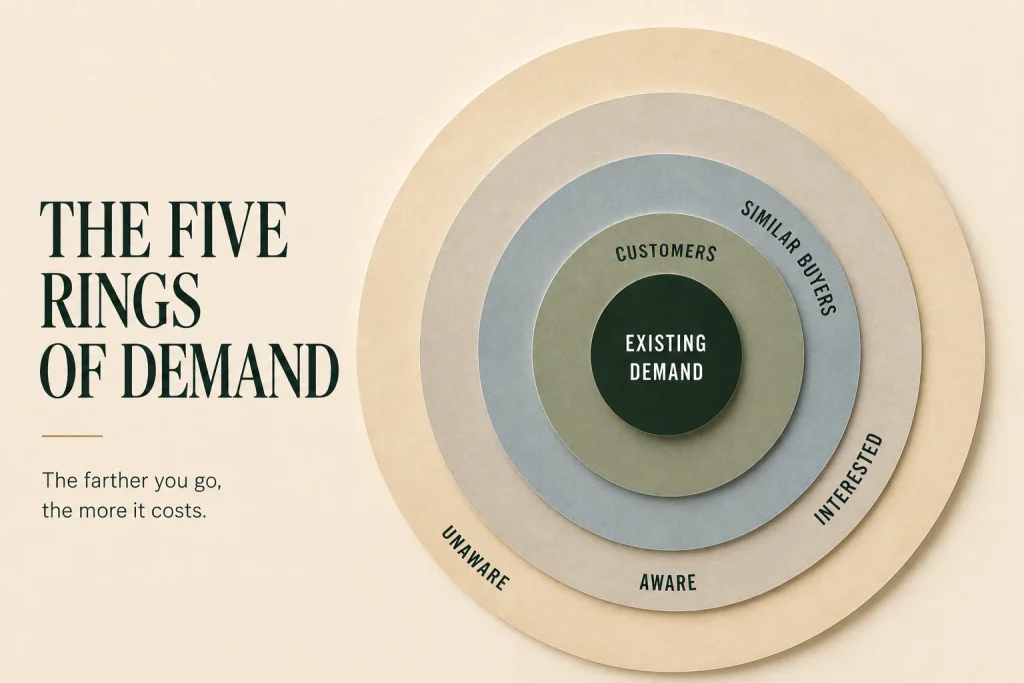
Spend outward from demand you already have. Each ring of audience costs more per customer than the ring inside it, so no outer ring gets funded while an inner one is still leaking.
Five rings. The rule is the same at every boundary: fix the inside before paying for the outside.
Ring one — enquiries you have already received
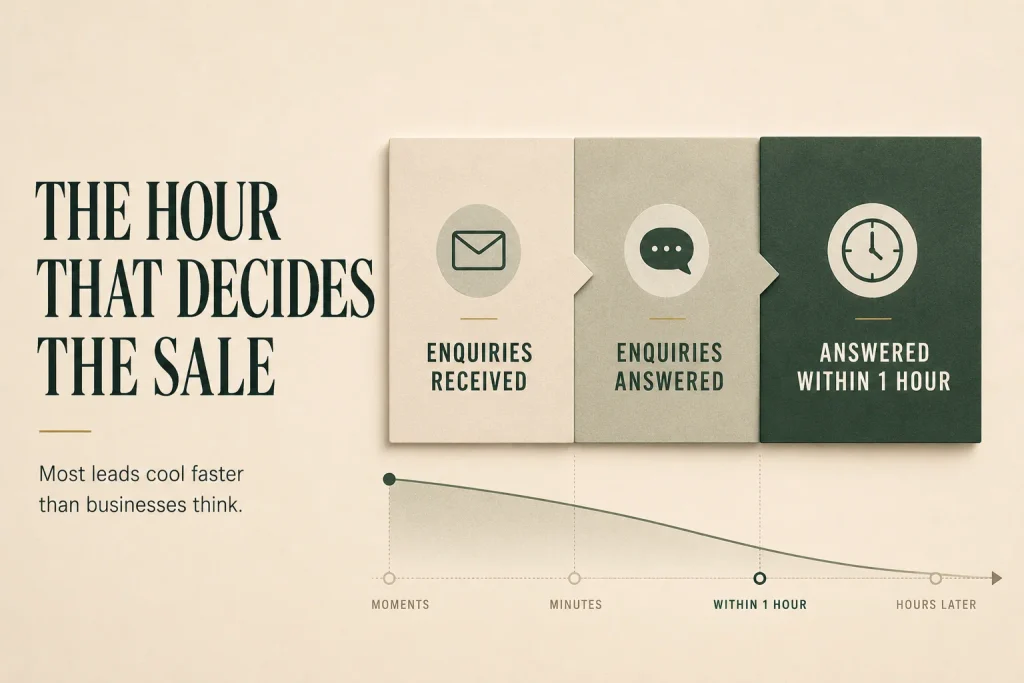
Cost in media: zero.
Every SME has them. The WhatsApp message answered two days later. The enquiry form that goes to an inbox nobody opens. The missed call at 7pm that nobody returned.
Harvard Business Review’s audit of 2,241 companies found an average first response time of 42 hours, and that 23% never responded at all. Those are large firms with sales teams. Small businesses are not doing better.
Work out what this is worth before spending anything. Take last month’s enquiries, count how many got a reply within an hour, and multiply the gap by your close rate and average order value. For most businesses we look at, that number exceeds the entire proposed ad budget.
What to do. One owner of enquiries. A response target in hours, not days. Every channel — phone, WhatsApp, web form, Google profile — landing in one place somebody actually watches.
This is not marketing. It is why marketing has not worked.
Ring two — people searching for you by name
The cheapest paid audience that exists.
Somebody heard about you from a friend, wrote your name into Google, and found a competitor’s ad above your listing. That customer was yours and was resold.
Two things cover this ring. A completed Google Business Profile with current hours, photos, services and recent reviews. And, if competitors bid on your name, a small brand-term search campaign — the highest quality score and lowest cost per click you will ever run, because the searcher already wants you.
Why this ring is skipped. It looks too small to matter. The volumes are low and the returns are proportionally enormous, which no agency proposal ever leads with because there is very little to bill against it.
Ring three — customers who already bought
Cost: the price of a message.
An SME with three years of trading has a customer list, whether or not it is in a system. Repeat purchase, upgrades, referrals and dormant accounts sit there, and reaching them costs a fraction of finding someone new.
What to do. Export the list. Send something useful rather than a discount. Upload it as a customer match audience on Google and Meta so past buyers are not treated as strangers by your ad accounts.
Do this before prospecting, because the same list also builds better lookalike audiences later — which makes ring five cheaper when you eventually reach it.
Ring four — people searching for what you sell
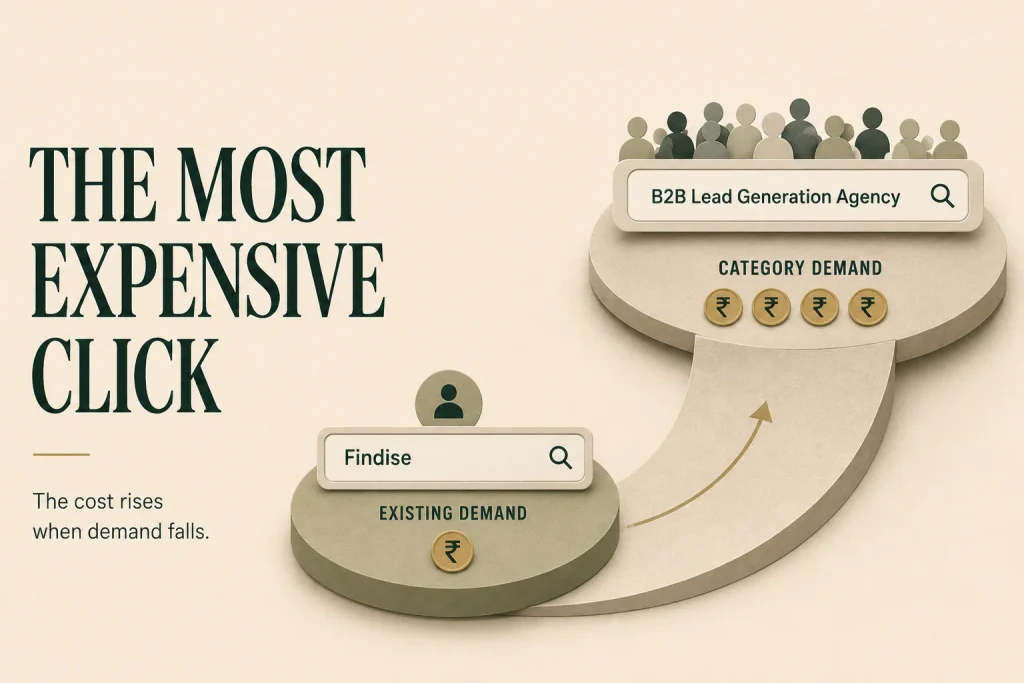
The first ring where real money starts.
Somebody types “CNC machining Mumbai” or “GST filing for small business.” They do not know you. They do know they have the problem, which puts them far ahead of anyone on a social feed.
Search advertising belongs in this ring, and it deserves the bulk of an SME’s first paid budget. Demand already exists; you are competing for it rather than creating it.
It is also the first ring with a real minimum. Google’s automated bidding wants at least 30 conversions in 30 days before it can optimise properly — what each stage costs to run properly sets out the arithmetic. Below that floor, spread the budget across fewer campaigns rather than more.
The honest caveat. Some categories have no category search. If nobody in India searches for what you sell, this ring is empty and you skip to the next one knowing your costs will be structurally higher.
Ring five — strangers with the problem
The most expensive customer you can buy, and where most proposals start.
Paid social prospecting on Meta, Instagram and LinkedIn reaches people who have never heard of you and were not looking. It works. It is also the slowest to prove and the most demanding of budget — Meta’s ad sets need roughly 50 optimisation events a week before delivery stabilises, which at a ₹700 lead is over ₹1.5 lakh a month for one ad set.
Two conditions before funding this ring. The four inside it are working, and you can afford the floor without starving them.
Why proposals start here. It is the ring with the largest billable media budget and the most impressive-looking deck. We build these campaigns and they are genuinely effective — for businesses that have finished the rings inside.
What this looks like on ₹80,000 a month
A rough shape for an established Mumbai service business, not a template.
Month one. Nothing on media. Fix enquiry handling, complete the Google Business Profile, install and verify conversion tracking. Ask for reviews from the last twenty customers.
Month two. A small brand-term campaign if competitors are bidding on your name. One message to the existing customer list. Still under ₹15,000 in media.
Months three to five. Category search, concentrated on your two or three clearest intent terms. Enough budget on one campaign to clear the conversion minimum — most of the ₹80,000 lives here.
Month six onward. If search demand is fully captured and you still want growth, that is the moment paid social earns its place.
The order matters more than the numbers. Businesses that run this sequence usually discover somewhere in month two or three that the constraint was never the advertising.
Mistakes that cost SMEs the most
Buying the outer ring first. Everything in this article, in one sentence.
Running five channels on a one-channel budget. Nothing accumulates enough data to be judged, and the conclusion is always that none of it worked.
Advertising while enquiries go unanswered. Paying to generate leads you will not call is the most expensive thing on this list.
Judging month one. Search advertising takes weeks to stabilise; a business with a two-month sales cycle cannot read results in four weeks.
Confusing activity with capture. Posting daily on Instagram while the Google Business Profile has 2019 hours and no reviews is effort spent in the wrong ring.
Accepting “₹5,000 a month” as a starting budget. It appears in a lot of Indian marketing content. It is below the point where any platform can learn anything, and it produces exactly the disappointing result that convinces owners this does not work.
When performance marketing is not the answer
When the phone is not being answered. Fix ring one. It costs nothing and it changes everything else.
When the business is at capacity. Generating demand you cannot service damages the reputation that referrals depend on.
When margins cannot carry acquisition costs. Some businesses genuinely cannot afford paid customers, and a good agency says so on the first call.
When referrals are still growing on their own. If word of mouth is compounding, the higher-return work is usually helping it compound faster.
When the website cannot convert. Traffic to a page that does not work is money converted into bounce rate — making the page do its job comes first.
The order of operations
☐ One person owns enquiries, across every channel
☐ Response time measured in hours and tracked weekly
☐ Missed-enquiry value calculated and compared against the proposed ad budget
☐ Google Business Profile complete — hours, services, photos, current information
☐ Review requests sent to recent customers, and every review answered
☐ Conversion tracking installed and verified against your own records
☐ Brand-term protection checked — search your own name and see who appears above you
☐ Customer list exported and uploaded as a match audience on Google and Meta
☐ Category search demand checked before assuming it exists
☐ Budget floor calculated for the one channel you will start with
☐ One channel funded properly rather than four funded partly
☐ Outer ring left unfunded until every ring inside is working
Questions we get asked
How much should a small business spend on digital marketing?
Enough to clear the learning minimum on one channel, which usually means ₹30,000–₹50,000 a month in media once you reach ring four. The rings inside cost far less. Calculate from your own cost per conversion rather than accepting a percentage-of-revenue rule.
Which strategy is best for SMEs in India?
The one nearest your existing demand and not yet finished. For most established businesses that is enquiry handling, the Google Business Profile, and category search, in that order.
Is performance marketing worth it for a small business?
Once the inner rings are working, yes — search particularly, because demand already exists and you are capturing rather than creating it. Before then it usually converts a fixable operational problem into a recurring media cost.
How long does it take to show results?
Ring one changes within days. Search campaigns need four to six weeks to stabilise and longer if your sales cycle is long. Paid social prospecting needs a quarter before the numbers mean anything.
Should an SME hire an agency or do it in-house?
Rings one to three are owner’s work and should stay in-house — nobody outside your business can answer your enquiries faster. Rings four and five benefit from experience. How to choose an agency without being sold to covers what to ask.
Everyone tells me to post on Instagram. Are they wrong?
Not wrong, just out of order. Social presence supports the rings; it rarely captures demand on its own for a business selling something people search for.
The uncomfortable part
SIDBI’s survey found roughly seven in ten Indian MSMEs still running on referrals, print and trade events, while only 13% use digital marketing at all.
The usual reading is that those businesses are behind. The more useful reading is that they have built demand through relationships and are simply not catching all of it — and catching it costs far less than manufacturing new demand from strangers.
We sell paid media. We are telling you it belongs fourth on the list, because we would rather have a client whose first three rings work than a campaign that gets blamed for a phone nobody answers.
If you want an honest look at which ring your business is actually leaking from, you can reach out to us on whatsapp at +91 7738844851 .
More in Blog
Keep reading
All articles →
Ready to talk about your growth?
Tell us what's stuck and we'll tell you what we'd do first. Free, 30 minutes, no pitch.