
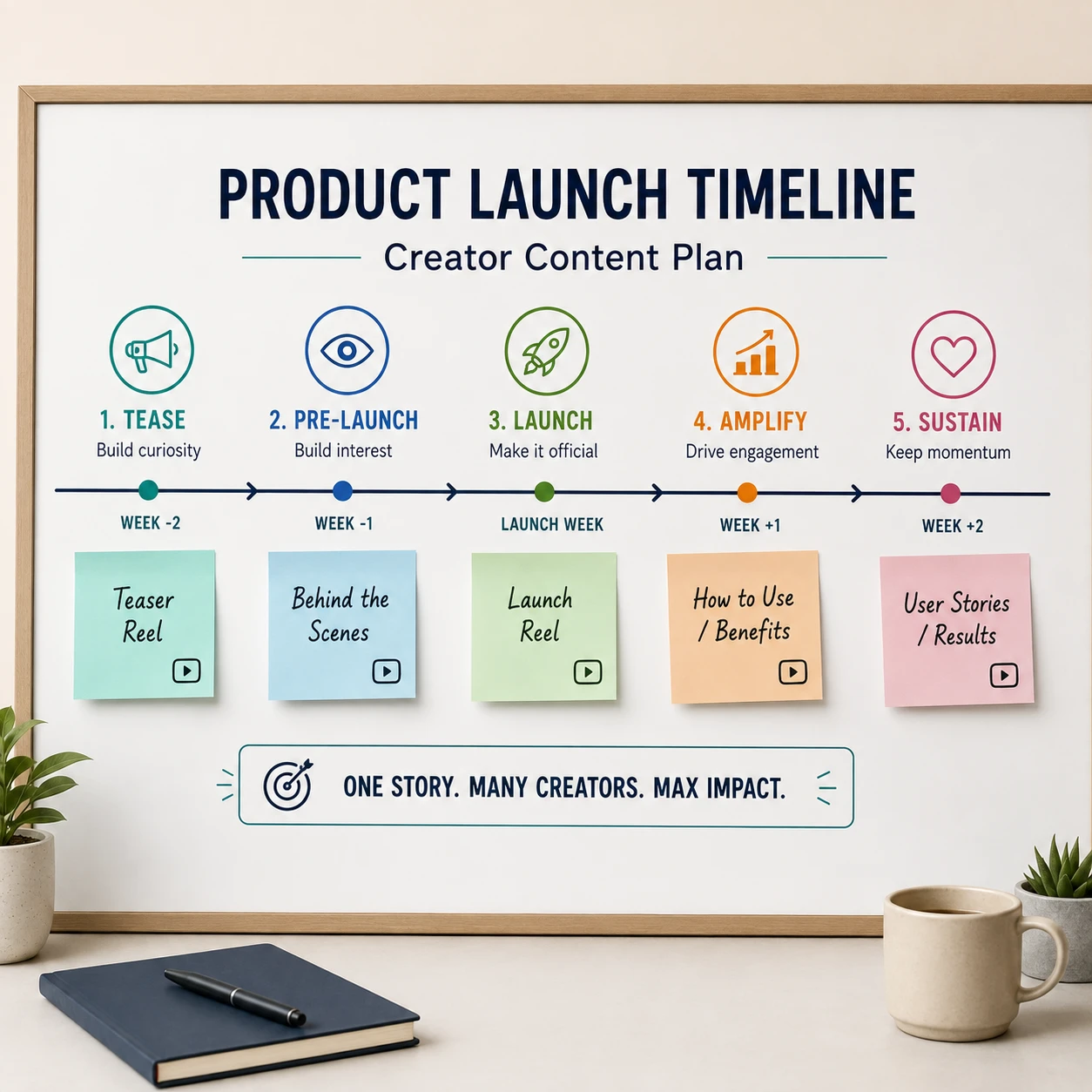
Most launch campaigns fail on a calendar, not on creative.
The product goes live on the 15th. Somebody starts contacting creators on the 1st. The product ships on the 8th, reaches a creator in Indore on the 13th, and the content everybody planned appears a fortnight after the launch it was meant to carry.
Nobody made a bad decision. They just started counting from the wrong day.
The short answer
Running an influencer campaign for a product launch in India means working backwards from the date buyers start deciding, not the date the product goes live. For most categories that is six to ten weeks earlier. The plan has to absorb creator negotiation, contracting, physical product delivery to creators who increasingly live outside metros, content approvals, and a disclosure check on every post. Seventy-five days is a comfortable runway. Thirty is not.
Key takeaways
- Indian buyers decide long before they buy. Redseer put festive e-commerce at ₹1.15 lakh crore GMV across the 30–35 days to Diwali 2025, up 20–25% and the strongest in five years — and the platform sales themselves opened in mid-September.
- Tier-2 is where the buyers are. Around 60–65% of festive shoppers came from tier-2 cities and beyond, which means your creators are there too, and so is your shipping time.
- Creator availability collapses before festivals. Everyone launches into the same window. Rates rise and calendars close roughly six weeks out.
- Disclosure is your risk, not just theirs. ASCI found 76% of Forbes India’s Top 100 Digital Stars failed to disclose paid collaborations properly, and the CCPA can penalise the advertiser up to ₹50 lakh for a repeat offence.
- Seventy-five days is the working runway. Anything shorter and something in the chain gets cut, usually the approvals or the compliance check.
Why a launch is not a campaign
An evergreen campaign can slip a week. A launch cannot.
That single difference changes everything about how you plan. In a campaign, a creator who posts late is a minor annoyance. In a launch, they post into an empty room — the press moment has passed, the paid media has moved on, and the content that was supposed to build momentum arrives as an afterthought.
Launches also concentrate risk. Forty creators posting in the same seventy-two hours means forty disclosure obligations landing at once, and any compliance problem is now a public one during the week your brand is most visible.
The upside is real, which is why brands keep doing it. India’s influencer market is heading for ₹3,375 crore by 2026 on an 18% CAGR, per EY and Collective Artists Network’s Big Bang Social, and Storyboard18 has reported brands putting up to 40% of festive advertising budgets into nano and micro creators. But the upside only arrives if the content does.
Step one: find your real anchor date
Launch day is not your anchor. The day your buyer starts deciding is.
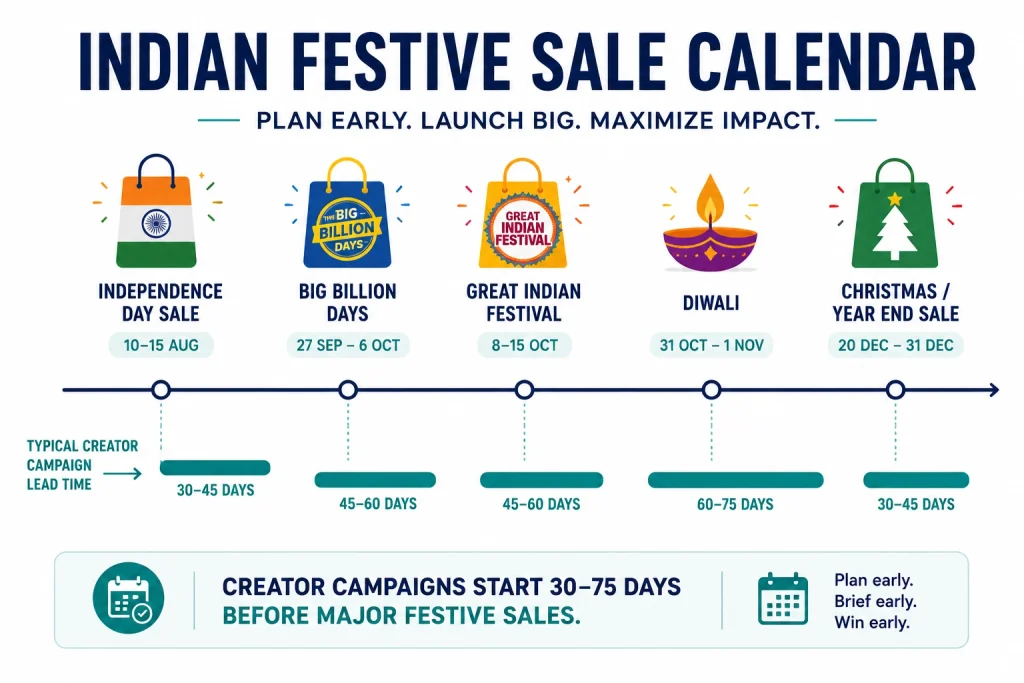
For most Indian consumer categories that is weeks earlier, and during festive season it is much earlier. In 2025, Meesho and Snapdeal opened their Diwali sales on 19 September, Myntra on the 20th, Amazon on the 23rd, and Flipkart ran its Big Festive Dhamaka from 4 October. The buying decisions were being made in August and September, not in the week of Diwali.
So the first task is not creator selection. It is drawing a line on a calendar for the date consideration actually begins in your category, then checking it against the festive and platform sale calendar for collisions.
If your launch lands inside a major sale window, assume creator rates are higher and calendars are fuller. Book earlier or move the launch.
The Reverse Launch Calendar
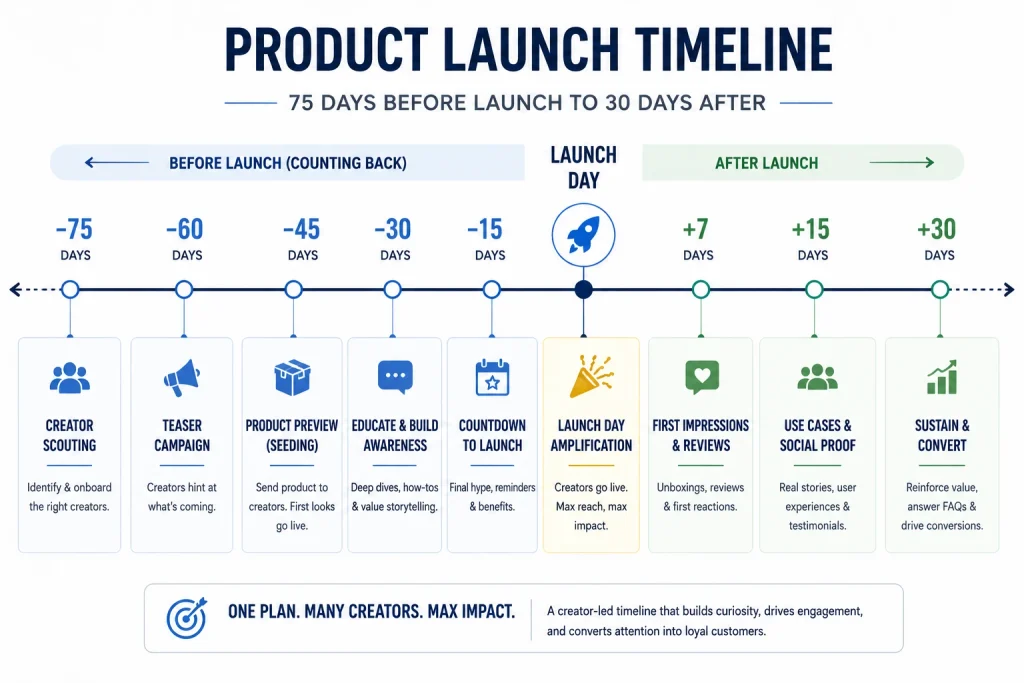
Count backwards from your anchor date. These are working days of runway, not a wish list.
| When | What happens | Why it sits here |
| T-75 | Category brief written, creator longlist built, sale calendar checked | Before rates rise and calendars fill |
| T-60 | Outreach and rate negotiation | Non-professional creators respond slowly; build in the chasing |
| T-50 | Contracts signed — deliverables, usage rights, exclusivity, disclosure wording | Rights and exclusivity are priced here, not later |
| T-45 | Product ships | The item has to physically arrive. Tier-2 and tier-3 addresses take real days |
| T-35 | Delivery confirmed with every creator | The first place a plan silently breaks |
| T-28 | Briefs and content directions approved | Creators need time to shoot, not just to post |
| T-21 | First drafts in | Enough runway for one honest revision round |
| T-14 | Approvals closed | After this point, changes cost the schedule |
| T-10 | Tracking links, discount codes and whitelisting access set up | Never on launch morning |
| T-7 | Teaser and seeding posts go live | Builds the audience the launch content lands in |
| T-0 | Launch posts, concentrated | The moment everything above was for |
| T+1 | Disclosure audit on every post, screenshots kept | Within hours, not days |
| T+7 | Amplify the winners as paid ads | The best organic creative becomes media |
| T+30 | Measure, pay, and decide who to keep | Retention beats re-sourcing every time |
Two milestones do most of the damage when they slip.
T-45, product shipping. This is the one teams forget is in the critical path. Around 60–65% of festive shoppers are in tier-2 cities and beyond, and your creators increasingly are too. A courier to a smaller city is not a same-week assumption.
T-35, delivery confirmation. Not “we shipped it” — confirmation from the creator that it arrived. Chase this individually. A campaign discovers its missing parcels at T-14 if nobody checks at T-35.
Step two: choose the creator mix
A launch usually wants three groups doing different jobs.
A small number of larger creators for the moment. Two or three mid-tier names posting on launch day give the launch a centre of gravity and something for press and paid media to point at.
A wider band of micro creators for credibility. Ten to twenty accounts in your category, posting across the launch week, produce the sense that the product is being talked about rather than announced.
Nano creators for depth and volume of content. Their engagement is the highest of any tier, and their content is the raw material for your paid social afterwards.
Ritesh Ujjwal, co-founder of Kofluence, framed the value of the smallest tier plainly: “a nano influencer with 5,000 followers generating meaningful conversations about products carries more weight than a larger creator with passive likes.”
Be honest about the operational cost of the third group. Every creator carries the same fixed management burden regardless of fee, so forty nano creators is forty briefings, forty parcels and forty disclosure checks.
Step three: the brief creators actually use
A brief that reads like a brand deck gets skimmed. A brief that reads like a shot list gets used.
Keep it to one page. Name the single message, the hook to open on, the two things that must be said, the things that must not be claimed, the exact disclosure wording, the deliverable and its format, the posting window, and the tracking link or code.
Leave the creative to the creator. The reason their audience trusts them is that they do not sound like your brand, and a script that erases that voice buys you a worse version of an ad you could have shot yourself.
Step four: contracts, disclosure and rights
Three things belong in writing before any product ships.
Deliverables and posting window — what, on which platform, between which dates.
Usage rights — whether you may run the content as paid media, on which surfaces, for how long. Buy this at contract stage. Buying it at T+7 when a post is performing costs several times more.
Disclosure wording — the exact tag, in the language of the content, placed where ASCI expects it. Specify it; do not assume.
That last one is not paperwork. ASCI’s second dipstick study on Forbes India’s Top 100 Digital Stars found 76% failed to disclose commercial collaborations properly, up from 69% the year before, across an audience of more than 110 million followers. ASCI’s chief executive, Manisha Kapoor, has said such violations “can no longer be dismissed as simple oversight.”
The CCPA’s 2022 guidelines allow penalties of up to ₹10 lakh on advertisers, manufacturers and endorsers, rising to ₹50 lakh for repeat contraventions, and they place due diligence duties on the advertiser and the agency. During a launch week, forty unchecked posts is a concentrated risk.
Step five: launch week, and the week after
Launch week runs itself if T-10 was done properly. The work that decides the outcome is what happens on either side of it.
T+1 — audit every post. Check the disclosure appeared, correctly worded, in the right place. Screenshot each one. Compliance you cannot evidence is compliance you may as well not have had.
T+7 — amplify. By now you know which two or three pieces of creator content actually performed. Put media behind them from the creator’s handle. Launch campaigns generate most of their return right here, and it is the step most brands skip because the launch felt finished.
T+30 — decide who to keep. The creators who delivered on time, on brief, with disclosure intact, are worth more than any new shortlist. Re-sourcing costs more than retention and produces worse work.
Mistakes we see
Counting from launch day. The entire article exists because of this one.
Shipping product late and hoping. The parcel is in your critical path. Treat it like one.
Buying usage rights after a post performs. Your negotiating position at that moment is the worst it will ever be.
One tracking link for the whole cohort. You will not know which creators sold anything, so you will renew all of them, including the ones who did nothing.
Briefing a script instead of a message. Kills the voice you paid for.
Treating the disclosure check as admin. It is the highest-consequence fifteen minutes in the campaign.
Stopping at launch day. The T+7 amplification step is usually where the money is.
When creators are the wrong launch channel
Your launch date is inside thirty days. There is not enough runway to do it properly. Run paid media for the launch and build the creator programme for the next one.
The product needs demonstration you cannot control. Complex assembly, technical claims, regulated categories. A creator’s honest confusion becomes your launch content.
You have no distribution. Creator content drives demand toward a purchase point. If the product is not buyable everywhere the audience is, you are paying to create frustration.
Your category requires substantiation. Health, financial products, anything where a claim needs evidence behind it. The compliance cost can exceed the media value, and the downside is asymmetric.
Launch runway checklist
☐ Anchor date set on when buyers start deciding, not on launch day
☐ Festive and platform sale calendar checked for collisions
☐ Creator longlist built at least ten weeks out
☐ Rates negotiated before the pre-festival crunch
☐ Contracts cover deliverables, posting window, usage rights, exclusivity and disclosure wording
☐ Product shipped with real delivery time built in for tier-2 and tier-3 addresses
☐ Delivery confirmed individually with every creator
☐ One-page brief per creator, message not script
☐ Unique tracking link or code per creator
☐ Whitelisting access arranged before launch week, not during it
☐ Teaser posts scheduled a week ahead of launch
☐ Disclosure audited within hours of posting, screenshots kept
☐ Paid amplification budget reserved for the week after launch
☐ Retention decision made at thirty days
Questions we get asked
How many creators do I need for a launch?
Fewer than most brands assume, run properly. A handful of mid-tier creators for the moment, ten to twenty micro creators for credibility, and nano creators only if you have the process to manage them. Volume without management produces silence, not noise.
How far ahead should I start?
Seventy-five days is comfortable. Sixty is workable. Below thirty, something gets cut — usually approvals or the compliance check, and those are the two you cannot afford to lose.
Should I seed a free product or pay for posts?
Seeding buys goodwill and no guarantee. Paying buys a deliverable and a date. For a launch, where the date is the whole point, pay for the posts that carry the moment and seed around them.
How do I measure it?
Unique code or link per creator, and one number reported afterwards — cost per acquisition from creator-attributed sales, or cost per qualified enquiry. Reach and impressions describe what happened; neither tells you what to do next time.
What if my launch is in six weeks?
Shorten the front of the calendar, not the back. Compress sourcing and negotiation, keep the shipping buffer, keep the approval round, keep the disclosure audit. Cutting the back end is what creates the failures.
Before you brief anyone
Open a calendar. Mark the day your buyers start deciding, not the day the product goes live. Count back seventy-five days from it.
If that date has already passed, you have useful information: this launch runs on paid media, and the creator programme starts now for the next one. That is a better outcome than a campaign whose content arrives after the moment it was built for.
If the runway is there, the first thing to book is not a creator. It is the shipping date.
For a launch calendar built against your actual date, category and creator mix, you can reach out to us on whatsapp at +91 7738844851 . We will tell you if the honest answer is that there is not enough runway this time.
More in Blog
Keep reading
All articles →
Ready to talk about your growth?
Tell us what's stuck and we'll tell you what we'd do first. Free, 30 minutes, no pitch.