
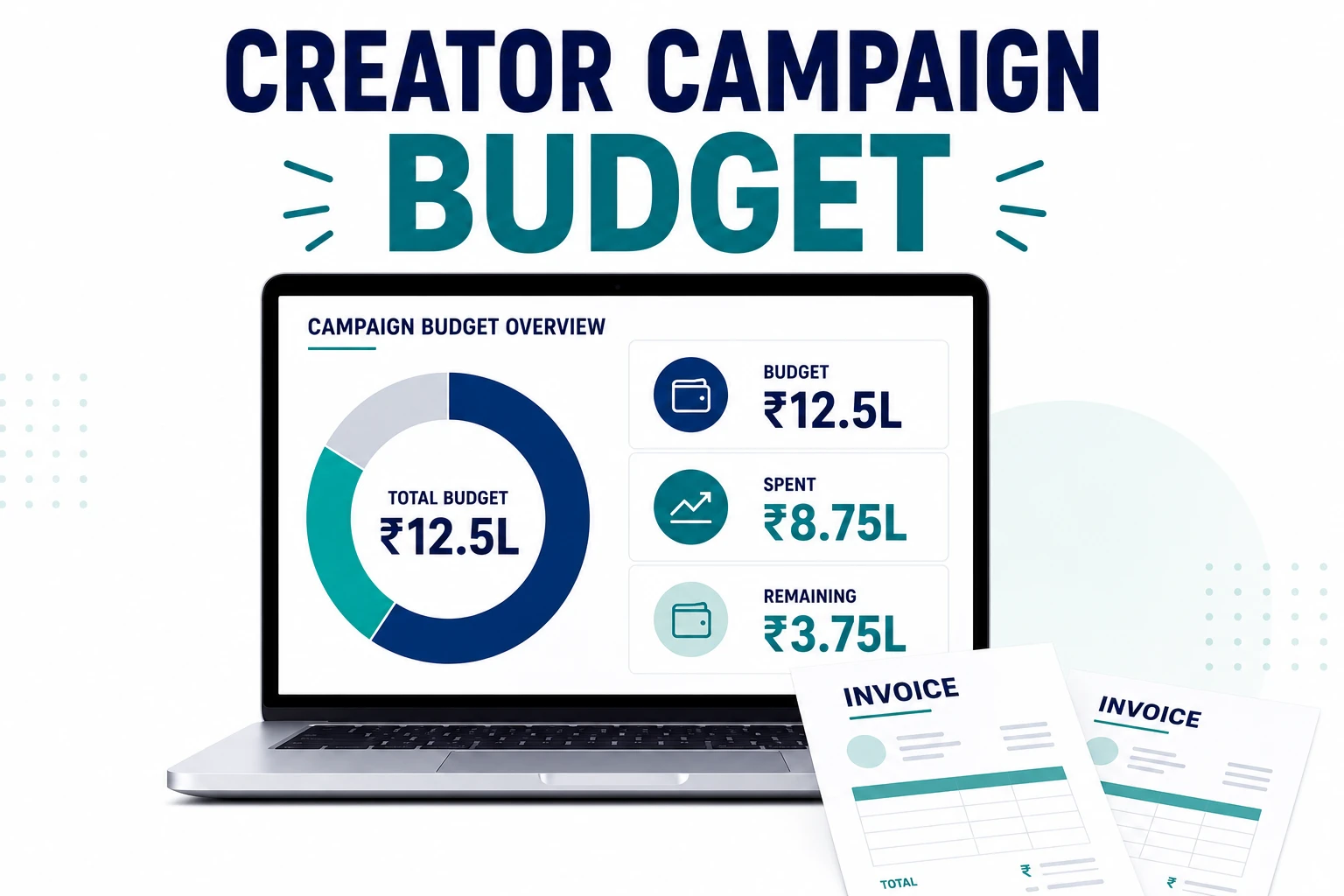
Your creator quoted a number. You approved it. Three months later finance asks why the campaign cost forty percent more than the approval note said, and nobody in the room has a clean answer.
That gap is not sloppiness. It is structural. The number a creator quotes covers one thing — making the content. Everything that happens to that content afterwards is priced separately, and most of it is priced by someone other than the creator.
This is about the rest of the bill.
The short answer
The quoted rate is the smallest component of an Indian influencer campaign. Sitting on top of it are six further layers: deliverable expansion after the brief lands, usage rights, category exclusivity, media spend behind the creator’s handle, agency management fees, and tax. Each is negotiable, each is routinely forgotten at approval stage, and together they usually exceed the base rate. Price the stack, not the post.
Key takeaways
- Indian influencer marketing was projected to reach ₹3,375 crore by 2026 — an 18% CAGR from ₹2,344 crore in 2024, according to EY and Collective Artists Network’s Big Bang Social. The money is arriving faster than the discipline to manage it.
- Barter is not free. A product sent in exchange for a post is a taxable transaction. GST applies at 18% on open market value, and Section 194R can pull a 10% TDS obligation onto the brand.
- The CCPA can fine ₹10 lakh for a first misleading endorsement and ₹50 lakh for a repeat — and it can bar the endorser from any endorsement for up to three years.
- 76% of Forbes India’s Top 100 Digital Stars failed to disclose paid collaborations properly, up from 69% the year before, per ASCI’s second dipstick study. If your creators are in that majority, your compliance risk is live right now.
- Agency management fees in India typically sit at 15–25% of creator spend, layered on top of any retainer. Whether that is good value depends entirely on what the agency actually does with the other six layers.
Contents
- Why the approved number is never the final number
- What “influencer marketing cost” actually means
- The Landed Cost Stack
- Working the stack, layer by layer
- The Landed Multiple — a rule for approving quotes
- Where the money quietly leaks
- When influencer marketing is the wrong spend
- A checklist for your next campaign
- Questions we get asked
- Sources
Why the approved number is never the final number
India’s creator economy grew up faster than its contracts did.
EY and Collective Artists Network’s Big Bang Social put the market at ₹2,344 crore in 2024 and projected ₹3,375 crore by 2026, an 18% compound growth rate. Three in four brands were expected to include creators in their strategy.
Growth that quick produces a specific failure. Budgets get approved on a WhatsApp screenshot of a rate. Contracts get drafted after the shoot. Tax gets discovered at year-end audit.
Here is what it looks like in practice. A Mumbai D2C skincare brand books eight micro creators for Diwali. The approval note lists eight rates and a total. By January the brand has also paid for extended usage on three of the posts, run two of them as ads, absorbed GST it had not budgeted, and settled a 194R liability on the products it shipped. None of that was in the approval note. All of it was predictable.
The creator did nothing wrong. The brand priced one layer of a seven-layer purchase.
What “influencer marketing cost” actually means
It means the total amount that leaves your business because you decided to work with a creator.
That includes what you pay the creator, what you pay for the right to keep using their content, what you pay to put media behind it, what you pay someone to run the programme, and what you pay the exchequer.
It does not include what people usually assume it includes — a single per-post price that scales neatly with follower count. Follower count is the input everyone anchors on because it is the only number visible from outside. It is also the weakest predictor of what you will actually spend.
| What people price | What they actually buy |
| One post from one creator | A content asset, plus a licence to use it |
| A follower count | A distribution reach that decays in 48 hours |
| A campaign fee | A fee, plus rights, plus media, plus management, plus tax |
| A barter product | A taxable supply with two separate obligations attached |
The gap between those two columns is where marketing budgets go to die.
The Landed Cost Stack
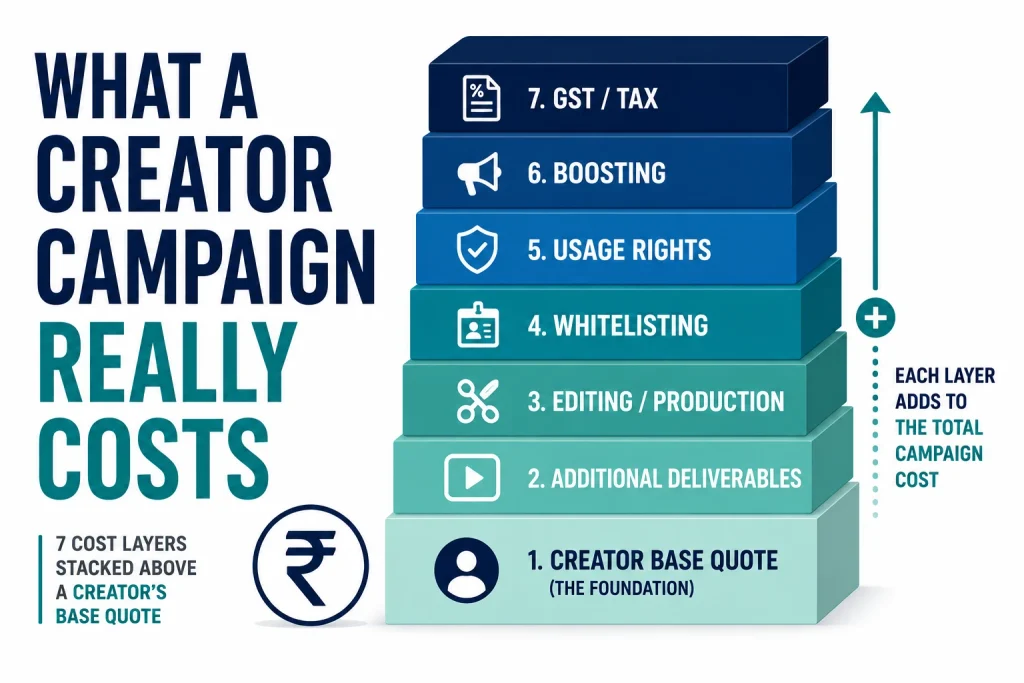
We use a seven-layer model to price creator work before anything is approved. It exists for one reason: to stop a campaign being signed off on a number that describes only its first layer.
| Layer | What it covers | Who sets the price |
| 1. Base rate | Producing the agreed deliverable | Creator |
| 2. Deliverable drift | Everything the brief adds after the quote | Your team, usually by accident |
| 3. Usage rights | How long you may use the asset, and where | Creator |
| 4. Exclusivity | Locking the creator out of your category | Creator |
| 5. Amplification | Media spend behind the creator’s handle | Meta, YouTube, your media plan |
| 6. Management | Running the programme end to end | Agency or in-house salary |
| 7. Tax and compliance | GST, TDS, and the cost of getting disclosure wrong | Statute, and the regulator |
Layers 1 and 2 are content. Layers 3 and 4 are law. Layer 5 is media. Layer 6 is labour. Layer 7 is not optional and does not care whether you budgeted for it.
Read the stack downward when you plan and upward when you audit.
Working the stack, layer by layer
Layer 1 — Base rate
What the creator charges to make the thing. This is the number everyone quotes and the only number most approval notes contain.
Rates in India move on category and format far more than on follower count. A fitness creator and a jewellery creator with identical audiences will quote very differently, because the brands chasing them have different margins.
Get this right: ask for the quote broken down by deliverable, not as a package total. You cannot negotiate a number you cannot see inside.
Layer 2 — Deliverable drift
The quote covered one reel. The brief, when it finally arrives, wants a reel, three stories, a static carousel and the raw files.
This is the most common and most avoidable overspend in Indian creator work. It happens because the brief is written after the rate is agreed, which is backwards.
Get this right: write the deliverable list before you ask for a price. Every addition after that point is a change order, and should be priced as one.
Layer 3 — Usage rights
The creator owns the content they make. What you buy is a licence — for a period, on named surfaces.
Industry practice puts standard organic-only rights somewhere between 30 and 90 days. Beyond that, most creators want a renewal fee. Rights that extend to paid media typically carry a meaningful uplift on the base rate, though published Indian benchmarks for that uplift do not exist. Third-party estimates circulate; treat them as directional and negotiate from your own history.
Get this right: decide the licence period before the shoot. Discovering in month four that your best-performing asset has expired is expensive and entirely self-inflicted.
Layer 4 — Exclusivity
You are asking a creator not to work with your competitors. That is income you are removing from them, and they will price it accordingly.
Exclusivity is worth paying for when the creator is genuinely associated with your category and a competitor booking would confuse the audience. It is worth nothing when you are one of forty brands the creator posts about in a quarter.
Get this right: define the category narrowly and the period tightly. “No skincare for six months” costs far more than “no vitamin C serums for eight weeks”, and often buys you nothing extra.
Layer 5 — Amplification
Whitelisting means running ads from the creator’s handle, using their name and face, to an audience you choose. It converts a post that reached their followers into a media buy that reaches yours.
This is media budget, not creator budget. Confusing the two is how a ₹5 lakh creator plan turns into a ₹12 lakh line item that nobody can explain.
Get this right: hold amplification in a separate budget line with its own approval. It should compete with your other media, not hide inside your creator fee.
Layer 6 — Management
Someone has to find the creators, negotiate, brief, chase, review, approve, track and report. Agencies in India commonly charge 15–25% of creator spend for this, often alongside a retainer.
That fee is not automatically bad value. Sourcing and negotiation alone can recover it. But it should be attached to specific work, and you should be able to name that work.
Get this right: ask what the fee covers at each of the other six layers. An agency that manages layers 1 and 2 and leaves you to discover layers 3, 4 and 7 is charging a full fee for a fraction of the job.
Layer 7 — Tax and compliance
This is the layer nobody writes about, and it is the one that produces year-end surprises.
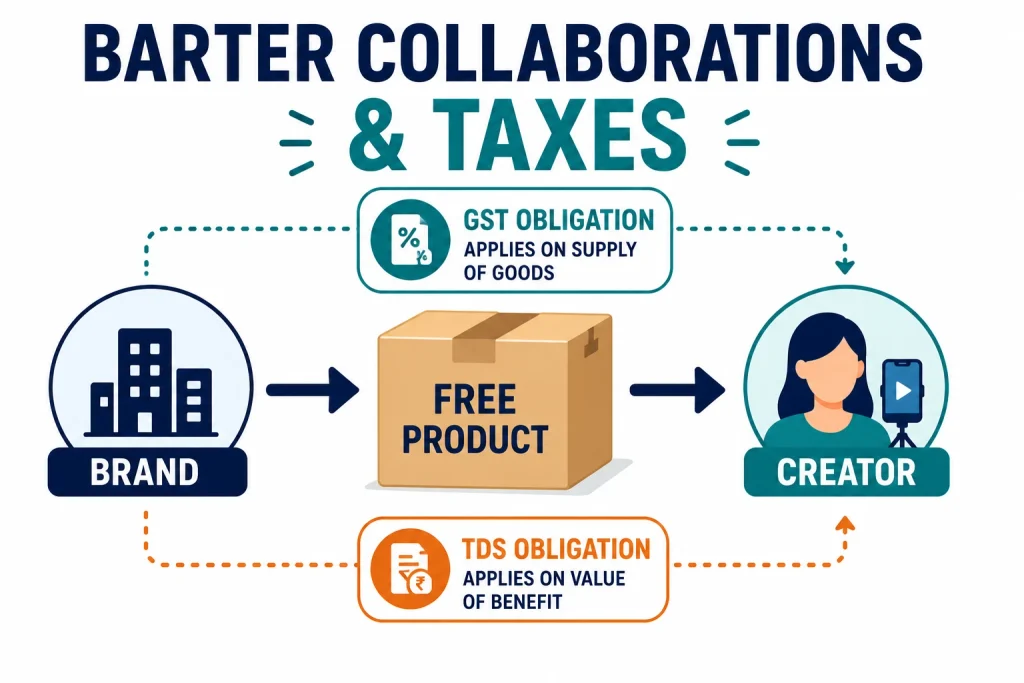
GST. Influencer services are professional services, taxed at 18%. A creator crossing the registration threshold must charge it. Barter does not escape this — when a brand supplies a product in exchange for content, that is a taxable supply, valued at open market value, with GST payable on it.
TDS under Section 194R. Where a brand provides a benefit or perquisite exceeding ₹20,000 in a financial year, a 10% deduction applies. CBDT Circular 18/2022 confirms that returning a product after using it in a shoot does not remove the obligation.
Disclosure. The real exposure sits here. The CCPA’s Guidelines for Prevention of Misleading Advertisements and Endorsements, notified in June 2022, allow penalties of up to ₹10 lakh on manufacturers, advertisers and endorsers, rising to ₹50 lakh for subsequent contraventions. The Authority can also bar an endorser from making any endorsement for up to one year, and up to three years for a repeat.
The guidelines place due diligence duties on the advertiser and the advertising agency. The creator is not the only party in scope. A brand that never asked whether the disclosure was correct is not obviously protected by not having asked.
And the base rate of non-compliance is high. ASCI’s second dipstick study on Forbes India’s Top 100 Digital Stars found that 76% failed to disclose commercial collaborations properly, up from 69% the previous year, across an audience of more than 110 million followers.
ASCI’s CEO and Secretary General, Manisha Kapoor, has been blunt about what that pattern represents. Disclosure violations among large brands and top influencers, she has said, “can no longer be dismissed as simple oversight.” She has also described “an unspoken understanding sometimes between brands and influencers to avoid disclosure and see if they can get away with it.”
Get this right: put the disclosure requirement in the contract, check the post in the first hour, and keep the screenshot. A campaign that was compliant and cannot prove it is in a weaker position than one that was checked.
The Landed Multiple — a rule for approving quotes
One rule, and it takes ninety seconds.
Before you approve any creator quote, write down what you expect the landed cost to be as a multiple of that quote — and write down which layers make up the difference.
A campaign with no rights extension, no exclusivity, no amplification and no agency lands close to its base rate plus tax. A campaign with 12-month paid usage, category exclusivity, whitelisting and an agency fee lands somewhere else entirely.
You do not need the multiple to be precise. You need to have stated it.
If you cannot write it down, you have not priced the campaign. You have priced one line of it — and that is the moment to go back and ask, not three months later when finance does.
Two things follow from applying this consistently.
The first is that some creators who look expensive are cheap, because they include broad rights in the base rate. Others who look cheap are not, because everything past the first post is a separate invoice.
The second is that it changes what you negotiate. Most brands negotiate layer 1 hard and accept layers 3 to 6 as given. Layer 1 is the layer with the least room in it.
Where the money quietly leaks
Approving on a rate, briefing later. The single most expensive habit in Indian creator marketing. Every deliverable added after a price is agreed is priced from a weak position.
Treating barter as free. It is not free, it is not untaxed, and it generates paperwork for both sides. Aggregate a year of “free” seeding and it is a real number sitting outside your marketing budget.
Buying rights you never use. Twelve-month paid usage on a post you will stop running in six weeks is a pure transfer of your budget to the creator.
Letting amplification hide inside the creator line. Media spend belongs in the media plan. When it hides, nobody benchmarks it, and unbenchmarked spend does not improve.
One tracking link across the whole campaign. Twelve creators, one UTM, and at renewal you keep all twelve — including the eight that did nothing. You have paid twice for the same mistake.
Assuming the creator handles compliance. The CCPA guidelines reach the advertiser and the agency. Delegation is not a defence you would want to rely on.
Paying an agency fee for layer 1 only. If nobody is managing rights, exclusivity, amplification and tax, the fee is buying you a booking service.
When influencer marketing is the wrong spend
We would rather say this than sell you a campaign that will not work.
Your product needs demonstration a creator cannot give. Complex B2B software, industrial equipment, anything with a six-month sales cycle and a procurement committee. Creator content generates awareness and consideration. It does not shorten a committee.
You cannot attribute anything yet. If you have no way to tell which creator produced which outcome, you are buying content and hoping. Fix measurement first. It is cheaper than a second campaign you also cannot read.
Your budget only covers one campaign. Creator marketing compounds through repetition and relationships. A single burst of eight posts is an experiment, and should be budgeted and judged as one — not as a growth channel.
Your category is regulated. Health claims, financial products, anything requiring substantiation. The compliance cost at layer 7 can exceed the media value, and the downside is asymmetric.
You need volume now. Performance media buys volume faster and more predictably. Creators are usually the better long-term cost per acquisition and rarely the faster one.
A checklist for your next campaign
Use this before anything is signed. It works whether or not you hire anyone.
☐ Deliverable list written and agreed before any price is discussed
☐ Quote broken down by deliverable, not supplied as a package total
☐ Licence period and permitted surfaces stated in writing
☐ Paid usage rights priced separately from organic rights
☐ Exclusivity defined by narrow category and short window, or dropped
☐ Amplification held in a separate budget line with its own approval
☐ Agency fee mapped to which of the seven layers it covers
☐ GST treatment confirmed for cash deals and for barter
☐ Fair market value recorded for every product, experience or perk supplied
☐ Section 194R obligation checked against the ₹20,000 threshold
☐ Disclosure wording specified in the contract, not left to the creator
☐ Post checked within the first hour and screenshot retained
☐ Unique tracking link per creator, not per campaign
☐ Landed Multiple written down and signed off with the base rate
Questions we get asked
Is barter genuinely taxable, even for a small product?
Yes. A product supplied in exchange for content is consideration, and the transaction is valued at open market value for GST. Separately, Section 194R can apply where benefits exceed ₹20,000 in a financial year. The size of the product does not change the principle, only the amount.
Who is liable if a creator forgets the disclosure — us or them?
Both are exposed. The CCPA guidelines impose due diligence duties on advertisers and advertising agencies as well as endorsers, and penalties reach all of them. Practically, the brand has the deeper pocket and the more visible name.
Should we pay an agency a percentage or a flat retainer?
Ask what the fee covers first, then choose the structure. A percentage aligns the agency with spending more. A retainer aligns them with spending less time. Neither is inherently right, and the more useful question is which of the seven layers they will own.
Can we just use the content forever if we paid for the post?
No, unless the contract says so. You bought a licence, not the copyright. Perpetual and paid-media rights are separate commercial terms and are priced as such.
How far ahead should we plan a festive campaign?
Further than most brands do. Creator availability in the six weeks before Diwali is the tightest of the year, and rates reflect it. Booking in the same quarter you intend to run is how brands end up paying peak rates for second-choice creators.
Before you approve the next quote
The most useful thing you can do this week costs nothing. Take your last completed creator campaign, pull every rupee that left the business because of it, and sort those rupees into the seven layers. Most teams find that layer 1 — the only layer they negotiated — was under half the total.
That single exercise changes how the next campaign gets approved.
If you want a second pair of eyes on it, message us on WhatsApp with your last campaign’s numbers and we will map the stack with you. No deck, no pitch — just the arithmetic.
More in Blog
Keep reading
All articles →
Ready to talk about your growth?
Tell us what's stuck and we'll tell you what we'd do first. Free, 30 minutes, no pitch.