
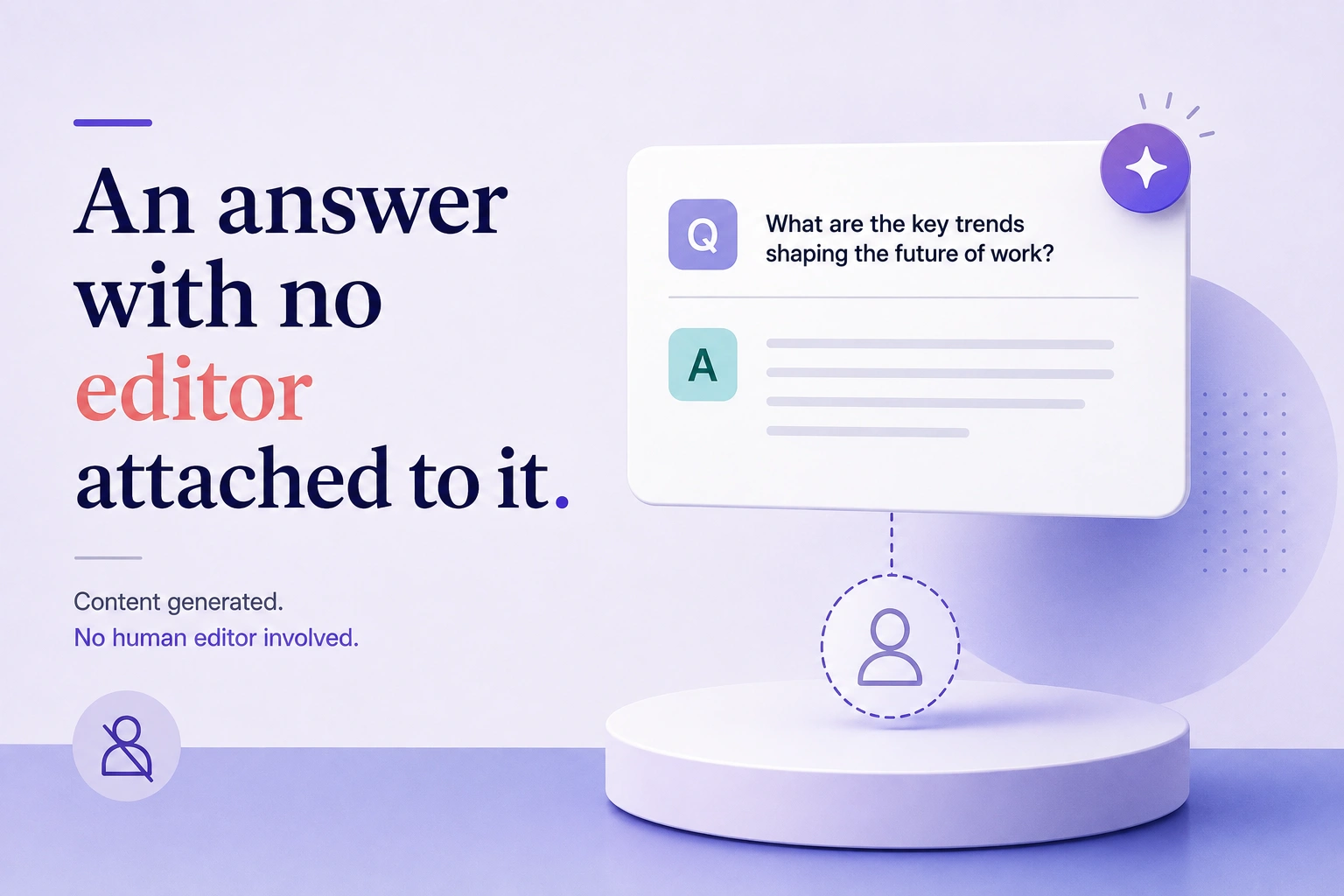
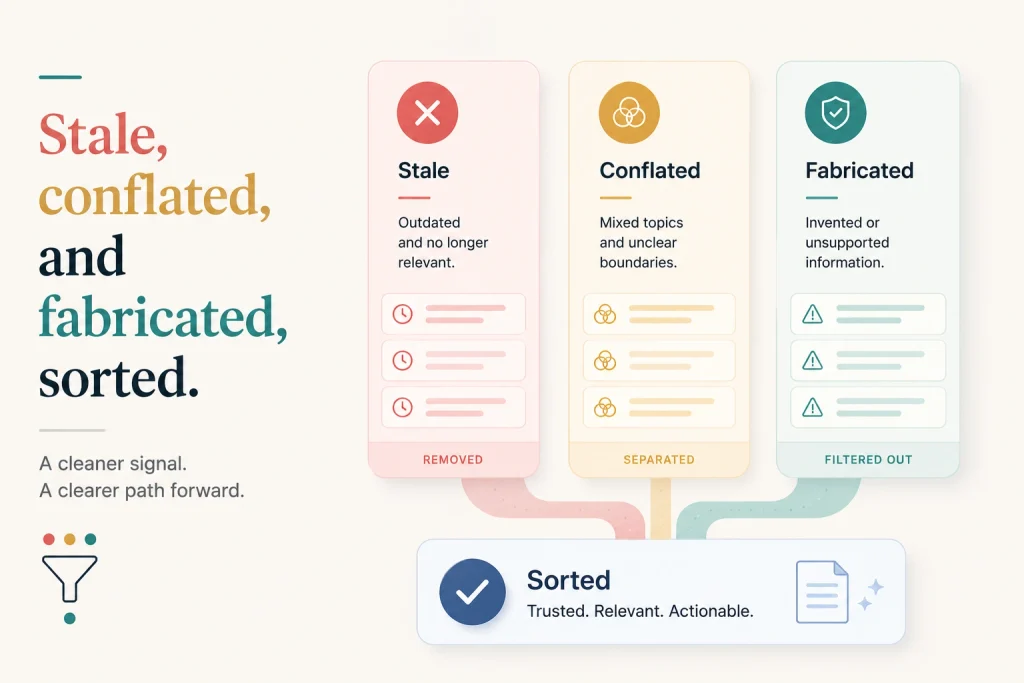
There is no editor to write to, so a false AI statement about a business is corrected by changing the inputs rather than the output. Three different problems wear the word wrong: stale, where the web is out of date and the system is reading it accurately; conflated, where a similarly named business has been merged with yours; and fabricated, which is rarest and has almost no lever available. Diagnosing which one you have decides everything that follows.
Somebody asks an assistant about your company and is told your office is in a city you left in 2021, or that you offer a service you dropped, or something with no basis at all.
The reflex is to look for the complaint form.
Understandable, and it is the slowest lever in the room. There is no editor, no correction notice, and no path by which somebody at one of these companies fixes your entry this week because you asked.
What you can change is what the systems read. Which is unsatisfying, and it is also the only thing that reliably works.
Before changing anything, work out which of three problems you have, because they have different causes and different fixes.
Stale: the web is out of date and the system is reading it correctly
The most common by a wide margin, and the least discussed, because it is uncomfortable.
Your old address is still on four directory sites. A press release from 2022 describes a service line you closed. A partner who left in 2023 is still listed on an association page. Your own site’s About section has not been touched since the rebrand.
The system is reporting what the web says, accurately, and the web says something you stopped maintaining.
The fix is the twenty-minute audit described in our article on mentions, pointed at facts rather than at name variants. Search your business name, your old name if you had one, your address and your phone number. Find every place carrying the stale version. Correct what you control, request correction where a platform allows it, and remove what should not exist.
Then update your own site, which is very often the oldest offender.
This is not a technology problem. It is a housekeeping problem that has become visible because something is now reading everything at once and repeating it confidently.
Conflated: somebody else’s facts attached to your name
The second kind, and it lands hardest on businesses with names that describe rather than identify.
Two firms with similar names in different cities become one entity. A founder is merged with somebody who shares their name. Your credentials acquire another company’s client list, or the reverse.
Our article on why your business name matters more than it did sets out why generic names cannot accumulate anything. This is the same property producing a different injury: a string that could refer to several businesses will sometimes be resolved as the wrong one.
The fix is distinctiveness, applied consistently and everywhere. The same name form, always paired with the same city and the same defining attribute, on every page you control and every profile you hold. Founder biographies that name the company. Company descriptions that name the founder. Enough co-occurrence that the association becomes unambiguous.
It is slow, and it is the only lever there is.
Fabricated: a claim with no source you can find
The rarest and the one people fear most. A specific assertion — a lawsuit, a closure, a product you never made — that traces back to nothing.
Two things worth saying honestly.
First, check properly before concluding it is fabricated. Search the claim in quotation marks, look for anything on the web that could have been misread, and consider whether it is a conflation you have not spotted. A surprising proportion turn out to be one of the first two problems in disguise.
Second, if it genuinely has no source, you have very little to work with. There is no input to correct. Use the feedback mechanism in the interface, document it with a screenshot and a date, and repeat the check monthly.
We would rather say that plainly than pretend there is a procedure.
The feedback buttons, assessed fairly
Every one of these interfaces has a thumbs down or a report option. Use them, and calibrate your expectations.
They exist so the operator can improve the system, which is a real thing and not the same as a customer service channel for you. There is no case number, no response, and no undertaking about timing.
What makes them worth the two minutes is the record. If this ever becomes a dispute, having reported it repeatedly, with dates and screenshots, is a materially better position than having been annoyed about it privately for a year.
Report it, log it, and go and fix the inputs.
When the wrong page is not yours
Most of the stale material sits somewhere you cannot log into, which is where people give up. There is more available than they think, in three tiers.
Platforms with a correction route. Directories, listing sites and aggregators mostly have a mechanism — a claim process, a suggest-an-edit link, a contact address. Many of those entries were generated without your involvement and can be claimed, which turns an uncorrectable page into a page you own. Tedious, and it works.
Search-level tools for pages that have already changed. Where a third party has corrected their page but the old version is still being served, Google’s outdated content removal tool exists for exactly that gap. It does not remove pages that are still live and still wrong; it refreshes what is being shown for pages that have already been fixed. Worth knowing which of those two situations you are in before spending an afternoon on it.
A polite email to a person. Underrated. Somebody wrote that page. Journalists, association secretaries and site owners generally correct factual errors when told clearly and without accusation — an argument our digital PR article makes about corrections generally. State what is wrong, state what is correct, link to the page carrying the current facts, and ask for nothing else.
And one category with no route at all, which is worth accepting rather than fighting. A published article that was accurate when it was written will not be corrected, and should not be. A 2021 piece describing your 2021 office is not an error. The answer there is to make the current position easier to find than the old one, which is the whole point of the next section.
The page we would build before any of this happens
The genuinely proactive move, and almost nobody has one.
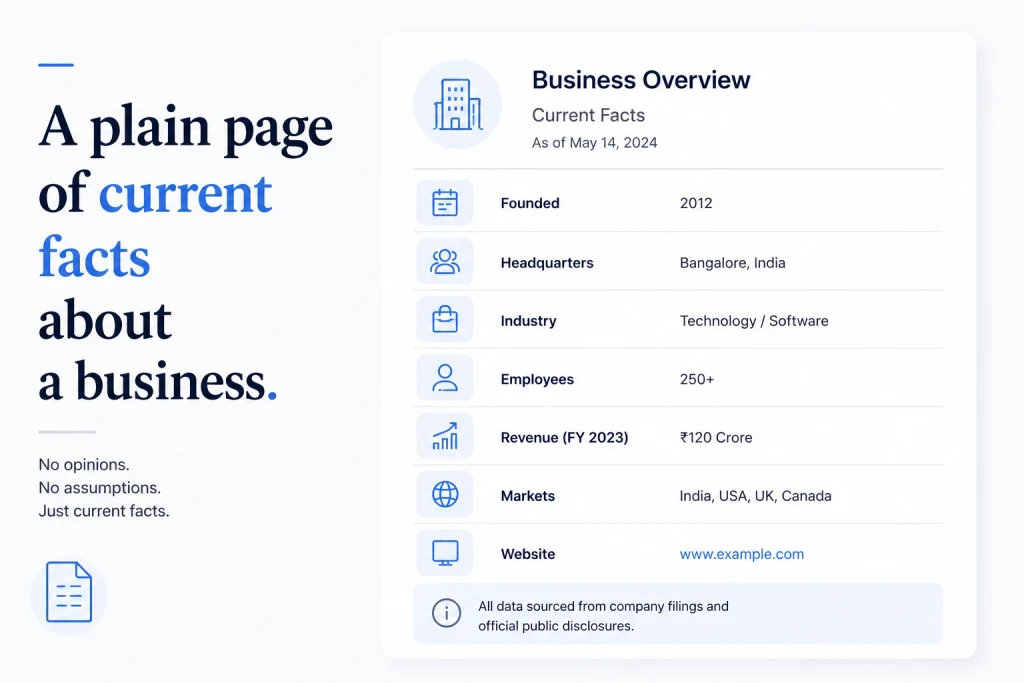
Publish a plain factual page about your business and keep it current. Legal name, trading name, founding year, registered city, offices, what you actually do, what you do not do, leadership with credentials, and any registration numbers that are public anyway.
Not an About page. About pages are written in mission language — committed to excellence, passionate about outcomes — which contains no facts and therefore supplies nothing to anything trying to establish what is true about you.
Date it. Update it when things change. Link to it from your footer.
This does two jobs. It gives retrieval something clean, current and unambiguous to draw on, from the domain most likely to be treated as authoritative about you. And when you need to correct somebody — a directory, a journalist, a platform — you have one URL to send instead of a paragraph of explanation.
It takes an hour. It is the highest-value hour in this article and it is not on anybody’s list.
How long the correction takes

Nobody publishes a figure and we are not going to invent one.
What can be said about the shape: sources you control update when you edit them, third-party pages update on their own schedule, and the systems reflect those changes on schedules of their own that differ by product. Some retrieve live and reflect a corrected page quickly. Others draw on material fixed at training time and will not change until the next one.
So expect the visible improvement to be uneven — corrected in one assistant and unchanged in another, for a while.
One thing that makes it worse: if you have blocked the agents that fetch pages to answer questions, you have also blocked the route by which your correction reaches them. Worth checking against which crawlers to allow before concluding nothing is working.
The legal position, which is unsettled
We are not lawyers and this section is deliberately short.
India has no settled position on liability for false statements about a business generated by an AI system. The existing routes — defamation, misrepresentation — were built for publishers and speakers, and how they apply to a generated statement assembled from third-party sources has not been worked out here.
There is an adjacent question worth flagging. Where the false information is personal data — about a named founder or director rather than about the company — the correction and erasure rights we describe in our article on data principal rights become relevant in principle. Whether those rights reach an operator of this kind, and how such a request would be made and answered, is not established.
If the statement is doing real commercial damage, take actual legal advice. Do not take it from a marketing article, including this one.
Find out before a customer does
Most businesses discover this because a prospect mentions it on a call, which is the worst possible way.
Our article on measurement sets out the monthly check for your category questions. Add three about yourself: what does this company do, is it any good, who runs it. Ask them of each system, signed out, and read the answers rather than skimming them.
Ten minutes a month, and it converts an ambush into a maintenance task.
Final thoughts
Diagnose first. Most of what looks like invention is a stale web page you stopped maintaining, and most of the rest is a name that could belong to somebody else.
Fix the inputs, build the fact page, log the reports, and accept that the correction arrives at different speeds in different places.
If something false is costing you enquiries and you want help finding where it came from, you can reach out to us on whatsapp at +91 7738844851 .
More in Blog
Keep reading
All articles →

Ready to talk about your growth?
Tell us what's stuck and we'll tell you what we'd do first. Free, 30 minutes, no pitch.