

Indian B2B pays the festive premium without receiving any festive demand, because consumer advertisers bid the same inventory that B2B campaigns use. Buyers are on leave, approvals have stalled and offices run skeleton staff, while costs rise on the strength of demand that has nothing to do with you. The exception reverses the decision entirely: if your customers sell into the festive season — packaging, logistics, retail supply, payments, corporate gifting — your own peak falls in July and August, because they buy from you before they sell to anybody else.
Our festive pillar has already reached the conclusion. Most B2B, most professional services and most industrial supply should not be competing in this window, and the same buyers are reachable far more cheaply in January.
We are not going to re-argue that. This article is about the four things that follow once you accept it, and the first is a question the pillar does not answer.
Why does the auction charge you at all

If your buyers are not shopping, why do your costs rise?
Because the auction does not know or care what you sell.
A social platform’s inventory is not divided into consumer impressions and business impressions. The same person scrolling in the evening can be shown a saree advertisement or an industrial fastener advertisement, and both advertisers are bidding for that impression. When thousands of consumer advertisers raise their bids for a fortnight, the price of reaching anybody rises — including the procurement manager you were trying to reach, who is himself being advertised at by everybody selling gifts.
Search behaves somewhat differently, because a specific commercial query is a narrower auction. But display, video and social are shared inventory, and that is where most Indian B2B awareness spending goes.
So a B2B advertiser in the festive window is paying a premium generated entirely by demand it cannot access.
That is the mechanism behind the pillar’s conclusion, and it is worth understanding rather than merely accepting, because it also tells you which parts of a B2B media plan are least affected — the narrow, high-intent search terms that consumer advertisers are not competing for.
The exception that moves your peak by two months
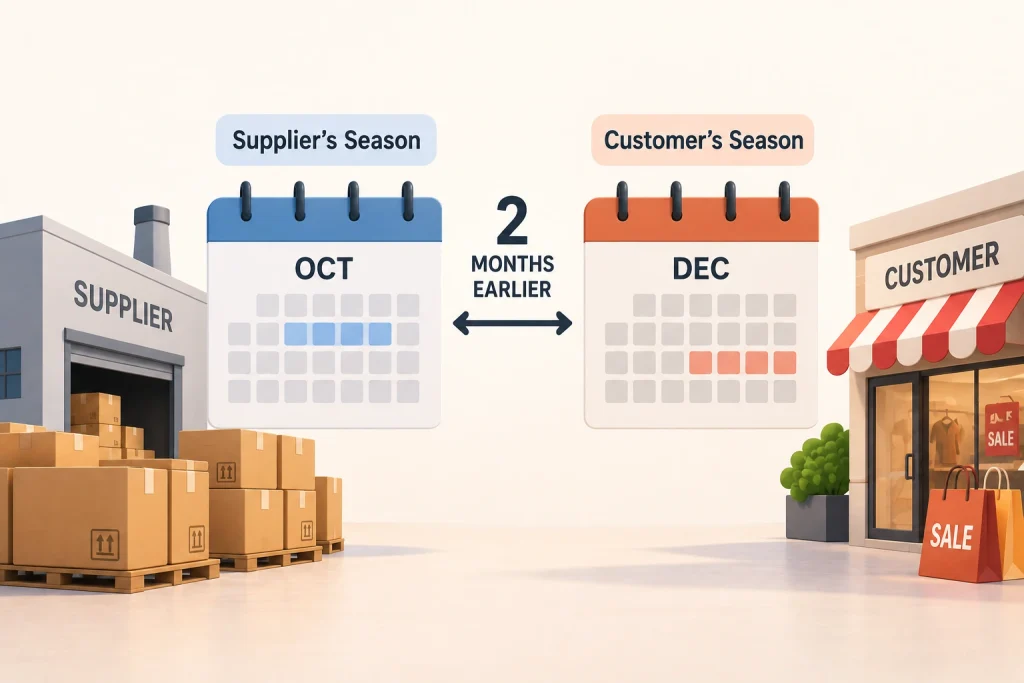
Now the part that reverses the decision for a meaningful share of Indian B2B, and which almost nothing published addresses.
Ask one question: do your customers sell into the festive season?
If they do, you are not a B2B business facing a quiet quarter. You are a supplier to businesses whose biggest quarter is coming, and they buy from you before they sell to anybody.
Packaging and printing. Logistics and warehousing. Retail supply of every kind. Payments and point-of-sale. Staffing and temporary labour. Corporate gifting, which is bought by companies weeks before it is given. Anything a retailer needs in place before their season opens.
For these businesses the peak is July and August, and a campaign launched in October has missed it entirely — the purchase orders were placed while everybody else was still planning their Diwali creative.
The regional stagger in our calendar article compounds this. If your customers sell into Onam, your window is earlier still.
The practical instruction is simple and rarely followed. Work backwards from your customer’s season rather than from the national calendar, and mark your own peak where their procurement happens rather than where their selling does.
What the quiet fortnight is actually for

For everybody else — the majority for whom the pillar’s conclusion holds — the window is the only uninterrupted stretch an Indian marketing team gets in the entire year, rather than empty time.
Enquiries are down. Nobody is asking for a campaign. The approvals that normally consume half a week are not coming, because the people who give them are away.
That is build time, and it is almost always spent watching campaigns that should not be running.
What to build in it, in rough order of value.
The annual data piece. The one number your business observes that nobody else has. It takes a fortnight of somebody’s attention and it is the single most durable asset a B2B firm can own.
The pages that answer the deciding questions — comparisons, costs, failure modes, who this is not for. Most B2B libraries are all definitions.
The operational work nobody has time for. Authentication checks, the enquiry form test, list cleaning, the internal links nobody has added.
And the conversations. Your clients are also less busy. A call with no agenda, made in a quiet week, produces more useful information than a survey.
None of that requires a buyer to be at a desk, which is precisely why the window suits it.
Sitting out must not become switching off
The warning, and it is where the pillar’s conclusion goes wrong in practice.
A team told to sit out the festive window frequently switches everything off. All campaigns paused, spend at zero, nothing running for six weeks.
Then January arrives, budgets reopen, and the account restarts from a standing position — no recent conversion data, no warm audiences, nothing for the platform to optimise against. Which is exactly the cold-auction problem our [budget article](https://findise.in/festive-ad-budget-india/) describes, arriving in a different month.
Sitting out the consumer peak means not competing for consumer inventory. It does not mean stopping.
Keep the narrow, high-intent search running throughout. Keep whatever always-on activity produces enquiries at ordinary cost. Reduce the awareness spending that competes with consumer advertisers, and hold the rest.
The account should arrive in January warm and ready, because January is when your buyers come back and the auction has emptied.
The customers you already have are reachable
One more thing the window is good for, and it is the least used.
Your existing clients are at their least pressured. The people who normally cannot find twenty minutes have some.
That is the right time for the conversations that never happen when everybody is busy — a renewal discussed early rather than at the deadline, an expansion nobody has had time to scope, a referral asked for properly, a review requested from somebody who is not in the middle of a delivery.
None of it costs media money, all of it is measurable in the following quarter, and it is the only festive activity that reliably produces revenue for an Indian B2B firm.
The one caution: a mass greeting message with a company logo on it is not a conversation. It is the B2B equivalent of the generic festive creative, and it is read as one.
When B2B genuinely should advertise into the window
Three cases, briefly, for completeness.
When your buyer is the founder of a small business, who does not stop and is frequently making decisions in the quiet week precisely because it is quiet.
When you are defending a branded term that competitors will bid on while you are absent — cheap, narrow, and worth holding.
And when the seasonal association is genuine. A business whose product is bought for the season is not doing festive marketing; it is doing ordinary marketing at its own peak.
Everything else can wait eight weeks and cost considerably less.
What we cannot tell you
We cannot tell you how much of the cost increase reaches your specific account. It depends on your channel mix, and a search-heavy plan is far less exposed than a social-heavy one.
We cannot tell you when your customer’s procurement actually happens. That is a question for three of your customers rather than for us, and asking them is a better use of an afternoon than any forecast.
And we cannot tell you the size of the January opportunity, though our pillar’s arithmetic on the window implies its shape.
Final thoughts
Ask whether your customers sell into the season. If they do, your peak was two months ago and next year’s plan should say so.
If they do not, take the pillar’s advice and step back from the consumer inventory — without switching the account off, and without wasting the only quiet fortnight you get.
Build the thing you never have time for. Speak to the clients who are finally free. Then arrive in January warm, while everybody else is starting cold.
If you want your own peak located against your customers’ procurement rather than the national calendar, you can reach out to us on whatsapp at +91 7738844851 .
More in Blog
Keep reading
All articles →
Ready to talk about your growth?
Tell us what's stuck and we'll tell you what we'd do first. Free, 30 minutes, no pitch.