
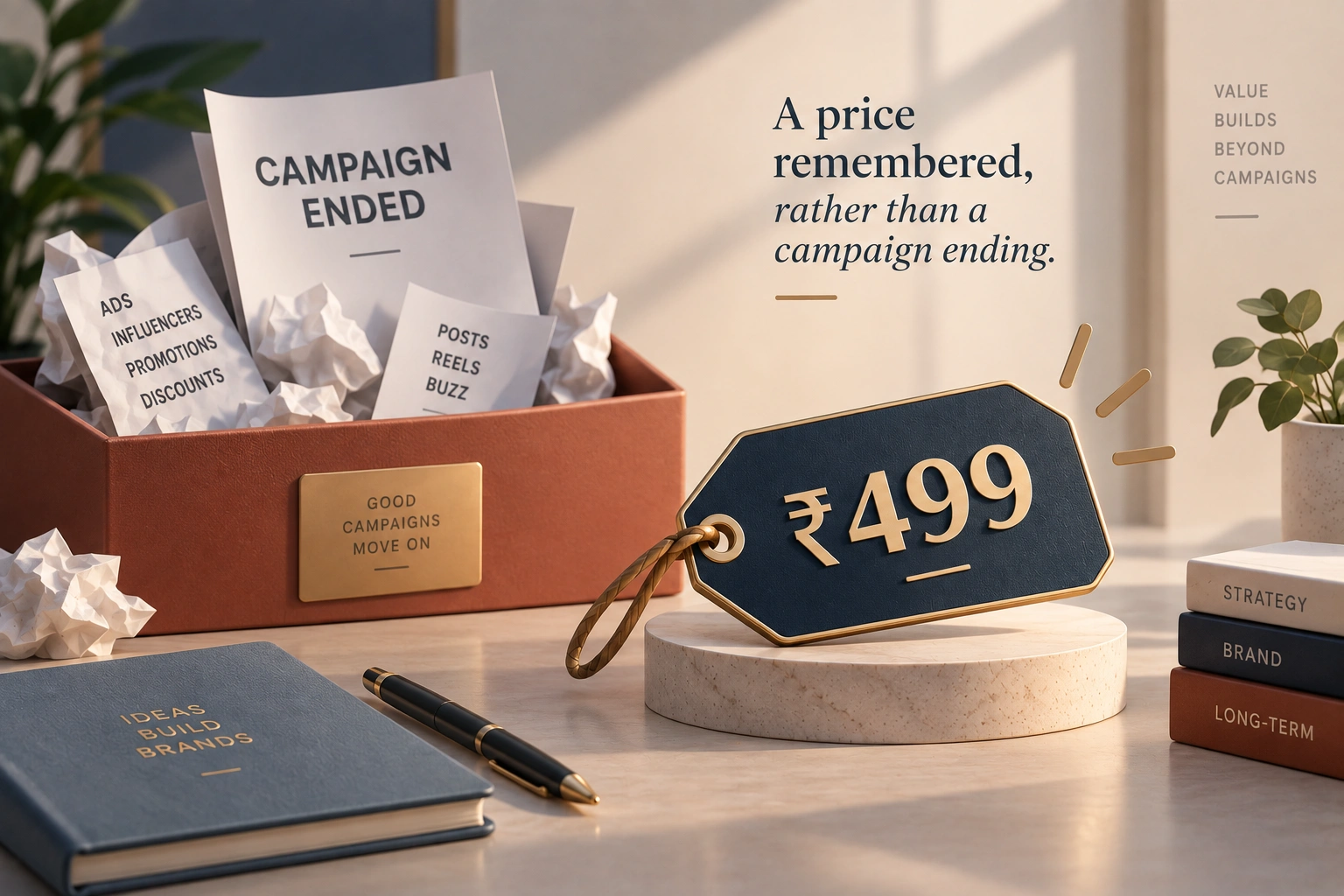
A festive discount is not a campaign that ends — it is a change to the price your customer remembers. Once a buyer learns the October number, the other eleven months become the anomaly they wait out, and each season teaches that lesson to a larger share of your market. In India the reference price is usually set by marketplace sale events rather than by the brand, so a business discounting to match is inheriting somebody else’s anchor. And because a discount changes gross margin, it changes the break-even return the account should be measured against — a target almost nobody moves when the offer goes live.
Our lead management pillar makes the point in a single line: discounting trains buyers to wait.
It is correct, it is easy to nod at, and almost nobody follows it through. What follows is what that training actually does over several years, and what to do instead of the two options usually on the table — match the discount, or lose the season.
The promotion ends. The price does not

A campaign has an end date. The number in somebody’s head does not.
A customer who bought at thirty per cent off in October has learned what your product is worth to them. Next September they are not comparing your full price to a competitor’s full price. They are comparing it to your October price, which they already know, and which makes your ordinary price look like a mark-up rather than a price.
The effect compounds. Every season teaches the lesson to a new group — the people who bought at full price this year and noticed the sale afterwards, the people a friend told, the people who searched and found last year’s offer page still indexed.
So the portion of your market willing to pay full price shrinks annually, and the discount that felt like a decision in year one is an obligation by year four.
The businesses that end up locked into a permanent October sale did not choose that. They chose it once, five times.
You are not setting the anchor. You are inheriting it

The reason this is harder in India than the theory suggests.
For most consumer categories, the reference price in a buyer’s head is set by marketplace sale events. Those prices are set by businesses with different cost structures, different funding, and frequently a different reason to sell at that number — clearing inventory, buying market share, meeting a platform commitment.
A brand that discounts to match is not competing on price. It is accepting a price set by somebody whose economics are not its own, and our festive pillar treats being unable to carry that depth as a reason to step back from the season entirely.
The useful addition is what to do when you cannot step back. You cannot win the anchor, so do not fight it. Change what is being compared instead — which is the second half of this article.
One thing worth saying plainly: a “was” price that was never a real selling price is a different problem altogether, and India’s consumer protection framework takes an interest in advertised savings that do not reflect a genuine prior price. Inflating a reference price in order to discount from it is not a pricing tactic.
The target moved and nobody moved it
The arithmetic almost every Indian festive account gets wrong, and it is a five-minute fix.
Our Google Ads ROI article sets out the relationship between gross margin and the return an account has to achieve simply to break even. We are not going to restate the formula.
The point for this article is that a discount changes the margin, so it changes that break-even figure — immediately, on the day the offer goes live.
What happens in practice is that the account keeps reporting against the target set in September, at the pre-discount margin. The campaign looks like it is performing well because volume is up and the return figure looks healthy against the old line.
A high return on a discounted order can be less profitable than a lower return at full price, and the report will not show it, because the report is measuring against a number that stopped applying.
Recalculate the target before the offer launches, not in the January review. And if the discount varies by product, the target varies by product, which is the point at which most businesses discover their reporting cannot do it.
Four things to change instead of the price

The reason “do not discount” fails as advice is that it leaves a business with nothing to do while competitors are visibly offering something. These are the substitutes that hold the anchor.
Change what is in the box. A bundle, an accessory, an extended warranty, a longer service period, installation included. The customer receives more value, the headline price is unchanged, and next year’s reference point is intact.
Discount the entry, not the range. One clearly designated seasonal product or package at a real price, with everything else held. It gives you something to advertise without teaching a lesson about the catalogue.
Make it genuinely time-bound, and mean it. A sale running six weeks is not a sale. It is a price cut with a countdown graphic on it, and buyers learn that the deadline is decorative. Short, honoured, and not extended.
And discount privately rather than publicly. An offer made to existing customers by email or message rewards the people who matter, produces revenue, and never enters the public reference price. This is the most under-used of the four in India and the cheapest to run.
None of these is as immediately powerful as cutting thirty per cent. All of them leave you with a business next year.
When discounting is genuinely the right answer
The article would be dishonest without this section.
When you are clearing dated or seasonal stock that will be worth less in January than the discount costs you now.
When you genuinely have the cost advantage and can carry the depth profitably. Some businesses can. If that is you, the anchor works in your favour and the rest of this article is a caution rather than a prohibition.
When the category’s reference price is already discounted and a full price is simply not credible to the buyer. Fighting that is expensive and usually futile.
And when you are buying a first purchase whose repeat value justifies it — provided you have actually calculated the repeat rate rather than assumed one, and provided the second purchase is not also discounted, which is the trap.
How to stop, once you have trained them
The question every business in this position eventually asks, and the answer is not encouraging.
It takes more than one season, and it requires a substitution rather than a removal.
Going from thirty per cent off to nothing in a single year produces a visible collapse and a set of customers who feel something was taken away. Going from thirty to twenty, with a bundle added that costs you less than the ten points, holds the perceived value while recovering margin.
Repeat that once more the following year. By the third season the offer is a genuine bundle and the discount is small enough to retire.
Two rules while you do it. Never extend a sale that has ended, because that teaches buyers that deadlines are negotiable and undoes the work. And do not run the recovery in the same year you also cut media spend, or you will not be able to tell which change caused the drop.
What we cannot tell you
We cannot tell you a discount depth. It follows from your margin, your competitors and your category’s existing anchor.
We cannot tell you what the training costs you. It is real, it accumulates, and it is close to unmeasurable in any single year — which is exactly why businesses keep doing it.
And we cannot tell you whether your category’s anchor can be resisted. Some can. Some were set years ago by somebody with more capital than you and are now simply the price.
Final thoughts
Before setting an offer, decide whether you are running a promotion or changing your price, because from the buyer’s side there is no difference.
Recalculate your break-even the day the discount goes live. Reach for the box before the price. And if you are already trained into it, plan the exit across three seasons rather than one.
If you want the substitute offers designed and the targets recalculated before the season, you can reach out to us on whatsapp at +91 7738844851 .
More in Blog
Keep reading
All articles →


Ready to talk about your growth?
Tell us what's stuck and we'll tell you what we'd do first. Free, 30 minutes, no pitch.