
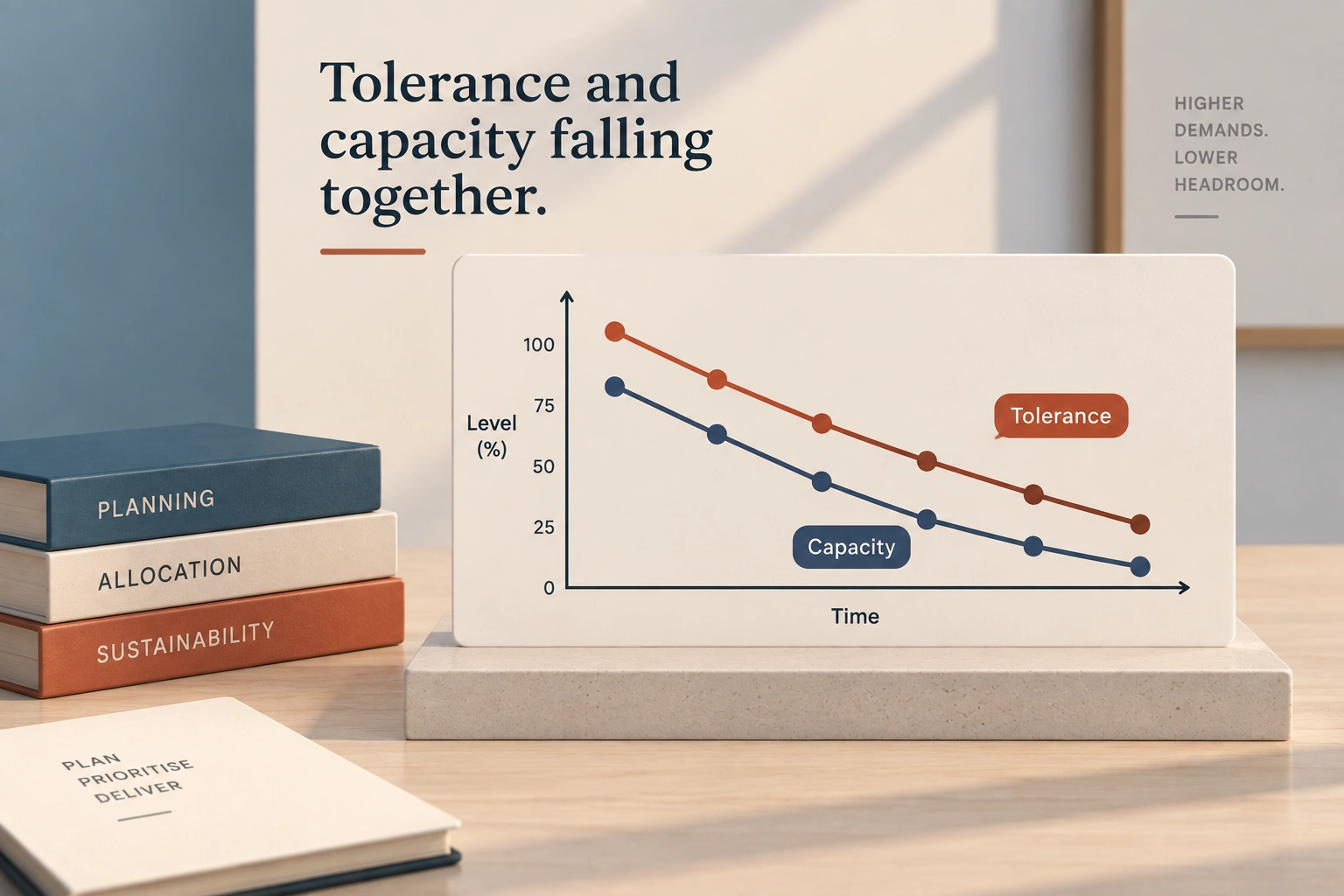
During the festive window, buyer tolerance for a slow reply collapses at exactly the moment your ability to reply collapses too. The buyer is choosing between several options today because the calendar set the deadline, while the people who answer are on leave or handling three times the usual volume. So the ordinary process — log, qualify, assign, follow up tomorrow — fails, because tomorrow is a different week of the season. The festive process is triage: answer what can be answered immediately, even imperfectly, and sort afterwards. And a business advertising on days when nobody is available is buying enquiries it has already decided not to answer.
Our lead management pillar sets out the evidence on response speed, with the provenance and the caveats that evidence deserves. We are not going to repeat it.
This article is about the thing that pillar does not cover: what happens to all of it in the six weeks when volume triples and half the people are away.
Two curves crossing
In an ordinary trading week, a reply within a few hours is fine. The buyer has time, is comparing at leisure, and expects a business to take a working day.
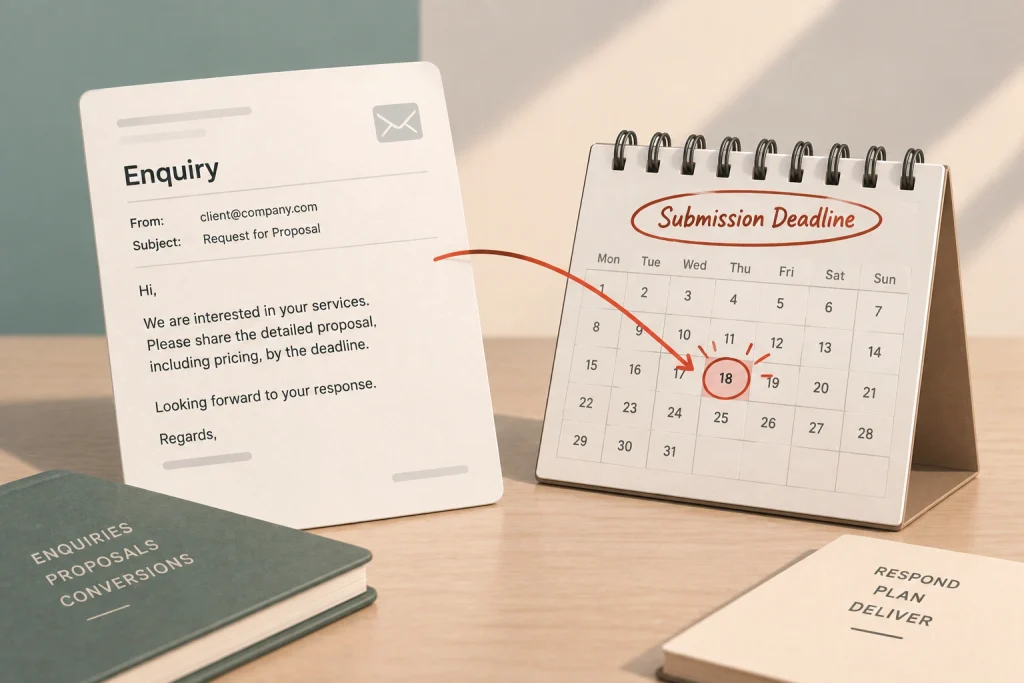
In a festive window that buyer has a deadline the calendar imposed. The thing must arrive, be fitted, be delivered or be given by a specific day. They are asking three suppliers this afternoon and buying from whoever answers usefully first.
So the acceptable response time falls sharply.
And your ability to meet it falls at the same moment. Your team is at family events. The person who normally answers is travelling. The two people still working are handling triple the ordinary volume of everything, including complaints from the orders already placed.
That crossing is where Indian festive enquiries are lost, and it is entirely predictable in June.
Stop running the ordinary process
Most Indian businesses apply the same handling to a festive enquiry as to any other. It gets logged, it waits for the right person, it gets qualified, and somebody follows up when they are next at a desk.
That process assumes tomorrow is comparable to today. In this window it is not — tomorrow is closer to a deadline, and by the day after the buyer has bought from somebody else.
Run triage instead.
Answer the answerable immediately, even if the answer is partial. Somebody asking whether you have something in a size, whether you deliver to a pin code, or whether a slot is available on a date wants a yes or a no. That reply takes forty seconds and it wins the conversation.
Batch the rest. Anything requiring a quotation, a specification or a decision from somebody unavailable goes into a single batch handled at fixed times — twice a day, by one person, with a holding message sent immediately.
And drop qualification until afterwards. Deciding whether an enquiry is worth pursuing is a luxury of ordinary weeks. In this window the cost of answering somebody who was never going to buy is far lower than the cost of not answering somebody who was.
Sort the pipeline in November. Answer everything in October.
The four things that actually break
Not abstractions — these are the specific failures, and they are the same every year.
The shared inbox that belongs to nobody on a holiday. It has three people with access and none of them is on duty, because nobody was assigned.
The messaging number that lives on somebody’s personal phone. They are at a family event with the phone in a pocket, and the business has no way to see what has arrived.
The website form that emails one person who is on leave, with no forwarding rule, no shared destination, and nobody aware that it is silently accumulating.
And the phone that rings in a closed office while the advertising is still running.
Each of those is fixable in an hour in September and unfixable at nine at night in October.
Advertising into a closed business

The line item nobody puts in a festive plan.
If your campaigns run on days when nobody is available to answer, you are paying the highest media prices of the year to generate enquiries you have decided in advance not to respond to.
That is worse than not advertising, because the enquiry arriving and going unanswered does damage that not appearing at all does not — the person contacted you, was ignored, and now knows something about your business.
Two straightforward responses.
Schedule the advertising to your actual availability rather than to the calendar. Every platform supports it, and a campaign that runs only when somebody can reply is a smaller campaign that converts better.
Or staff the days rather than pausing them, which is the right answer if those days genuinely carry demand. The decision belongs in the roster conversation, not to whoever notices at the time.
And publish your actual holiday hours where customers look — the profile, the site, the messaging account — which our calendar article makes easier by telling you which days matter regionally.
The acknowledgement that helps, and the one that harms
A distinction worth getting right, because most businesses send the harmful version.
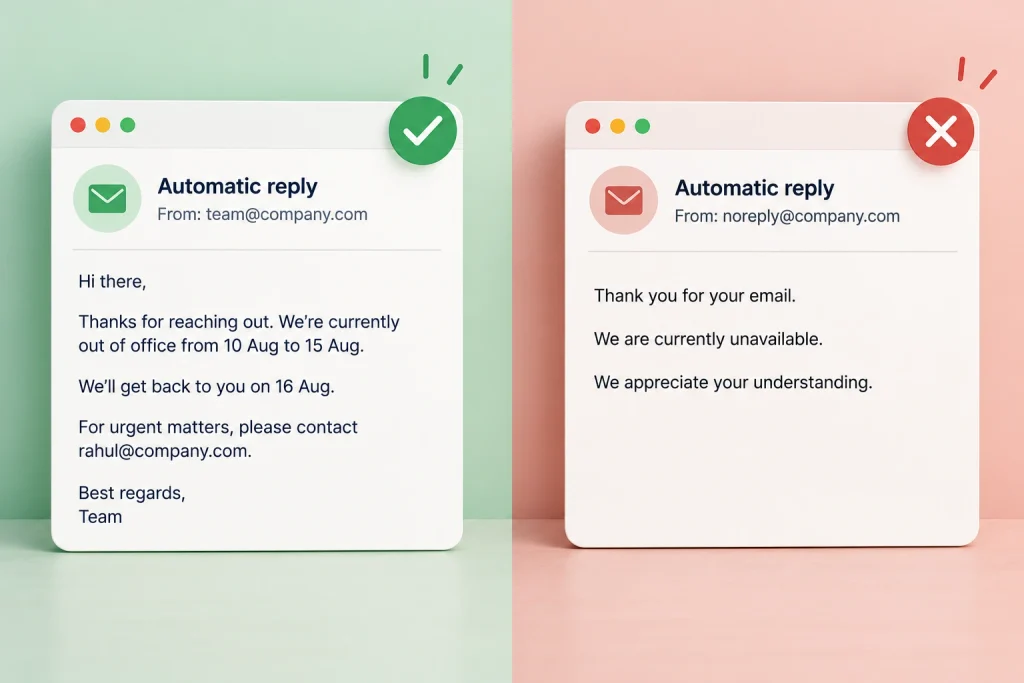
Harmful: Thank you for contacting us. We will get back to you shortly. This is worse than silence. It proves a system received the message and no person did, and “shortly” is a word that means nothing to somebody with a deadline on Thursday.
Useful: We are closed today for the festival. Your message is with us and you will have a reply before eleven tomorrow morning. If it is urgent, call this number.
Three things make the second one work. It states the reason, which is human and in this country entirely understood. It gives a specific time, which lets the buyer decide whether to wait or move on — and letting them move on honestly is better than losing them slowly. And it offers a route for the genuinely urgent, which most people will not use and all people appreciate.
Write it in September. Then honour the time you stated, which is the only part that matters.
The answer is usually a person, not a system
Every published answer to this problem is software — a CRM, a routing tool, an automation.
At the volume most Indian SMEs handle, that is the wrong answer and an expensive distraction three weeks before the season.
What actually works is smaller. One named person on duty each day, with the messaging account on a business profile rather than a personal number so that somebody else can see it. Permission to quote prices and confirm availability without asking anybody. A single shared destination for every enquiry route. And a printed list of the five answers that cover most questions.
That is a morning’s setup and it outperforms a system nobody has been trained on.
If you are large enough that this genuinely does not scale, the staffing question is the subject of the last article in this cluster.
Measure one thing
Time from enquiry arriving to a human replying.
Not average, which is flattered by the easy ones. Look at the slowest tenth, because those are the customers who formed a view.
Most Indian businesses have never measured this and cannot, because the enquiries arrive in four places and none of them records a timestamp anybody reads. Fixing that is a September job and it is the only festive metric that predicts next year’s result.
What we cannot tell you
We cannot give you a target response time. It depends on your category and your buyer’s deadline, and the honest instruction is faster than you currently are.
We cannot tell you how much volume to expect. That follows from your own history and the plan in our capacity article.
And we cannot tell you whether to staff the closed days or stop advertising on them. That is a margin question, and it should be answered in August by somebody with both numbers.
Final thoughts
Decide in September who is on duty each day of the window, and make sure every enquiry route reaches them.
Switch to triage for the six weeks. Answer the answerable in under a minute, batch the rest, and stop qualifying until the season ends.
And if you cannot answer on a given day, do not advertise on it — because an unanswered enquiry costs more than an absent one.
If you want the routes, the roster and the holding messages set up before the season, you can reach out to us on whatsapp at +91 7738844851 .
More in Blog
Keep reading
All articles →

Ready to talk about your growth?
Tell us what's stuck and we'll tell you what we'd do first. Free, 30 minutes, no pitch.