
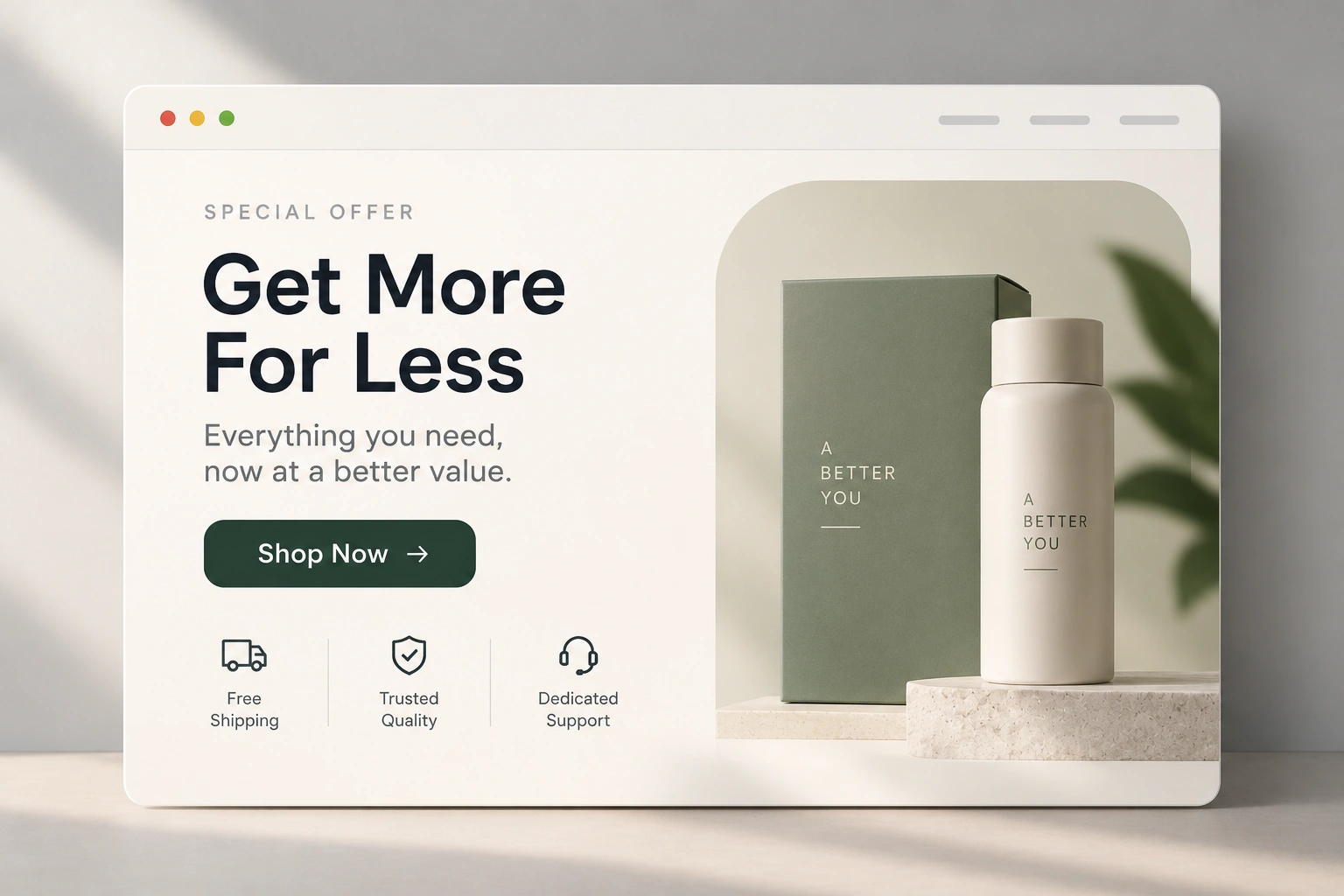
A festive landing page is decided by a question the rest of the year never asks: will it arrive in time. Ordinary page work is about message match and friction, and both still apply — but in this window the visitor is choosing on a date, and on most Indian festive pages no date appears. A page built three days before the peak is also a new URL with no conversion history, which means the platform cannot optimise to it at the moment inventory costs most. For most businesses the better answer is not a new page at all: add the seasonal section and the cut-off to a page that already ranks and already converts.
Our landing page work covers the craft of these pages in detail — message match, friction, speed, forms — and we are not going to repeat any of it. Everything in that library still applies.
This article is about the four things that only matter for six weeks a year.
The date is the page

Watch what a festive buyer is actually doing.
They are not weighing your product against a competitor’s on features. They have largely decided what they want. They are working out whether it can be in their hands by a specific day, because the day is the entire reason for the purchase.
So the question in their head is a date, and on most Indian festive pages the answer is either absent or written as urgency theatre — hurry, limited time, order soon.
Order soon is not an answer. A date is.
Order by the fourteenth for delivery before the festival does more work than every other line on the page combined, because it converts an anxiety into a decision the visitor can actually make.
Two conditions on it, and they are not optional.
It has to be true, which means it comes from the capacity work in our demand planning article rather than from optimism.
And it has to change when the date passes. A page still promising festival delivery two days after the cut-off is generating orders you will refund and reviews you will keep.
Remove the risk, do not just claim urgency
The second element that only matters in this window.
A festive buyer is unusually exposed. If the thing does not arrive, the occasion has passed and the purchase was pointless — which is a bigger downside than an ordinary purchase carries and it makes them hesitate.
So state what happens if it does not arrive. The return position, the refund position, who to contact and how quickly.
Most Indian pages bury this in a policy link or omit it entirely, on the reasoning that mentioning failure invites it. The opposite is true in a deadline purchase. A clear failure position is what allows a nervous buyer to proceed, and it converts better than another urgency banner.
The same applies to the practical questions that only surface at this time of year. Whether cash on delivery is available, whether the item can be delivered to a different address from the billing one, whether gift packaging exists, whether it can be sent to another city. Each of those is a real reason somebody abandons, and each takes one line.
And put a phone number on it. Festive buyers call — more than at any other time — because the stakes are time-bound and a person can answer in ten seconds what a page takes five minutes to establish.
A page built in October has no history
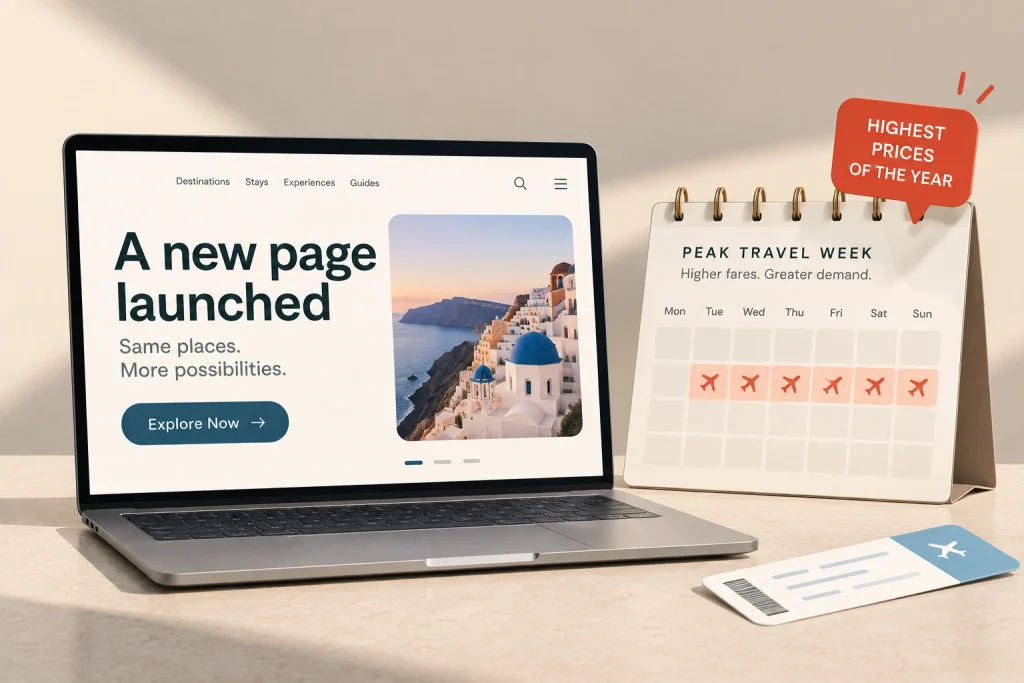
The timing error, and it is the same failure our budget article describes for accounts, arriving on a URL.
A page created three days before the peak is new to everything. No conversion history for the platform to optimise against, no organic standing, no internal links, and nothing learned about how visitors behave on it.
So the most expensive traffic of the year is being sent to the least understood page you own.
Build it in August. Send some ordinary traffic to it during the cheap weeks. Fix what the first hundred visitors reveal, which will not be what you expected. By the time the window opens the page has data, the platform has signals, and you have already found the thing that was broken.
This is the single highest-return change available on this subject and it costs nothing but sequence.
Most businesses should not build a new page
The default is a fresh URL for the campaign. For most Indian businesses that is the wrong call.
An existing page that already ranks, already has links, and already converts is a better host than a new one that has none of those things. Add a seasonal section at the top, the cut-off date, the offer, and the risk-removal lines. Remove them in December.
You keep the organic standing, the internal links, the conversion history and everything you have learned about the page, and you avoid creating a URL you will have to decide about later.
Build a separate page when there is a genuine reason. A campaign with an offer that would confuse your ordinary visitors. A product range that exists only for the season. A page with a fundamentally different structure. Our article on when a page belongs outside your site covers that decision properly.
If none of those apply, the existing page is the answer, and it is faster to prepare.
Decide the disposal before you build it
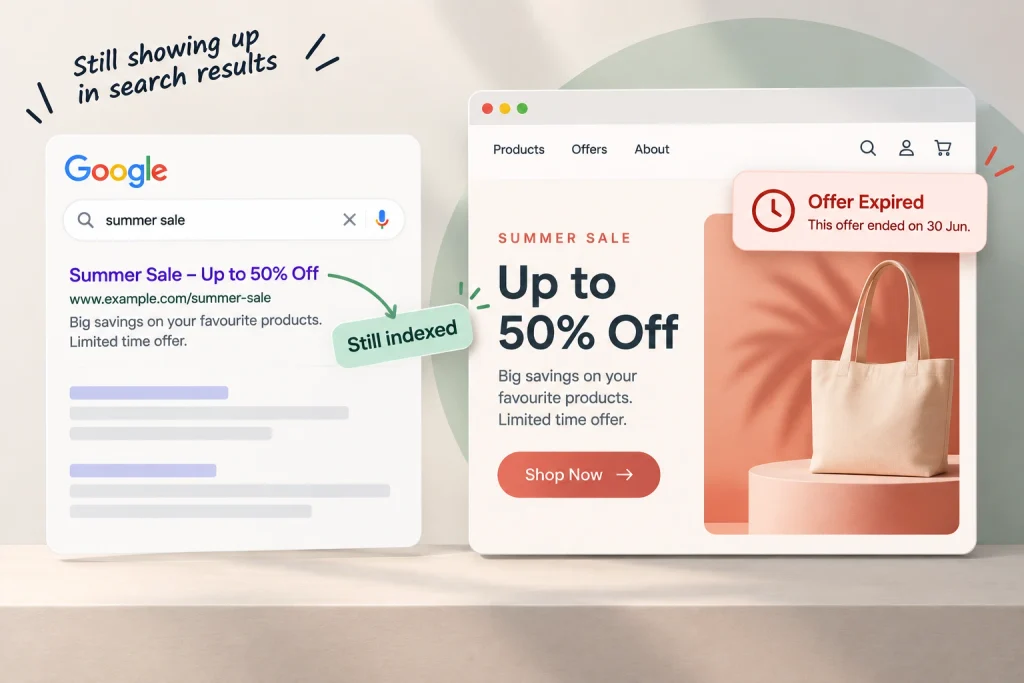
The part nobody plans, and the reason Indian sites accumulate expired offer pages.
A festive page is created, indexed, linked from campaigns, and then the season ends. Nothing happens to it. Next August somebody searches, finds last year’s page, and either believes an offer that expired eleven months ago or leaves.
Worse, it now competes with this year’s page for the same queries — the self-competition our topic clusters article describes, created by your own calendar.
Decide the disposal before the page exists, and there are only three honest options.
Redirect it to the ordinary product or service page when the season ends. Cleanest for a one-off campaign.
Update it in place and keep the same URL every year, which is the best option if you run a festive campaign annually — the page accumulates standing instead of starting again.
Or unpublish it, which is fine provided you handle the URL rather than leaving it to return an error to everybody who saved it.
What is not an option is leaving it live and unchanged, which is what happens by default. If the page has already been indexed and the offer has expired, our indexation article covers what the search side of that looks like.
The seasonal version of an ordinary discipline
Two smaller things worth carrying over from the rest of the year, because they break more visibly in this window.
The page has to load on a mid-range phone on mobile data, which is how most Indian festive traffic arrives, frequently while the person is doing something else. Our landing page library covers this properly and the festive addition is only that the traffic is more mobile and less patient than usual.
And the offer on the ad has to be the offer on the page. A visitor arriving from an advertisement promising a specific saving and finding a general page has been told something about the business in three seconds.
What we cannot tell you
We cannot tell you your cut-off date. It comes from your delivery partner and your own capacity, and it should be conservative rather than hopeful.
We cannot tell you whether to build a new page. The test is whether an ordinary visitor would be confused by the seasonal content — if not, use the page you have.
And we cannot tell you what a festive page converts at. It depends on the offer, the category and whether the date is on it, and any benchmark quoted is somebody else’s season.
Final thoughts
Put a real date on the page, and change it when the date passes.
Say what happens if it does not arrive, because that is what lets a nervous buyer proceed.
Build it in August and send it traffic while traffic is cheap. Host it on a page that already works. And decide now what happens to it in December, before it becomes another expired offer nobody remembers publishing.
If you want the page prepared and tested before the window opens, you can reach out to us on whatsapp at +91 7738844851 .
More in Blog
Keep reading
All articles →

Ready to talk about your growth?
Tell us what's stuck and we'll tell you what we'd do first. Free, 30 minutes, no pitch.