
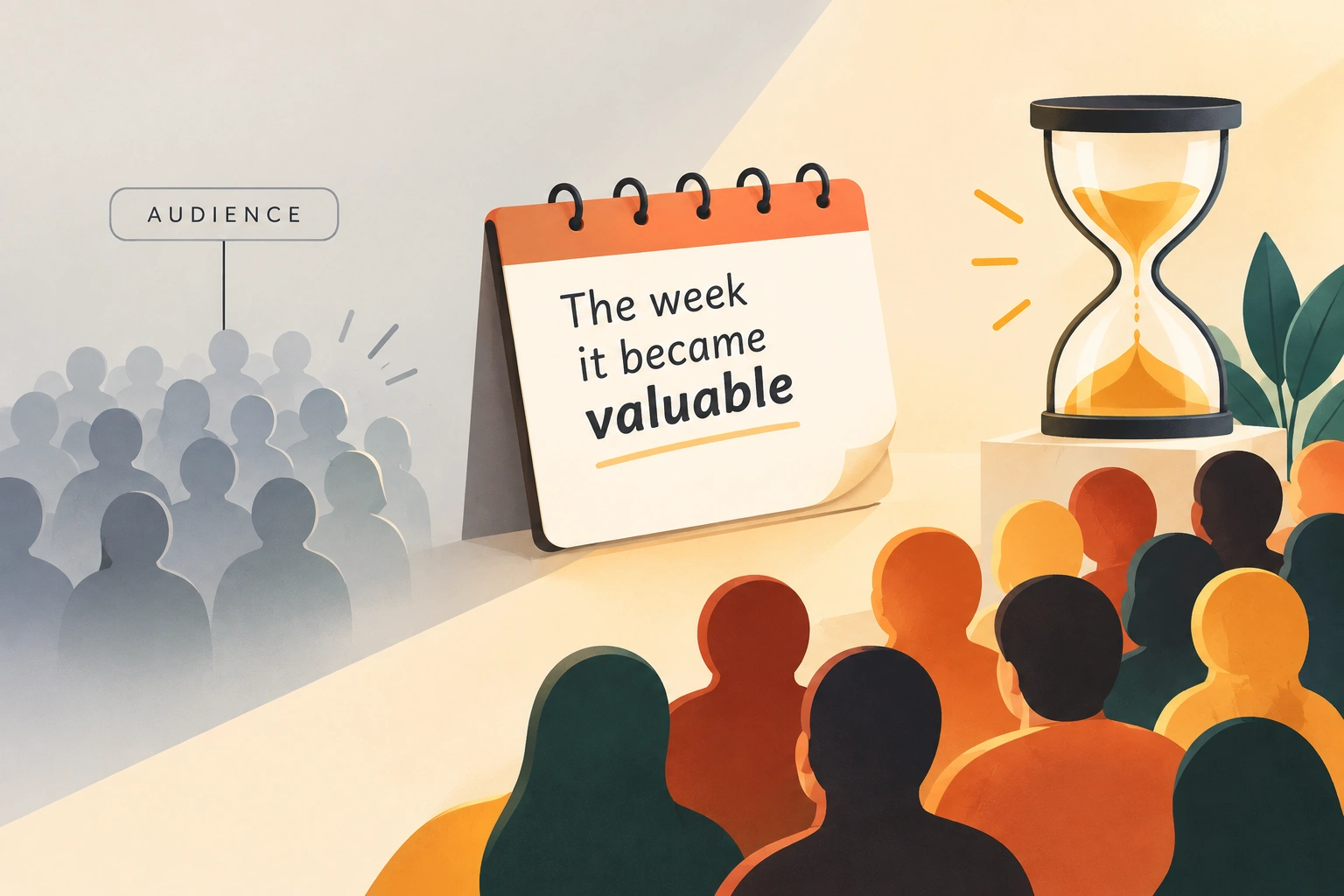
A retargeting window set once at account setup is wrong in both directions during a festive season. Festive intent carries a deadline, so it decays in days rather than months — a long window in the final fortnight spends peak-priced impressions on people who bought elsewhere a week ago. At the same time the audience built during the run-up, which is the most valuable one the season produces, expires on a standard window in the exact week those researchers became buyers. And almost nobody excludes purchasers, so the year’s most expensive impressions chase customers who have already paid.
Most Indian accounts have a retargeting window that was chosen during setup, by somebody who is no longer there, and has not been examined since.
For eleven months of the year that is harmless. In the festive window it costs money in two opposite directions at the same time.
Intent with a deadline decays faster

Ordinary retargeting logic assumes interest fades gradually. Somebody looked at a product, they might still be thinking about it in three weeks, keep showing them the ad.
Festive intent does not fade. It resolves.
The buyer has a date. They will buy from somebody before that date, and once they have, their interest in your product goes to zero immediately rather than tapering.
So a person who visited your site twelve days before the festival is not a warm prospect any more. They are either a customer of yours or a customer of somebody else’s, and in the final fortnight the odds of the second rise every day.
Which means a long window during the peak is buying the most expensive impressions of the year to reach people whose decision has already been made.
Shorten the window during the peak fortnight. Not to nothing — some buyers are genuinely still deciding — but a window measured in days rather than weeks matches how the decision actually behaves.
The run-up audience is the season’s best asset
Now the more valuable half, and it is a September decision.
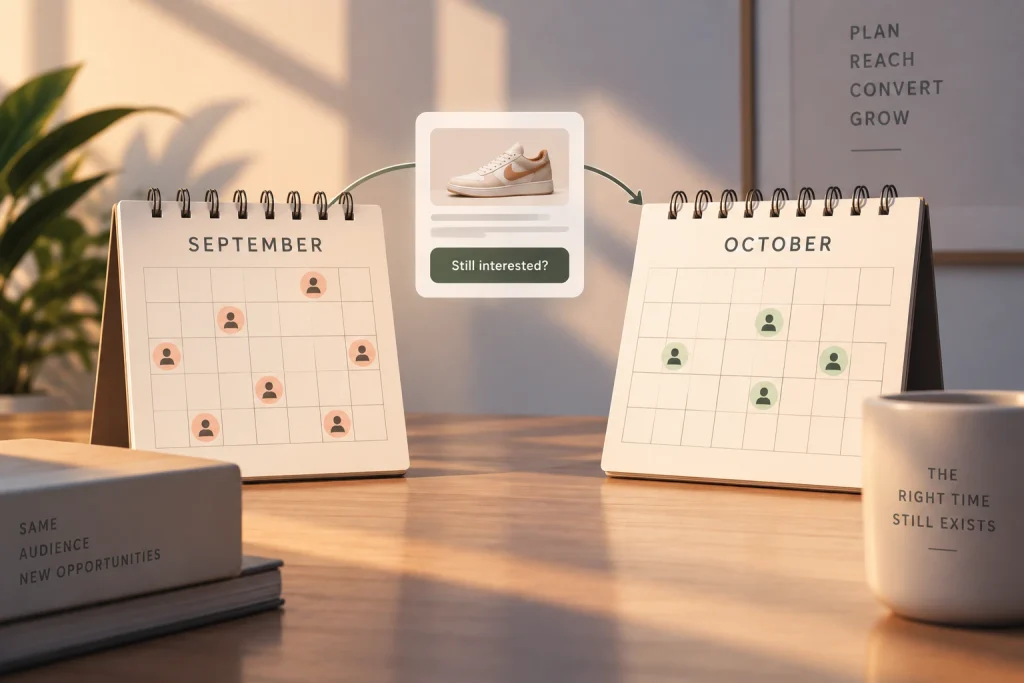
Somebody who visits your site in September is researching for the season. They are early, they are not ready, and they will not convert then.
They convert in October.
On a standard window, that person aged out of your audience in late September or early October — which is precisely the week they became a buyer. You paid to acquire their attention during the cheap weeks and then let the audience expire before the moment it was worth something.
Extend the membership duration before the run-up begins, so that September and early-October visitors are still reachable during the peak. It is a setting change, it costs nothing, and it has to be made before the traffic arrives rather than after.
This is what the pre-window spending in our budget article is actually buying. Not conversions in September — an audience that is still alive in October, at a fraction of what reaching those same people would cost then.
Two audiences are worth building deliberately in the run-up. Everybody who visited a product or service page, and everybody who engaged with the seasonal content. Both should be set to outlive the season they were built for.
Exclude the people who already bought
The commonest waste in Indian festive accounts, and it takes ten minutes to fix.
Purchase volume is high in the window. Retargeting audiences refresh constantly. And unless somebody has explicitly excluded converters, the campaign keeps showing acquisition advertising to people who have already paid.
Two costs, and the second is worse than the first.
You are spending peak-rate money on impressions that cannot convert, at the one time of year that spend is most expensive.
And you are irritating a customer during the most sensitive fortnight of their relationship with you — while they are waiting for delivery, while they are unsure whether it will arrive, and shortly before they decide whether to write a review. Our January article covers why those reviews matter more than the impressions did.
Set the exclusion before the season. Then check it, because exclusions are the setting most likely to be lost when somebody duplicates a campaign in a hurry.
The exception is genuine: an accessory, a refill, a complementary product where a purchaser is a good prospect for something else. That is a different campaign with a different message, not the acquisition campaign left running.
The frequency problem is worse in this window
Briefly, because our creative fatigue article owns this subject and its arithmetic.
The festive addition is that a single person is frequently in several of your audiences at once — a site visitor, a product viewer, an engager, a list member. During the peak they are being served from multiple campaigns simultaneously, at raised delivery, in a period when they are already seeing more advertising than at any other time of year.
The result is a level of exposure nobody planned and nobody is looking at, because each campaign’s own numbers look reasonable.
Check the overlap before the peak rather than after, and read the frequency at the person level rather than the campaign level.
What the audiences are worth afterwards

The decision nobody makes, and it is worth making in November.
At the end of the season you own the largest and warmest audiences you will have all year — people who visited, engaged, abandoned or bought during a period of high intent.
Then they quietly decay. Membership durations expire, the campaigns that fed them are paused, and by February the asset has evaporated without anybody deciding it should.
Three things to do with them instead.
Extend the durations before they lapse, so the audience survives into the quieter months when reaching those people is inexpensive.
Separate the buyers from the non-buyers, because they need different things — and what to do with the buyers is the subject of the next article in this cluster.
And use the non-buyers in January, when competitive pressure has collapsed. Somebody who was interested enough to visit repeatedly in October is worth a message in a month when reaching them costs a fraction of what it did.
The layer underneath all of this
One thing to state rather than assume.
An audience is a list of people, and how it was collected matters — our work on custom audiences under the Act sets out the position and we are not going to repeat it here.
The festive relevance is narrow and worth flagging. A season generates audiences faster than any other period, largely from people who arrived once and never came back, and the volume makes it easy to stop thinking about what those lists are. Volume does not change the position on any of it.
What we cannot tell you
We cannot give you a window length. It depends on your category’s consideration period and your own data, and the honest instruction is shorter at the peak and longer before it.
We cannot tell you the overlap in your audiences. It is visible in your own account and nowhere else.
And we cannot tell you what the run-up audience is worth. That is the comparison to run this season — the cost of reaching a September visitor in October, against the cost of reaching a comparable new person in October — and it is the number that would settle the argument permanently.
Final thoughts
Treat the window as a seasonal decision rather than a setting somebody chose once.
Extend the durations in August so that the run-up audience is still alive at the peak. Shorten the reach during the final fortnight, because the decision has resolved. Exclude the people who bought. And in November, decide what happens to the audiences instead of letting them expire.
If you want the windows and exclusions set before the traffic arrives, you can reach out to us on whatsapp at +91 7738844851 .
More in Blog
Keep reading
All articles →
Ready to talk about your growth?
Tell us what's stuck and we'll tell you what we'd do first. Free, 30 minutes, no pitch.