
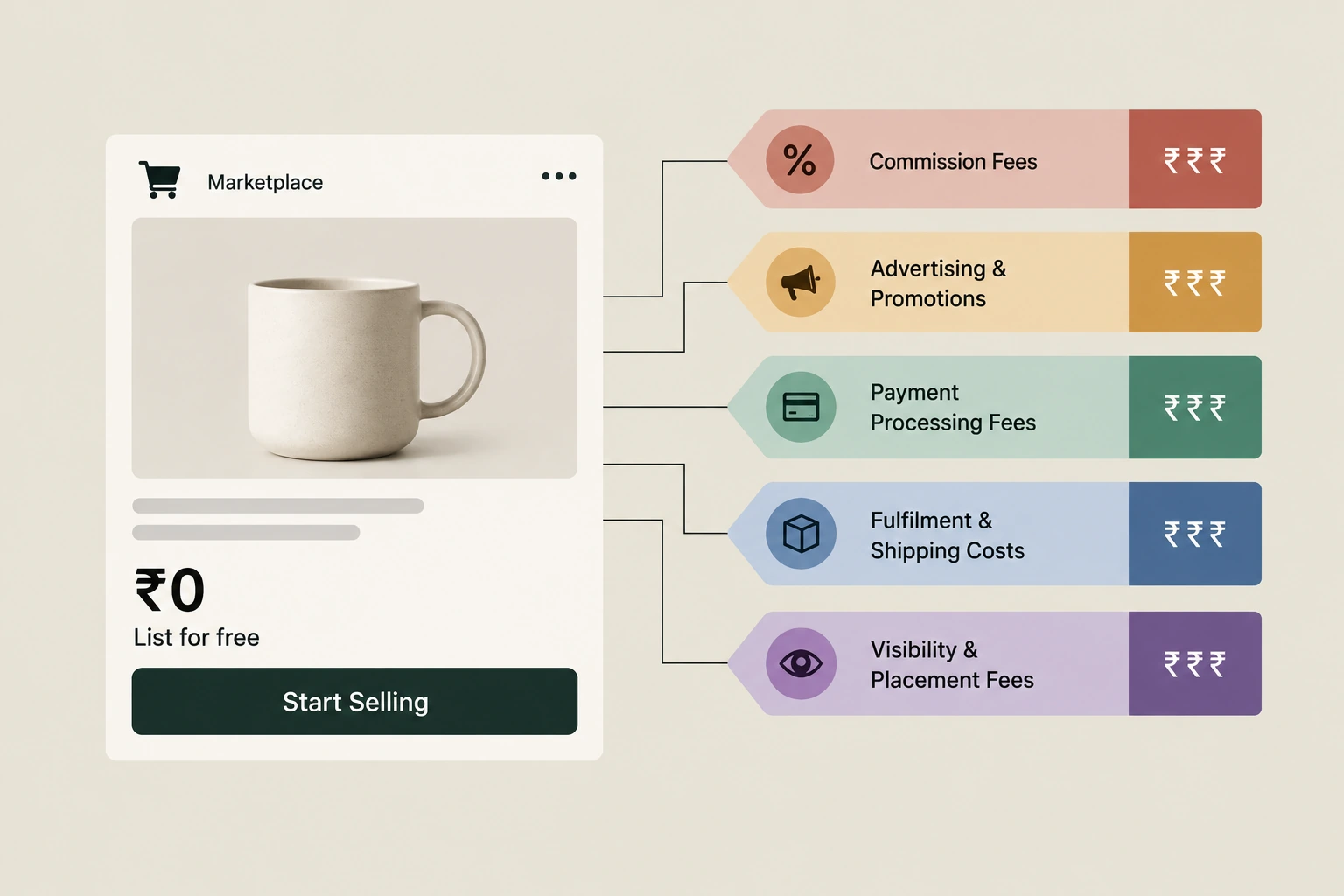
A festive marketplace listing looks cheaper than your own channel and usually is not. The real price is five separate costs — commission, the discount the sale event requires, advertising bought inside the platform, the return liability and the fulfilment terms — and none of the five reaches a media plan. The durable cost is different again: you receive the sale and the platform keeps the customer, so you cannot contact them afterwards and next season you rent them again. And a sale event is committed months ahead, which removes the ability to slow down if capacity tightens.
Almost every Indian seller comparison runs the same way. Own-channel acquisition has a visible cost per order. The marketplace listing appears not to.
So the marketplace looks like the efficient choice, and during the festive window it is the choice most sellers make by default.
Five costs, none of them in the plan
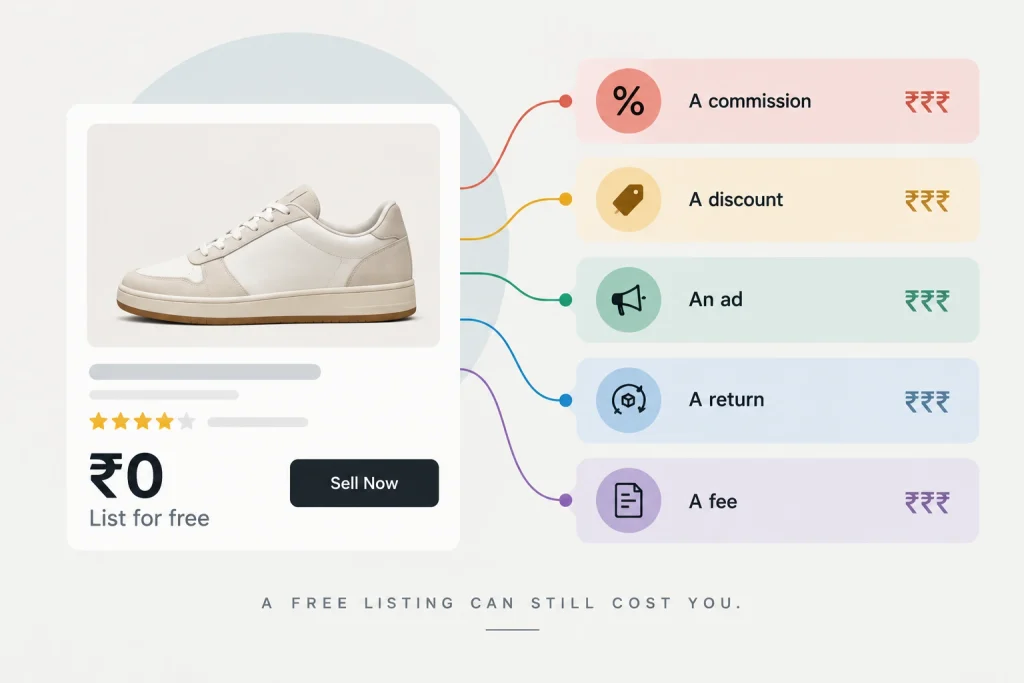
Add them up once and the comparison changes.
The commission, which varies by category and is the only one anybody counts.
The discount the event requires. Participation in a sale event generally comes with expectations about depth, and that depth is set by the platform rather than by your margin — which is the inherited anchor our discount article describes, arriving as a condition of entry rather than as a decision.
The advertising you buy inside the platform to be visible during an event where every other seller is doing the same. This is a real auction with real inflation and it is frequently the largest of the five.
The return liability. Festive return rates are higher than ordinary ones — gifts, sizes, changed minds — and the cost of a returned order runs well past the refund. It also covers shipping in both directions, the handling, and the item’s condition when it comes back.
And the fulfilment terms, whichever model you are on.
Total those and compare them, per order, against your own-channel cost per order including media. Most Indian businesses have never done this because the numbers live in different systems and nobody owns both.
Our article on break-even sets out how margin and return relate, and we are not going to restate it. The point here is narrower: the marketplace order has a margin, it is usually much lower than the own-channel margin, and it is almost never calculated before the season.
What you are actually renting

Our email pillar makes the argument that every channel except a permission-based list is rented. This is that argument at its sharpest.
On a marketplace, the customer is not yours.
You do not get the email address. You do not get the phone number. You do not get permission to contact them. You cannot run the post-purchase sequence, cannot ask for a review on your own terms, cannot tell them about the thing they would buy next.
So the busiest season of your year is the season in which you transfer the largest number of customer relationships to somebody else — and next festive season, you rent the same people again, at the same commission, having built nothing in between.
That is the durable cost, and it does not appear in any comparison because it is not a cost. It is an absence.
The tactic everybody recommends, and why we will not
The obvious response is to convert marketplace buyers to your own channel. Put a card in the box, a discount code, a QR pointing at your site.
Most marketplace seller policies prohibit exactly this, in some form — diverting a customer off-platform after acquiring them through it. Enforcement varies, the wording varies, and the consequence for a seller who is caught can be serious.
We are not going to recommend it, and we would treat any agency that does as having told you something about how it manages risk with somebody else’s business.
What is legitimate is narrower. Registering a warranty, providing genuine after-sales service, and being findable if the customer chooses to look for you. A buyer who has a good experience and searches your brand name is a customer you have earned, and the branded search that follows is visible in your own reporting.
The honest conclusion is uncomfortable: the marketplace customer is largely not convertible, and that is precisely the cost being described above rather than a problem to be solved with a clever insert.
The marketplace is frequently the right answer
The article would be posturing without this section, and Indian agency content on this subject is usually posturing.
Refusing marketplaces is a luxury position available to businesses that already have demand.
A marketplace supplies four things a new brand cannot buy at any price. Reach, on a scale no independent media budget matches. Trust, borrowed from a platform the buyer already transacts with. Logistics into pin codes you cannot service. And payment methods — including cash on delivery in places where card penetration is low — that a small business cannot offer alone.
For a new brand in the festive window, the marketplace is often the only channel that works at all. A first season spent building an own-channel presence that nobody visits is a season wasted, and the honest advice is to take the reach and accept the terms.
The question is what each channel is for, rather than whether to use one at all.
The division of labour
Which gives the framework, and it is simpler than a comparison table.
The marketplace is for acquisition and discovery, at a cost you should calculate rather than assume. It reaches people who will never find you otherwise, in places you cannot serve, with payment methods you cannot offer.
Your own channel is for margin, relationship and repeat. Better economics per order, the customer’s contact details, the ability to run everything in our email cluster, and a price you set rather than inherit.
Two practical consequences.
Do not put your best margin product into the deepest discount event. Use the marketplace for the range that acquires — the entry product, the volume line, the one that introduces somebody to the brand.
And measure them separately. A blended cost per acquisition across both channels hides which one is working, and in most Indian accounts one of the two is subsidising the other invisibly.
The trap that only appears at festive
The one that makes this a seasonal article rather than a general one.
Sale event participation is committed in advance — inventory allocated, discount depth agreed, terms accepted, frequently months before the window opens.
On your own channel, when the capacity problem our demand planning article describes arrives, you can slow down. Reduce spend, throttle by geography, pause the campaign with the longest delivery promise.
You cannot throttle a committed marketplace event. The inventory is allocated, the price is set, and the orders arrive at whatever rate the platform’s traffic produces.
So a business that has committed heavily to an event and then discovers a delivery constraint has one lever fewer than it thought — and the failures it produces are recorded in a review system it does not control.
Commit at a level you could serve on your worst week, not your best one. That is a smaller commitment than the platform will encourage and it is the one you can honour.
What we cannot tell you
We cannot tell you the commission or the terms. They vary by category, by seller tier and by year, and they are negotiated rather than published.
We cannot tell you which channel is more profitable for you. That is the five-cost calculation above, run against your own numbers, and it is a July job.
And we cannot tell you what your festive return rate will be. Your own history is the only source and most sellers have never separated festive returns from ordinary ones.
Final thoughts
Total the five costs per order before the season and put them beside your own-channel figure. Most sellers have never seen the two numbers together.
Then decide what each channel is for rather than which one wins. Acquisition and reach on one, margin and relationship on the other.
Commit to sale events at a level you could serve in a bad week. And accept that the customers acquired there are not yours — which is not a problem to be engineered around, but a price you have chosen to pay.
If you want the five-cost comparison run before you commit to this season’s events, you can reach out to us on whatsapp at +91 7738844851 .
More in Blog
Keep reading
All articles →


Ready to talk about your growth?
Tell us what's stuck and we'll tell you what we'd do first. Free, 30 minutes, no pitch.