
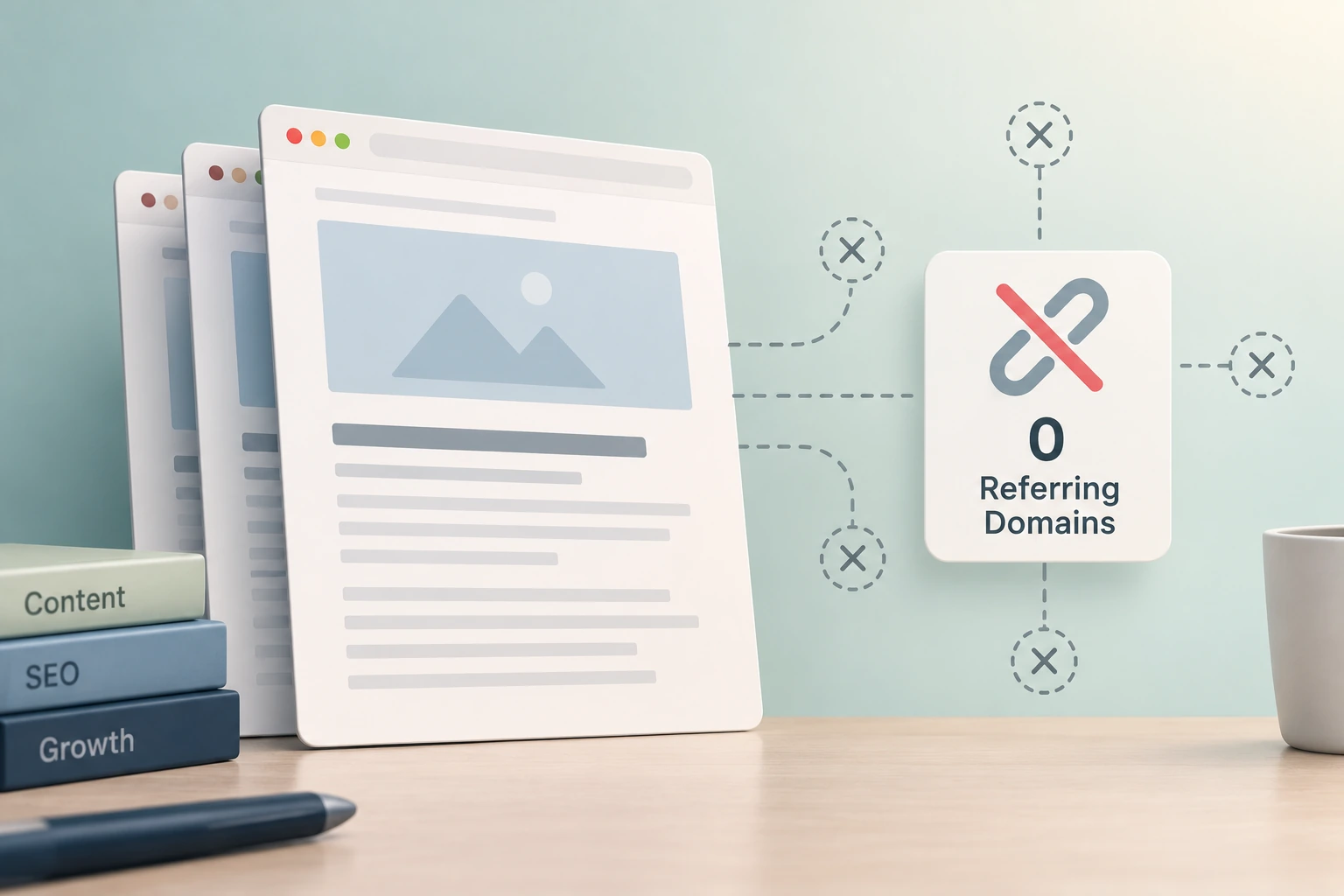
Google is reported to have said links are not among its top three ranking factors, and its leaked documentation is reported to contain a siteAuthority attribute. Both can hold at once: links matter less at the margin and still set the band a site competes within. For an Indian business with few referring domains, content quality moves you inside a ceiling decided by something else. Findise has three published posts and more than a hundred written, so we are the low-authority site in this argument.
You published. You waited. Nothing moved.
The usual diagnosis is that the content was not good enough, and the usual prescription is more of it, better optimised.
For most Indian businesses that diagnosis is wrong, and the reason sits in a claim that Google itself has made and that almost everybody has misread.
The contested claim
Google has spent several years telling people that links matter less than they used to.
Gary Illyes is reported to have said in 2023 that links are not in the top three ranking factors. In March 2024, Google is reported to have edited its spam policy documentation to remove the word “important” from its description of links.
And yet. Correlation studies keep finding the same thing — referring domains, their quality, and the authority of the pages linking to you all track with position. The leaked internal documentation is reported to contain a site-wide link authority attribute, which is difficult to square with links being incidental.
Both of these can be true, and reconciling them is the most useful thing this page can do.
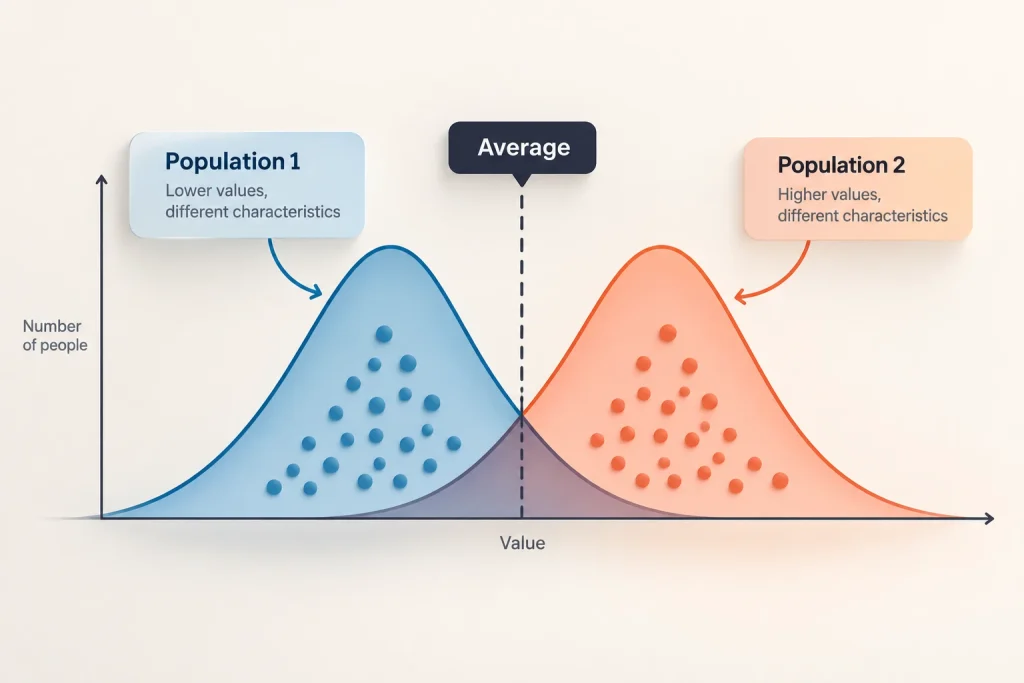
An average is not a distribution
Links are less decisive on average. That statement covers every query Google handles, including the enormous majority served by established sites — brands with search volume of their own, years of engagement history, deep topical coverage and accumulated trust.
For those sites, links are one input among many, because the many already exist.
Now consider a site with none of them. No brand searches. No engagement history. No topical depth. Nothing that tells a search engine anybody has ever found this useful.
For that site, links are not one input among many. They are the only input that produces authority at all.
So “links matter less” is accurate as an average and misleading as advice, and it is being repeated at exactly the businesses for whom it is least true.
Which is why your content is not the problem. A page that would rank on a site with authority does not rank on a site without it, and no amount of rewriting changes the input that is missing.
Our own position, since we are writing about this
Findise has three published blog posts and a hundred and twelve written.
We are the low-authority site in this article. Every argument here is one we are applying to ourselves, and we have told our own team plainly that publishing the library will not, by itself, make it rank.
That is not a confession, it is the reason this page is worth reading. An agency selling SEO has an obvious incentive to tell you the work it does is sufficient. We are telling you it is necessary and not sufficient, while being in exactly the position we are describing.
What actually produces links
Four routes, and only one of them is what people mean by “link building.”
Original research and data. A number nobody else has published gets cited, because writers need sources and there are only so many. This is the highest-return activity available to most businesses and almost none do it, because it requires having data and being willing to publish it.
Being quoted. Journalists and trade publications need practitioners to explain things. Being reachable, responsive and quotable produces links on domains you could never buy your way onto.
Tools and calculators. A thing that does a job gets linked from forums, communities and articles for years. It requires building something rather than writing something, which is why it is rare.
And outreach, which is the only one anybody sells, and the one with the worst return per hour when you have nothing distinctive to point at. Outreach works when there is something worth linking to. It substitutes for nothing.
The pattern across the first three is that they are publishing activities rather than SEO activities, which is why SEO agencies are structurally poor at them and why the businesses that win at this usually did something else well first.
What on-page still does, and where it stops

None of this makes on-page work worthless. It makes it bounded.
On-page determines whether you rank as well as your authority permits. Title tags, structure, internal links, matching the format the query expects, covering what the searcher actually needs — all of it moves you within the band your site can reach.
It cannot move the band.
Which produces the practical test. If your pages are indexed, well structured and matched to intent, and still invisible, the constraint is not on the page. If they are not indexed, or they are thin, or they answer a different question from the one asked, fix that first — because until you do, you cannot tell which problem you have.
Most Indian SEO engagements sell on-page work indefinitely, because it is legible, deliverable and produces a monthly report. It has a ceiling, and reaching it takes a few months rather than a few years.
The honest timeline
For a site starting near zero: six to twelve months before meaningful organic traffic, and that assumes links are being built the whole time.
Without links, considerably longer, and possibly never for competitive terms.
Three things make that timeline shorter, and none of them is publishing faster. Earning coverage. Building something linkable. Choosing queries where the incumbents are weak rather than where the volume is highest.
And one thing makes it longer: publishing a great deal very quickly on a site with no authority, which produces a large set of pages competing for attention that the domain cannot yet command.
The sequence we would actually run

First, check what is indexed. Not what is published — what Google has actually taken. A page that is not in the index cannot rank however good it is, and the number of Indian sites publishing into a partial index is remarkable.
Second, fix internal linking. It is the only authority signal you control completely, it costs nothing, and on most sites it is close to random.
Third, choose queries by weakness rather than volume. A term with a hundred searches and three bad results is worth more than one with ten thousand and ten strong ones.
Fourth, build one linkable thing. A dataset, a calculator, a piece of original research. One, done properly.
Fifth, get it in front of people who write. Journalists, trade publications, community moderators, professional bodies.
Sixth, and continuously, publish — at a rate the domain can absorb, with each piece answering a question properly rather than covering a topic broadly.
On-page optimisation runs alongside all of it and is never the plan.
Where to go next
On the constraint — link building for Indian businesses, treated properly.
On the trap — why your tool’s keyword difficulty score misleads a low-authority site.
On the free lever — internal linking, and why most sites do it by accident.
On the first blocker — crawling and indexing, and why some of your pages do not exist as far as Google is concerned.
Questions we get asked
Why is my website not ranking on Google?
Most often because the domain has no authority, which is a function of referring domains rather than of content quality. Check indexation first, then look at links.
How long does SEO take to show results in India?
Six to twelve months from a standing start, if links are being built throughout. Longer without.
Do backlinks still matter in 2026?
Less than they used to on average, and decisively for sites that have none. The average conceals the case you are in.
Is SEO worth it for small businesses in India?
Where the queries are specific and the incumbents are weak, yes, and it compounds in a way paid media does not. Where you are competing for head terms against national brands, no.
What should I do first for SEO?
Check what is actually indexed. It is free, it takes twenty minutes, and it frequently explains everything.
Should I buy links?
No. Beyond the policy risk, purchased links are the ones that most reliably do nothing, because the sites selling them have already sold to everybody.
Final thoughts
The uncomfortable version of this subject is that the work which compounds is the work nobody can sell you as a monthly retainer.
Publishing more is comfortable. Earning a citation is not. The first is what most Indian SEO engagements consist of, and the second is what actually moves a site that is starting from nothing.
If you want an honest assessment of where your constraint actually sits — and it is frequently not where the last agency said — you can reach out to us on whatsapp at +91 7738844851 .
More in Blog
Keep reading
All articles →


Ready to talk about your growth?
Tell us what's stuck and we'll tell you what we'd do first. Free, 30 minutes, no pitch.