Instagram Collab Posts: How to Borrow an Audience the Right Way
How Instagram collab posts work, how to set one up, and a three-question test for picking partners, with ASCI disclosure rules for paid collabs in India.


The short answer
A collab post is one Instagram post or Reel that appears on two or more profiles at once. Both names show in the header, and likes, comments and shares are pooled into one count. You can invite collaborators under Tag people › Invite collaborator before posting, and newer app versions let you add them after posting too. Business guides report a limit of up to five collaborators. A good collab puts your content in front of an audience that already trusts your partner. If the collab is paid, India’s ASCI rules require a clear disclosure.
Why collabs work
Most growth advice is about getting Instagram to show your post to strangers. A collab skips that: your partner’s followers see the post because they follow your partner.
Three things make them useful for businesses:
- Endorsement is built in. The post carries both names. A café’s followers see a bakery vouched for by the café
- Pooled social proof. Engagement from both audiences counts on one post
- Shared effort. One piece of content, two distribution lists, split production cost
The Borrowed Audience Test
Before agreeing to any collab, ask three questions.
1. Is their audience my buyer?
Not “is the account big”, but “would their followers buy from me”. A Pune wedding photographer and a Pune decorator share buyers. A Pune wedding photographer and a Delhi food blogger don’t.
2. Do our offers fit together without competing?
Complementary, not overlapping. A gym and a nutritionist fit. Two gyms don’t.
3. Is the deal fair on both sides?
If one account has 50,000 engaged followers and the other has 2,000, the bigger partner needs a reason: a fee, product, content quality, or access to a niche audience. Settle it upfront.
If any answer is “no”, skip the collab. A mismatched one gets you followers who don’t buy, and a lower engagement rate.
Collab ideas for Indian businesses
- Complementary local businesses: a Bandra café and a nearby bakery on a “weekend brunch pairing” Reel
- Supplier and brand: a fabric mill and a D2C clothing label showing how a kurta fabric is made
- Client and agency or consultant: a client’s result explained by both sides (with permission)
- Creator and brand: a small creator’s honest review. Paid, so disclosure applies
- Event partners: co-hosts of a workshop, webinar or pop-up
- Founder and brand account: the founder’s personal account and the company account on one post, so opinion and proof live together
How to create a collab post
- Create a post or Reel as usual
- On the final screen, tap Tag people
- Tap Invite collaborator and search for the account
- Publish. The post goes live on your profile, and on theirs once they accept
- The invited account accepts from their notifications or DMs
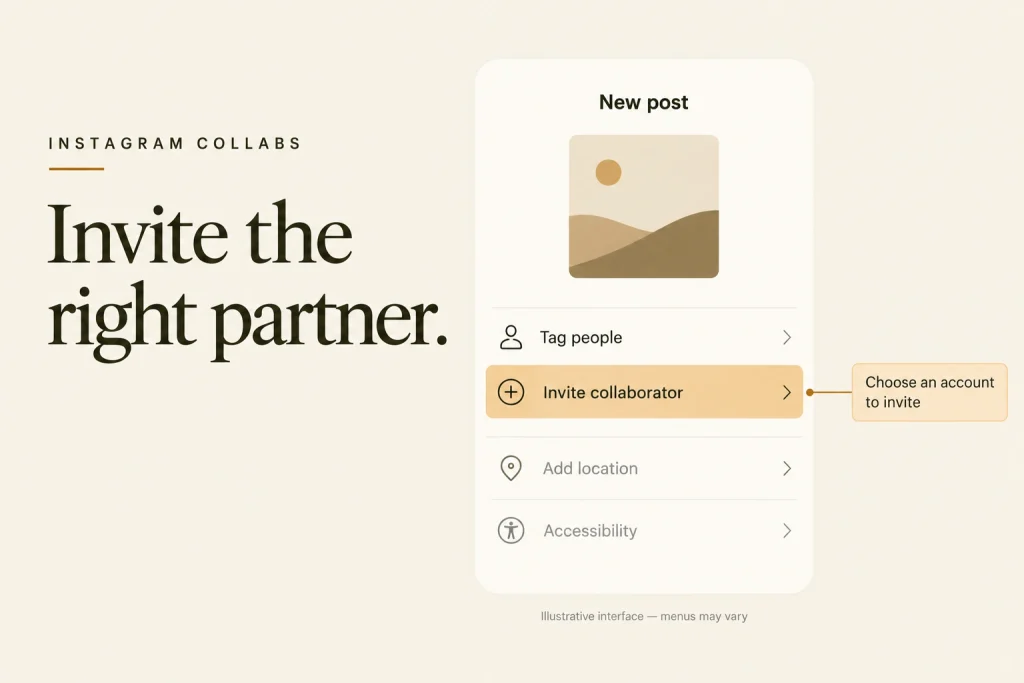
Requirements to check: both accounts should be public professional (business or creator) accounts, as reported by business guides. Private accounts face restrictions. Menu names shift between app versions, so follow the app if the labels differ.
Adding collaborators later: newer versions let you edit a published post and invite collaborators. Useful if a partner joins after launch.
When a collab is paid: disclose it
If money, free products, discounts or any other benefit changed hands, it’s advertising. India’s advertising standards body, ASCI, requires influencer and brand content with a material connection to carry a clear, upfront disclosure label that people can’t miss. Do this in the caption’s first lines, and on screen for video.
For creators, a paid collab can also run as a Partnership Ad, which adds a “Paid partnership” label and lets you put budget behind it. Our guide to Partnership Ads covers both Meta’s requirements and ASCI’s. For budgets, see influencer marketing cost in India.
Making the post work
A collab post is still judged on watch time, likes and sends. Two logos don’t make it interesting.
- Lead with the viewer’s problem, not “We’re excited to partner with…”
- Show both partners doing something, not a joint poster
- Write one caption for both audiences. Explain who each partner is in a line
- Agree the ask. One call to action, usually a send or a follow
- Both reply to comments. Split the job; don’t leave the partner’s audience unanswered
Mistakes to avoid
Collabing for follower count. Big but irrelevant audiences give you vanity numbers.
No written agreement. Agree on who makes what, posting time, captions, and whether it can be boosted as an ad.
Missing disclosure on paid collabs. A reputational and regulatory risk.
A joint poster instead of content. Announcement graphics rarely get sent.
Collabing too often with the same account. The shared audience sees the same faces. Rotate partners.
Checklist
- Passed all three Borrowed Audience questions
- Written agreement on content, timing, captions and paid boosting
- Both accounts public and professional
- Invite collaborator set before posting
- Content leads with the viewer’s problem
- Disclosure label added if any benefit was exchanged
- Both partners reply to comments
- Results reviewed after seven days: reach, sends, follows for each side
Questions we get asked
Do collab posts get more reach?
They reach both accounts’ followers, and pooled engagement helps. They’re still ranked on watch time, likes and sends.
Can you remove yourself from a collab post?
Yes, a collaborator can remove themselves, and the post stays on the original account.
Who owns the post’s insights?
Each account sees insights for the post. Agree to share screenshots so both sides can judge results.
Final thoughts
A collab is the fastest way to borrow trust on Instagram, if the audience fits. Run the three-question test, disclose paid work, and treat it as content, not an announcement. It belongs in the “get believed” rung of your Instagram marketing strategy.
Looking for the right collab or creator partners? Book a consultation with our team. You can reach out to us on whatsapp at +91 7738844851.
More in Blog
Keep reading
All articles →
Ready to talk about your growth?
Tell us what's stuck and we'll tell you what we'd do first. Free, 30 minutes, no pitch.