
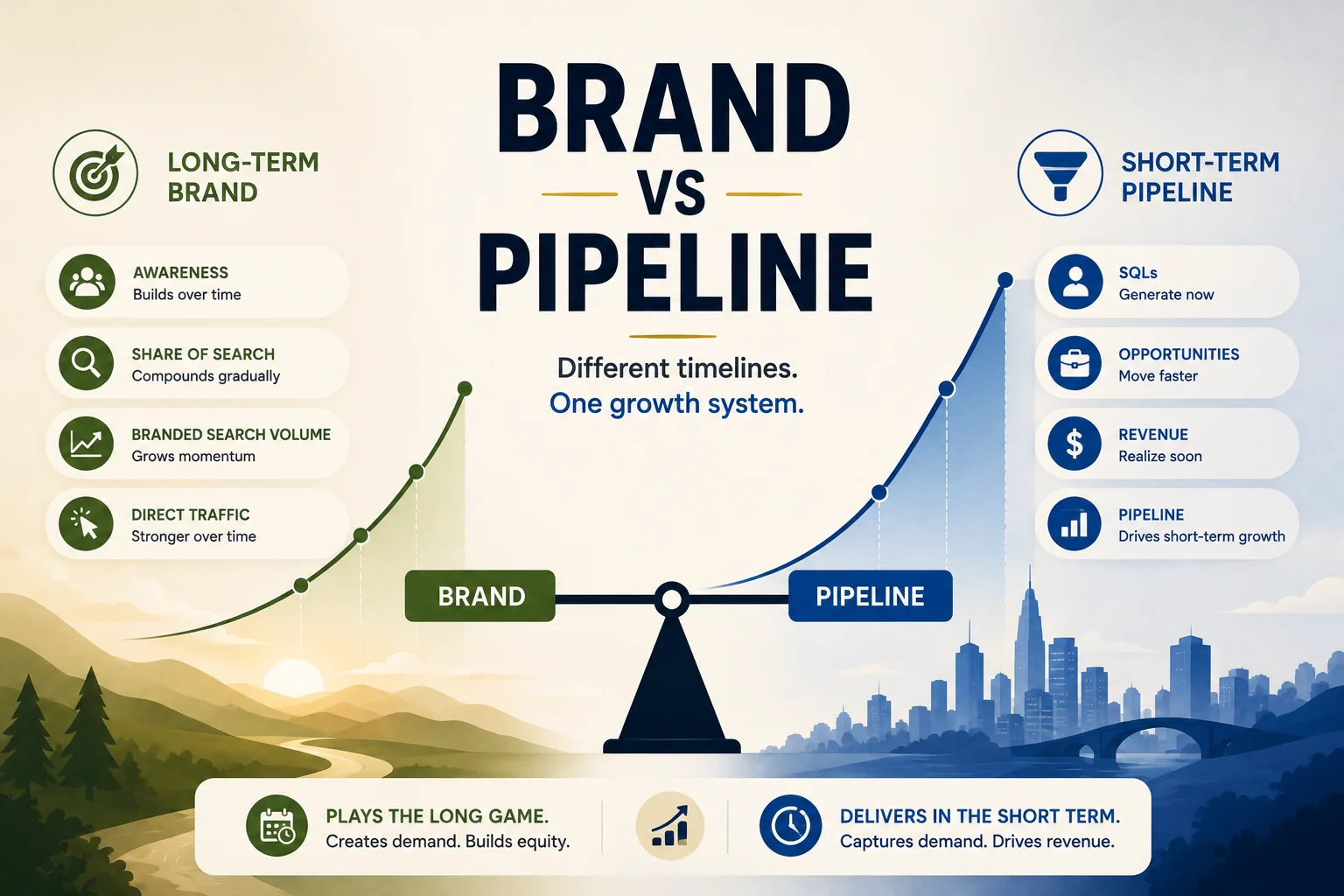
Ask a marketing head why their demand generation budget was cut and you will hear a version of the same sentence: it wasn’t producing leads.
It was never going to. Not in the first two quarters, and not measured that way. Demand generation is the work of making people want something before they go looking for it, and it gets assessed with instruments built to count people who are already looking.
The discipline is not hard to understand. What is hard is proving it works before somebody stops funding it. So this article spends most of its length on that.
The short answer
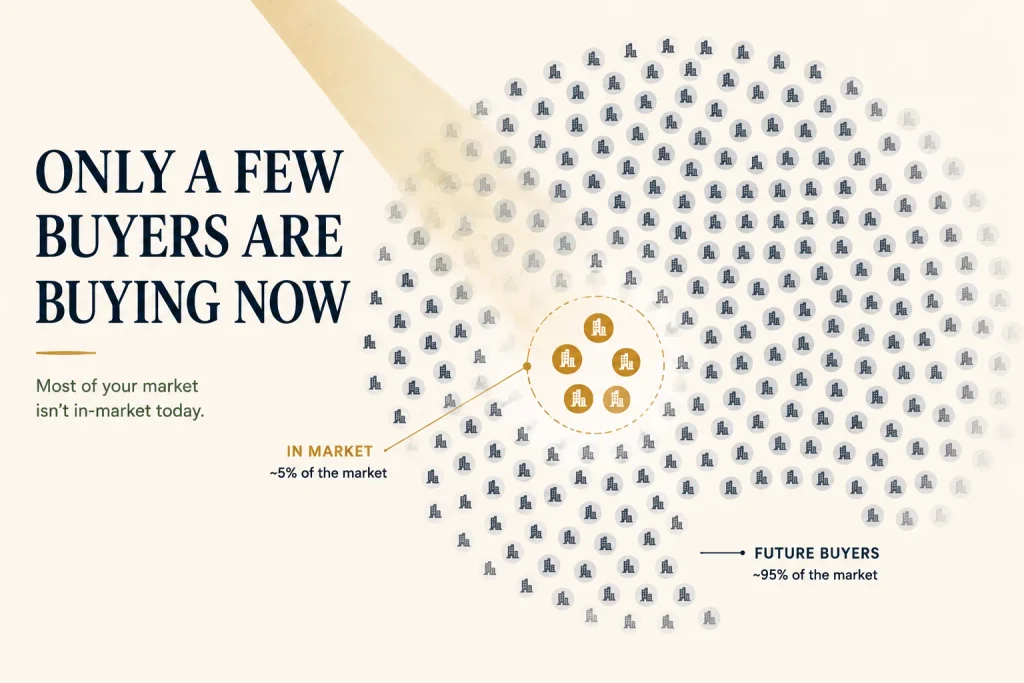
Demand generation creates awareness and interest among buyers who are not currently shopping. Lead generation captures the ones who are. Roughly 5% of your potential buyers are in the market at any moment, which caps how far capture alone can take you. Demand generation addresses the other 95%, pays back over quarters and years rather than weeks, and produces a different kind of evidence at each stage. Knowing which evidence to expect, and when, is what keeps the budget alive.
Key takeaways
- About 95% of your buyers are not buying right now. Professor John Dawes at the Ehrenberg-Bass Institute, working with the LinkedIn B2B Institute, found roughly 5% of potential B2B buyers are in market at any given time. Capture channels compete for that 5%. Everything else is demand generation’s territory.
- Branded search volume is the cheapest proof you are not tracking. It sits in Search Console, costs nothing, and rises within two to three months if demand creation is working. Almost nobody watches it.
- The 60:40 split is a starting point, not a law. Binet and Field’s analysis of close to a thousand IPA case studies puts the average at 60% brand building and 40% activation — with Binet himself stating plainly that “60/40 is not an iron rule.”
- Buyers arrive informed and late. Gartner puts time spent with potential suppliers at around 17% of total buying time. Most of the decision happens where your demand generation either exists or does not.
- The most common failure is a timing mismatch, not a channel mistake. Demand creation judged on next month’s lead count fails a test it was never designed to pass.
The 5% problem
Here is the number that justifies the entire discipline.
Research by Professor John Dawes at the Ehrenberg-Bass Institute, conducted for the LinkedIn B2B Institute, found that only about 5% of potential B2B buyers are in the market at any given moment. The other 95% are not shopping — but they are still your addressable market, and at some point over the next one to three years, many of them will be.
Sit with what that means for a paid search budget.
Search advertising reaches people typing a query, which means it reaches a slice of the 5%. It is efficient, it works, and it is capped by a number you do not control. This is precisely what we describe as the capture ceiling and how to measure yours — and the 95:5 finding tells you what that ceiling is made of.
Now the second number. When a member of that 95% finally enters the market, they do not start neutral. Gartner’s research on B2B buying found buyers spend roughly 17% of total buying time meeting potential suppliers, with six to ten stakeholders each researching independently beforehand. By the time you hear from them, a shortlist already exists in their heads.
Demand generation is the work of being on that list before the search begins.
Brent Adamson, then a distinguished vice president in Gartner’s sales practice, described why this is getting harder: buyers are “reaching an information saturation point, where each new idea reduces the value derived from information and turns sound decision making into ‘best guesses’ or ‘gut feeling’ choices.” In saturated categories, being remembered beats being findable.
What demand generation is, and what it is not
Demand generation is marketing aimed at people who do not yet know they need you.
It includes founder-led visibility, industry content, webinars, events, trade press, podcasts, original research, community presence and the slow accumulation of being a name people recognise. Its output is not a lead. Its output is that more people, later, search for you by name or shortlist you without being asked to.
It is not lead generation with better branding, which is how most agencies sell it. Lead generation captures existing demand and can be attributed to a click. Demand generation grows the pool and cannot.
It is also not the same as brand advertising in the consumer sense. In B2B, demand generation and brand building overlap heavily but the goal is narrower — you are not building affection, you are building recall inside a specific buying category.
One practical way to tell which you are looking at: if the activity would still make sense with the enquiry form removed, it is demand generation.
The Evidence Ladder
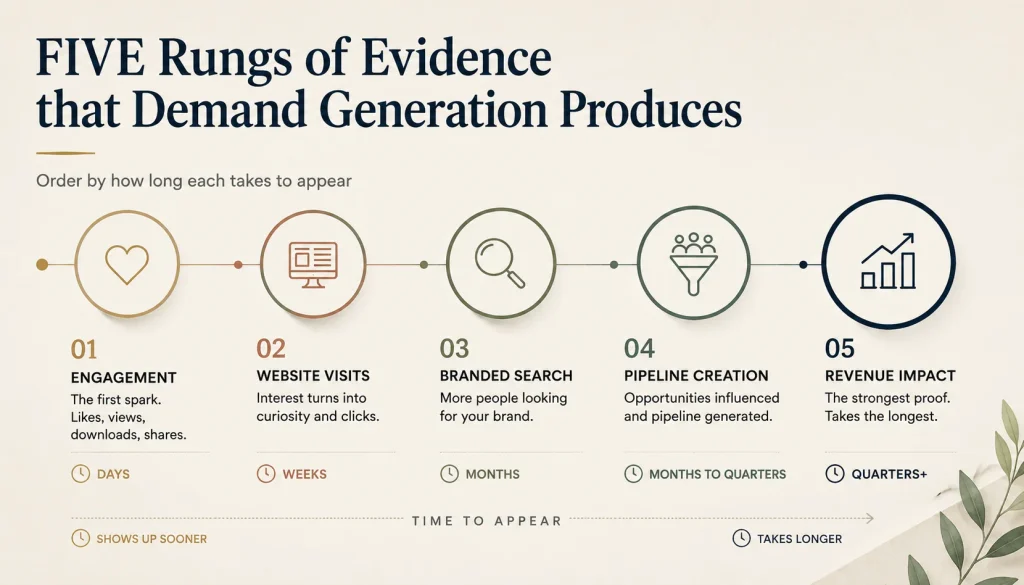
The reason these budgets die is not that they fail. It is that they are asked for the wrong proof at the wrong time.
Demand generation produces different evidence at different stages, and each rung is real. Knowing which rung you are standing on is the difference between a programme that survives and one that gets cancelled in month two.
The rule: judge demand generation on the rung you are actually on. Asking for year-one evidence in month two is how creation budgets get cut — and the answer is not “trust us,” it is “here is the rung we are on and here is what it shows.”
Rung one — engagement, weeks one to four
Views, follows, replies, saves, comments from people with the right job titles.
This is weak evidence and it is not zero evidence. What you are checking is whether the right audience finds the material worth their attention. Ignore volume; read who is engaging. Twenty comments from procurement heads in your category matters more than two thousand views from nobody in particular.
What it cannot tell you: whether anyone will remember you.
Rung two — branded search volume, months two to three
The single most useful and least used metric in demand generation.
Open Search Console and look at impressions and clicks for queries containing your company name. If demand creation is working, that line rises — people who saw your content later search for you specifically rather than for your category.
It is free, it is unambiguous, and it moves months before anything else does. Set a baseline before you start.
What it cannot tell you: whether that recognition converts.
Rung three — direct traffic and attribution answers, months four to six
Two things shift together.
Direct traffic rises, because people type your URL or find you through a channel that reports nothing. And the answer to “how did you hear about us” starts changing — add that field to your enquiry form now if it is not there, because it is the only attribution demand generation ever gets.
What it cannot tell you: the revenue effect.
Rung four — unprompted inbound, months six to twelve
Enquiries that name your content, quote something you published, or arrive from a referral you did not ask for. Sales conversations that open with the prospect already understanding what you do.
This is the first rung where the commercial effect becomes legible. It is also where the sales team stops being sceptical, which matters more organisationally than it should.
What it cannot tell you: the size of the effect.
Rung five — win rate and cost per lead, year one onward
Two lagging indicators, both meaningful.
Win rate improves on deals where capability is equal, because familiarity is doing work in the room. And cost per lead in your capture channels falls, because more of the people clicking already know who you are.
That second effect is the one finance understands. Demand generation makes lead generation cheaper, and the effect is measurable in the channel that was already being measured.
What actually creates demand in Indian B2B
Fewer things than the channel lists suggest, and most of them are unglamorous.
Founder-led visibility. The highest-return demand generation available to an Indian mid-market business, and the hardest to sustain. A named person publishing a specific point of view weekly to a specific industry outperforms a company page doing anything. It fails when it is delegated to an agency writing in the founder’s name — the voice is the product.
Content that answers pre-purchase questions. Not “what is CRM”. How to specify the thing, what it should cost, what goes wrong in implementation, how to compare suppliers. These are the questions the 95% ask themselves quietly, months before they search for a vendor.
Events and trade shows. Still among the strongest sources in Indian manufacturing and industrial B2B, still treated as a cost centre rather than a channel with a measurable return. Track them like media and the conversation changes.
Original data. The most durable and least attempted. A company that publishes its own benchmark — real numbers from its own operations, updated annually — becomes the thing the trade press quotes. India’s digital advertising market reached ₹71,621 crore in 2025 and became the country’s largest medium for the first time, per dentsu India, and yet Indian first-party benchmark data remains scarce in almost every B2B category.
Trade press and industry PR. Cheap relative to its effect, and largely ignored by agencies because it is not billable by the impression.
What creates less demand than people expect: paid social awareness campaigns with no distinctive creative, gated whitepapers nobody downloads twice, and company-page posting that reads like a press release.
How much to spend on it
The honest answer is that the published guidance needs adjusting for Indian budget realities.
Binet and Field’s analysis of close to a thousand advertising effectiveness case studies from the IPA Databank produced the widely quoted 60:40 rule — roughly 60% of marketing budget to long-term brand building, 40% to short-term activation. Binet has since been direct that the ratio is contextual: “60/40 is not an iron rule.”
Two adjustments matter for an Indian mid-market business.
Below a certain absolute budget, split the time rather than the money. A ₹3 lakh monthly marketing budget divided 60:40 leaves too little of either to work. Better to run capture properly with the media budget and fund demand creation with founder time, which costs nothing and works better than money at this scale.
Weight toward activation when you are unknown and buyers are searching. If your category is well established and people are already looking, capture first, build later. The 60:40 average includes many businesses in categories where demand is mature.
The reverse also holds. If nobody searches for what you sell because they do not have a name for it, activation has nothing to activate, and the split should move sharply toward creation regardless of what it does to this quarter’s numbers.
Which mandate you are buying from an agency is worth settling explicitly — we cover which marketing mandate you are actually buying separately.
Mistakes that cost real money
Measuring rung five in month two. The failure this article exists to prevent.
Funding demand generation from the performance budget. Same pot, same review meeting, same metric. It loses every time, because activation shows a number this month and creation does not.
Delegating the founder’s voice. Ghost-written thought leadership reads as ghost-written, and the whole asset is credibility.
Publishing without a baseline. If you did not record branded search volume before starting, you have given up the clearest evidence you were going to get.
Gating everything. A whitepaper behind a form reaches the 5% who will fill it in. The 95% do not fill in forms, because they are not shopping.
Treating it as a campaign. Demand generation is a standing commitment. A three-month burst produces three months of engagement and no memory.
When not to do demand generation
Your capture channels are not exhausted. If your search impression share is low and there is untapped demand in your category, harvest it first. It is cheaper and faster, and it funds everything else.
You cannot sustain it for a year. A programme that stops in month five wastes everything spent in months one to four. Recognition decays. If a year of commitment is not available, put the money into capture and conversion.
Nobody will be the face of it. In Indian mid-market B2B, demand generation works largely through people rather than logos. If no founder or senior figure will be visible, expect materially less return.
Your problem is win rate, not volume. If enquiries arrive and you lose them, creating more demand adds cost. Fix proof, follow-up and sales enablement first.
Your business will not exist in two years without revenue now. This is not a moral point. Demand generation is a compounding investment, and compounding requires time you may not have. Say so honestly and spend on capture.
The demand generation checklist
☐ Record branded search volume in Search Console as a baseline before starting
☐ Add “how did you hear about us” to every enquiry form, as free text
☐ Name the person whose voice carries the programme
☐ Agree a publishing cadence that survives a busy quarter — weekly beats daily-then-nothing
☐ Write the ten questions buyers ask before they shortlist, from sales, in their words
☐ Fund it on a separate budget line from performance media
☐ Agree with leadership which rung of evidence is expected at three, six and twelve months
☐ Set the review date at six months, not six weeks
☐ Track cost per lead in capture channels as a lagging demand generation metric
☐ Commit to twelve months or do not start
Questions we get asked
What is the difference between demand generation and lead generation?
Lead generation captures people already looking for what you sell. Demand generation increases how many people are looking. The practical test: remove the enquiry form and ask whether the activity still makes sense. If yes, it is demand generation.
How do you measure something that cannot be attributed?
By expecting the right evidence at the right time. Branded search volume at two to three months, changing attribution answers at four to six, unprompted inbound at six to twelve, and falling capture-channel cost per lead beyond a year. Attribution is not available; evidence is.
Is demand generation worth it for a small company?
Often yes, but funded with time rather than money. A founder publishing consistently to a specific industry is demand generation, and it costs nothing but discipline. Paid awareness campaigns at small budgets are usually the wrong version.
How long before it works?
Branded search moves in two to three months. Commercial effects become legible between six and twelve. Anyone promising pipeline from demand generation in the first quarter is selling you lead generation with a different label.
Should we hire an agency for this?
For content production, events and PR, an agency helps. For the founder-led half, it cannot — that part is not outsourceable, and agencies that claim otherwise are selling ghost-written posts that will not do the job.
What if our competitors are not doing this?
Then it is cheaper and more effective for you than it will ever be again. Being the only recognised name in a category where nobody invests in recognition is the strongest position available in Indian B2B.
What to do this week
Open Search Console and write down your branded search volume for the last ninety days. That single number is your baseline, it costs nothing, and without it you will have no way to prove anything for the next year.
Then ask one question in your next leadership meeting: which rung of evidence do we expect at three months, at six, and at twelve? Getting that answer agreed in writing does more to protect a demand generation budget than any result will.
If your capture channels are still producing cheaply, do this later and harvest first. If they have stopped, the 95% is where the growth is, and the work starts with a baseline and a named person willing to be visible.
To have that mapped against your category and what you are already spending, you can reach out to us on whatsapp at +91 7738844851 . We will tell you if the honest answer is that you should exhaust capture first.
More in Blog
Keep reading
All articles →


Ready to talk about your growth?
Tell us what's stuck and we'll tell you what we'd do first. Free, 30 minutes, no pitch.