
AI answers are assembled from passages rather than pages, so the unit of competition is the sentence. A paragraph that opens “as we saw above” cannot be extracted. A claim written as “our audits found” loses the business’s name when it travels, while naming the firm inside the sentence keeps it. And honest hedging survives extraction only if you hedge the scope rather than the claim — “Google publishes no indexing timeline” is liftable, “indexing times can vary” is not.
Our article on citation sources establishes the mechanism: an AI answer is assembled from passages, each source supplying one claim rather than being judged as a whole page.
This article is what that does to your writing.
It turns out to be a craft problem rather than an optimisation problem, and the habits it breaks are ordinary ones that nobody thinks of as faults.
Dependency is the first thing to go
Read your last published page and find every paragraph that cannot stand on its own.
They usually announce themselves. “As we saw above.” “This means that.” “That is why.” Any sentence whose subject is a pronoun pointing back at something four paragraphs earlier. Any list item that only makes sense under its heading.
Lifted out, none of these says anything. There is nothing to quote because the meaning lives somewhere else on the page.
The fix is a habit rather than a rule: write each paragraph as though it might be the only one anybody reads. Restate the subject where you would normally use “it”. Name the thing you are referring to instead of pointing at it.
This produces slightly more repetition than a literary editor would like. It also produces writing that survives being skimmed on a phone, which is how most of your readers arrive.
The word that decides whether you get named
Here is the part almost nobody writes about, and it is one word wide.
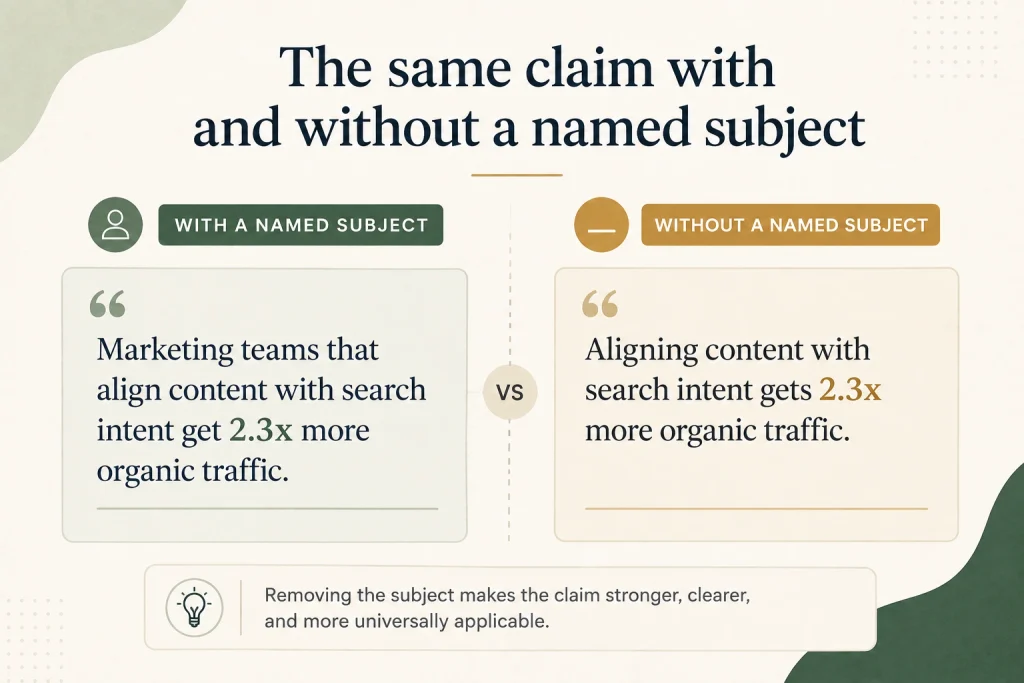
Consider two sentences carrying the same finding.
Our audits found that eleven of twelve location pages typically go unindexed.
Findise’s audits found that eleven of twelve location pages typically go unindexed.
Both are true. Both are useful. The first, extracted and shown to somebody who never sees your page, is an anonymous claim from nowhere. The second carries you into the answer.
This matters more now than it used to. When the reward was a click, the source of the sentence was the page it linked to. When the reward is being named in an answer somebody reads without clicking — the situation our pillar describes — the attribution has to be inside the sentence or it does not travel.
Two cautions, because this can be overdone quickly.
Use it where you are making a claim that is yours: your data, your finding, your position. Not on general statements of fact, where it reads as vanity.
And keep it to one form of your name, for the reason set out in our article on mentions.
Roughly one attributed claim per major section is enough. More than that and you are writing a brochure.
The hedging problem, and how to solve it
Every guide on this subject says be specific. None of them addresses the obvious objection.
Honest writing hedges, because the world is uncertain. In this library we have written that no reliable timeline exists for indexing, that published click-through datasets disagree, and that the correlation research on AI citation is vendor-produced and should be read as direction only. Those hedges are the most valuable sentences on their pages.
They are also, in the form above, close to unextractable. There is no crisp proposition to lift.
The resolution is to hedge the scope rather than the claim.
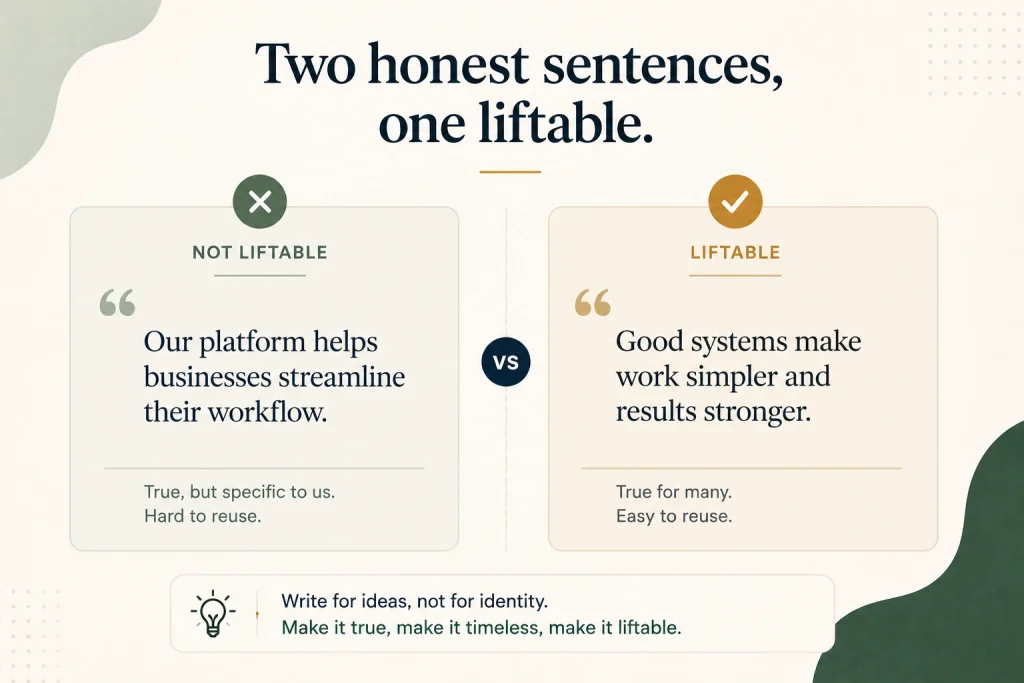
Weak: Indexing times can vary quite a lot depending on several factors.
Strong: Google publishes no indexing timeline, and the practitioner figures in circulation are estimates rather than measurements.
The second is more hedged than the first — it makes a narrower and more defensible statement — and it is entirely liftable, because the uncertainty has been moved into the claim rather than smeared across it.
Do that and you get to keep your honesty and your extractability at once. It is also just better writing.
Why question headings work, and the reason usually given is wrong
The standard advice is to use question-shaped headings because they match the way people search. That is a partial truth and it leads people to write bad headings.
The better reason: a heading marks where an answer begins and, critically, where it ends. An extractor needs boundaries. A page organised as one continuous argument under three vague headings has no obvious unit to take.
So write headings that make a promise the next two paragraphs keep, and then keep them within two paragraphs. If the answer runs to eight, the heading was too broad.
One thing not to do. Do not bolt a frequently-asked-questions section onto the bottom of every page for this purpose. The rich result that once rewarded it was withdrawn — a subject we cover in what structured data does and does not do — and a list of questions the article has already answered is padding whichever system reads it.
If a question is worth answering, answer it in the body under its own heading.
Put the answer in the first sentence
The highest-yield edit available on an existing page, and it takes an afternoon across a whole site.
Take your best page. List every heading. Under each one, read the first sentence and ask whether it answers the heading.
Most will not. Business writing is trained to set up before it delivers — a sentence of context, a sentence acknowledging the difficulty, and then the answer in the third or fourth position. It is a habit from essays and it is exactly backwards for a reader arriving mid-page and for anything lifting a passage.
Move the answer to the first sentence under the heading. Keep the context; put it after.
Nothing is lost. A reader who wants the reasoning reads on. A reader who wanted the answer has it. And the unit sitting directly under the heading is now a complete statement rather than a preamble.
We would rate this above every other item in this article for effect per hour, and it requires no new writing at all.
Length is not the variable; granularity is
The question that always comes up is how long a page should be, and there is no target — a point our article on the on-page checklist makes about search generally.
But length interacts with this subject in a way worth understanding.
A three-thousand-word page organised under three broad headings offers three large, tangled units. The same content under twelve specific headings offers twelve clean ones. Same words, four times the surface area.
So the useful instruction is not to write longer or shorter. It is to break what you have into units that each answer one thing completely.
The failure this guards against is the long undifferentiated essay — genuinely good, thoroughly researched, and structured as one continuous argument with no seams. Those pages are frequently the best thing on the subject and they are hard to take anything from.
What cannot be extracted at all
Worth stating, because it is most of what business websites contain.
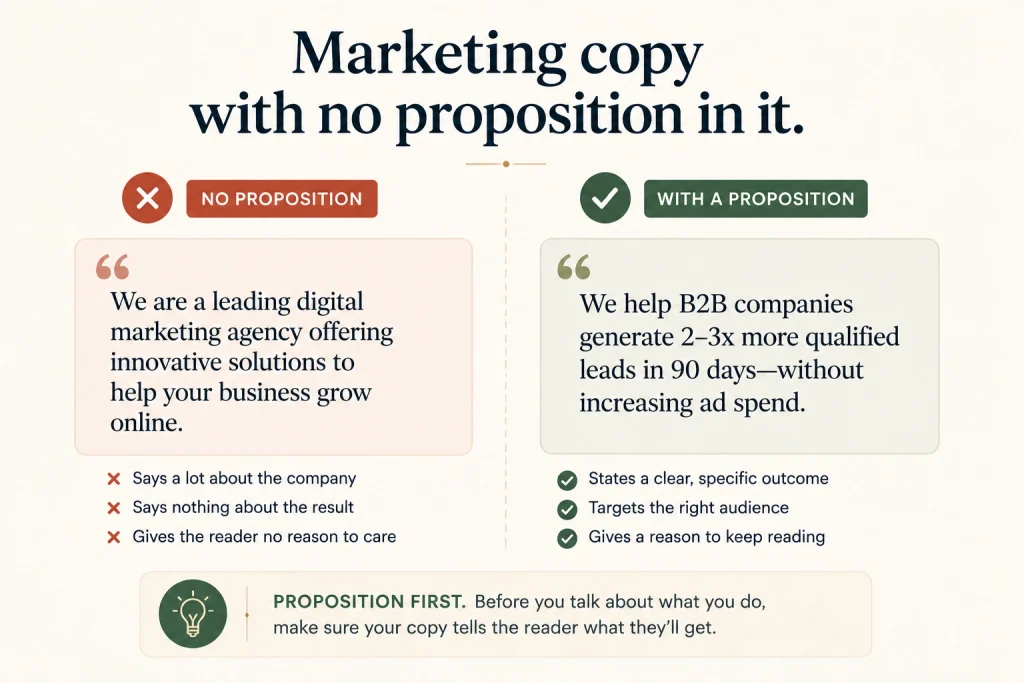
We are committed to delivering excellence. No proposition. Nothing to check, nothing to lift.
Our team has years of experience across industries. Unfalsifiable and true of everyone.
We provide end-to-end solutions tailored to your needs. A description of a category, not a claim.
The common property is that none of them could be wrong. A sentence that cannot be wrong cannot be evidence for anything, which is why nothing quotes it.
The test is unkind and effective: could a competitor put this sentence on their site without changing a word? If yes, it is doing nothing for you in any channel, and it certainly is not being cited.
Does this ruin the writing
It should not, and the reason is that these are constraints on structure rather than on voice.
You can be funny, blunt, opinionated and idiomatic while writing paragraphs that stand alone. What you cannot do is build long chains of reference, or resolve a point three sections after raising it.
The honest cost is a little redundancy. You will restate subjects that a reader who started at the top would not need restated.
We think it is a good trade, and the reason is that most readers do not start at the top. They arrive from a search at the middle of a page, read one section, and decide. Writing for extraction and writing for that reader turn out to be the same job.
This library is written this way. Every major claim in it is set as a standalone sentence, one idea to a paragraph, with the subject named rather than implied. Whether it produces citations we will report; that it produces pages people can read in ninety seconds we can already see.
What we cannot tell you
We cannot tell you this increases citation. The mechanism is plausible and consistent with how these systems are described as working. No study we would trust has isolated the effect of writing style on citation rates, and we are not going to imply otherwise.
What we can say is that everything recommended here is defensible on its own terms. Self-contained paragraphs are better for skim readers. Named attribution is better for credibility. Narrow claims are better than vague ones. Even if the citation argument turned out to be wrong, none of this would have been wasted — which is a reasonable test for any advice given about a subject this unsettled.
Final thoughts
Open your most important page. Find the five sentences that state something specific enough to be wrong. If there are none, that is the finding.
Then check whether any of them would carry your name if somebody lifted it out and showed it to a stranger.
That is the work. It is writing, not configuration, which is why nobody can sell it to you as a package.
If you want us to run that test across your key pages and mark up what to change, you can reach out to us on whatsapp at +91 7738844851 .
More in Blog
Keep reading
All articles →
Ready to talk about your growth?
Tell us what's stuck and we'll tell you what we'd do first. Free, 30 minutes, no pitch.