
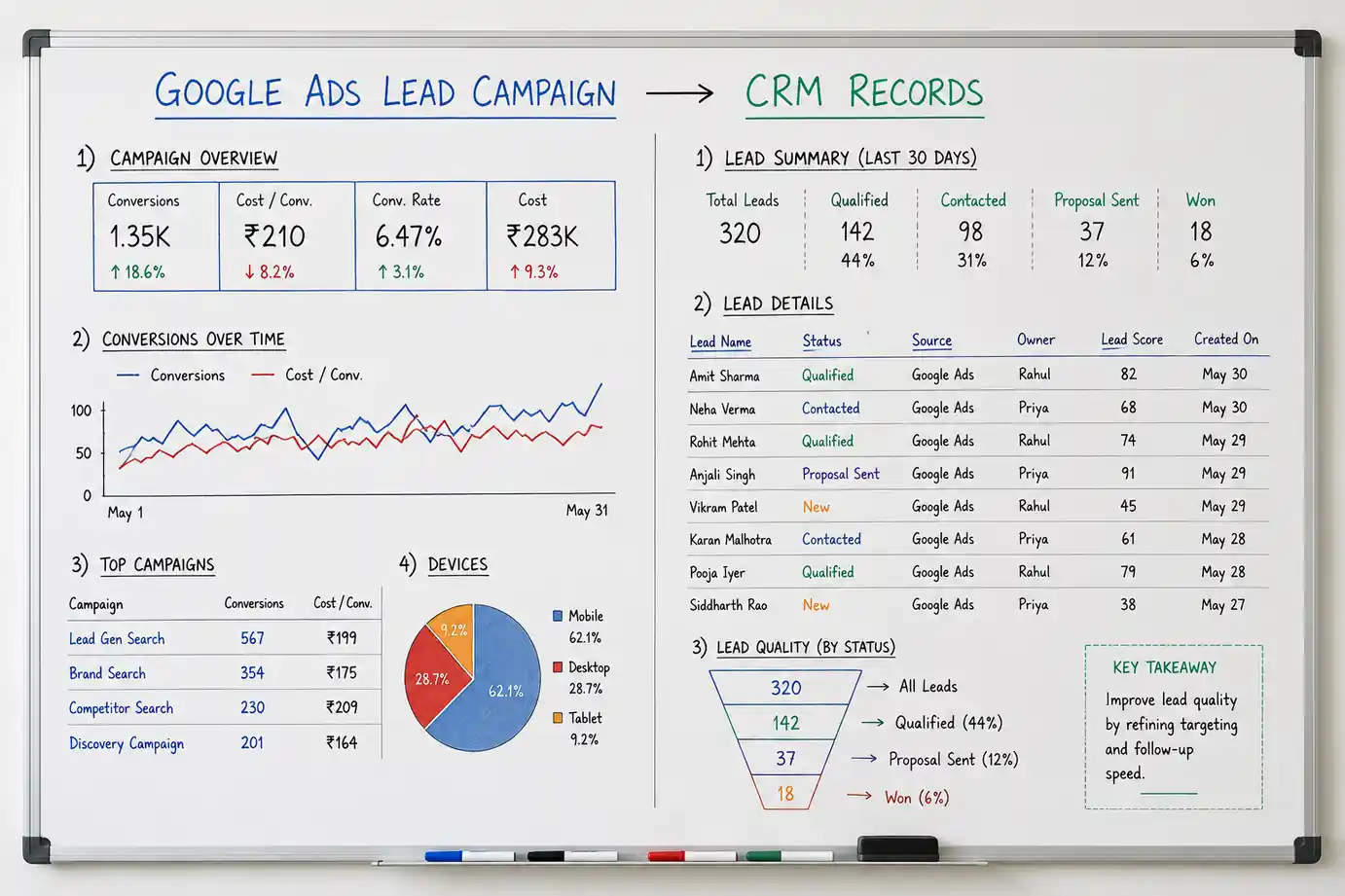
The campaign is built correctly. Conversion tracking fires. The landing page converts at a respectable rate. Cost per lead is falling month on month.
And your sales team says the leads are rubbish.
Both of you are right, and the reason is not in any of the setup guides. Google Ads is optimising exactly as instructed. The instruction was wrong.
The short answer
Smart Bidding pursues whatever you defined as a conversion. Define it as a form submission and the system will get very good at finding people who submit forms — which is not the same population as people who buy from you. The fix is to send the later outcome back into Google: which leads were qualified, and which closed. That closes the loop and lets the algorithm optimise toward revenue instead of form fills. Most Indian advertisers have never done it, and it is the biggest single improvement available on a lead generation account.
Key takeaways
- The algorithm cannot optimise for something you never sent it. If Google only ever hears “form submitted”, that is the only thing it can learn to produce.
- Offline conversion import and enhanced conversions for leads are Google’s own mechanisms for feeding qualified and closed outcomes back into bidding. Both are documented, free, and largely unused in India.
- Two changes land this year. From April 2026 Google Ads accepts user-provided data from website tags, Data Manager and API connections simultaneously. From 15 June 2026 these uploads migrate to the Data Manager API and are blocked in the Google Ads API.
- Paid search is a ₹16,581 crore market in India, around 23% of digital advertising spend in 2025 per dentsu India. A lot of money is being optimised toward the wrong signal.
- None of this survives slow follow-up. Harvard Business Review’s audit of 2,241 companies found the average first response took 42 hours and 23% never responded at all.
What “poor lead quality” actually means
It is worth being precise, because the phrase covers three different problems and only one of them is a Google Ads problem.
Wrong person. The enquiry came from someone outside your market — wrong size, wrong geography, wrong requirement. This is a targeting and signal problem, and it is what this article fixes.
Right person, wrong moment. They were researching, not buying. Partly unavoidable in paid search, and partly a landing page and offer problem.
Right person, right moment, nobody called them. Not a Google Ads problem at all, and more common than either of the others.
Establish which one you have before changing anything. If enquiries sit unanswered for a day, no amount of bidding sophistication will help, and buying better leads simply wastes money faster.
Why the algorithm does what you told it
Modern Google Ads runs on Smart Bidding. You are not setting bids; you are setting a target and letting the system decide what each auction is worth based on signals it has learned from your conversion data.
That last part is the whole game. The system learns from the conversions you report. It notices that people searching a particular phrase, on a particular device, at a particular time, tend to produce conversions — and it bids more for people who look like them.
So if your conversion is a form submission, the model builds a picture of a form submitter. Some of those people are buyers. Others are students, competitors, job seekers, and people who fill in every form on the first page of results. The algorithm cannot distinguish between them, because you never told it there was a difference.
Feed it better information and it optimises toward better people. That is not a metaphor for the process. It is the process.
The Signal Ladder
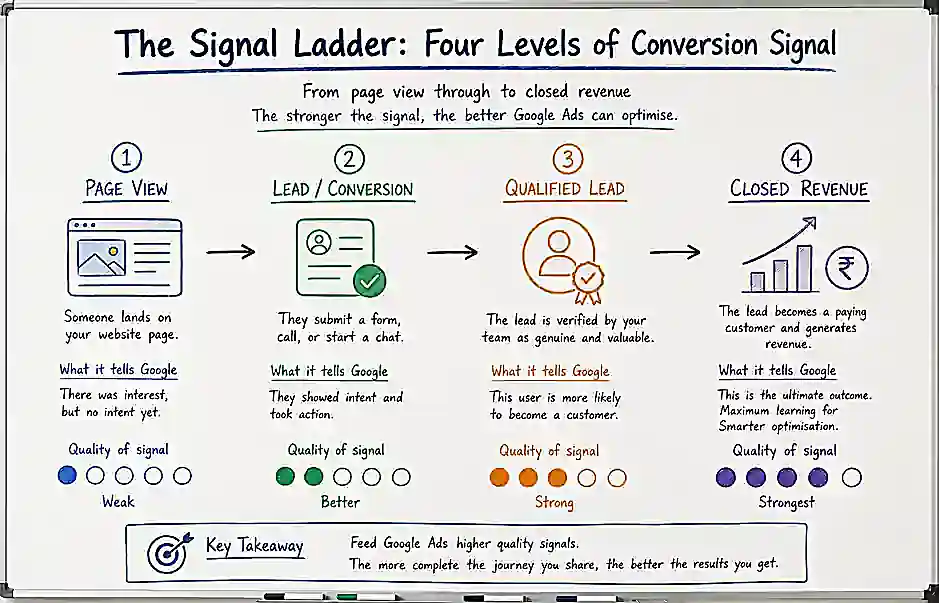
Four levels. Most Indian advertisers sit on the second and complain about problems that only the third and fourth solve.
The rule: Google can only optimise toward outcomes you send it. Every rung you climb narrows the population the algorithm is chasing.
Level one — page views and thank-you pages
The conversion fires when someone reaches a page.
This is the weakest signal available and surprisingly common. If the conversion action is a page load rather than a genuine action, the model is optimising for people who browse. Some accounts have run for years on this without anyone opening the conversion action to check.
Fix it by: opening the conversion actions and reading the definitions. If any of them fire on a page view that a non-converting visitor could reach, that is the first hour of work.
Level two — form submissions and calls
The conversion fires when someone completes a form or calls from the ad.
This is the default and it is genuinely useful. It is also where the trouble starts, because a form submission is a claim of interest, not evidence of it. The algorithm gets good at finding people willing to give you a phone number, which is a low bar.
Most accounts stop here. Cost per lead looks fine, lead volume grows, and sales quality falls as the campaign scales — because scaling means reaching further into a population defined by willingness to fill in forms.
Level three — qualified leads sent back
Here is where it changes.
Your CRM knows which of last month’s leads were actually worth working. Google does not — unless you tell it. Offline conversion import, and its upgraded form enhanced conversions for leads, exist precisely for this. You send the qualified outcome back, matched to the original click through hashed customer data such as the email address collected in your form.
The algorithm now has a smaller, better-defined population to chase. It stops bidding for people who look like form fillers and starts bidding for people who look like leads your team accepted.
This requires one thing you may not have: a written definition of “qualified” that somebody applies consistently. If your sales team decides case by case, there is no signal to send. We cover how to write your qualification definition separately, and it is the prerequisite for this entire rung.
Level four — closed revenue sent back
The same mechanism, one step further. Instead of sending “qualified”, you send “won” with a value.
Now Smart Bidding optimises toward revenue. Search terms that produce plenty of enquiries and no deals get bid down without anyone noticing they were a problem, because the model sees the outcome you actually care about.
This needs volume — enough closed deals for the model to learn from — and a sales cycle short enough that the feedback arrives while it is still relevant. For a business closing three deals a month on a nine-month cycle, level three is the honest ceiling.
Closing the loop, practically
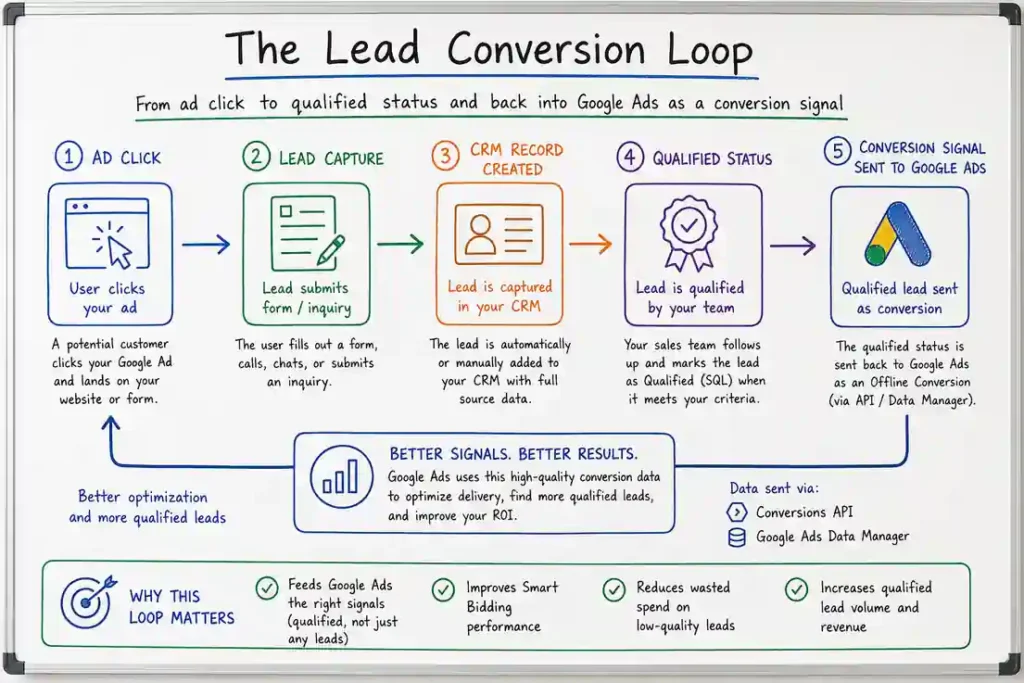
The mechanics are more approachable than they sound.
Capture a click identifier with every lead. When someone submits your form, the Google click ID travels with them if the tag is set up correctly. Store it in your CRM alongside the enquiry. This is the thread that ties an eventual sale back to an auction.
Or use enhanced conversions for leads, which matches on hashed user-provided data — typically the email address someone gave you — rather than requiring you to store a click ID. Less brittle, and it is the direction Google is moving.
Update the record when status changes. Qualified, quoted, won, lost. Whatever your funnel calls it.
Upload on a regular cadence. Weekly is usually enough. Many CRMs will do this natively; otherwise it is a scheduled job.
Two changes to plan for this year. From April 2026, Google Ads accepts user-provided data from website tags, Data Manager and API connections at the same time, so you no longer have to choose one implementation path. And from 15 June 2026, offline conversion import and enhanced conversions for leads uploads migrate to the Data Manager API and are blocked in the Google Ads API. If your setup was built on the old path, that migration is due — check it now rather than discovering it when uploads stop.
The Indian specifics nobody writes about
Your enquiry arrives on the phone. A large share of Indian B2B and considered-purchase enquiries come as calls or WhatsApp messages rather than form submissions. If call conversions are not tracked, an entire channel of results is invisible to the algorithm, and campaigns that actually work look like they do not.
The phone number is the identifier, not the email. Enhanced conversions can match on hashed phone numbers as well as emails, which suits Indian lead capture better than the email-first assumption in most guidance.
Lead form assets are tempting and usually a mistake for considered purchases. They convert well because they are frictionless, which is precisely the problem — a pre-filled form on a phone produces volume with weak intent. For low-value high-volume offers they can work. For anything with a real sales conversation behind it, send traffic to a page instead. What that page needs is covered in the 21-point landing page checklist for Indian pages.
Paid search is large and getting more competitive. dentsu India put paid search at ₹16,581 crore in 2025, roughly 23% of the country’s digital advertising spend. More money chasing the same in-market buyers each year makes signal quality a competitive advantage rather than a refinement.
Mistakes that cost real money
Never reading the conversion action definitions. Every number in your account sits on top of these, and most clients have never opened them.
Counting every conversion action in the bidding target. Newsletter signups and brochure downloads reported alongside genuine enquiries teach the algorithm that both are equally valuable. Mark the secondary ones as observation only.
Scaling before the signal is right. Doubling budget on a level-two signal doubles the volume of a population you did not want.
Judging in week one. Smart Bidding needs a learning period, and changes to conversion actions reset it. Make a change, then leave it alone for a fortnight.
Ignoring call tracking in a market that calls. Especially in India, and especially for services.
Optimising the account while enquiries go unanswered. The most expensive mistake on this list, and the cheapest to fix.
When climbing the ladder is not worth it
Your volume is too low. Smart Bidding needs conversions to learn from. Below roughly 30 conversions a month, feeding back qualified status gives the model too little to work with. Run level two properly and get the volume first.
Your sales cycle is very long. If deals close nine months after the click, level four feedback arrives too late to be useful. Level three, based on qualification within a fortnight, is the practical ceiling.
Nobody maintains the CRM. The loop depends on someone updating lead status honestly and consistently. If your CRM is a contact list, fix that first — the plumbing will only carry what the process produces.
Your problem is upstream. If your traffic is wrong because the keywords are wrong, or your landing page converts at 1%, better bidding signals will not rescue either. Fix the obvious things first.
The lead generation account checklist
☐ Every conversion action opened and its definition read
☐ Any conversion firing on a page view removed or reclassified
☐ Secondary actions set to observation, not counted in bidding
☐ Call conversions tracked, with a minimum call duration set
☐ WhatsApp click tracked as a conversion event where it is a real channel
☐ Google click ID captured and stored with every lead in the CRM
☐ Enhanced conversions for leads configured, or offline conversion import in place
☐ Written qualification definition agreed with sales before any upload begins
☐ Lead status updated in the CRM on an agreed rhythm
☐ Weekly upload of qualified outcomes running and verified
☐ Migration to the Data Manager API checked ahead of 15 June 2026
☐ Enquiry response time measured before any budget increase
Questions we get asked
Why are my Google Ads leads poor quality?
Usually because the account is optimising toward form submissions and nothing else. The algorithm is finding the people most likely to fill in a form, which overlaps with but is not the same as people likely to buy. Send qualified status back and the population it chases narrows.
What is a good cost per lead on Google Ads in India?
The one below what a qualified lead is worth to you. Take your average deal value, multiply by gross margin, divide by the number of qualified leads it takes to close one — that is your ceiling. Published benchmarks come from other people’s economics and other countries’ cost structures.
Should I use lead form assets or a landing page?
A landing page for anything with a real sales conversation behind it. Lead forms convert well precisely because they remove friction, and some of that friction was doing useful qualifying work. For high-volume low-value offers, forms can earn their place.
How much budget do I need to start?
Enough to generate roughly 30 conversions a month, because that is where Smart Bidding starts having something to learn from. Work backwards from your expected cost per lead rather than picking a round number.
How long before it produces leads?
Two to four weeks for signal, six to eight for a stable picture. Every material change to conversion actions or bidding resets the learning period, so resist the urge to adjust weekly.
Can I do the offline conversion import myself?
If your CRM has a native Google Ads integration, often yes. If it involves API work or the Data Manager migration, get help — a broken upload is worse than none, because it teaches the model something untrue.
What to do this week
Open your conversion actions and read every definition out loud. Not the dashboard — the definitions.
Most people find at least one surprise: a conversion firing on a page view, a newsletter signup counted equally with a sales enquiry, or the same action counted twice. Fixing that alone changes what the algorithm is chasing, and it costs an hour.
Then ask one question of your CRM: do we know which of last month’s Google Ads leads were actually any good? If the answer is yes, you are one integration away from a materially better account. If the answer is no, that is the real work — and it is worth more than any bid adjustment.
If you want the loop built properly, you can reach out to us on whatsapp at +91 7738844851. We will tell you first whether your volume justifies it, because below a certain number of conversions it genuinely does not.
More in Blog
Keep reading
All articles →

Ready to talk about your growth?
Tell us what's stuck and we'll tell you what we'd do first. Free, 30 minutes, no pitch.