
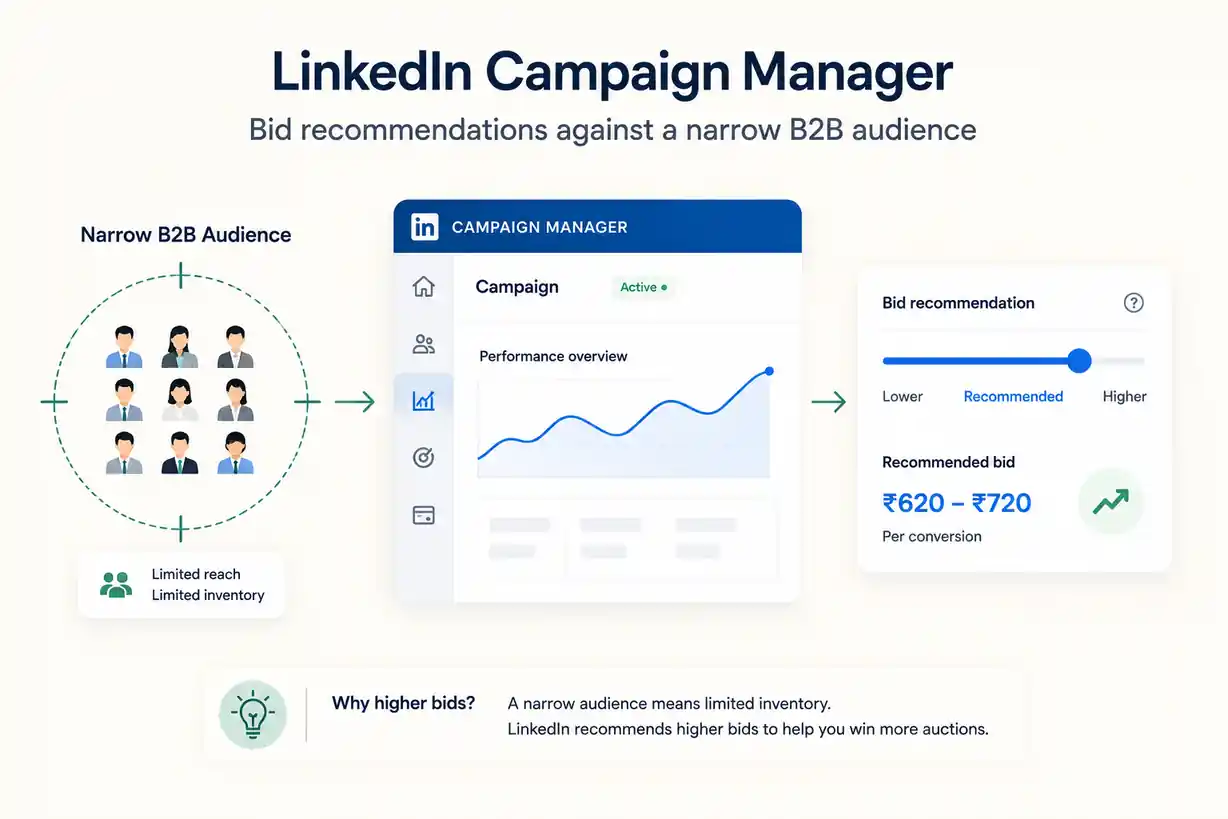
Every advertiser’s instinct is that tighter targeting means less waste, and less waste means lower cost.
On LinkedIn that is backwards. Narrow your audience and the price per impression goes up, because there are fewer impressions to buy and you have to outbid everyone else who wants the same rare person.
You are not paying for a click. You are paying for how hard that person is to reach.
The short answer
Reported Indian LinkedIn CPCs run roughly ₹150 to ₹650, with a median near ₹320 — several times what the same click costs on Meta. The premium buys declared job titles rather than inferred ones. Three things move what you actually pay: how narrow your audience is, which bid strategy you choose, and how relevant your ad is judged to be. LinkedIn’s minimum audience is 300 members, but it recommends 50,000 for Sponsored Content, and campaigns below that threshold routinely need higher bids to deliver at all.
Key takeaways
- Narrower targeting costs more, not less. Fewer available impressions means higher bids to win them.
- LinkedIn recommends at least 50,000 audience members for Sponsored Content, against a technical minimum of 300.
- It is a second-price auction scored on bid multiplied by relevance — better creative genuinely lowers your cost.
- Maximum Delivery is CPM-priced and reportedly overpays against manual CPC on LinkedIn, unlike other platforms where the two converge.
- Below roughly ₹15,000 of gross profit per customer, Indian LinkedIn cost-per-lead ranges are unlikely to clear at any level of skill.
What the published figures say, and how much to trust them
Collected from the Indian pages ranking for this question.
Cost per click is reported at roughly ₹150 to ₹650, with a median around ₹320 across industries. One source puts the range at ₹150 to ₹800. Indian rates are reported at 40–60% below US equivalents, which reflects lower advertiser competition rather than a different mechanism.
Cost per thousand impressions is reported at ₹500 to ₹3,500 depending on audience and placement.
Cost per lead for B2B lead generation is reported at ₹850 to ₹2,500 across most verticals, with SaaS and fintech at the higher end.
Minimum daily budget is around ₹800 per campaign — LinkedIn’s floor — though practical guidance suggests ₹4,000 to ₹8,000 daily before a campaign generates enough data to optimise. Most meaningful campaigns are described as needing ₹50,000 to ₹1,50,000 a month.
How much to trust these. None of the sources states a sample size, a date range or a methodology, and they disagree with each other at the edges. Treat them as an order of magnitude — Indian LinkedIn clicks cost hundreds of rupees, not tens — and nothing more precise than that. The same caveat applies to what Meta Ads cost in India, where the published spread is even wider.
The Scarcity Premium
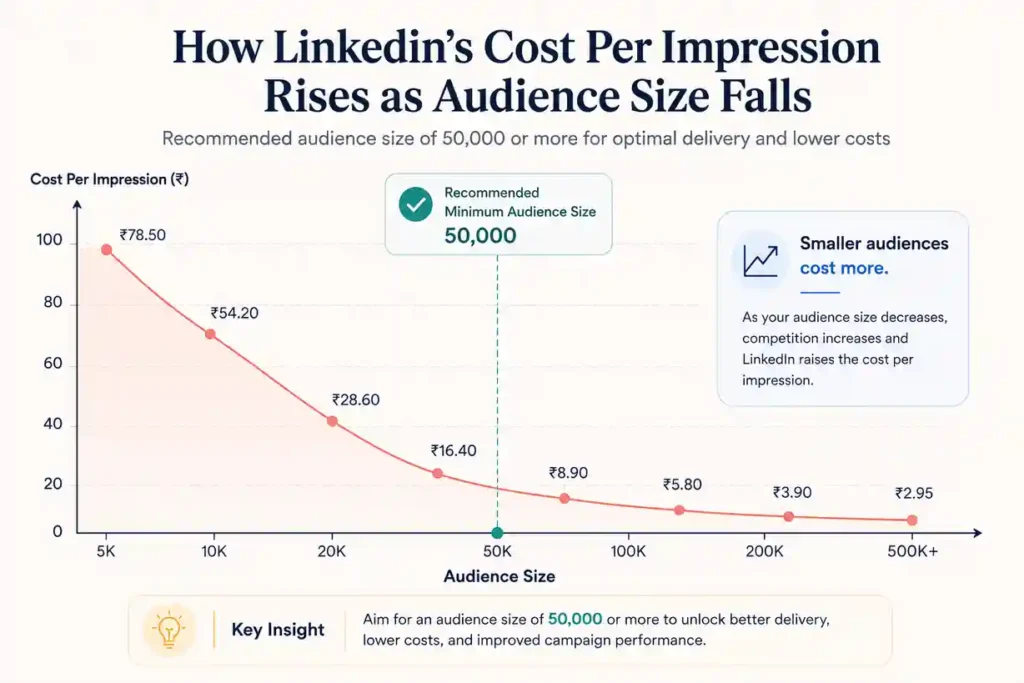
LinkedIn prices access to people, and the price rises as the people get rarer. Every filter you add removes inventory from the auction and forces your bid up. Precision is not efficiency here — it is a surcharge you are choosing to pay, and it should be worth something.
The mechanism is simple once you see it.
LinkedIn’s technical minimum audience is 300 members per ad set. Its recommendation for Sponsored Content is 50,000.
That gap is not conservatism. Below the recommended size, campaigns commonly under-deliver or require substantially higher bids to win impressions, because the pool of available impressions is small and other advertisers want the same senior, specific people you do.
Reported practice puts the workable range at roughly 20,000 to 50,000 for budgets under about ₹8,00,000 a month — large enough for the system to find responsive people, small enough to stay relevant.
What this means in practice. The five-filter audience most B2B advertisers build — job title, seniority, company size, industry, geography — often lands under 10,000 people in India. It feels precise. It prices like a rare commodity, delivers unevenly, and gives the system too little room to optimise.
The counter-intuitive fix. Drop one filter. Usually seniority or company size, since both are frequently over-specified and both correlate with the others anyway. A 30,000-person audience that costs less per impression and delivers consistently will often produce cheaper qualified leads than a 6,000-person audience that is theoretically perfect.
When narrow is right. Account-based work against a defined target list, where you genuinely only want those companies and the deal values justify paying the premium. That is a deliberate purchase of scarcity, not an accident.
The three levers that change what you pay
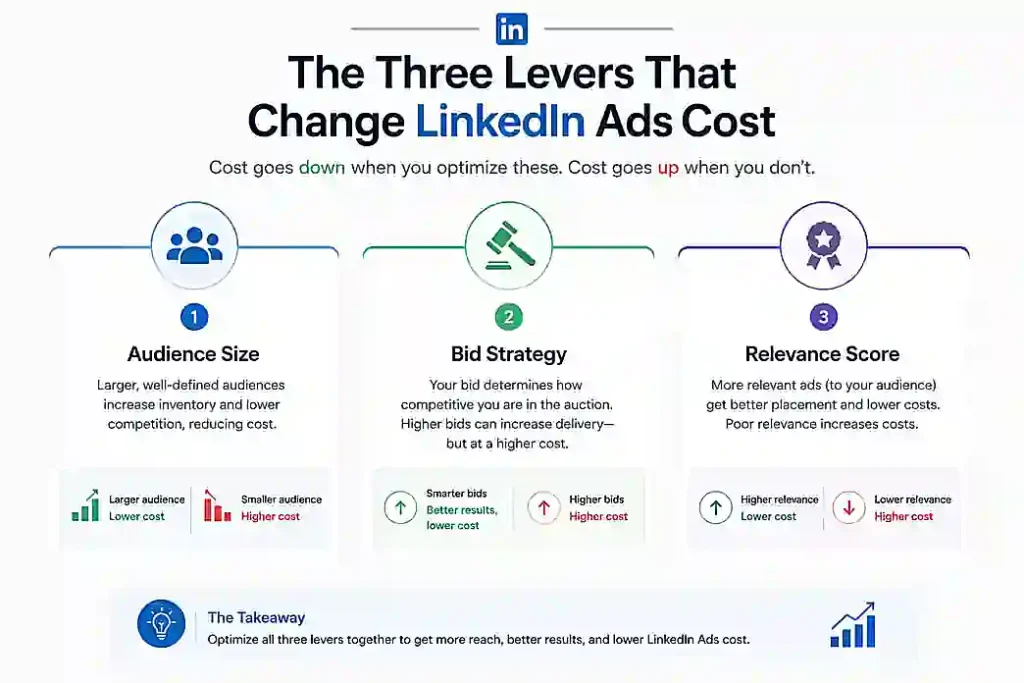
Beyond audience size, two more, and together they are most of the controllable cost.
Bid strategy
LinkedIn runs a second-price auction. If you win, you pay only what was needed to beat the next bidder, not your maximum. That means a high maximum bid is less dangerous than it feels — you are setting a ceiling, not a price.
Manual bidding is the only strategy that permits floor bidding — setting your bid at or near LinkedIn’s minimum to buy the cheapest available impressions. Reported practice is to start at roughly two-thirds of LinkedIn’s recommended bid and raise incrementally until delivery is consistent.
Maximum Delivery is priced on CPM and reportedly overpays. On most platforms CPM and CPC costs converge over time as the system optimises. On LinkedIn, reported practice is that Maximum Delivery consistently costs more per outcome than manual CPC. It is the easiest option to accept and frequently the most expensive.
The practical sequence. Start manual, bid low, raise until you deliver, then hold. It requires attention for a fortnight and typically saves more than any targeting change.
Relevance
The auction score is your bid multiplied by a relevance score. Higher relevance wins impressions at a lower bid. This is the same quality-discount mechanic Google runs, and it is the one lever that reduces cost without reducing reach.
Relevance is driven by engagement — clicks, reactions, comments. Which means creative quality is not a soft consideration on LinkedIn; it is a direct discount on the auction. What earns attention on LinkedIn covers what actually gets engaged with, and the same principles apply to paid.
Format matters here too. Some formats consistently earn more engagement per impression than others, which feeds relevance and lowers cost — which LinkedIn ad format to use sets out the choices.
Frequency and fatigue
LinkedIn audiences are small and see your ad repeatedly. A 20,000-person audience with a meaningful budget will see the same creative many times in a fortnight.
Engagement falls as fatigue sets in. Relevance score follows it down. Your effective cost rises without the auction changing at all — the same pattern that appears on Meta, and the same fix: refresh creative on a schedule rather than in response to a decline.
Can you actually afford it
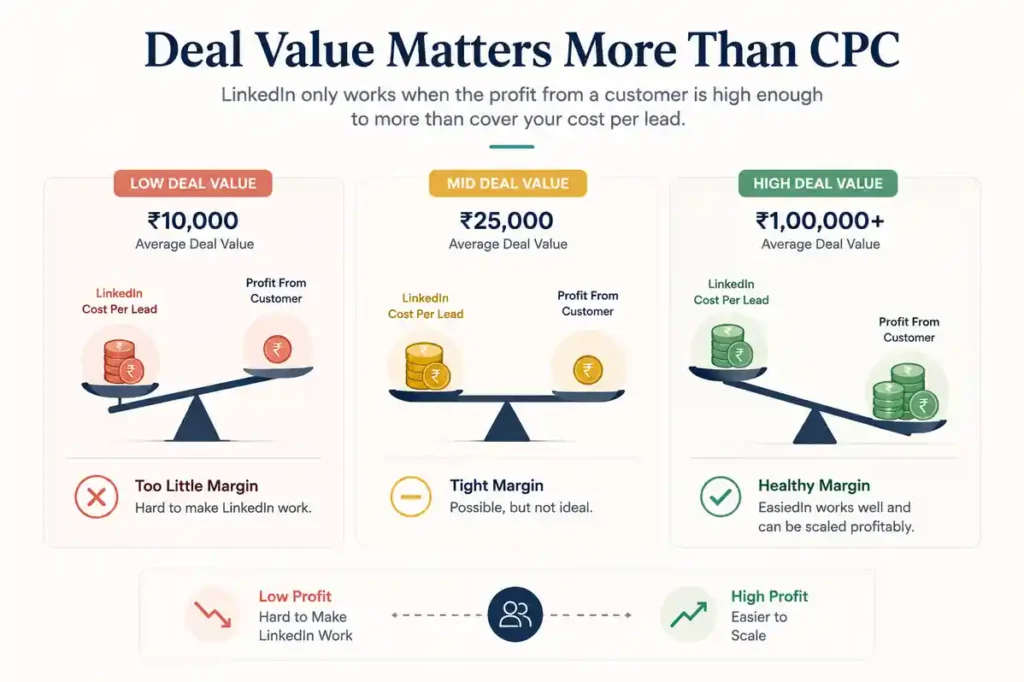
The arithmetic that decides everything, and the one most guides skip.
Start from gross profit per customer. Not revenue. What is left after the cost of delivering the work.
Apply your close rate on qualified leads. If one in five qualified leads becomes a customer, each qualified lead is worth a fifth of that gross profit.
That is your maximum cost per lead. Compare it against the reported Indian range of ₹850 to ₹2,500.
A worked example. A services business with ₹1,00,000 gross profit per customer and a 20% close rate can pay up to ₹20,000 per qualified lead. LinkedIn at ₹2,000 is comfortable.
The same business at ₹40,000 gross profit and a 10% close rate can pay ₹4,000. Still workable, with less margin for error.
At ₹15,000 gross profit and a 10% close rate, the ceiling is ₹1,500 — inside the reported range, but only at the bottom of it, which requires everything to go right.
Below roughly ₹15,000 of gross profit per customer, LinkedIn is unlikely to clear at Indian cost-per-lead rates, whatever anyone promises. Working out what a lead is actually worth has the full method and a calculator.
The second test. Can you sustain the monthly floor for a quarter? A campaign that runs for three weeks and stops has bought you a learning period and nothing else.
Why LinkedIn costs more than Meta
Worth being precise, because the comparison drives most of the sticker shock.
You are buying declared data. A LinkedIn user typed their job title, employer, function and seniority, and their professional network can see it. Lying is possible and socially awkward. Meta infers the equivalent attributes from behaviour.
The inventory is smaller. LinkedIn users spend far less time on the platform than on Instagram or Facebook, so there are fewer impressions available to sell against the same population.
The buyers are competing for the same people. Every B2B advertiser wants senior decision-makers. Nobody is bidding against you for people who scroll Reels at eleven at night.
Whether the premium is worth paying comes down entirely to deal value. High-value B2B, usually yes. Anything transactional, usually not — and whether LinkedIn Ads are the right route at all covers the alternatives, including the two that cost something other than money.
Mistakes that cost real money
Over-filtering the audience. The most expensive habit on the platform and the one that feels most professional.
Accepting Maximum Delivery because it is easier. Reported to overpay consistently against manual CPC.
Bidding at LinkedIn’s recommendation. It is a recommendation, not a requirement. Manual floor bidding exists for a reason.
Ignoring relevance. Creative is a direct discount on your auction price, not a branding matter.
Running at the ₹800 daily minimum. The campaign cannot optimise and you will conclude the platform does not work.
Comparing LinkedIn CPC to Meta CPC. Different products. Compare cost per qualified lead or do not compare at all.
Judging in three weeks. Learning periods and B2B sales cycles both outlast that.
When LinkedIn Ads are the wrong spend
When gross profit per customer is under about ₹15,000. The arithmetic does not clear.
When your buyer is not professionally active on LinkedIn. Many Indian B2B buyers — traders, small manufacturers, retailers — are reachable far more cheaply elsewhere.
When you cannot sustain the monthly floor for a quarter. Partial funding produces unstable results and a false conclusion.
When your addressable audience is genuinely tiny. Under a few thousand people, the scarcity premium becomes severe and direct outreach is usually better value.
When your follow-up is slow. A ₹2,000 lead nobody calls for two days is more expensive than a ₹6,000 lead answered in ten minutes.
The LinkedIn budget checklist
☐ Gross profit per customer calculated, not revenue
☐ Close rate on qualified leads established
☐ Maximum acceptable cost per lead derived from both
☐ That figure compared against the ₹850–₹2,500 reported range
☐ Audience size checked — above 20,000, ideally near 50,000 for Sponsored Content
☐ One filter removed if the audience is under 10,000
☐ Manual bidding selected rather than Maximum Delivery
☐ Opening bid set at roughly two-thirds of LinkedIn’s recommendation
☐ Bid raised incrementally until delivery is consistent, then held
☐ Monthly budget confirmed as sustainable for a full quarter
☐ Creative refresh scheduled before fatigue, not after
☐ Cost per qualified lead tracked, never cost per click alone
Questions we get asked
How much do LinkedIn Ads cost in India?
Reported CPCs of roughly ₹150 to ₹650 with a median near ₹320, CPM of ₹500 to ₹3,500, and cost per lead of ₹850 to ₹2,500. None of the published sources states a methodology, so treat these as orders of magnitude.
Why are LinkedIn Ads so expensive?
Declared professional data, limited inventory, and every B2B advertiser competing for the same senior people. The premium is real and it buys something specific.
What is the minimum budget?
LinkedIn’s floor is around ₹800 a day per campaign. The practical floor is several times that, and most campaigns need ₹50,000 or more a month to optimise properly.
How do I reduce LinkedIn Ads cost?
Widen the audience above 20,000, switch to manual bidding and bid near the floor, and improve creative to raise relevance. In that order — the first two are immediate and the third compounds.
Is LinkedIn advertising worth it in India?
If gross profit per customer comfortably exceeds ₹15,000 and your buyer is professionally active on the platform, usually. Otherwise the same money works harder elsewhere.
Should I use CPC or CPM bidding?
Manual CPC for most B2B lead generation. Maximum Delivery is CPM-priced and reportedly costs more per outcome on LinkedIn specifically.
Two numbers before you fund anything
Work out gross profit per customer, apply your close rate, and write down the maximum you can pay for a qualified lead. Then look at your audience size in Campaign Manager.
If the first number is under about ₹1,500, LinkedIn is unlikely to work at Indian rates and the honest answer is to spend elsewhere.
If the second number is under 10,000, you are paying a scarcity premium you probably did not intend to buy — and removing a single filter is usually the cheapest performance improvement available on the platform.
If you would like both numbers worked out against your actual pipeline before committing a quarter’s budget, you can reach out to us on whatsapp at +91 7738844851 .
More in Blog
Keep reading
All articles →
Ready to talk about your growth?
Tell us what's stuck and we'll tell you what we'd do first. Free, 30 minutes, no pitch.