
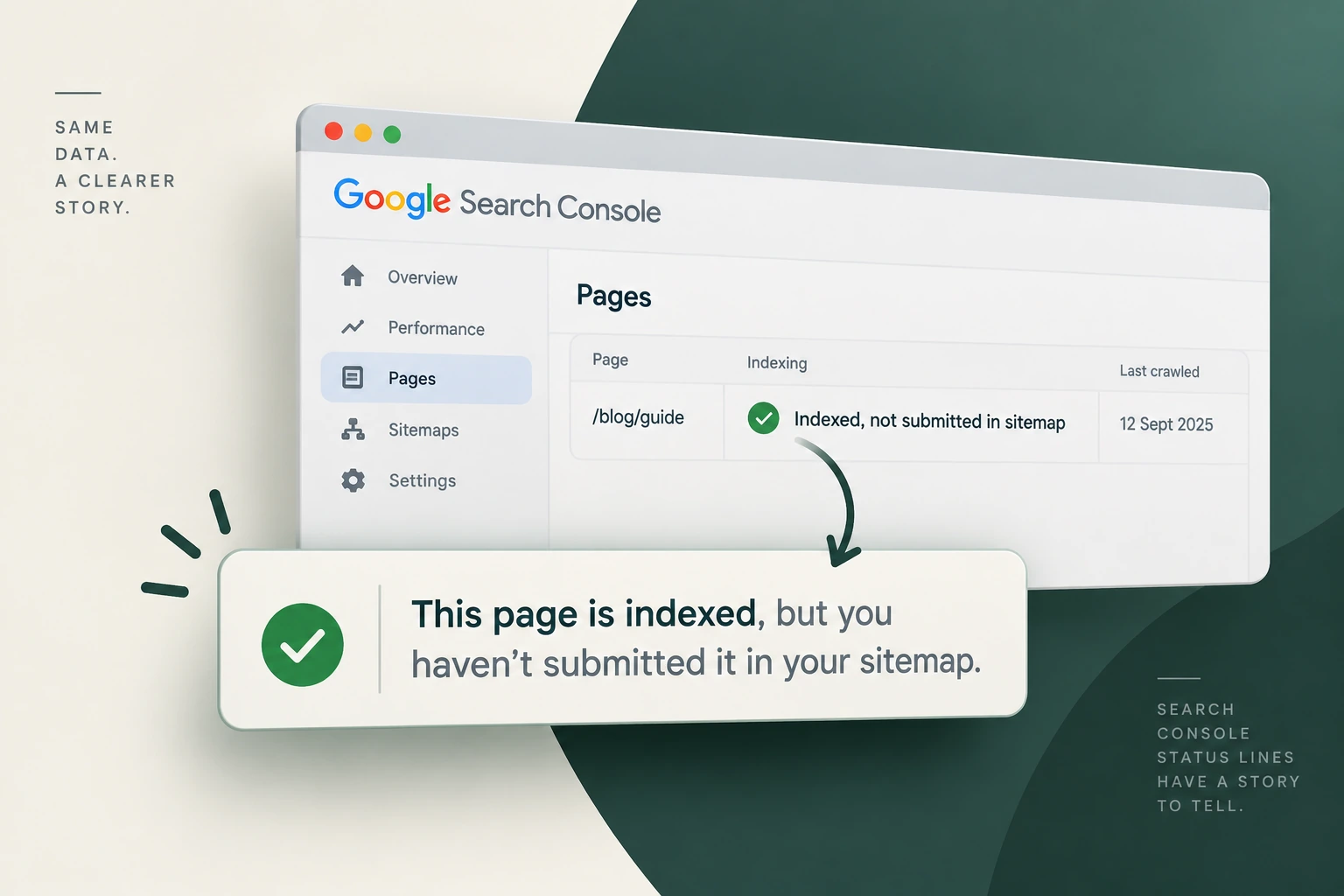
Crawled, currently not indexed is a verdict rather than an error. Google found the URL, fetched it, read it, and chose not to store it — so resubmitting a sitemap or requesting indexing addresses access that was never the problem. It is a different status from discovered, currently not indexed, which means the fetch has not happened yet and responds to different treatment. The commonest Indian cause is a set of location pages that differ by one word.
Open Search Console, go to the Page Indexing report, and there is a row that ruins people’s afternoons: Crawled — currently not indexed. Sometimes twelve pages. Sometimes four hundred.
Everybody treats it as a fault. It is not a fault.
Read the words. Google found the URL. Google fetched it. Google read what was on it. And then Google chose not to put it in the index.
Nothing is broken. You were assessed.
That distinction decides everything you do next, because the standard advice — resubmit the sitemap, request indexing, check robots.txt — all addresses whether Google can reach the page. Google reached the page. That is what “crawled” means.
Our SEO strategy page says to check indexation before anything else. This is what you find when you do, and what it actually tells you.
The status next to it means the opposite
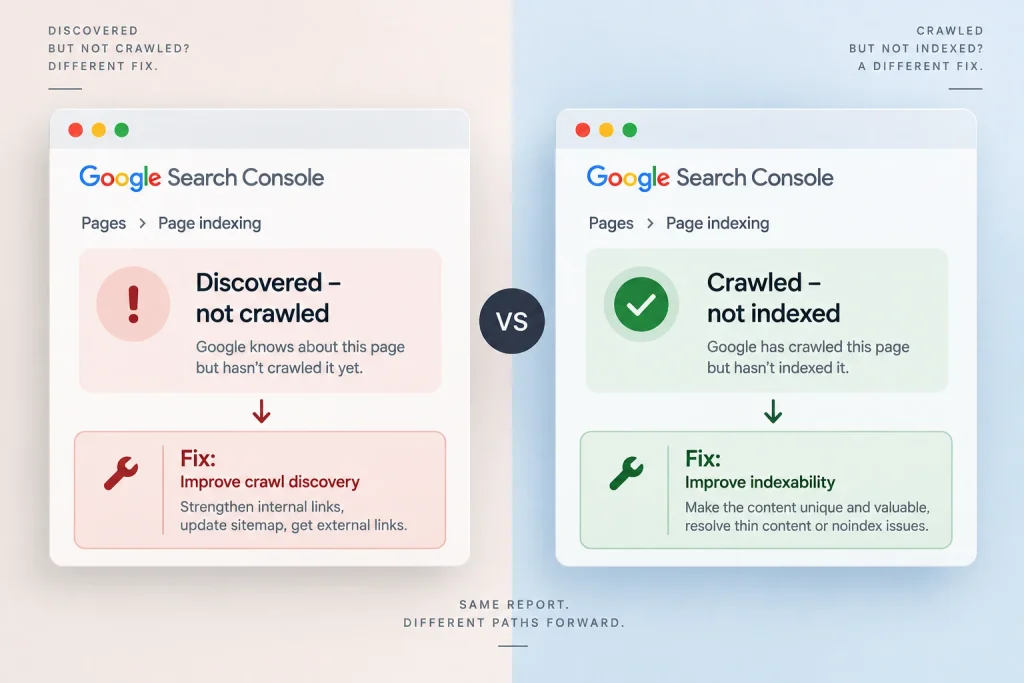
In the same report, usually a few rows away, sits Discovered — currently not indexed.
These get treated as the same problem constantly. They are close to opposites.
Discovered means Google knows the URL exists — from a sitemap, from a link — and has not fetched it. No judgement has been made. The page is queued behind other things, and how quickly a site’s new URLs get fetched relates to how much attention the site attracts generally.
Crawled means the fetch already happened. The judgement was made, and it went against you.
So if your report is full of discovered, the questions are about attention and priority: is the site linked to, is it updated, is it worth returning to. If your report is full of crawled, none of those questions apply. The page had its chance.
Getting these two backwards costs Indian SME teams weeks. It is worth thirty seconds in the report to check which one you actually have.
Requesting indexing again will not help
The URL Inspection tool has a Request Indexing button, and it is the first thing everyone does. Then does again the next day.
For a page that was declined, this achieves close to nothing. You are asking for the same assessment that already returned a no, on a page that has not changed. The answer does not change either.
The button has a legitimate use: telling Google that a page it already knows has been meaningfully updated, so it gets looked at sooner than it otherwise would. That is a different situation from this one.
Change the page first. Then ask.
Verdict one: it duplicates something you already published

This is the most common cause on Indian business sites and it is almost never diagnosed, because the pages do not look like duplicates to the person who commissioned them.
A development agency builds a site. The client wants to appear in searches across the city, so the agency produces location pages. Digital Marketing Agency in Andheri. In Bandra. In Powai. In Lower Parel. In Thane. Twelve pages, identical structure, identical body copy, one word swapped, the map embed changed.
Or a services firm lists nine services on nine pages, each 400 words, each describing the same process with the noun changed.
Google reads these, recognises that eleven of the twelve say nothing the first one did not, and keeps one. The other eleven land in crawled, currently not indexed and stay there.
The fix is fewer pages, not more words on each. Merge the near-identical set into one strong page, or make each one genuinely different — a different client story, different local specifics, a different question answered. If you cannot think of anything true and distinct to say about Powai, that page should not exist.
When you consolidate, the pages you remove were carrying links. Where those links now point is a decision worth making deliberately, and we have written separately about where the links from merged pages should go.
Verdict two: the index already has this
The second verdict is less comfortable, because it is about quality without saying so.
Google is not obliged to store every page on the web. Where a page restates what is already indexed many times over, keeping it adds nothing to the index and costs storage and processing. So it is not kept.
A 700-word article titled “What Is Digital Marketing” competes against several hundred thousand near-identical pages, most of them older and better supported. Yours may be perfectly good. Its contribution is still zero.
The way out is to be about something narrower and more specific — which is a content decision rather than a technical one, and it is the subject of our piece on choosing queries with a gap in them.
Verdict three: the site has not earned patience
The third verdict is site-level, and it is the one nobody tells small businesses.
An individual page is not judged purely on its own. A site with a long history, external citations and a pattern of publishing things people reference gets treated generously — new pages go in quickly and stay in. A domain registered eight months ago with no external references gets less benefit of the doubt, and a marginal page from it is more likely to be left out.
Which means some indexing problems are not indexing problems at all. They are the site’s standing, presenting as one. That is a slower fix and we have written about how a site earns it.
We should say plainly that findise.in is in this category. Three published posts. We expect to see this status ourselves and we will report what happens rather than borrow somebody else’s account of it.
The small number of cases that really are technical
A minority genuinely are mechanical, and they are worth ruling out in ten minutes.
A noindex tag that shipped from staging to production is the classic, and it is common enough at Indian development shops that it should be the first thing you check. View the page source and search for the word.
Then a canonical tag pointing somewhere else, which tells Google to keep a different page instead. Then a page returning something other than a 200 status. Then blocked resources or a robots directive that prevents proper rendering.
Ten minutes, all four, using the URL Inspection tool and view-source. If they are clean, stop looking for a technical cause — there isn’t one — and go back to the three verdicts.
Being indexed is the floor
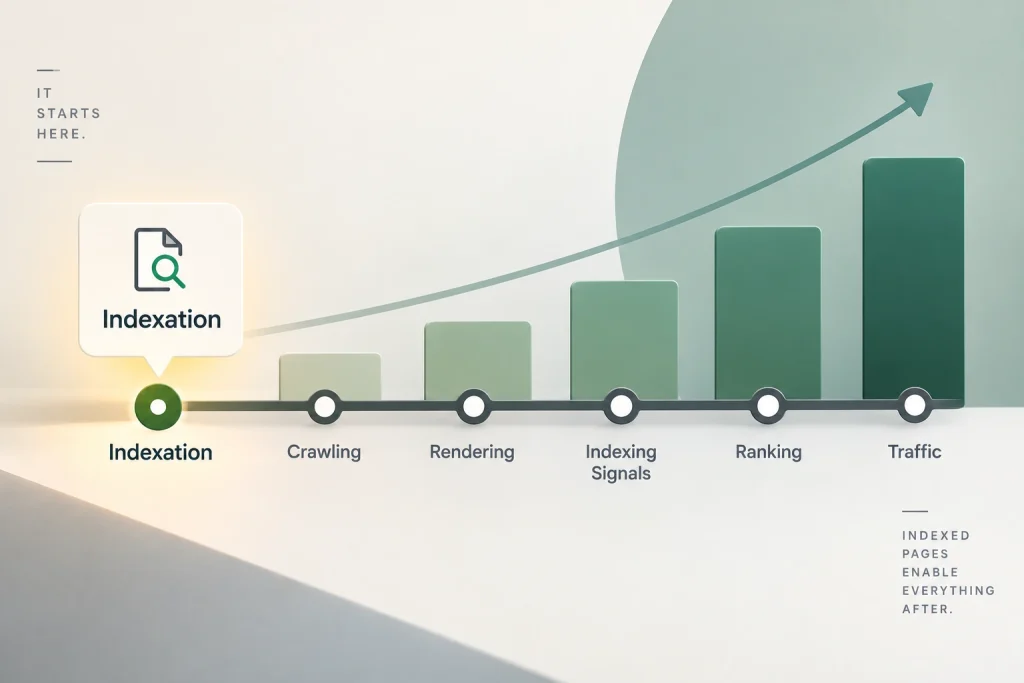
One correction worth making before you spend a month on this.
Getting a page indexed means Google has agreed to store it. It does not mean the page will rank, receive traffic, or produce a single enquiry. Plenty of thoroughly indexed pages have never had a visitor.
Treat indexation as the entry condition. It tells you the page is eligible. Everything that determines whether it actually performs happens after.
A large excluded count can be perfectly healthy
People see a number in that report and assume all of it is loss. Much of it is not.
Tag archives, author archives, paginated listings, filtered and sorted variants of a product listing, internal search result URLs — a normally configured site generates a great many URLs that exist for visitors and have no business being in an index. Google leaving them out is the system working.
So the number by itself carries no information. What matters is what is in the list.
Sort your excluded pages by whether you would be annoyed to lose them. On most sites, the honest answer for the majority is no. The ten or twenty you would be annoyed about are the entire investigation, and they are usually easy to spot because you remember commissioning them.
Your sitemap is not an argument
There is a habit of responding to this status by adding the declined pages back into the sitemap, resubmitting, and waiting.
A sitemap tells Google which URLs you consider worth its attention. It is a suggestion, and it has never been a requirement to index anything. Listing a page twice does not make the case stronger.
There is a smaller point worth making here too. A sitemap listing four hundred URLs of which Google keeps thirty is itself telling Google something about how well your judgement of your own site matches its own. Keeping the file honest — the pages you actually want ranked, not every URL the CMS can produce — costs nothing and is a better habit than resubmission.
What to actually do this week
Filter the Page Indexing report and separate crawled from discovered. Different problems.
Take the crawled list and sort it by what you meant the pages to do. Anything you would not miss, ignore — old tag archives and thin category pages sitting outside the index is normal and healthy.
For the rest, run the ten-minute technical check. Then ask the only question that matters: does this page say anything that the pages already in the index do not? If it does not, either make it say something or merge it into the page that already works.
We have deliberately not given you an expected timeline, because our article on SEO for professional firms covers why any such number would be invented.
Final thoughts
The report is not telling you that something failed. It is telling you what Google thought.
Which is far more useful, because a fault gets patched and forgotten, while a judgement tells you what to build differently. Twelve location pages that vary by one word are not an indexing problem. They are twelve pages nobody needed, and the report noticed before you did.
If you have a few hundred pages sitting in that status and would like someone to work out which ones are worth saving, you can reach out to us on whatsapp at +91 7738844851 .
More in Blog
Keep reading
All articles →


Ready to talk about your growth?
Tell us what's stuck and we'll tell you what we'd do first. Free, 30 minutes, no pitch.