
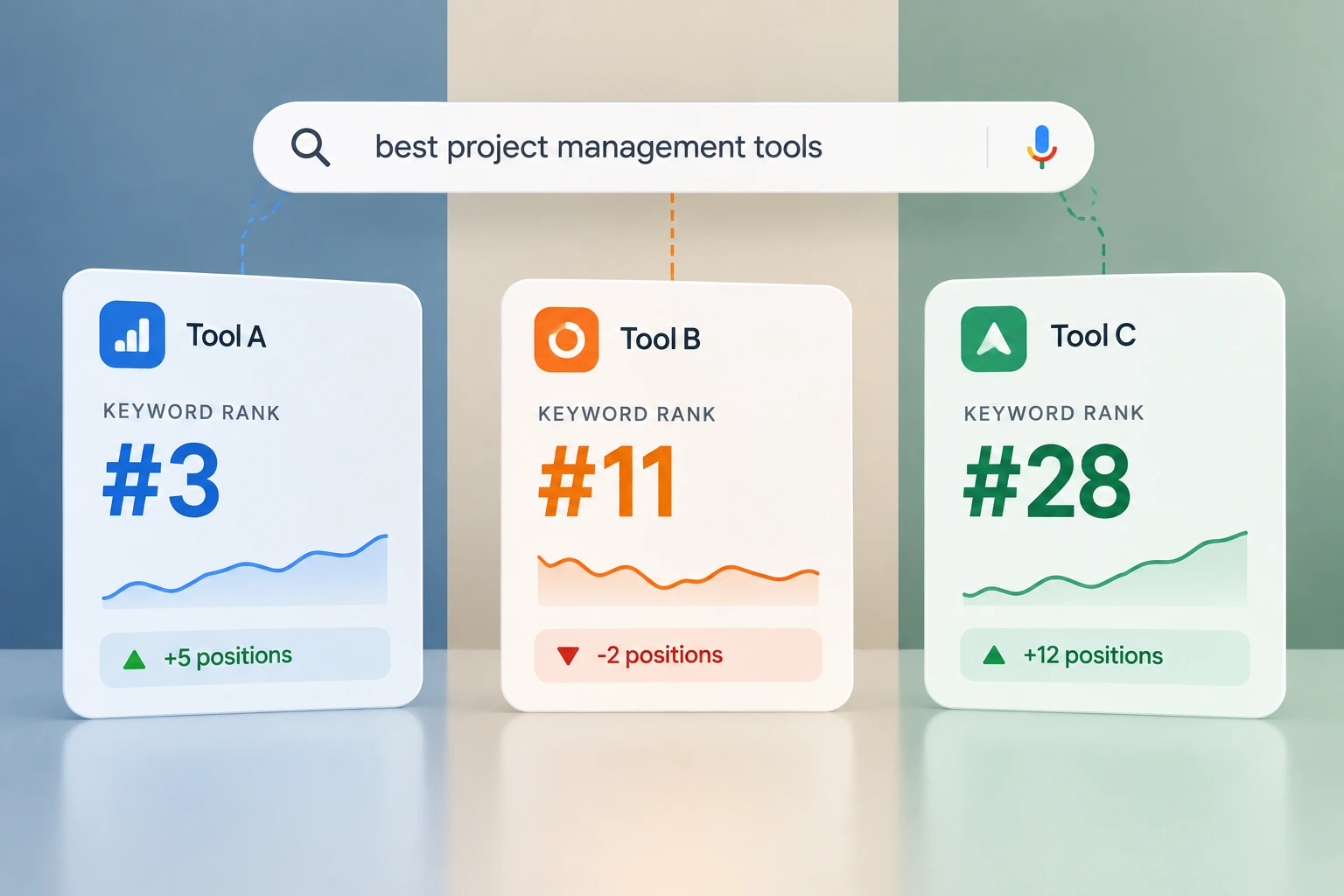
Keyword difficulty is not a Google metric. Each tool computes its own estimate, largely from the link profiles of the pages currently ranking, which is why three vendors return three different numbers for one query. The formula contains no input for your own website, so a score of 28 describes a moderate fight for a site of average strength and may describe a wall for yours. The results page that score summarises is on your screen and worth reading directly.
You open a keyword tool, type in something your business does, and get back a list with a number beside each row. Green is easy. Red is hard. You pick the green ones.
The number does not know your website exists.
Difficulty scores are estimates each tool builds for itself. They are not published by Google, they are not standardised, and the major tools return different figures for the same query because they use different link indexes and different formulas. Ahrefs is documented as deriving its score largely from how many separate websites point at the pages currently ranking. Others fold in domain-level strength and the mix of result types. Same query, three vendors, three answers. That disagreement is the most honest thing about the metric.
This is the article behind a claim made on our SEO strategy page: that averages hide the only thing that matters. Difficulty scoring is where that hiding actually happens.
What the number is made of
Strip the presentation away and a difficulty score is a statement about the pages that already rank. It looks at the ten results, measures how much external support each one has, and compresses that into a figure between 0 and 100.
Which means the score is a summary of something sitting on your screen. The results page is the raw data. The number is a lossy compression of it.
Once you see that, the useful question changes. Not what is the score. What did the score look at, and does the summary survive contact with the actual page.
The input that is missing
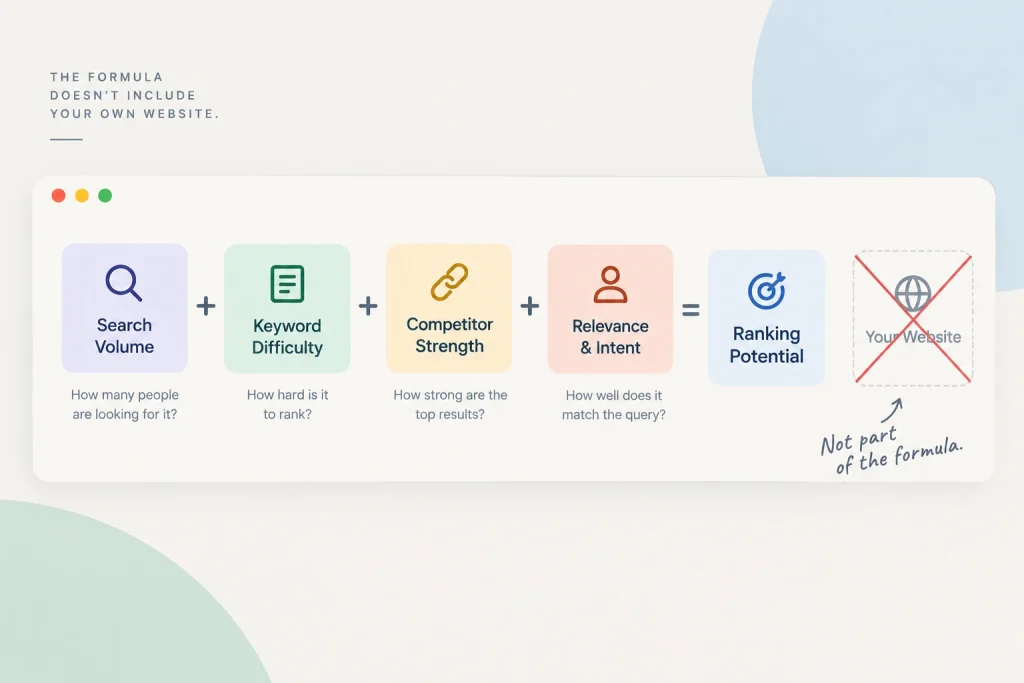
Here is the part the tool documentation is quiet about.
The formula has no slot for your website.
A difficulty of 28 means roughly: a site of unremarkable strength would find this a moderate fight. Nobody runs a site of unremarkable strength. You run yours. If your domain has fourteen referring domains and the ranking pages have three hundred each, a 28 is not moderate. It is a wall.
Run it the other way and the same thing happens in your favour. A site with genuine authority in its subject can take queries scored in the fifties without much drama, because the score was calibrated on a stranger.
So the score is not wrong. It answers a question about an imaginary site, correctly, and then gets read as though it answered a question about yours.
For a new or thin Indian business site — and most are — the practical ceiling sits far lower than the green band suggests. We would rather say that plainly than pretend a colour code is doing work for you.
Read the results instead

The replacement is four questions asked of the actual results page. About four minutes per query, and no score involved.
Who is on the page. If the first page is directories, marketplaces, aggregators and forum threads, there is room. Those results are holding a slot nobody has claimed properly. If the first page is five well-maintained pages from established brands, each one written deliberately for this query, the room is gone regardless of what the score says.
Whether the page was written for the query. This is the single most useful signal and almost nobody checks it. Open the results. Is the query the subject of the page, or is it one paragraph inside a page about something broader? A results page full of near-misses — pages ranking because nothing better exists — is winnable at any difficulty score. Google is filling a gap with the closest thing available. Be the thing that fits.
When it was written. Look for the dates. A first page where three of five results predate the last significant change in your subject is a page with a vacancy on it. In fast-moving areas — anything touching platform policy, compliance or pricing in India — that vacancy opens repeatedly.
Whether there is an editorial slot at all. Some results pages are entirely product pages, category listings and ads. Google has read that query as transactional. An article will not be placed there no matter how good it is. Move on. Spotting this early saves more wasted effort than any other check on this list.
Those four take you further than a score, because they read the evidence the score was built from. To go one level deeper on the link side, count the referring domains behind the pages that beat you — that turns “hard” into a target you can actually size.
Zero volume does not mean zero people
Now the other number on the row.
Keyword tools estimate search volume from clickstream samples and modelled data. Below a certain threshold, they report zero. Zero in a tool means below detection, not absent.
In India this matters more than it does elsewhere. Query volumes fragment across English and several other languages, across transliterated spellings, and across a long tail of very specific phrasings. A question that fifty real buyers type each month, in three different spellings, can register as nothing at all in three separate rows.
For B2B this is close to fatal if you follow the tool. The queries that bring in a serious enquiry are usually narrow, specific, and asked by very few people — because very few people have that problem, and every one of them has a budget for it.
A query with no recorded volume, asked by exactly your buyer, is a better target than a popular one you cannot reach.
Ninety beats nine thousand

The arithmetic is worth doing once, because it settles the argument.
Take a query with 9,000 monthly searches. You are a low-authority site, so realistically you land somewhere past the third page. Traffic from position forty is approximately nothing. Not small. Nothing.
Take a query with 90 monthly searches where the results page is three forum threads and a 2019 blog post. You can hold position two or three there. Click-through at that position on an informational query runs in the low double digits, so call it a dozen visits a month.
Set against nothing, a dozen visits is the only number on the page that exists.
And the dozen compounds in a way the nine thousand never does. Fifteen such queries is a hundred and eighty visits a month from people describing a specific problem you solve. That is a different business input from broad traffic — and it is available to a site with almost no authority, which broad traffic is not.
Findise has three published posts and well over a hundred written. We are running exactly this play. We will report the numbers rather than borrow somebody else’s.
Where the queries actually come from
The tool is a checking instrument, not a source. Build the list first, then look it up.
Sales calls are the richest source anyone has and the least used. The question a prospect asks in the second half of a call — the practical one, after the polite opening — is nearly always a real query, phrased the way people phrase it.
Support tickets and the questions your delivery team answers twice a week are the same material. So is the People Also Ask box, which is Google telling you directly what else it associates with the query. And once you have any impressions at all, Search Console reports queries you already appear for, however faintly, which is demand data the tools do not have because it is yours.
That list — real sentences from real conversations — is then worth running through a tool. Not to be told what is easy. To find out which of your customers’ questions already has a well-defended answer, and which does not.
When the score is worth using
Fairly, the metric has a job.
At scale, it screens. If you have four hundred candidate queries and an afternoon, sorting by difficulty and reading the bottom two hundred is a reasonable filter. Comparatively, it works: between two similar queries, the lower score is genuinely the easier fight more often than not.
It fails as a threshold. “We target under 30” is a rule that means nothing without knowing whose 30 it is.
What we cannot tell you
We cannot tell you your site’s actual ceiling. There is no published mapping from a domain’s link profile to a difficulty figure it can reach, and anyone offering one has invented it. You find your ceiling by ranking for things and noticing where you stop. That is unsatisfying and it is the truth.
We also cannot tell you how Google weighs any of this internally. The four questions above are inferences from what ranks, not from documentation.
Final thoughts
The score is a compression of the results page. When you are strong, the compression is harmless. When you are not, it hides the only thing you needed to see.
So use it to sort a long list, then close the tool and open the results. Ask who is there, whether they were writing about this or something else, when they last touched it, and whether Google is willing to place an article at all.
Then pick the queries where the answer is thin — and be less thin.
If you want the query list built from your own sales conversations rather than a tool’s suggestions, you can reach out to us on whatsapp at +91 7738844851 and we will start with the calls.
More in Blog
Keep reading
All articles →


Ready to talk about your growth?
Tell us what's stuck and we'll tell you what we'd do first. Free, 30 minutes, no pitch.