
Every comparison of these three models is published by one of the three. Freelancer marketplaces conclude that freelancers win. Agencies conclude that agencies win. Subscription services conclude something in between.
We are an agency, and the arithmetic below says most Indian SMEs should not be paying an agency retainer for creative production. It is worth publishing anyway, because the number that settles it is one almost nobody puts on the page.
The short answer
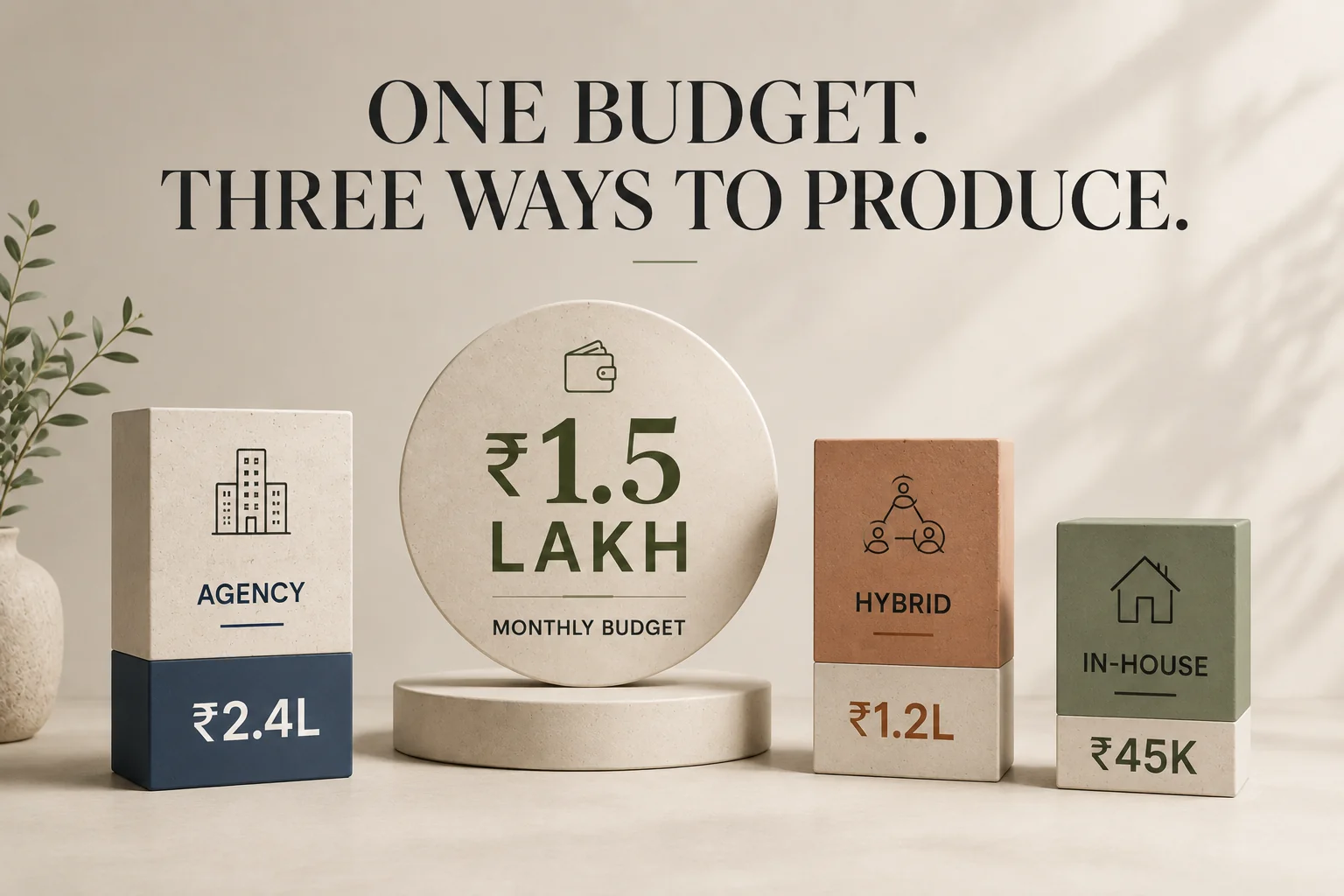
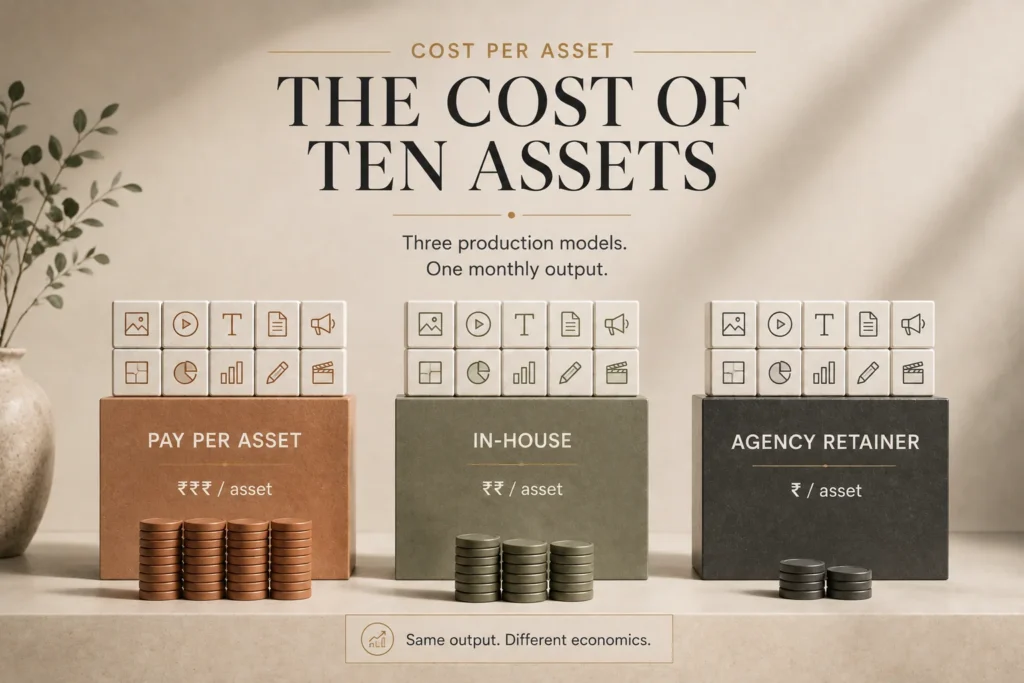
At ₹2 lakh a month in media, a production budget at 15–20% of spend is ₹30,000 to ₹40,000. Entry-level agency retainers in India start around ₹45,000 — more than that entire budget. At ten assets a month, paying per asset costs about ₹3,000 each, a loaded in-house editor about ₹4,167, and an entry agency retainer ₹4,500. A fixed cost only starts to win above roughly fifteen assets a month, and most Indian SME accounts need eight to twelve. So below that volume, rent the hands per asset — and keep the argument, which is the part that decides whether any of it works.
Key takeaways
- Entry agency retainers exceed the whole production budget of a ₹2 lakh advertiser.
- The crossover is around fifteen assets a month. Below it, pay per asset.
- In-house salary is not the in-house cost. Load it by roughly a quarter.
- All three models make files. None of them decides what the ad argues unless you ask them to.
- The argument is the thing to keep close, whoever holds the camera.
- Every comparison you will read is published by one of the three options. Including this one.
The numbers, published and loaded
Freelance retainers in India run from about ₹9,000 to ₹90,000+ a month. For ongoing video work at ten to thirty videos monthly, quoted retainers sit at ₹25,000 to ₹1,50,000+.
Agency retainers run ₹45,000 to ₹4,50,000+, depending on scope and team size. Design subscription services sit at ₹18,000 to ₹85,000+, with premium tiers above a lakh.
In-house. A full-time editor or designer is quoted at ₹4 to ₹8 lakh per annum — ₹33,000 to ₹67,000 a month.
That salary figure is not the cost. Add statutory contributions, equipment, software, workspace and paid leave and a realistic loading is around 25%. So ₹4 lakh becomes roughly ₹41,700 a month, and ₹8 lakh becomes about ₹83,300.
Nobody publishes the loaded number, which is one reason in-house looks cheaper than it is in most comparisons.
Cost per asset, which is the only useful comparison
Take an account producing ten assets a month — realistic for a Meta account spending around ₹2 lakh, using the sizing at how to plan a quarter of creative production.
Paying per asset at ₹3,000 — a mid-range Indian creator rate, from what UGC costs in India — costs ₹3,000 per asset. Obviously.
A loaded in-house editor at ₹4 lakh costs about ₹4,167 per asset.
An entry agency retainer at ₹45,000 costs ₹4,500 per asset.
A loaded in-house editor at ₹8 lakh costs about ₹8,333.
A mid agency retainer at ₹1.5 lakh costs ₹15,000 per asset — five times the pay-as-you-go rate.
Now find the crossover. A ₹45,000 monthly fixed cost only beats ₹3,000 per asset above about fifteen assets a month. A loaded ₹4 lakh salary crosses over around fourteen.
And the account needs eight to twelve. Which is the whole answer for most Indian SME advertisers: you are below the volume at which a fixed cost pays for itself.
Own the Argument, Rent the Hands

Below the crossover, making files is a commodity and you should buy it by the file. What is never a commodity is the decision about what the ad argues — and that decision, not the production quality, is what determines whether any of it works.
Here is why the cost comparison misses the point even when it is done properly.
All three models can produce competent assets. A ₹3,000 creator, a ₹41,700 in-house editor and a ₹45,000 agency will all deliver something well-made.
None of them knows why your customers do not buy — unless someone hands them that, in writing, before production starts. And the arithmetic elsewhere in this cluster is unforgiving about how much that matters: at the industry’s published hit rate you would need thirty-four concepts to find a winner and your account can run four, so the odds on each one are the only lever you control. That is set in the brief — how to brief creative that works first time.
So the real question is not who makes the files. It is whether anyone in your business can write a claim, name the objection it answers, and quote the customer who said it.
If the answer is yes, buy production by the asset and keep that person close. You are already doing the expensive part.
If the answer is no, that is what you should be paying for — and no amount of production capacity substitutes for it. This is the one thing worth a retainer at any volume, and it is the thing most retainers do not actually include.
What each model is genuinely good at

Cost is not the only variable, so here is the honest version.
Per-asset creators. Cheapest below the crossover, no fixed commitment, easy to test several. Weak on consistency, slow to brief repeatedly, and you carry the coordination. Rights need handling every time.
Freelance retainer. Better than per-asset once you are working with the same person monthly — they learn your product, turnaround shortens, briefing gets faster. The low end of the Indian band, around ₹9,000 to ₹25,000, is genuinely good value for a small account. The risk is single-point dependency: one person’s holiday is your creative pipeline.
In-house. Fast iteration, institutional memory and full control. Worth it above roughly fifteen assets a month, or when the work is continuous and confidential. Below that, you are paying a salary for idle capacity, and the person you hire is usually a producer rather than a strategist — which means you have solved the cheap problem.
Agency. Worth paying for judgement, media management and the accumulated pattern recognition of running many accounts. Not worth paying for asset production at low volume, where the retainer is a tax on files you could buy individually.
Subscription design services. Predictable and quick for statics and resizing, weaker where the work needs to understand your customer. A reasonable middle option for high-volume, low-judgement production.
The mixed setup that usually wins
For most Indian SMEs spending ₹1 to ₹5 lakh a month on media, the arrangement that works looks like this.
The argument stays in the business. Whoever talks to customers — often the founder, often a salesperson — writes the claim and names the objection. Twenty minutes per concept.
Production is bought per asset or on a small freelance retainer. Creators for talking-head and demonstration work, a freelancer for edits, resizes and statics.
Mechanical work is automated — resizing, format variants, first-draft translation, transcription. Where AI genuinely helps in production covers what belongs there.
An agency, if retained, is retained for the account and the thinking — what to test, how to read results, where the money goes — rather than for producing files.
Total fixed cost: low. Total judgement: kept close. And when volume grows past the crossover, you bring production in, by which point you know exactly what you need because you have been buying it by the asset for a year.
Mistakes worth the money they cost
Comparing salary against retainer. Load the salary or the comparison is meaningless.
Retaining for production below the crossover. You are paying a fixed cost for variable work.
Hiring in-house to fix a strategy problem. A producer will produce what you brief. If the brief is the problem, you have hired the wrong role.
Outsourcing the argument. The one thing nobody outside your business can do well, handed over first because it looks like the hard part.
Choosing on cost per hour. Nobody buys hours. Buy assets, or buy judgement, and price accordingly.
Reading comparisons published by the models being compared. Check who publishes before you check what they conclude.
Ignoring rights when buying per asset. Cheap production with a short licence gets expensive at renewal — covered at what UGC costs in India, and what the rights cost.
When to change model
Move from per-asset to a freelance retainer when you are commissioning the same person more than three or four times a month and briefing is getting repetitive.
Move to in-house above roughly fifteen assets a month, or when turnaround time is costing you more than the salary.
Retain an agency when the constraint is judgement rather than capacity — you do not know what to test, why results moved, or where to put the next rupee.
Do not change anything if the current work is performing and the only complaint is the invoice. Cheaper production of worse creative is the most expensive saving available.
The resourcing checklist
☐ Monthly asset requirement calculated from the account, not from ambition
☐ Production budget set as a share of media spend
☐ Per-asset market rate established from real quotes
☐ In-house salary loaded by roughly 25% before comparing
☐ Crossover volume calculated — fixed cost ÷ per-asset rate
☐ Current volume compared honestly against that crossover
☐ Named person identified who can write the claim and the objection
☐ If nobody can, that gap treated as the priority, not production capacity
☐ Rights handled explicitly on every per-asset purchase
☐ Mechanical tasks automated before adding headcount
☐ Any retainer checked for what it actually includes — files or judgement
☐ Model reviewed whenever monthly volume changes materially
Questions we get asked
Is it cheaper to hire in-house or use an agency?
Below about fifteen assets a month, neither — pay per asset. Above it, a loaded in-house salary usually beats an equivalent retainer on cost, and loses on breadth of experience.
How much does a video editor cost in India?
Freelance retainers run ₹9,000 to ₹90,000+ a month, with ongoing video work quoted at ₹25,000 to ₹1,50,000+. Full-time salaries sit at ₹4 to ₹8 lakh a year before loading.
What is a typical creative retainer in India?
Agency retainers start around ₹45,000 and run past ₹4,50,000. Design subscriptions sit lower, at ₹18,000 to ₹85,000+.
When should you hire an in-house designer?
When your monthly volume clears the crossover, or when turnaround speed is worth more than the cost difference. Not to solve a strategy problem.
Should a small business use a freelancer or an agency?
For production, a freelancer, almost always. For judgement about what to make and where to spend, an agency can be worth it — and you should check which one you are actually buying.
Why is an agency telling me not to hire an agency?
Because the arithmetic says so at this volume, and because the work worth retaining us for is the thinking, not the files. A client paying us to make assets they could buy for ₹3,000 will notice eventually.
Work out your own crossover
Two numbers settle this.
Take the fixed monthly cost you are considering — a retainer, or a salary loaded by twenty-five percent. Divide it by what one asset costs you to buy outright.
That is the number of assets a month at which the fixed cost starts making sense. Compare it to what your account actually needs, which is usually a smaller number than anyone expects.
Then ask the second question, which matters more. Who in this arrangement decides what the ads argue? If the answer is nobody, or the cheapest person in the chain, the resourcing decision was never the important one.
If you want that calculation run against your own volume, and an honest view of whether you need production capacity or better thinking, you can reach out to us on whatsapp at +91 7738844851 .
More in Blog
Keep reading
All articles →


Ready to talk about your growth?
Tell us what's stuck and we'll tell you what we'd do first. Free, 30 minutes, no pitch.