
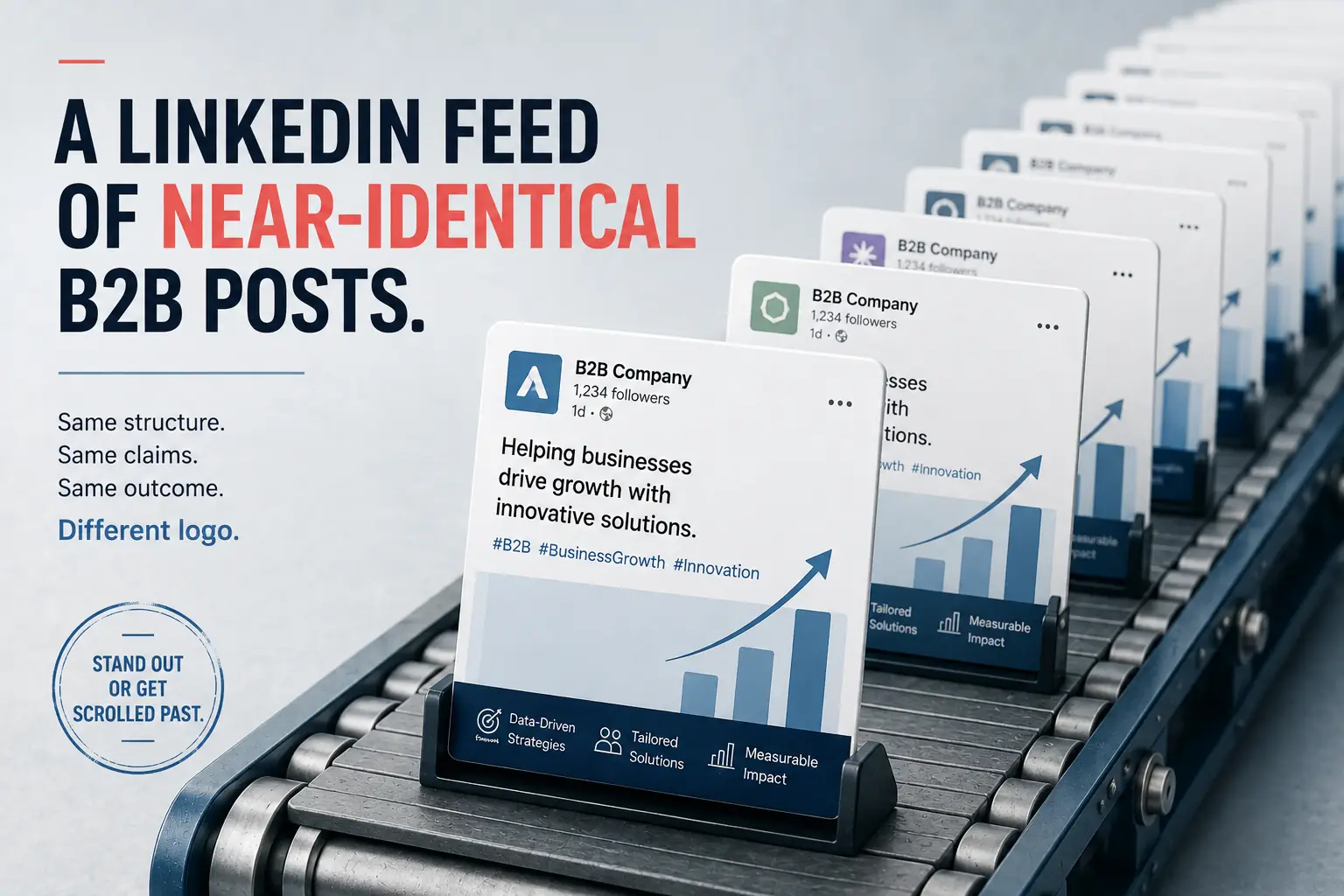
Scroll your LinkedIn feed and count how many B2B posts could be swapped between companies without anyone noticing.
“Excited to share our thoughts on the future of digital transformation.” “Five tips for better customer engagement.” “Consistency is the key to growth.”
Any of those could belong to any of two hundred firms. That used to mean they were ignored. In 2026 it reportedly means something worse.
The short answer
LinkedIn’s feed has shifted toward original expertise and genuine discussion, and reported 2026 changes indicate it now actively demotes generic AI-generated writing, engagement bait and duplicate content rather than simply ranking it low. That makes one editorial question decisive before publishing: could a competitor have posted this exact thing? Content that passes draws on what only your business knows — your numbers, your repeated observations, your mistakes and your defensible positions. Content that fails is now a cost rather than a neutral act.
Key takeaways
- Reported 2026 algorithm changes penalise generic AI writing, engagement bait and duplicate content, where previously such posts were merely unrewarded.
- Apply one test before publishing: could a competitor have written this? If yes, do not post it.
- Personal profiles consistently outperform company pages, and a handful of active employee advocates reportedly doubles a company’s organic reach.
- One post that starts a real discussion beats ten that fill a calendar. Judge by engagement rate, not impressions.
- Most Indian B2B businesses have publishable expertise they do not recognise as expertise — the raw material is operational, not intellectual.
What changed, and who is not telling you
LinkedIn’s feed has been moving in one direction for several years: toward posts that generate conversation between real people, and away from broadcast.
Reported changes through 2026 sharpen that considerably. Original ideas, demonstrable expertise and substantive comment threads are said to be prioritised. Generic AI-generated writing, engagement bait and duplicate content are reportedly penalised — a meaningful distinction from being ignored, because a penalty affects everything else the account posts.
These reports come from third parties rather than from LinkedIn statements, so treat the mechanism as directionally reliable and the specifics as unconfirmed. The direction is consistent with where every major platform has moved, and with Google’s own treatment of scaled, mass-produced content.
Now consider who publishes the guides ranking for this question. An AI LinkedIn content tool. A cold email platform. An outreach automation company. A scheduling tool.
Their products exist to increase output. The change being reported penalises output that is indistinguishable from everyone else’s. That is not a reason to distrust them entirely — but it explains why “post consistently” is the universal recommendation and “post only when you have something” is nowhere on the page.
The Only-You Test
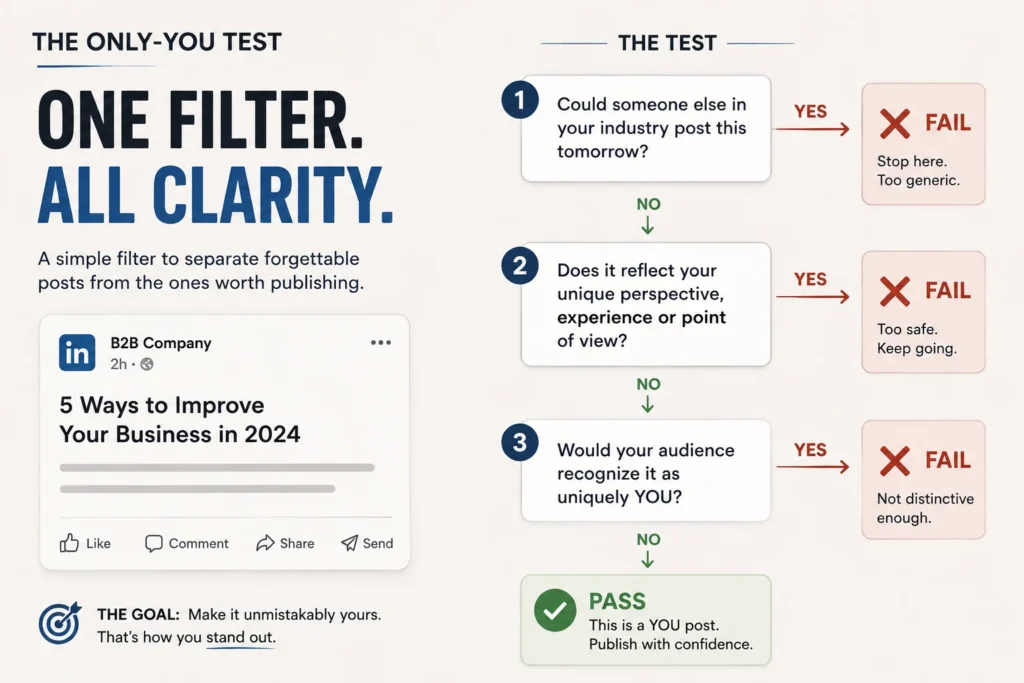
Before publishing anything, ask one question: could a competitor have posted this identical thing? If the answer is yes, it will not earn attention from readers or the feed — and in 2026 it may cost you both. If the answer is no, you have something worth publishing however plainly it is written.
The test is deliberately harsh, and most B2B content fails it in the first line.
It also solves a problem the standard advice creates. “Post three times a week” produces filler by the second week, because nobody has three genuinely original things to say every week. The filter inverts the instruction: publish when you pass the test, and build a cadence you can sustain at that standard.
A useful corollary. If a post takes ten minutes to write and could have been written by anyone, it will take the reader ten seconds to dismiss. The effort asymmetry is the whole signal.
What passes the test
The objection is always the same — we do not have original insights. Almost always untrue. Businesses confuse insight with novelty. What passes is not clever, it is specific.
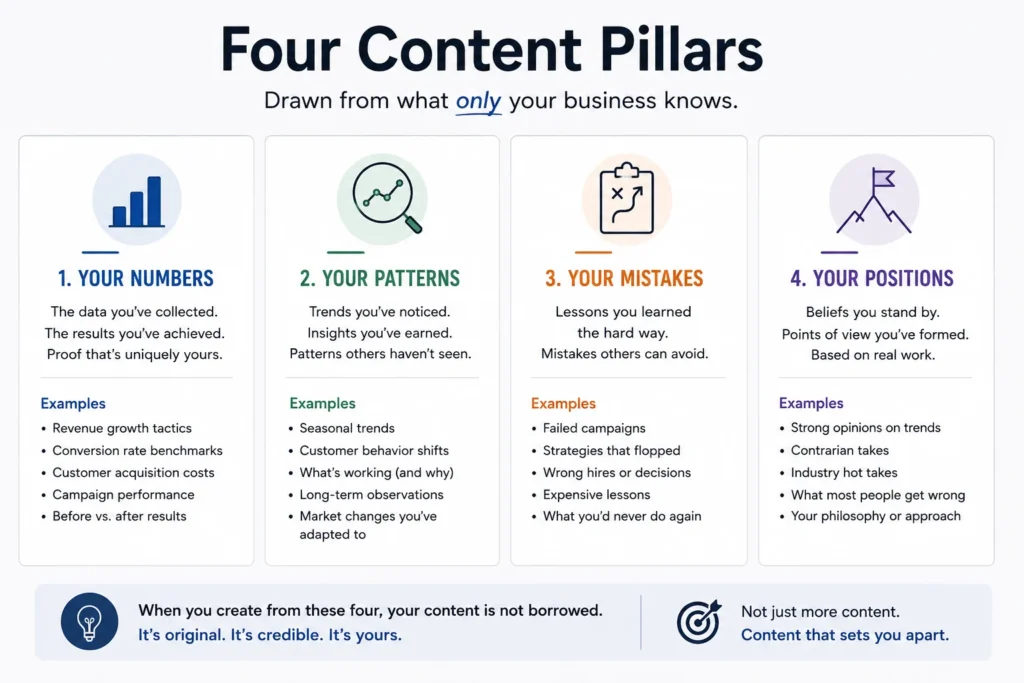
Four pillars, drawn from what only your business has seen.
Your numbers
You have data nobody else has. What your conversion rate actually is. How long your sales cycle really takes. What proportion of enquiries turn out to be unqualified. What a project costs versus what it was quoted at.
Publish one real number with context and you have something no competitor can copy. It need not be flattering — “our average deal takes 94 days, not the 45 we tell clients” is a better post than any prediction about the industry.
Your patterns
Things you have seen repeatedly across clients or projects. The mistake that appears in four out of five new accounts. The characteristic that separates customers who stay from those who leave.
Patterns are earned by volume of experience, which is precisely why they cannot be generated.
Your mistakes
The most under-published category and the most reliably read. A decision that did not work, what it cost, what you changed.
Most firms will not publish these, which is why they perform. In Indian B2B, where LinkedIn skews heavily toward achievement announcements, a plainly written account of something going wrong is genuinely differentiated.
Your positions
Something you believe that a reasonable person in your industry would dispute. Not manufactured contrarianism — an actual professional opinion you would defend in a meeting.
If nobody could disagree with your post, it contains no information. That is the sharpest version of the test.
Who should be posting
Briefly, because it is covered more fully elsewhere and the answer is unambiguous.
Personal profiles outperform company pages. LinkedIn’s feed favours interactions between people, and readers follow people. A founder’s post reaches further than the same words from a logo — why founder accounts outperform company pages covers the mechanism.
Employee advocacy multiplies this. Reports suggest even five active employee advocates can roughly double a company’s organic reach, and the reach comes from networks the company page cannot access.
What makes advocacy work — and what kills it. A shared bank of material employees can adapt in their own words works. Asking staff to reshare the company post verbatim does not, and now risks the duplicate-content penalty directly.
The company page still has a job. It is where someone checks that you exist and are active — the verification function. It does not need to carry the content programme.
Cadence and measurement
Set the cadence from what you can sustain at this standard, not from a benchmark. Two posts a week for a year beats five a week for six weeks and then silence, and the second pattern is what most Indian B2B accounts actually do.
One substantial post that starts a fifty-comment discussion outperforms ten shallow updates, both in reach and in the only thing that matters afterwards — whether anyone remembers you.
Reply to every comment, properly. Comment threads are the conversation signal the feed reportedly rewards, and a one-word reply is a wasted opportunity in front of an audience that is already paying attention.
Judge by engagement rate, not impressions. Impressions rise with follower count and tell you nothing about whether the post worked.
Review fortnightly and look for patterns — topic, format, length, time. Three months of data will show you which of your four pillars your audience actually wants, and it is usually not the one you expected.
Expect a year. Around 5% of B2B buyers are in-market at any moment, per Ehrenberg-Bass research for the LinkedIn B2B Institute. Content reaches the other 95% and waits. Judging it at ninety days measures the wrong thing — how B2B demand generation actually works covers the timing properly.
Mistakes that cost real money
Posting to fill a calendar. The clearest route to failing the test repeatedly.
Using AI to generate posts wholesale. Useful for editing, structuring and shortening. What it cannot supply is the thing that passes the test — your numbers, your patterns, your mistakes.
Engagement bait. “Agree?” and “Comment YES below” are reportedly penalised, and they signal that you have nothing else.
Asking employees to reshare company posts verbatim. Duplicate content, and it reads as a mandate rather than an opinion.
Announcing things nobody outside asked about. Awards, anniversaries, conference attendance. Fine occasionally, weightless as a strategy.
Abandoning it at month four. The most expensive mistake, because the cost is already sunk and the return had not arrived yet.
When LinkedIn organic is the wrong investment
When nobody will own it. This route needs a person with something to say and time to say it. Without one, do not start — what each LinkedIn route actually costs covers the alternatives honestly.
When you need pipeline this quarter. Content is the slowest route on the platform. Paid reaches people now.
When your buyer is not professionally active on LinkedIn. Many Indian B2B buyers — traders, small manufacturers, retailers — are reachable elsewhere.
When the founder will not participate and no employee will either. A company page posting alone is the weakest configuration available.
When you are unwilling to say anything disputable. A strategy of publishing only uncontroversial statements is a strategy of publishing nothing.
The LinkedIn content checklist
☐ Named owner with weekly time committed
☐ Founder or senior employee participation confirmed, not assumed
☐ Four pillars drafted from your own numbers, patterns, mistakes and positions
☐ Only-You Test applied to every post before publishing
☐ Cadence set at a level sustainable for twelve months
☐ Personal profiles prioritised over the company page
☐ Employee advocacy material provided for adaptation, not for verbatim resharing
☐ Every comment replied to substantively
☐ Engagement rate tracked, not impressions
☐ Fortnightly review of topic, format and length patterns
☐ Company page kept current for the verification visit
☐ Review horizon set at twelve months, not ninety days
Questions we get asked
What should I post on LinkedIn for business?
Your own numbers, patterns you have observed repeatedly, decisions that went wrong, and opinions you would defend. If a competitor could publish it unchanged, it is not worth your slot in the feed.
How often should a company post?
Whatever you can sustain for a year at a standard that passes the test. Two a week held for twelve months beats five a week for six.
Does the LinkedIn algorithm penalise AI content?
Reported 2026 changes indicate generic AI-generated writing is demoted rather than merely unrewarded. Using AI to edit and structure your own material is a different matter from asking it to generate opinions you do not hold.
Company page or personal profile?
Personal, for content. The company page serves the person checking whether you are real.
How do I measure this?
Engagement rate per post, comment quality, and — over a year — branded search volume and enquiries that mention having seen you. Not impressions.
Should we promote our best organic posts?
Often the highest-return spend available, since you are amplifying something that already earned attention. Which LinkedIn ad format to use covers how.
One post, this week
Take the last thing your team learned that surprised you. A number that came in differently from expected, a client problem that turned out to be something else, a decision you would now make differently.
Write it plainly, in about two hundred words, with the actual number in it.
Then apply the test. If a competitor could have written that same post, you have written the generic version — go back to the specific thing that surprised you and put that in instead.
Most businesses discover the raw material was always there and the strategy was never the constraint.
If you would like help building a content practice around what your business actually knows, you can reach out to us on whatsapp at +91 7738844851 .
More in Blog
Keep reading
All articles →
Ready to talk about your growth?
Tell us what's stuck and we'll tell you what we'd do first. Free, 30 minutes, no pitch.