
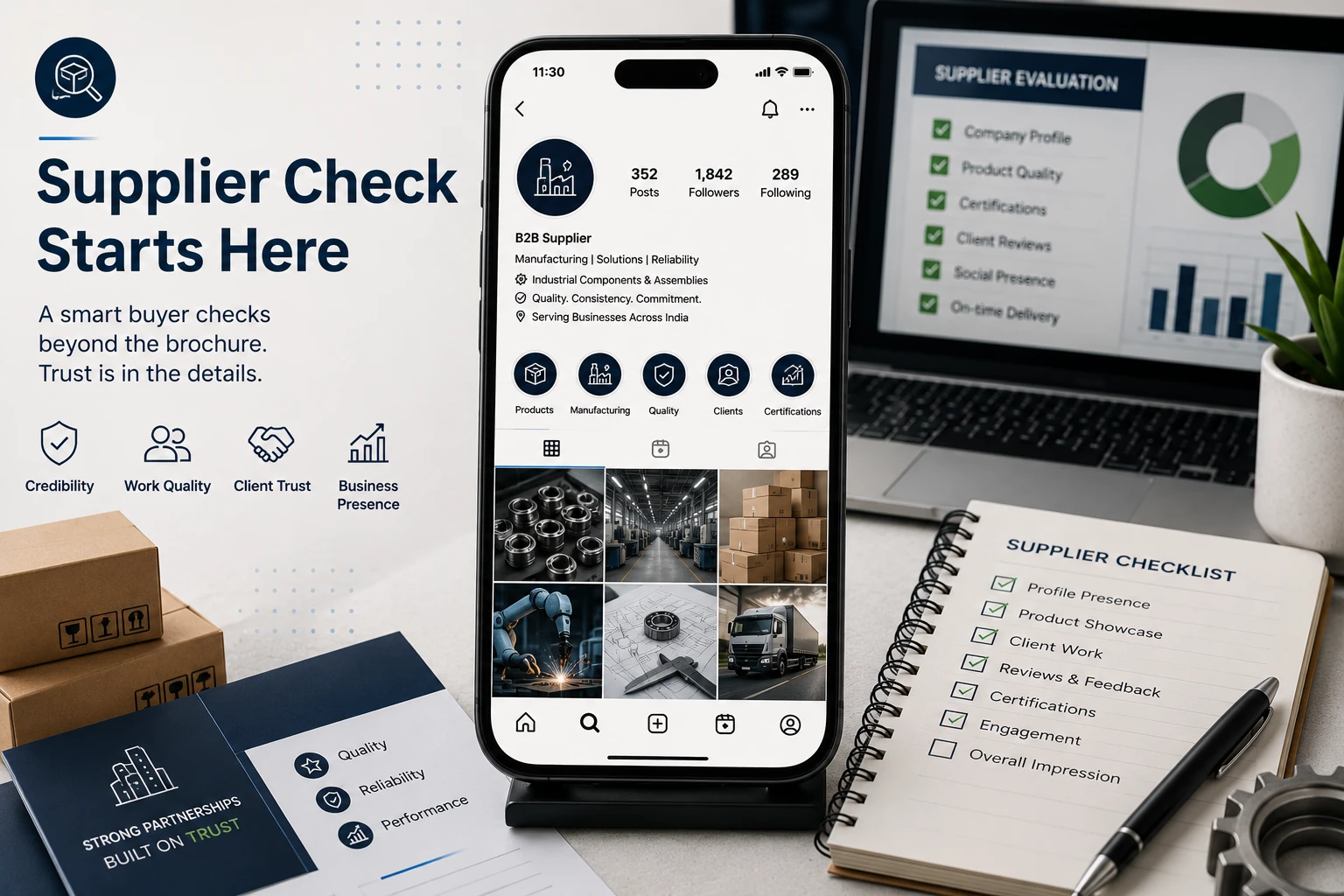
“Our buyers aren’t on Instagram.”
They are. Almost certainly all of them. The procurement head at the company you want as a client scrolls Reels in the evening like everyone else.
The objection is wrong and the instinct behind it is right — because being present where someone scrolls is not the same as being useful to them there. Instagram does have a job in Indian B2B. It is just not the job most people try to make it do.
The short answer
Instagram will not generate qualified B2B leads at meaningful volume, and businesses that measure it that way switch it off before it does anything useful. What it does well is everything that happens before a buyer searches: making you look like a real company when someone checks, keeping you familiar so you are recalled when the need arises, attracting people you want to hire, and giving a founder reach that a company page never gets. Judge it on those and it earns its place. Judge it on leads and it will not.
Key takeaways
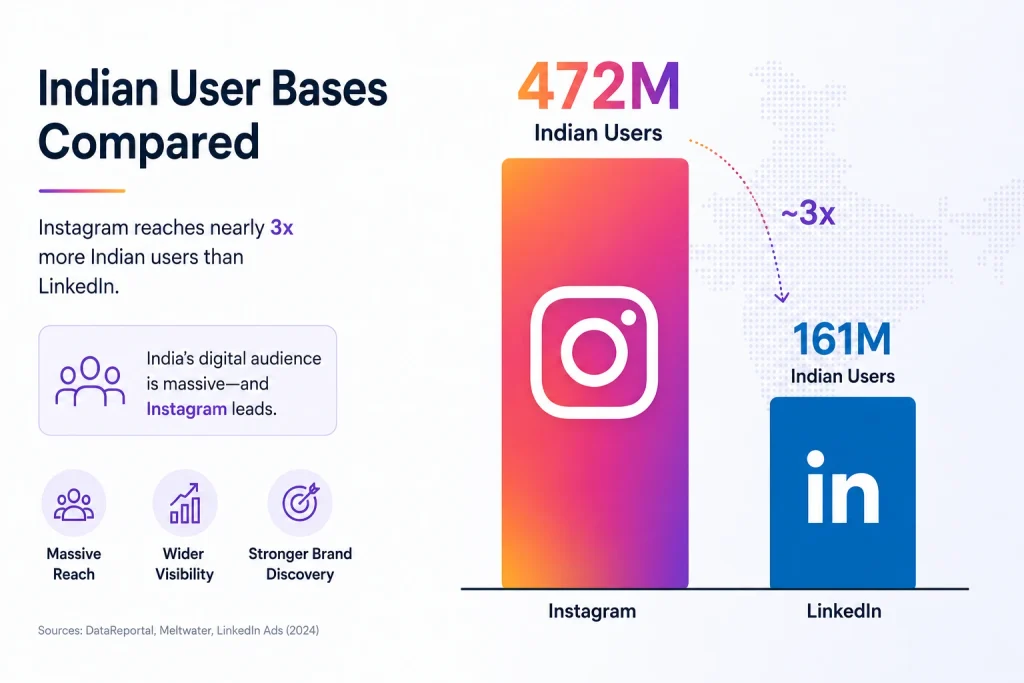
- Instagram’s Indian user base is roughly 472 million against LinkedIn’s 161 million — about three times the reach, reported by third-party trackers rather than the platforms.
- Only about 5% of B2B buyers are in-market at any time. LinkedIn reaches people in work mode; Instagram reaches the same people during the other 95%.
- Organic reach has fallen and the published figures disagree — recent benchmarks put average Instagram reach somewhere between 3.5% and 7.6% of followers depending on methodology and account size.
- Recruitment is the most underrated B2B use and often the one with the clearest return.
- A dead Instagram is a negative signal. Indian buyers check, and an abandoned profile reads as an abandoned business.
The arithmetic nobody publishes
India is Instagram’s largest market. Third-party trackers put the Indian user base around 472 million, well ahead of the United States at roughly 180 million.
LinkedIn’s Indian membership is reported at somewhere between 161 and 167 million — the platform’s second-largest market after the United States, and its fastest-growing, having added roughly 30 million members across 2024 and 2025.
Both figures come from statistics aggregators rather than from Meta or LinkedIn directly, so treat them as well-triangulated estimates rather than official counts. The ratio is what matters and it is not close: Instagram reaches roughly three Indians for every one LinkedIn reaches.
The obvious objection. LinkedIn’s users are there in a professional capacity, with job titles you can target. Instagram’s are not. That is true and it is exactly why LinkedIn dominates B2B lead generation.
The less obvious point. Professor John Dawes’s work for the LinkedIn B2B Institute put the share of B2B buyers in-market at any given time at around 5%. LinkedIn is excellent at reaching that 5% while they are thinking about work. It is expensive and inefficient at reaching the other 95%, who are not thinking about work at all — and who will be in-market eventually.
Instagram reaches that 95% cheaply, in a context where nobody has their professional guard up. What it cannot do is tell you which of them will be in-market next quarter.
The Pre-Search Job
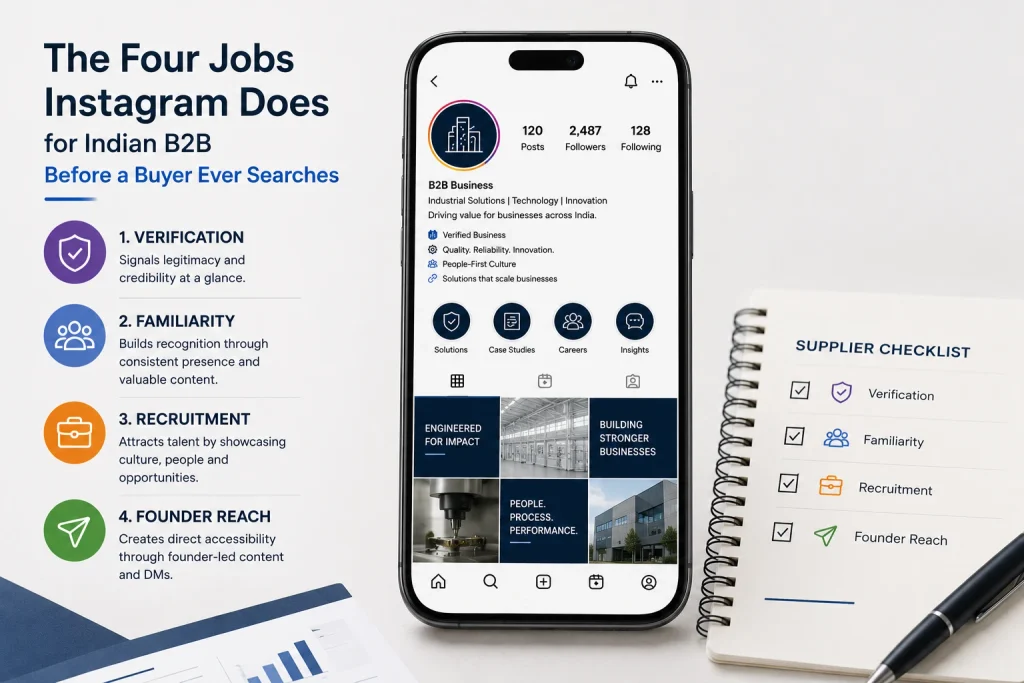
Instagram’s work in Indian B2B happens before anyone searches for what you sell. Once they search, Google takes over. Everything Instagram does well is preparatory, and measuring preparatory work on last-click leads guarantees you will kill it early.
Four jobs. Each is real, each is measurable, and none of them is lead generation.
1. Verification — you look like a real company
This is the most underrated and the easiest to underestimate.
An Indian buyer evaluating an unfamiliar supplier checks. Website, yes — but also Instagram, because a website can be built in an afternoon and a two-year posting history cannot be faked cheaply. They are looking for signs of life: recent activity, real people, work that exists, comments from actual humans.
An empty or abandoned profile is not neutral. It reads as a business that stopped, and it costs you deals you never hear about.
What this requires is modest. Consistent evidence that the company exists and does things. Project photos, team, events, client work with permission. This is a low bar and most Indian B2B firms fail it.
2. Familiarity — being known before the need arises
Someone eventually searches for what you sell. In that moment, a name they half-recognise beats four names they do not.
That is the whole mechanism, and it is why B2B demand generation is a different activity from lead generation. Instagram is a demand-side instrument. The gap between exposure and enquiry can be a year, which is precisely why last-click attribution reports it as worthless.
What this requires is being memorable rather than being informative. A carousel restating what your website says builds nothing. A specific opinion, a real project, a problem you solved that your buyer recognises — that lodges.
3. Recruitment — the return nobody counts
For a lot of Indian B2B firms, hiring is a larger and more painful cost than customer acquisition. Agency fees, months of vacancy, and the compounding cost of a bad hire.
Instagram is where people under thirty-five decide whether they want to work somewhere. Office, team, culture, what the work actually looks like. A candidate who arrives already wanting to join is cheaper and better than one recruited cold.
This is a genuine, attributable return and it almost never appears in a marketing report because it sits in a different budget.
4. Founder reach — the account that actually works
In Indian B2B, a founder’s personal account consistently outperforms the company page. People follow people. A managing director posting about what they are seeing in their sector reaches further and lands harder than the same words from a logo.
The uncomfortable part is that it requires the founder’s time and cannot be delegated convincingly. A ghostwritten founder account reads as ghostwritten, quickly.
If the founder will not commit twenty minutes a week, do not build the strategy on it.
What Instagram will not do for you
Stated plainly, because half the value of this article is the disqualification.
It will not generate qualified B2B leads at volume. Some enquiries arrive. Few are qualified. Cost per qualified lead is almost always worse than search for anything with existing demand.
It will not shorten your sales cycle. Familiarity helps at the top. It does not compress procurement.
It will not target job titles reliably. Meta’s targeting infers interests; it does not know who signs the purchase order.
It will not attribute cleanly. A buyer who saw you for eight months and then searched your name arrives as direct or branded search traffic. Instagram gets no credit and you will underfund it accordingly.
It will not work as a broadcast channel. Which brings us to the reach problem.
The reach problem, honestly
Published benchmarks disagree, and the disagreement is worth understanding rather than hiding.
Recent studies put average Instagram organic reach somewhere between 3.5% and 7.6% of followers per post, with variation by account size — smaller accounts generally reaching a higher proportion. Reported figures for feed posts have fallen from roughly 9.3% in 2023 to the range above.
Those numbers come from different analytics platforms measuring different account samples with different definitions, which is why they do not agree. The direction is consistent across all of them and the direction is what matters: a follower is worth substantially less than they were three years ago.
Notice who publishes the guides telling you to post more. Scheduling and social management software companies, almost exclusively. That is not dishonesty, but it is an interest, and it explains why “post consistently” is the universal recommendation regardless of what reach is doing.
The practical consequence for B2B. With a thousand followers and 5% reach, a post reaches fifty people. Posting daily does not fix that — it produces fifty people, daily, mostly the same fifty.
If reach matters to the objective, pay for it. Running creator content as Instagram ads is usually a better use of the same budget than a bigger content calendar, and whether your budget can fund a platform properly covers the thresholds.
How to measure it without killing it
Do not report cost per lead. It will be terrible and the conclusion drawn from it will be wrong.
Track branded search volume in Search Console. If familiarity is working, people search your name more over time. This is the cleanest available proxy and almost nobody uses it.
Ask on enquiry calls where they first heard of you. Imperfect and still more informative than your attribution model.
Count qualified applicants and what your recruitment costs were before and after.
Track profile visits from unfamiliar accounts, which indicates the verification behaviour is happening.
Give it four quarters. Preparatory work reviewed at ninety days always looks like failure, because at ninety days it is.
Mistakes that cost real money
Measuring it on leads. The central error and the reason most Indian B2B Instagram accounts are abandoned in month five.
Posting company announcements. Nobody outside your company cares that you attended a conference.
Reposting website copy as carousels. Restating is not the same as being memorable.
Starting and stopping. Three months of activity then silence is worse than never starting, because now the abandonment is visible and dated.
Building on a founder who will not participate. Decide this before designing the strategy, not after.
Ignoring the enquiries you do get. They arrive rarely and are worth answering quickly — the Harvard Business Review audit of 2,241 companies found an average first response of 42 hours and 23% never responding at all. On a channel producing few enquiries, losing any of them to slow follow-up is expensive.
When to skip Instagram entirely
When your buyer universe is tiny. Selling to forty companies in India means direct outreach and relationships beat any broadcast channel.
When nobody will own it. Instagram punishes intermittence. Without a named owner and a realistic cadence, do not start.
When your current lead flow is already unmanageable. Fix the follow-up before adding a channel — see where B2B leads in India actually come from for where the immediate wins usually are.
When the honest answer is that you want it because competitors have it. That is a poor reason and it produces exactly the abandoned profile described earlier.
The B2B Instagram checklist
☐ Objective chosen from the four jobs — verification, familiarity, recruitment, founder reach
☐ Lead generation explicitly ruled out as the success measure
☐ Named owner with a realistic weekly time commitment
☐ Founder participation confirmed or ruled out before planning
☐ Baseline branded search volume recorded in Search Console
☐ Baseline recruitment cost and time-to-hire recorded
☐ Profile complete — real address, working contact, current description
☐ Posting cadence set at a level sustainable for a year
☐ “Where did you hear about us” added to enquiry calls
☐ Paid budget considered as an alternative to a larger content calendar
☐ Review date set at four quarters, not one
☐ One metric agreed for the year
Questions we get asked
Does Instagram actually work for B2B?
For the four jobs above, yes. For direct lead generation, rarely and expensively. Most disagreements about this are really disagreements about what “work” means.
Instagram or LinkedIn for B2B?
LinkedIn to reach people in work mode with job-title targeting — better for direct pipeline. Instagram to reach the same people far more cheaply during the 95% of time they are not in-market. If you can only do one and you need enquiries this quarter, LinkedIn.
What should a B2B company post?
Work you have done, opinions you can defend, the people who do the work, and problems your buyer recognises. Not announcements, not restated website copy, not motivational quotes.
How often should we post?
Whatever you can sustain for a year. Twice a week forever beats daily for two months and then nothing.
Can we generate leads with Instagram ads instead?
Better odds than organic, and the mechanics matter — how lead generation works on Meta covers why frictionless forms produce volume without qualification.
How long before we see anything?
Verification benefits are immediate — a credible profile helps the first buyer who checks. Familiarity takes a year. Recruitment usually shows within two quarters.
What to do this month
Open your own Instagram profile and look at it the way a buyer evaluating you would. Recent activity? Real people? Evidence the company does things? Most Indian B2B profiles fail that inspection in four seconds.
Then record two baselines before changing anything: your branded search impressions in Search Console, and what your last three hires cost you in fees and vacancy time.
Those two numbers, twelve months apart, will tell you more about whether Instagram is working than any engagement report.
If you would like help deciding which of the four jobs is worth pursuing for your business — or whether none of them are — you can reach out to us on whatsapp at +91 7738844851 .
More in Blog
Keep reading
All articles →
Ready to talk about your growth?
Tell us what's stuck and we'll tell you what we'd do first. Free, 30 minutes, no pitch.