
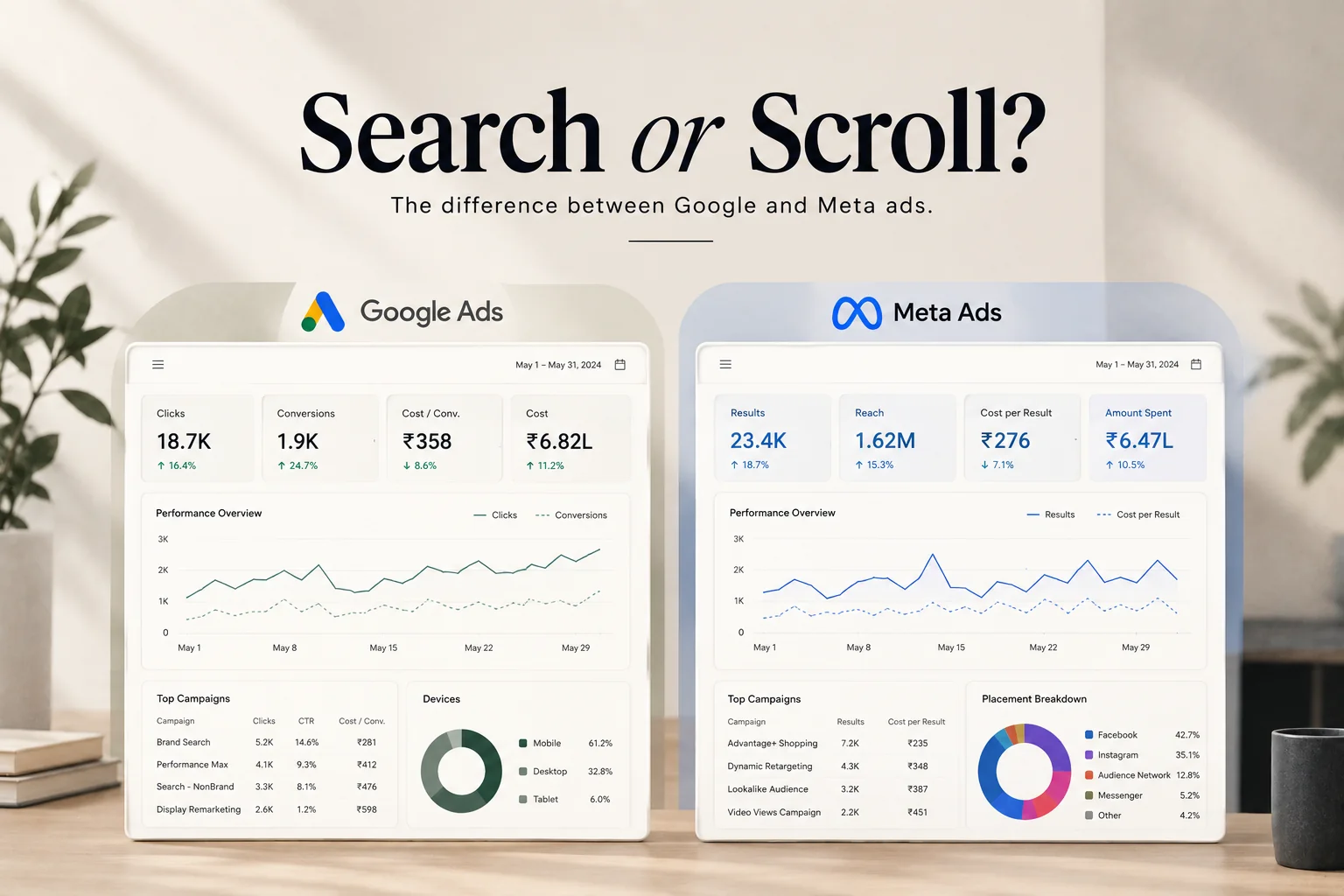
Every article on this question ends the same way. Neither is better. Google captures demand, Meta creates it. Use both.
Which is true, and useless to somebody with ₹40,000 a month deciding where to put it.
There is an arithmetic answer, and both platforms have published the numbers you need. Nobody has set them next to each other, which is odd, because together they settle the argument in about two minutes.
The short answer
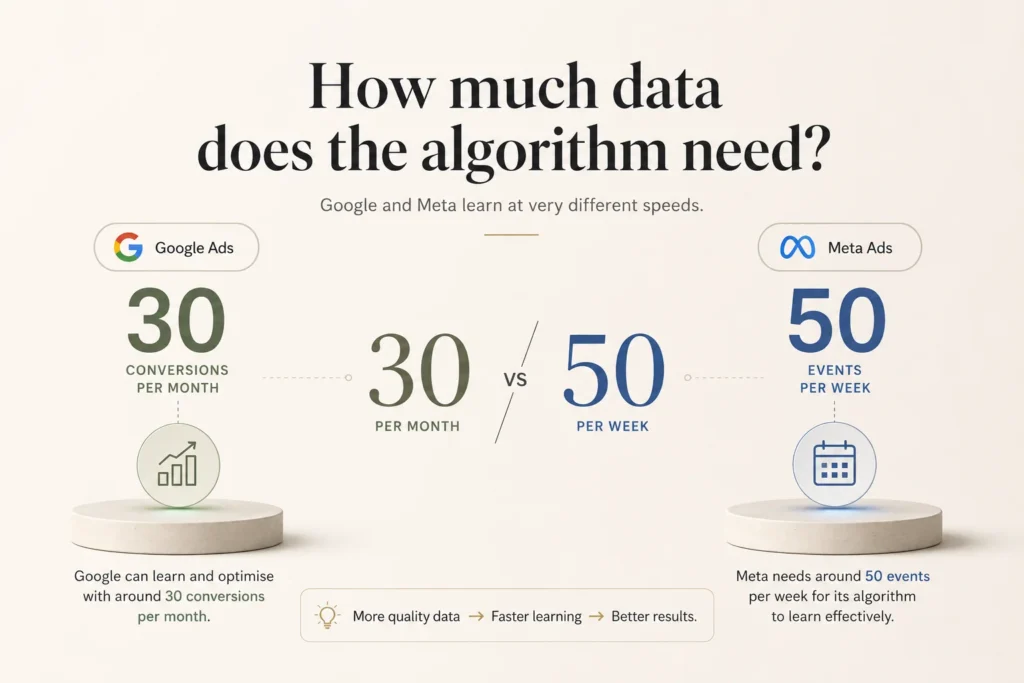
Both platforms run on machine learning that needs a minimum volume of conversions to work. Google recommends at least 30 conversions per campaign in 30 days for Target CPA bidding. Meta’s learning phase needs roughly 50 optimisation events per ad set within a rolling seven days — around 200 a month. Most businesses asking which platform to choose cannot feed one of them properly. Splitting a budget across both guarantees neither works. Fund one to its threshold first.
Key takeaways
- The thresholds are published. Google: 30 conversions per campaign per 30 days for Target CPA. Meta: about 50 optimisation events per ad set per rolling week to exit the learning phase.
- Meta’s bar is higher than most people realise. Fifty a week is roughly 200 a month, per ad set — not per account.
- Splitting a small budget halves your data on both platforms and leaves each below the line where its algorithm becomes useful.
- India is not a search-first market. dentsu India put social media at 29% of 2025 digital spend and online video at 28%, against paid search at 23%. Most readers arrive assuming Google is the default; the money says otherwise.
- One free search tells you which to start with. Keyword Planner volume for your terms, in your geography.
The two numbers nobody puts together
Both platforms are transparent about what their systems need. The information is sitting in their help documentation and almost nobody quotes it in a comparison article.
Google. Target CPA bidding is recommended once a campaign has at least 30 conversions in the past 30 days. Target ROAS asks for 50. Below that, the algorithm has too few examples to bid reliably, and what you experience is a campaign that swings without explanation.
Meta. An ad set exits the learning phase after roughly 50 optimisation events in a rolling seven-day window. That is per ad set, not per account, and it counts pixel events, server-side events and modelled conversions together. Ad sets that do not reach it get flagged as Learning Limited, and performance stays unstable.
Fifty a week is about 200 a month. From one ad set.
Now put a real business next to those numbers. A services company generating 25 enquiries a month across everything is below Google’s floor for its single best campaign and nowhere near Meta’s for one ad set. Split that budget across both platforms and each gets roughly twelve — which is not a strategy, it is two experiments running at once, neither long enough to conclude anything.
What this means for an Indian budget
The uncomfortable part is that this affects more businesses than it sounds like it should.
Paid search reached ₹16,581 crore in India in 2025, around 23% of a ₹71,621 crore digital advertising market, per dentsu India. Social media took the largest share at 29%, or ₹21,057 crore, with online video close behind at 28%. Digital became the country’s largest advertising medium that year for the first time.
Two things follow.
India is not a search-first advertising market. Most Indian readers arrive at this question assuming Google is the sensible default and Meta is the softer option. The spending says the opposite. That does not make Meta right for you — it means the assumption deserves examining rather than inheriting.
Competition is rising on both. More advertisers chasing the same auctions each year makes the data thresholds harder to reach on a fixed budget, not easier.
The Runway Rule
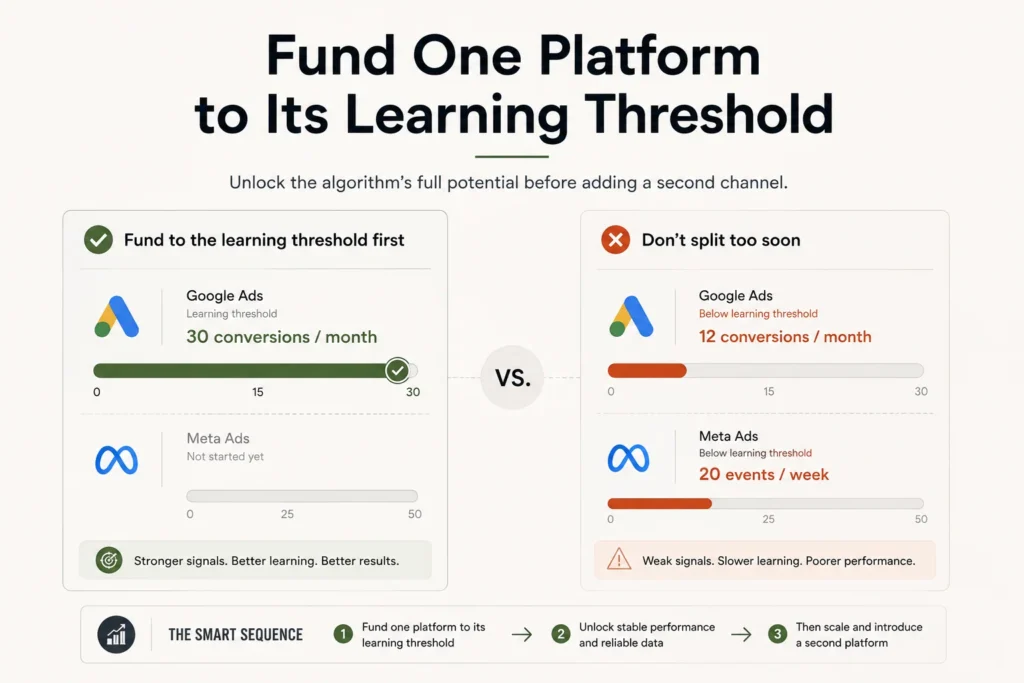
Fund one platform to its learning threshold before adding a second. A budget split below those thresholds does not buy you two channels — it buys you two campaigns that never learn.
The logic is uncomfortable because it means saying no to a platform someone in the business wants to run. But the alternative is worse: a year of spend across two accounts, both underperforming, with no way to tell whether either would have worked.
Work out your runway before you allocate. Take your expected monthly conversions at your current cost per acquisition. If that number sits below thirty, you have one platform’s worth of budget at best, and possibly not even that.
Give it a full quarter. Learning phases reset when you make material changes, and a platform judged in three weeks has told you nothing. This is also why chopping between platforms every two months is the most expensive pattern available — you pay the learning cost repeatedly and never get past it.
Add the second only when the first is stable and self-funding. Stable means past the learning threshold and holding a cost per acquisition you can live with. At that point the second platform is an expansion, not a hedge.
There is a related version of this problem inside a single account, where a business splits thin conversion data across six campaigns instead of two platforms. We cover that as why B2B accounts run short of conversion data — same mechanic, different level.
Which one to start with
A free ten-minute test, and it beats an opinion.
Open Google Keyword Planner. Enter the specific phrases a buyer would type to find what you sell. Not your category — the actual search. Set the location to where you sell.
Read the monthly search volume.
If there is meaningful volume, start with Google. People are already looking. Capturing existing demand is faster, cheaper per acquisition and easier to measure than creating it. You can be in front of them this week.
If volume is negligible, Google cannot work for you yet, however well the account is built. There is nothing to capture. Meta is where you go, because Meta does not require the buyer to know they want you — it puts you in front of people who match a profile, whether or not they are searching.
That single check resolves most of the debate, and it is more reliable than any list of business types. A category that “should” suit Google according to a comparison table is irrelevant if nobody in your city is searching for it.
Two caveats worth stating. Search volume in Keyword Planner is an estimate, and low volume on your first ten keywords sometimes means you chose the wrong ten — check the phrases your customers actually use, not your internal vocabulary. And in a high-value category, low volume can still be enough; twenty searches a month for a ₹40 lakh product is a viable channel.
What each platform is genuinely better at
Briefly, because this part is well covered elsewhere and the thresholds matter more.
Google is better when the buyer knows what they want. Someone typing “industrial water chiller supplier Pune” has a problem, a solution in mind and a shortlist forming. You are joining a decision already in progress. That is why local services, B2B products with names, and replacement purchases work well here.
Meta is better when the buyer does not know you exist. Visual products, impulse categories, new propositions and anything where seeing it creates the want. It also reaches the people who will search for you later — the roughly 95% of a market not currently shopping, in the framing from Ehrenberg-Bass research for the LinkedIn B2B Institute.
Google is easier to measure. The click follows an intent you can read. Meta’s contribution is real and harder to attribute, which is why it gets underestimated in last-click reporting and cut first when budgets tighten.
Meta demands more creative. Google rewards relevance between query, ad and page. Meta rewards creative that stops a scroll, and it consumes creative faster — expect to produce new material regularly rather than setting it and leaving it.
Mistakes that cost real money
Splitting a small budget to hedge. The mistake this article exists for.
Switching platforms every two months. You pay the learning cost twice and reach the payoff never.
Judging Meta on last-click. It will always lose that comparison, including when it is working.
Running many ad sets on Meta with a small budget. Same error as splitting platforms, one level down. Fifty events per week is per ad set, so more ad sets means fewer events each.
Assuming Google by default because it feels serious. India’s spending pattern does not support that assumption, and your category may not either.
Blaming the platform for a follow-up problem. Harvard Business Review’s audit of 2,241 companies found the average first response took 42 hours and 23% never responded at all. Neither platform fixes that.
When neither platform is the answer
Your monthly budget will not clear either threshold. If the arithmetic says you cannot reach thirty conversions on Google or fifty weekly events on Meta at any allocation, paid platforms are not your channel this year. Referral, trade platforms and organic search are, and they are cheaper.
Your follow-up is broken. Fix it first. It is free.
Your offer is uncompetitive. Paid media makes an existing advantage visible faster. It cannot create one, and it will make a weak offer expensive to demonstrate.
Your product needs explanation neither format allows. Some genuinely complex propositions are sold in conversations, and paid media’s job is only to start one — which changes what you should measure and what you should spend.
The platform decision checklist
☐ Monthly conversions across all channels counted, honestly
☐ Expected cost per acquisition estimated from Keyword Planner or existing data
☐ Achievable monthly conversion volume calculated at your budget
☐ That number compared against 30 for Google and roughly 200 for Meta
☐ Keyword Planner search volume checked for your actual buyer phrases
☐ One platform chosen, with the reason written down
☐ A full quarter of budget confirmed as available before starting
☐ Ad sets or campaigns kept to the minimum the data can support
☐ Creative production capacity assessed honestly if choosing Meta
☐ Enquiry response time measured before spend begins
☐ One metric agreed for the quarter
☐ A stated condition for when the second platform gets added
Questions we get asked
Which is cheaper, Google or Meta?
Meta usually has a lower cost per click and Google a higher intent per click, which makes cost per acquisition the only comparison worth making. Neither is reliably cheaper on that measure — it depends on your category and how well each account is built.
Should I run both at the same time?
Only if your conversion volume clears both thresholds. Below that, running both means neither leaves its learning phase, and you pay for the privilege on two platforms.
Which is better for ecommerce?
Both, eventually. Meta tends to work earlier for visual and impulse products because it creates demand rather than waiting for it. Google Shopping becomes strong once people search your product category by name.
Which is better for lead generation?
Google, in most cases, because enquiry intent is easier to capture than to create. The exception is a category nobody searches for, where Meta is the only realistic option.
How much budget do I need for each?
Work backwards from the thresholds. Estimate your cost per conversion, multiply by 30 for Google or by roughly 200 for one Meta ad set, and that is your monthly floor. Our guide to what Google Ads actually costs in India sets out how to estimate the first number without spending anything.
What if my industry is supposed to suit one platform?
Check the search volume anyway. A category that theoretically suits Google is a poor bet if nobody in your geography is searching, and the tables in comparison articles are not written about your city.
What to do this week
Two numbers, one afternoon.
Count your conversions across all channels last month. Then open Keyword Planner and check the search volume for the phrases your buyers actually type.
The first tells you whether you can afford a platform properly. The second tells you which one. If the first number is small, the honest answer is one platform for a full quarter — and the discipline to leave it alone long enough to learn something.
If you would like that arithmetic run against your category, your budget and your current conversion volume, you can reach out to us on whatsapp at +91 7738844851 .We will tell you if the answer is that neither platform is where your next rupee should go.
More in Blog
Keep reading
All articles →
Ready to talk about your growth?
Tell us what's stuck and we'll tell you what we'd do first. Free, 30 minutes, no pitch.