
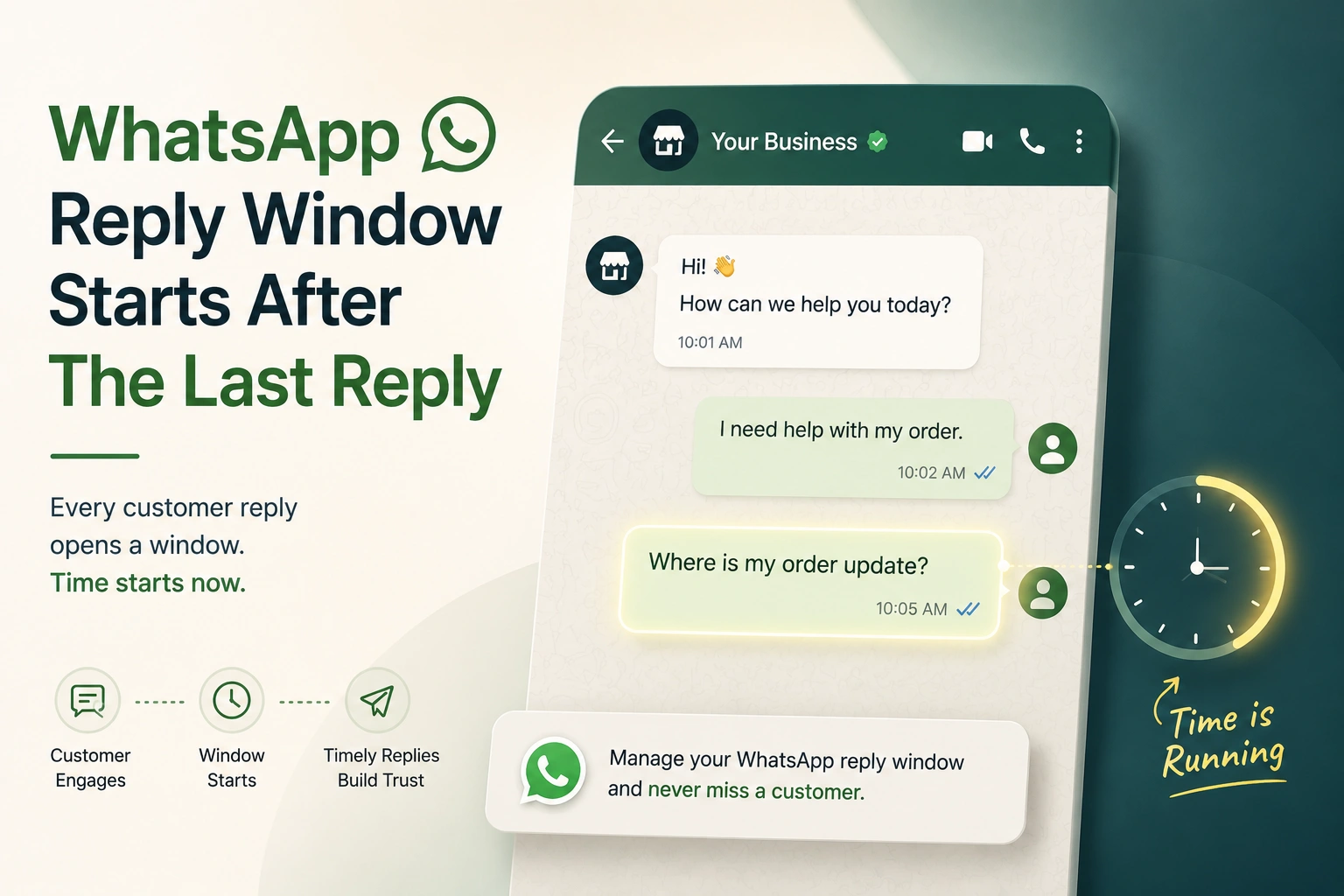
Most explanations of this rule treat it as a pricing detail. Reply inside twenty-four hours and it is free; reply later and you pay.
That is true and it is the smaller half. The larger half is that after twenty-four hours you cannot write your own sentences to that person at all. Not a typed reply, not a photograph, not an answer to the question they asked you yesterday. Only a template somebody approved in advance.
It is a permission, not a discount, and the difference shows up in your sales process rather than your invoice.
Hour zero
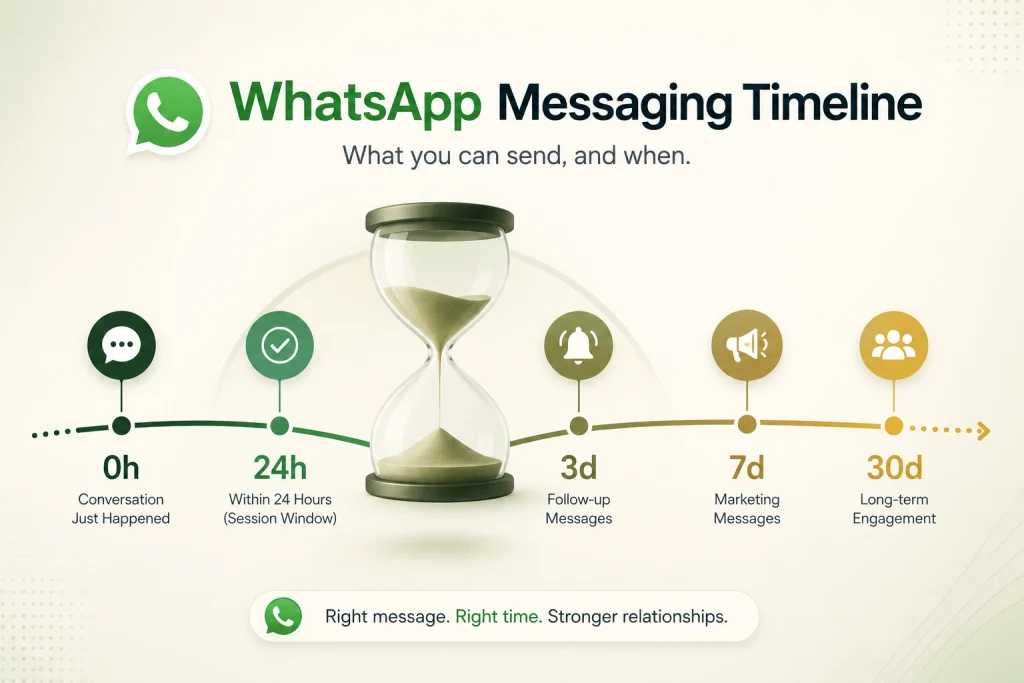
A customer messages you. The window opens and runs twenty-four hours from their most recent message.
Inside it you can send anything. Free-form text, images, documents, voice notes — Meta’s documentation is explicit that non-template messages can only be sent within an open window, and that inside one they are free. Utility templates sent inside the window are free as well.
Which is the most permissive state your account will ever be in with that person, and it lasts a day.
Hour twenty-three
The window is still open and most businesses have not noticed it is closing.
This is the last cheap moment, and the useful move here is not a sales push. It is a question — anything that invites a reply, because their reply restarts the clock from zero.
A reply is worth more than a message sent. Every response resets the twenty-four hours, which means a genuinely conversational exchange can run for days without ever leaving the free, unrestricted state.
Sales teams that understand this stop writing statements and start writing questions. Not as a trick — a question is simply the only sentence that keeps the channel open.
Hour twenty-five
The window has closed and your options have collapsed.
You may now send template messages only. Approved in advance, fixed wording, variables filled in. If the conversation was mid-negotiation and the customer asked something specific, you cannot answer it in your own words.
This catches sales teams badly, because it is the opposite of how every other channel works. You can always email someone back. You cannot always WhatsApp someone back.
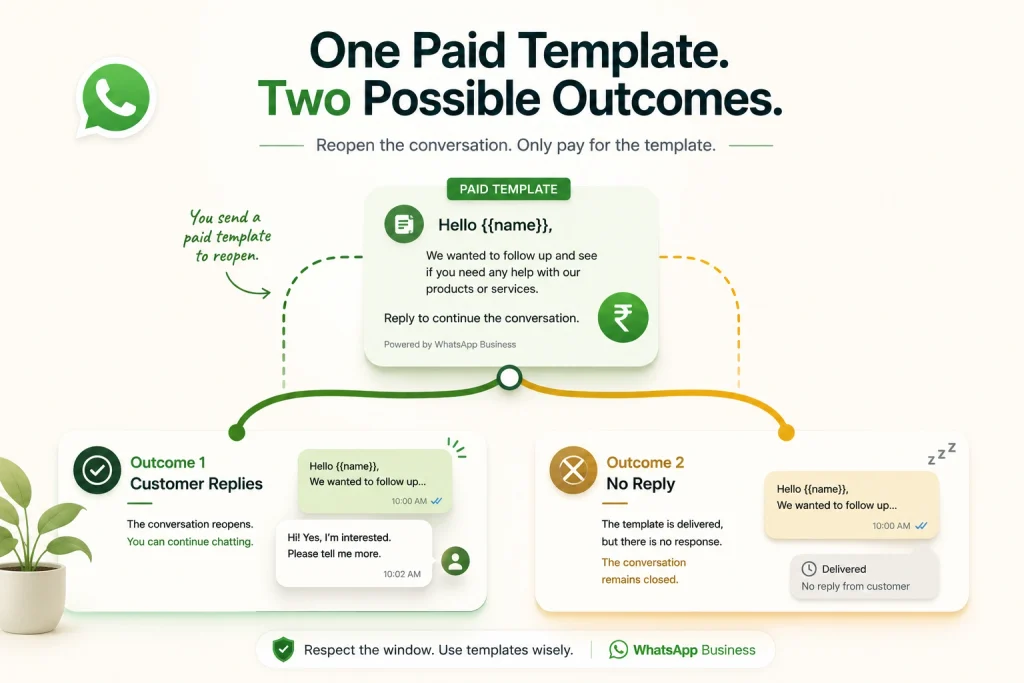
And the template you send to reopen the conversation is a gamble. You pay for it — a marketing template costs about ₹0.8631 at Meta’s list rate before margin and tax, with the full stack at what a year of WhatsApp actually costs.
If they reply, the window reopens and you can speak normally again. If they do not, you have paid for a message into silence and you are still locked out.
Which is why the reopening template matters more than its price. A generic “just checking in” earns no reply and buys nothing. A specific, useful message — their quote, their order, the thing they actually asked about — earns the reply that restores your access.
Friday evening, and why Indian businesses lose windows in bulk
Here is the pattern we see most often.
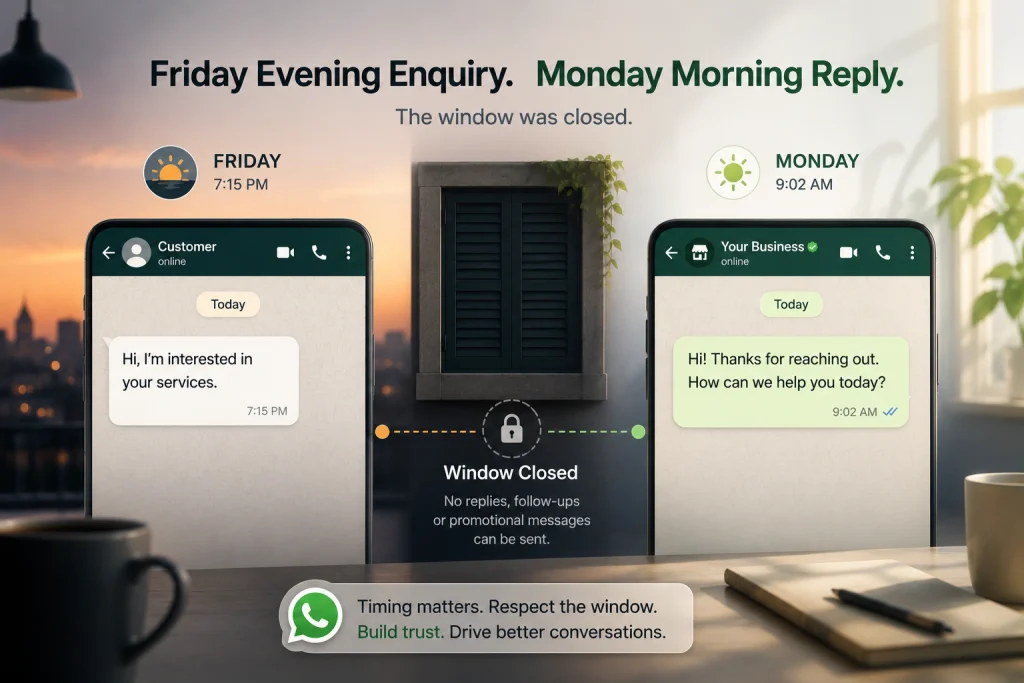
An enquiry arrives at 7pm on Friday. Nobody is watching. Monday morning the team opens the inbox at 10am — thirty-nine hours later.
The window closed at 7pm on Saturday. Every one of Friday evening’s enquiries is now template-only, and the person who was interested enough to message on a Friday night has spent a weekend not hearing back.
This is not a small leak. For consumer and local businesses in India, evenings and weekends are when people message — which means a Monday-to-Friday, ten-to-six response process systematically loses the windows that matter most.
The fix is not a bigger team. It is an acknowledgement inside the window — even an automated one — that opens the door to a real reply on Monday, plus somebody checking twice over the weekend. Both are cheaper than the alternative, and the alternative is paying to reopen every Friday conversation you had.
Day three, and the different window nobody distinguishes
If the person arrived through a click-to-WhatsApp ad, a second and separate window may be in play — a longer one, opened by your reply rather than by their message, in which everything is free.
It runs independently of the twenty-four-hour window. Which produces a state that confuses people: you can be inside the free period and still unable to send free-form messages, because the customer service window has closed underneath it.
Free is not the same as permitted. The mechanics of that second window are at what the free window is really worth; the point here is only that they are two clocks, not one.
Day thirty
At some distance the question stops being about windows and becomes about whether you should be messaging this person at all.
Re-engagement templates to people who stopped replying weeks ago are the highest-risk sends in the channel. They attract blocks, and blocks feed the quality rating that decides whether your templates keep working — why templates stop sending covers what that costs.
A cold list and a reopening template is a bad combination. The people most likely to block you are the ones who have already ignored you.
What this means for how you actually work
Measure time-to-first-reply, in hours, per channel. It is the single number that determines how much of your WhatsApp is free and unrestricted, and most businesses have never looked at it.
Give WhatsApp a named owner with cover at evenings and weekends. Not a team. A person, and a deputy.
Acknowledge instantly, even automatically. An instant acknowledgement inside the window is not the same as a real reply, but it keeps the channel open long enough for one.
Write questions, not statements, when a conversation is going quiet. A reply resets the clock; a statement ends it.
Keep two or three genuinely useful reopening templates approved and ready — an order or quote update, a specific answer, a status. Not “checking in.”
And stop reopening conversations that have gone cold. After a few weeks the cost is not the template. It is the block.
Questions we get asked
What is the WhatsApp 24 hour rule?
A customer’s message opens a window lasting twenty-four hours from their most recent message. Inside it you can send any message type. Outside it you may send approved templates only.
What can you send after the 24 hour window closes?
Template messages only. No free-form text, no images typed in reply, nothing written in the moment.
How do you reopen a WhatsApp conversation?
Send an approved template and hope they reply. Their reply opens a fresh window; without it you remain restricted.
Does the window reset every time they message?
Yes. Twenty-four hours runs from their most recent message, so an active exchange can stay open indefinitely.
Can you send images after 24 hours?
Not as a free-form message. Media can be included in an approved template, but you cannot simply attach and send.
Is the free entry point window the same thing?
No. It is a separate, longer window that opens from your reply when someone arrives through an ad, and it runs independently of the customer service window.
The number that decides all of this
Take last month’s WhatsApp conversations and count how many received a human reply within an hour.
Then count how many received one within twenty-four.
The gap between those two numbers is the portion of your WhatsApp programme running on templates and permissions rather than on conversation — and it is almost always larger than the team expects, concentrated in evenings and weekends.
If you want that measured properly and a response process built around the clock rather than the working day, you can reach out to us on whatsapp at +91 7738844851 .
More in Blog
Keep reading
All articles →
Ready to talk about your growth?
Tell us what's stuck and we'll tell you what we'd do first. Free, 30 minutes, no pitch.