
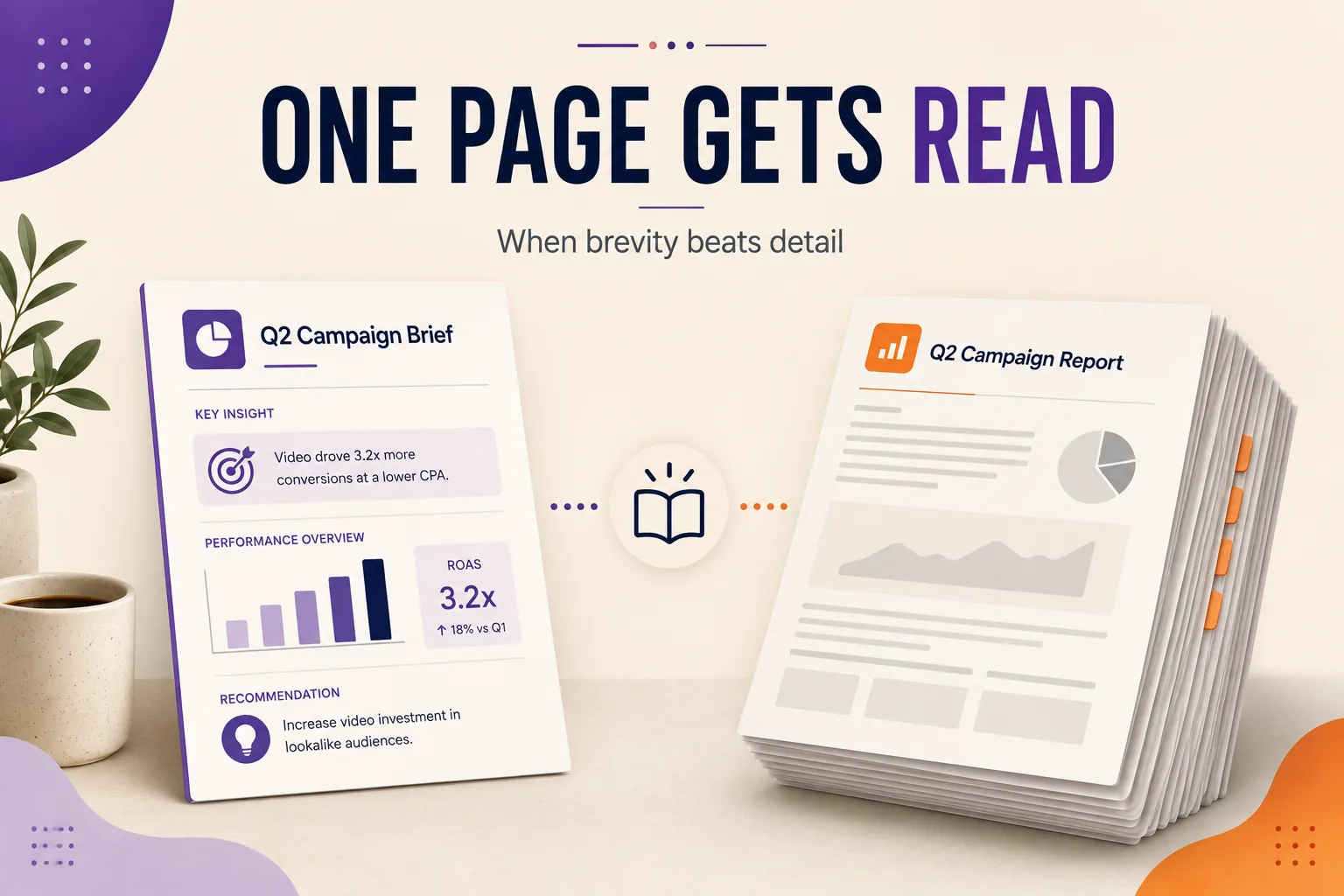
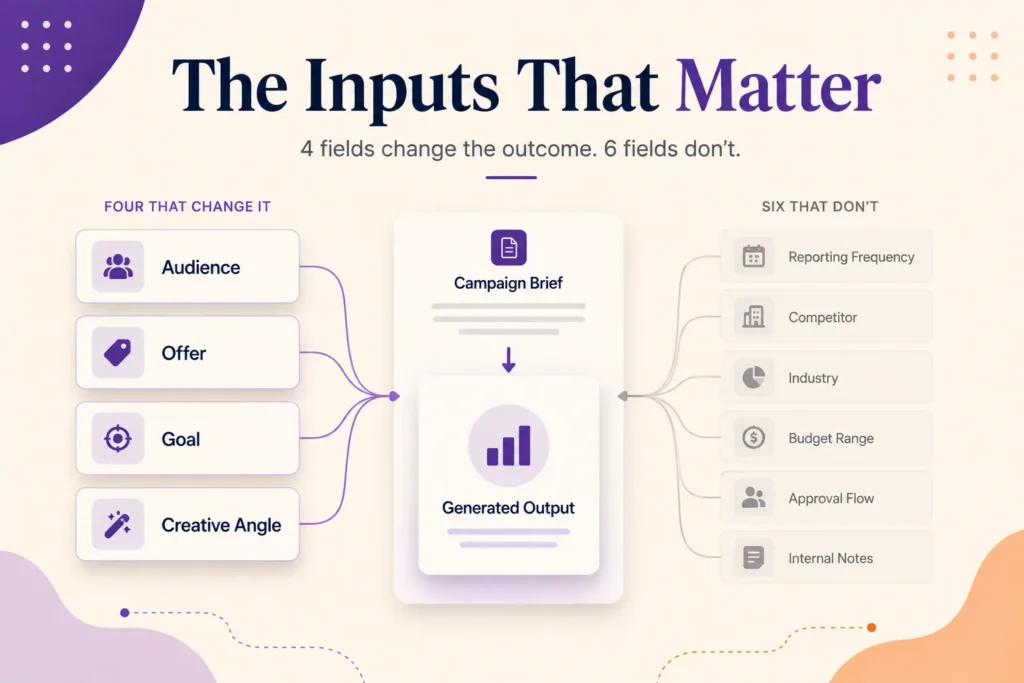
Open any published creative brief template and you will find ten fields. Objective. Target audience. Unique selling proposition. Key message. Call to action. Channels. Budget. Timeline. Creative direction. Approval process.
Now ask which of those changes what the person actually makes.
Four, at most. The rest is a record that a process was followed — useful for the person who signed it off, and no help whatsoever to the person holding the camera on Thursday.
The short answer
A creative brief for advertising has one job: decide what the ad will argue before anyone starts making it. That means a single claim, the evidence behind it, the objection it answers, and the constraints it must survive. Everything else — budget, timeline, approvals, brand guidelines — belongs in a project document, not in the thing the maker reads. One page, four decisions, and a review standard so that feedback is measured against the claim instead of against taste.
Key takeaways
- A brief without a claim is a requisition form. Most published templates contain no claim at all.
- The brief is where your hit rate is set. At a 2% hit rate you would need 34 concepts to find one winner; your account can run four.
- Four fields matter: the claim, the evidence, the objection, the constraints.
- State where the claim came from. A brief citing a customer’s actual words outperforms one citing a positioning document.
- Write the review standard into the brief, or feedback becomes preference.
- Indian briefs now need two more lines: language and script, and sound-off comprehension.
Why the ten-field brief fails
It fails quietly, which is why it survives.
Nobody in that template decides what the ad will say. “Key message” comes closest, and in practice it gets filled with something like premium quality at affordable prices — a category, not a claim.
So the argument is invented by whoever makes the thing. They are often good at this. They are also working without your sales calls, your objection log or your churn reasons, so they invent from the material available, which is the website.
Then it comes back and gets judged by taste. Nobody can say the ad failed the brief, because the brief did not specify anything falsifiable. So the review becomes a discussion about the music, the colour and whether the model feels right — and two rounds later you have a competent ad arguing something nobody chose.
The cost of this is not the rounds. It is the hit rate.
The brief is where the odds are set
Our own arithmetic on this is uncomfortable. At the industry’s published creative hit rate of around 2%, you would need roughly thirty-four concepts for a coin-flip chance of one winner. A Meta account under about ₹3 lakh a month can properly run three or four — how many ad creatives your account can carry sets out why.
So a small advertiser cannot find winners by volume. The only lever left is making each concept more likely to work.
The brief is that lever. Not the camera, not the editor, not the media buyer. The decision about what the ad will argue, made before anything is filmed, is the single largest influence on whether it works — and it is the one step almost universally treated as paperwork.
The One-Claim Brief
One claim, the evidence for it, the objection it answers, and the constraints it must survive. One page. If a field does not change what gets made, it belongs somewhere else.
Field one — the claim
One sentence, in plain language, that this ad is trying to make someone believe.
Not a description. Not a category. A claim someone could disagree with.
Weak: “Communicate our premium quality and trusted service.”
Strong: “You will get your first qualified enquiry within two weeks, or you stop paying.”
Test it like this. Could a competitor put their logo on this claim without changing it? If yes, it is not a claim, it is a genre.
And one claim only. A brief with three claims is three briefs, and the ad that results will make none of them well.
Field two — the evidence
Where the claim came from, quoted.
An actual line from a sales call, a review, a WhatsApp enquiry, a churn conversation. Written as the customer said it, not tidied.
This is the field nobody includes and the one that changes the output most. A maker given real language will use real language. A maker given a positioning statement will produce something that sounds like a positioning statement, because that is what they were handed.
It also settles arguments later. When somebody says nobody talks like that, the brief contains the person who did.
Field three — the objection
The specific reason someone does not buy, which this ad exists to answer.
Price. Trust. Switching cost. Whether it works in Indian conditions. Whether you will still be around next year.
Naming the objection does two things. It stops the ad being a general advertisement for the company, and it gives the maker somewhere to aim.
And it forces useful separation. Four different objections is four concepts — which is exactly the coverage a four-concept account needs, rather than four executions of one idea.
Field four — the constraints
The things that will break the ad if ignored, stated as instructions rather than preferences.
It must make sense with the sound off. Most of it will be watched muted.
The first second must contain motion, and the claim must land within three seconds. Why is a separate subject — what actually moves the first three seconds — but the brief just states it.
Format and aspect ratio, including whether stills are needed from the same session.
Language and script, which for an Indian advertiser is now a brief-level decision rather than a post-production one: advertising in Indian languages.
Anything legally required — substantiation for performance claims, mandatory disclosures, category restrictions.
Nothing else. No tone adjectives, no mood boards describing a feeling, no brand values. Those are real things and they belong in a brand document the maker reads once, not in the brief they read on the day.
The template, in full
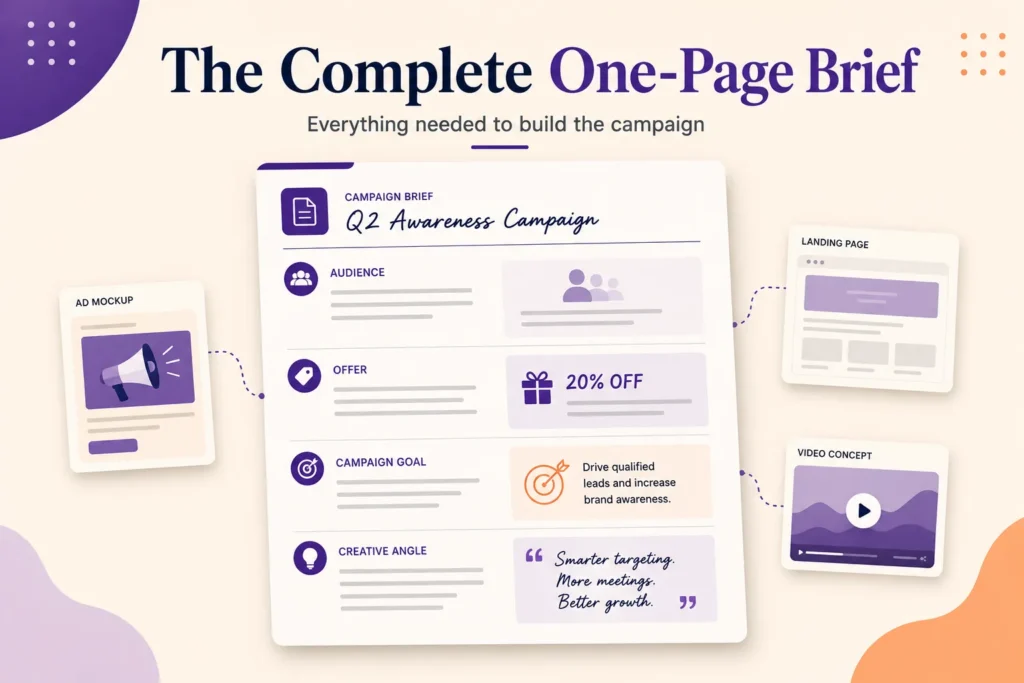
Copy this. It fits on one page.
Ad concept name. Something memorable, so people can talk about it.
The claim. One sentence. What we want someone to believe after seeing this.
The evidence. A direct quote from a customer, review or sales call, in their words.
The objection. The specific reason this person does not buy, which this ad answers.
Who this is for. One line. Not a persona document — the person the objection belongs to.
Constraints. Sound-off comprehension. Motion in the first second, claim by three. Aspect ratios required. Language and script. Any legal requirements.
Deliverables. How many assets, which formats, whether stills are needed from the same shoot.
How we will judge it. The review standard — see below.
That is the brief. Budget, timeline, contacts and approvals go in the email or the project tool. The maker does not need them on the page they are working from.
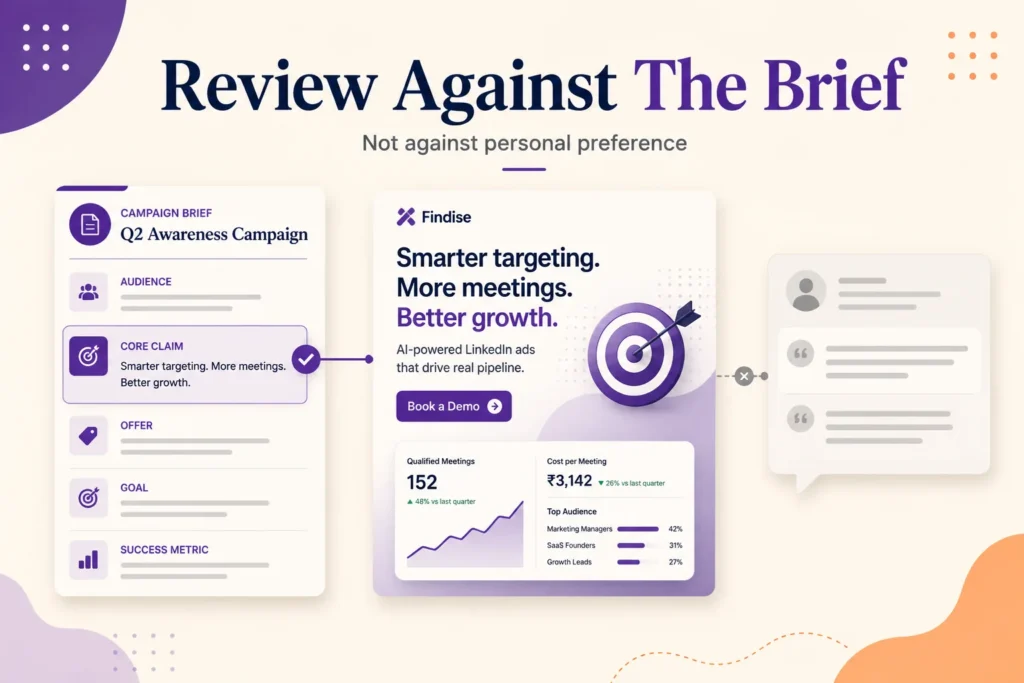
Write the review standard into the brief
The reason creative review turns into an argument about colour is that nobody agreed in advance what “good” meant.
So put it in the brief. Two or three lines, written before the work exists.
“We will judge this on whether a stranger, watching muted, understands the claim within three seconds and can say what problem it solves. We will not judge it on whether we personally like the music or the presenter.”
It sounds procedural and it works. It gives everyone in the room — including the client, including the founder — a standard that is not their own taste, and it makes the useful feedback easy to give and the unhelpful feedback awkward.
One more rule worth adopting. Feedback that cannot be traced to a line in the brief is a preference, and preferences get logged rather than actioned. If a preference keeps recurring across projects, it belongs in the brand document — which is a different conversation, held once, rather than the same conversation every fortnight.
How to fill it in without guessing
Get the evidence first. Twenty minutes in your own CRM, review pages and WhatsApp enquiries will produce more usable language than a day of workshops.
List objections before claims. Objections are observable; claims are invented. Start from the observable end and the claims write themselves.
One brief per objection. Four objections, four briefs, four concepts. That is a quarter’s coverage for most Indian SME accounts.
Write it before you cost it. A brief written to fit a budget produces creative built to a price. Write what the ad needs to say, then decide what you can afford to make.
Then hand it over intact. A brief that gets summarised verbally on a call is a brief that did not survive.
Mistakes worth the money they cost
No claim, only a description. The failure this article exists to fix.
Three claims in one brief. The ad makes none of them.
Adjectives instead of instructions. “Premium, warm, aspirational” tells a maker nothing they can act on.
Evidence invented in a meeting. If nobody said it, do not brief it.
Briefing after the shoot. Deciding what an asset argues once it exists is how libraries of unusable footage happen.
Skipping the review standard. Guarantees the taste conversation.
Ten pages. A brief nobody finishes is a brief nobody follows.
When a brief is not the problem
When the offer is uncompetitive. No claim survives an offer the market has already judged.
When you have never spoken to a customer. You cannot brief evidence you do not have. Get it first.
When the account cannot run what you brief. Four concepts is coverage; twelve is inventory.
When the same brief keeps producing good work that fails. The claim may be fine and the problem downstream — page, offer, tracking.
When you are commissioning a creator rather than a concept. Rights, rates and sourcing matter as much as the argument then, and those sit at what UGC costs in India, and what the rights cost.
The brief checklist
☐ One claim, in one sentence, that a competitor could not also make
☐ Claim written as something a person could disagree with
☐ Evidence quoted from a real customer, in their words
☐ The specific objection this ad answers, named
☐ One brief per objection, not one brief with several
☐ Sound-off comprehension stated as a requirement
☐ Opening instruction stated — motion first second, claim by three
☐ Aspect ratios and whether stills are needed from the same session
☐ Language and script decided at brief stage
☐ Legal and substantiation requirements listed
☐ Review standard written into the brief before work begins
☐ Budget, timeline and approvals kept off the page the maker reads
☐ Brief handed over in writing, intact
☐ Feedback traced to the brief or logged as preference
Questions we get asked
What should a creative brief include?
A claim, the evidence behind it, the objection it answers, and the constraints it must survive. Plus a review standard. Everything else in the standard ten-field template is project administration.
How long should a creative brief be?
One page. A brief people finish outperforms a thorough one they skim, and the discipline of one page forces you to decide the claim.
What is the difference between a creative brief and a campaign brief?
A campaign brief covers budget, channels, flighting and approvals. A creative brief decides what a single asset argues. Keeping them separate is most of the improvement.
How do you brief an ad agency?
The same way, in writing, before the call rather than during it. If the agency asks better questions than your brief answers, that is a good agency and a poor brief.
Who writes the creative brief?
Whoever is closest to real customer language — often a founder or a salesperson rather than a marketer. The person with the objections in their head should write the field about objections.
Do I need a separate brief for each concept?
Yes, if the concepts argue different things. If they argue the same thing, they are variations and you have one concept.
The one change worth making today
Take the last piece of creative that came back wrong.
Find the brief and look for a sentence stating what the ad was supposed to make someone believe. In most cases there isn’t one, and the disagreement in that review was never about the work.
Then write the next brief with a claim, a quote from a real customer, and one named objection. It takes twenty minutes and it is the cheapest improvement available to a small advertiser — because at four concepts a quarter, the odds on each one are the only thing you control.
If you want your briefing standard built and your objection list pulled out of your own sales conversations, you can reach out to us on whatsapp at +91 7738844851.
More in Blog
Keep reading
All articles →
Ready to talk about your growth?
Tell us what's stuck and we'll tell you what we'd do first. Free, 30 minutes, no pitch.