
The most expensive mistake on LinkedIn is not choosing the wrong targeting. It is sending a message ad to someone who has never heard of you.
That single decision costs more per result than almost anything else you can do on the platform, and it is the default instinct — the format that feels most direct feels most efficient. It is neither.
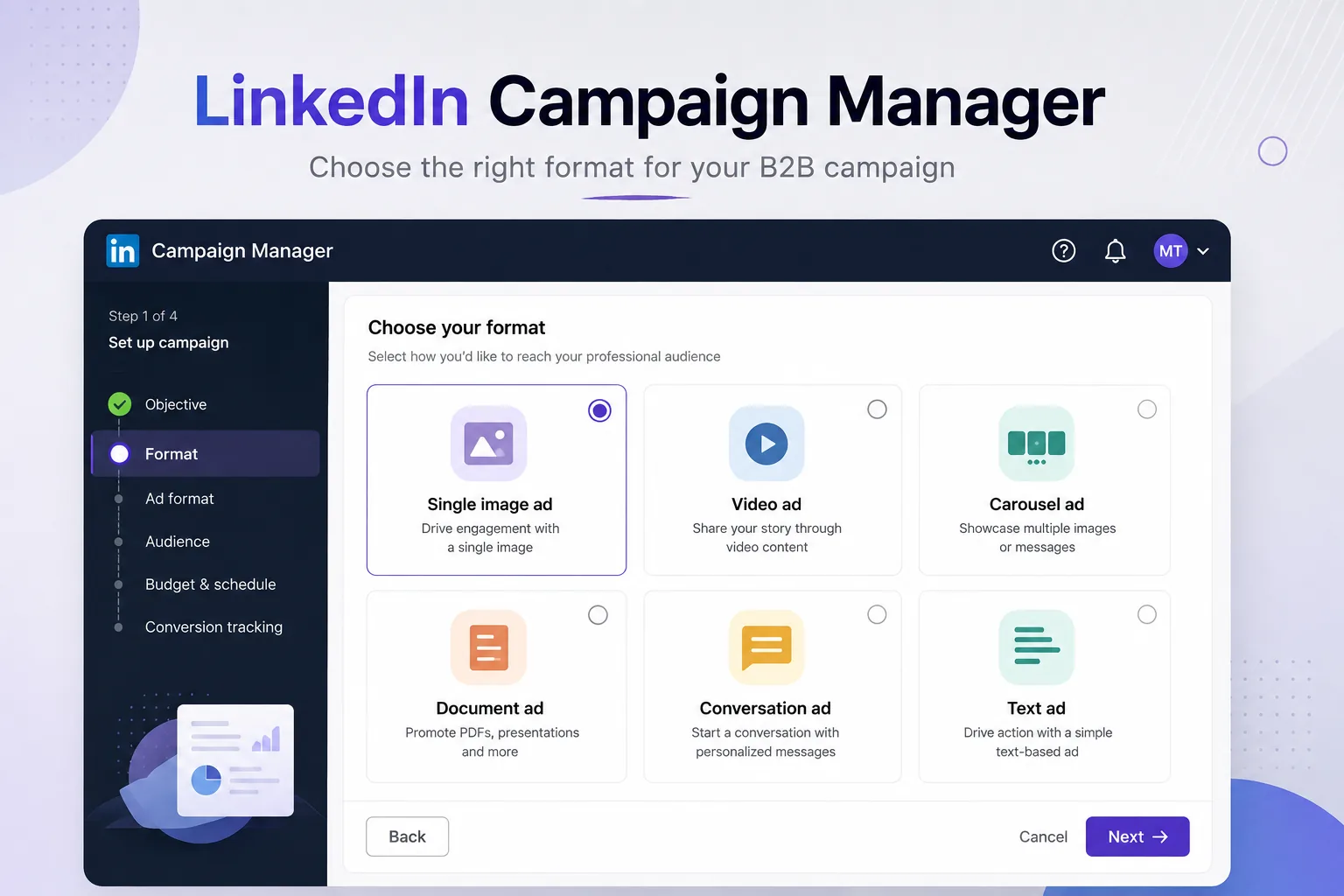
Formats are usually presented as a catalogue: single image, video, carousel, document, message, conversation, event, dynamic, text. Nine options, alphabetically, with specs. Which is accurate and does not help you choose.
The short answer
LinkedIn’s ad formats differ in what they ask the viewer to do, and cost rises with the size of the request. Single image, video, document and carousel ads ask only for attention and are the cheapest way to reach a cold audience. Lead Gen Forms and event ads ask for an action without leaving LinkedIn. Message and Conversation ads ask for a conversation and should be reserved for audiences who already recognise you. Your campaign objective determines which formats are even available, so choose the objective last, not first.
Key takeaways
- Match the ask to audience familiarity. Cold audiences get attention formats; warm audiences get action formats; known contacts get conversation formats.
- The objective gates the format. Pick your format intention first, then choose the objective that permits it.
- Ads from a person’s account tend to cost less than the same ad from a company page — the same pattern that holds on Meta.
- Accelerate versus Classic is a volume question, not a philosophy. Below meaningful conversion volume, automation has nothing to learn from.
- Document ads are the most underused format in Indian B2B and among the cheapest ways to demonstrate expertise.
The thing that traps people mid-build
Before formats, one piece of mechanics that costs people an afternoon.
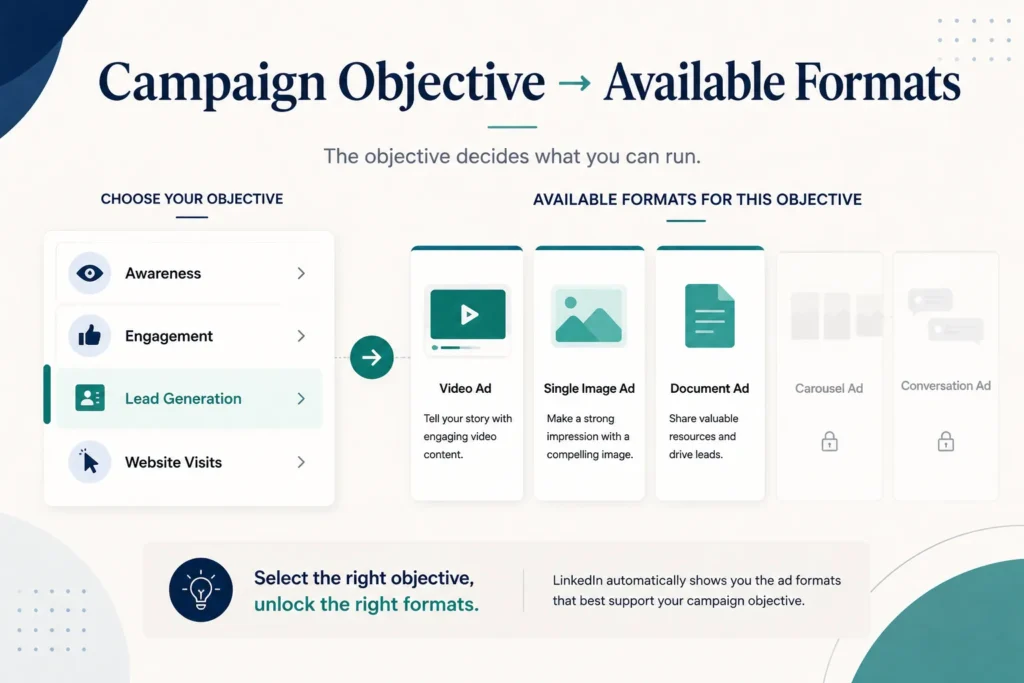
Your campaign objective determines which ad formats are available. Choose Brand Awareness and you cannot use Lead Gen Forms. Choose Lead Generation and Conversation Ads become available with a form attached. Choose Website Visits and the optimisation changes underneath everything.
Most people choose the objective first because it appears first on the screen, then find their intended format greyed out.
Work backwards. Decide what you want the ad to ask of the viewer, identify the format that makes that ask, then select the objective that permits it. The objective is a means, not the starting point.
The Ask Ladder
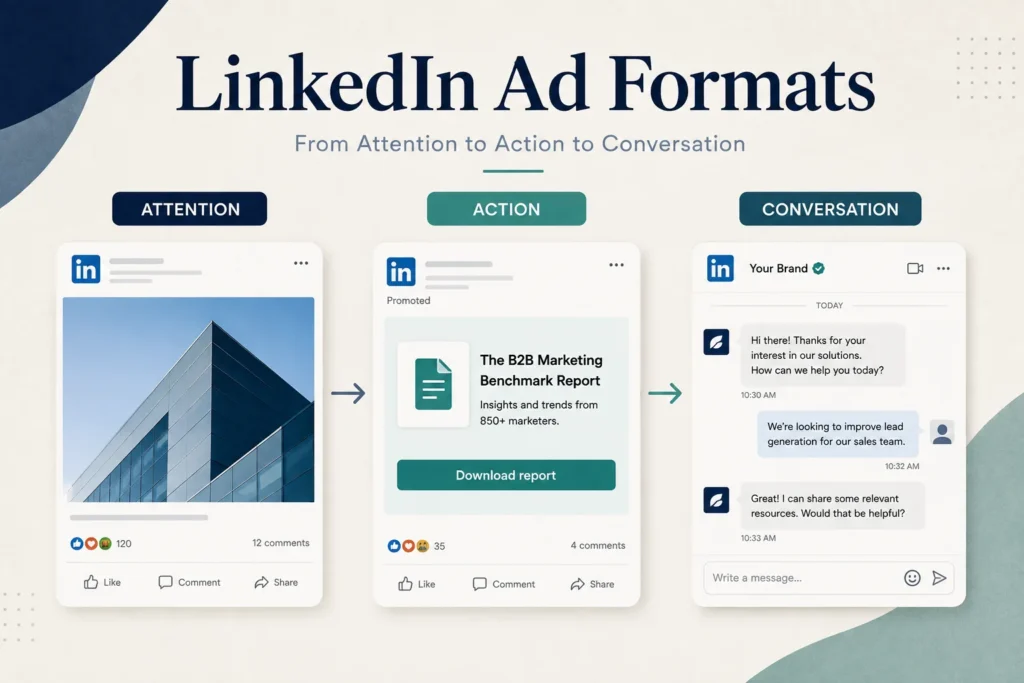
Every LinkedIn format makes a request of the viewer. Attention is a small request, a form is a larger one, a conversation is the largest. Cost per result rises with the size of the ask — so the format should match how well the audience already knows you, not how badly you want the outcome.
Rung one — asking for attention
The cheapest requests, and the right choice for anyone who has never encountered you.
Single image ads. The workhorse. Fast to produce, easy to test, and the format most campaigns should start with. Its weakness is that it competes with everything else in the feed on the strength of one image and a line of copy.
Video ads. Better for explaining something with moving parts. Expect most viewing to happen without sound, so the first three seconds and the on-screen text carry the load.
Document ads. The most underused format in Indian B2B. A multi-page PDF that readers swipe through in the feed — a framework, a checklist, a short analysis. It asks nothing but attention, and it demonstrates expertise in a way a single image cannot. If you have published anything substantive, this is the format that puts it in front of people.
Carousel ads. Useful for sequences and comparisons. Higher production cost, and it works best when there is a genuine order to the cards rather than four unrelated claims.
All four suit cold audiences, which matters because around 5% of B2B buyers are in-market at any time, per Ehrenberg-Bass research for the LinkedIn B2B Institute. Most of the people you reach are not buying yet, and asking them for anything more than attention is asking too early.
Rung two — asking for an action, without leaving LinkedIn
Larger requests, appropriate once someone has seen you before.
Sponsored content with Lead Gen Forms. The form opens inside LinkedIn and pre-fills from the user’s profile. Completion rates are high and LinkedIn reports these forms generating more leads at lower cost than sending traffic to an external landing page — their claim about their own product, though the mechanism is plausible and matches what pre-filled forms do everywhere.
The trade is the same one Meta’s instant forms make: less friction means more volume and less qualification. Someone who taps twice has not read your proposition. Why frictionless forms produce unqualified leads covers the mechanics and what to do about it — the short version is to add a qualifying question and accept fewer, better leads.
Event ads. Strong for webinars and roundtables, and genuinely underrated in Indian B2B where a well-run session does more than a whitepaper. The registration is a meaningful signal of interest.
Website visit campaigns. Sending people to your own page asks more than an on-platform form — a click, a load, a read, then a decision. Worth it when the page does work the ad cannot, and wasteful when the page simply repeats the ad.
Rung three — asking for a conversation
The largest request on the platform, and the one most often made too early.
Message ads deliver a single message to the inbox. Conversation ads offer branching choices, and now integrate with Lead Gen Forms and events so the action can complete inside the thread.
Both work — for audiences who already know you. Retargeting pools, event attendees, people who engaged with earlier content, existing customers.
Both are expensive when sent cold, and the cost is more than monetary. A message from a company nobody recognises consumes something you cannot rebuy: the recipient’s willingness to open the next one. In Indian B2B, where sectors are small and people talk, that cost compounds — what each LinkedIn route actually costs covers why reputation is the scarcest currency on this platform.
A simple rule. If you would not send that message to that person from your personal account, do not send it as an ad.
The formats worth knowing but rarely worth using
Text ads. Small, sidebar, cheap and largely ignored. Occasionally useful for remarketing at low cost.
Spotlight and follower ads. Dynamic formats that personalise using profile data. They can perform for recruitment and follower growth. For lead generation they are rarely the best available option.
Include them in your knowledge, not usually in your plan.
Person or page
Worth stating even without publishing a figure.
Thought Leader Ads promote a post published by a person — a founder, a specialist, an employee — rather than by the company page. Reported cost differences circulating on agency blogs are substantial, though we could not trace them to LinkedIn or to independent research and so do not repeat them here.
The direction is consistent with what happens elsewhere. On Meta, ads run from a creator’s handle outperform the same creative from a brand account, which is the entire basis of running creator content as paid ads.
The mechanism is the same on both platforms. A post from a person carries a name, a face, a comment section with real replies, and the implicit signal that a human staked their reputation on it. A company page carries a logo.
The practical constraint is consent and supply. You need someone willing to post regularly and to have those posts promoted. That is a person’s time and their professional identity, and it cannot be manufactured by the marketing team.
Accelerate or Classic
The SERP disagrees with itself on this, so here is a rule rather than a preference.
Accelerate is LinkedIn’s automated mode — it optimises audience, bidding and creative combinations against your objective. Classic gives manual control over targeting, bids, formats and scheduling.
The deciding factor is volume. Automated systems learn from conversions. With few conversions there is nothing to learn from, and automation becomes expensive guessing — the same constraint that limits automated bidding on every other platform, covered in why your pipeline caps what you can optimise toward.
Use Classic when your addressable audience is small and precisely definable, your conversion volume is low, or you are testing a specific message or segment and need clean variables.
Use Accelerate when your audience is broad enough that manual targeting is guesswork, you have enough conversion volume for the system to learn, and you care more about outcome than about knowing why.
For most Indian mid-market B2B advertisers — small addressable markets, modest conversion volume — that points to Classic more often than the automated-first advice suggests.
Mistakes that cost real money
Message ads to cold audiences. The most expensive default on the platform.
Choosing the objective first. You will discover the format you wanted is unavailable.
One ad per campaign. Nothing to compare, nothing to learn.
Sending Lead Gen Form traffic straight to sales with no qualification. High completion rates include people who tapped twice.
Running LinkedIn like Meta. Higher costs mean lower volumes and slower learning; the same testing cadence does not transfer.
Ignoring document ads because they look old-fashioned. They are among the cheapest ways to demonstrate expertise to a cold audience.
When LinkedIn Ads are the wrong tool
When deal values cannot carry the cost. LinkedIn’s premium buys verified job titles, and that premium has to be recoverable in gross profit — working out what a lead is actually worth has the arithmetic.
When your buyer is not on LinkedIn professionally. Many Indian B2B buyers — traders, small manufacturers, shop owners — are reachable elsewhere and barely present here.
When your budget cannot clear the data floor. Underfunded LinkedIn campaigns produce unstable results and a false conclusion about the platform.
When you have no content worth promoting. Every format above assumes something worth putting in front of someone. Formats do not fix that.
The format selection checklist
☐ Audience temperature established — cold, warm, or already known to you
☐ Format chosen from the matching rung of the ask ladder
☐ Objective selected after the format, to permit it
☐ Message and Conversation ads restricted to warm audiences only
☐ At least three creative variants per campaign
☐ Document ads considered if you have publishable expertise
☐ Thought Leader Ads considered, with a named person who consents
☐ Lead Gen Forms carrying at least one qualifying question
☐ Conversion volume checked before choosing Accelerate over Classic
☐ Budget checked against the data floor, not the platform minimum
☐ Landing pages justified — they must do something the ad cannot
☐ Response time to inbound conversations agreed in hours
Questions we get asked
What LinkedIn ad format works best for B2B?
Single image for cold reach and testing, document ads to demonstrate expertise, Lead Gen Forms for warm audiences, and message formats only for people who already recognise you. There is no single best format, only a best match to audience familiarity.
Should I use Accelerate or Classic?
Classic if your audience is small and precisely definable or your conversion volume is low. Accelerate if you have volume and breadth. Most Indian mid-market B2B fits the first description.
Are Lead Gen Forms worth it?
For completion rate, clearly. For lead quality, only with a qualifying question added — the same trade every pre-filled form makes.
Do message ads still work?
For warm audiences, yes. Sent cold they are expensive in budget and in goodwill, and the second cost does not appear in any report.
How many ads should I run per campaign?
At least three variants, few enough that each gets meaningful impressions. On LinkedIn’s costs, splitting a small budget across eight creatives teaches you nothing.
Can I use the same creative as Meta?
Rarely well. The format specs differ and so does the reading posture — LinkedIn viewers are in a professional register and respond to specificity rather than to scroll-stopping.
Before your next campaign
Write down how well your intended audience knows you. Cold, warm, or already talking to you.
That single answer eliminates most of the format menu. A cold audience gets attention formats and nothing more. A warm audience can be asked for a form. Only people who already recognise you should receive a message.
Then choose the objective that permits the format you picked — in that order, not the reverse.
If you would like a view on whether your deal values support LinkedIn’s costs at all, and which formats fit your audience, you can reach out to us on whatsapp at +91 7738844851 .
More in Blog
Keep reading
All articles →
Ready to talk about your growth?
Tell us what's stuck and we'll tell you what we'd do first. Free, 30 minutes, no pitch.