
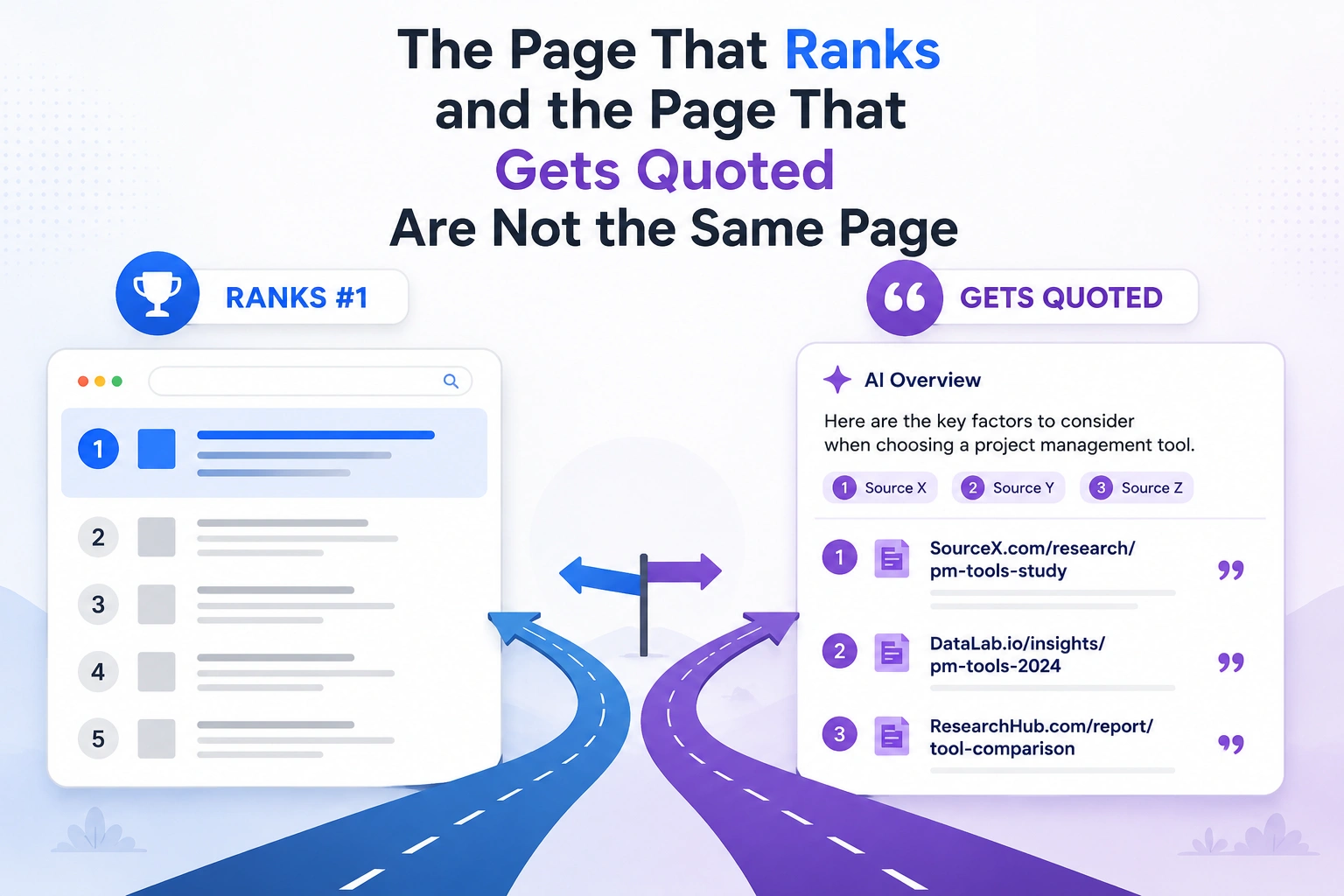
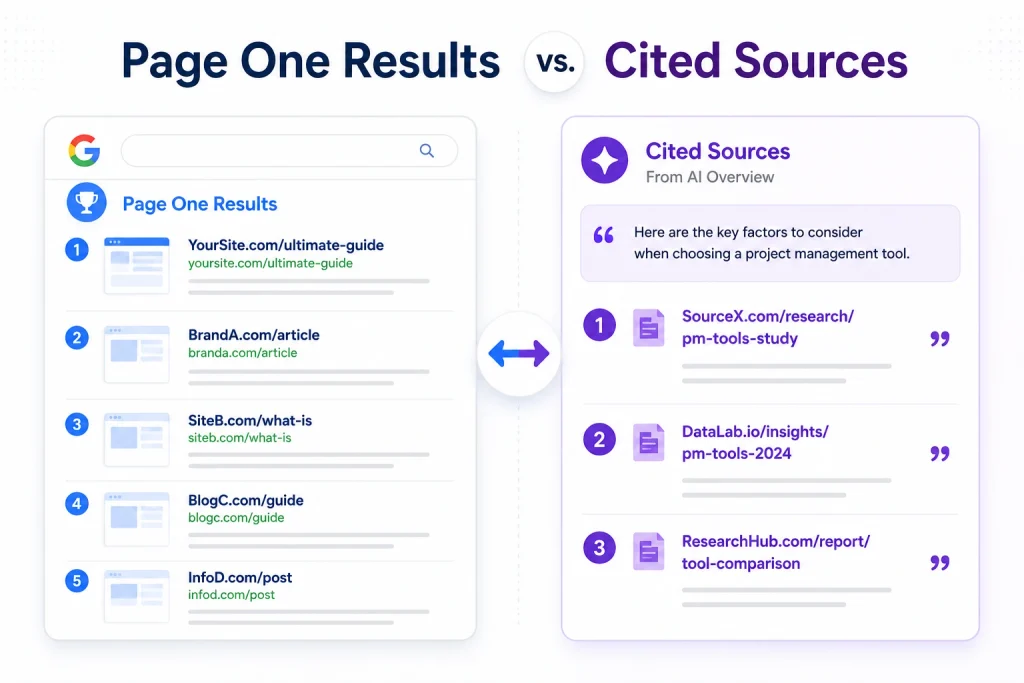
Reported 2026 analyses put the overlap between AI Overview citations and page-one organic results at under a fifth, and report that off-site brand mentions correlate with citation more strongly than backlinks do. An Ahrefs analysis published in February 2026 reported a 58 per cent reduction in click-through rate for top-ranking pages when an overview appears. So being ranked and being cited are partly separate outcomes, and the entry condition for the second is being talked about rather than being linked to.
Two lists exist now.
One is the search results. The other is the set of sources an AI answer draws on and names.
Everyone assumed the second list would be the first list, lightly reshuffled. The 2026 evidence says otherwise. Reported analyses put the overlap between AI Overview citations and page-one organic results at under a fifth, varying widely by industry.
That single number changes what a business should spend money on, and almost nobody selling AI search services in India is mentioning it.
What it is costing you already
Start with the size of the thing, because the argument for doing anything rests on it.
An Ahrefs analysis published in February 2026 reported a 58 per cent reduction in click-through rate for top-ranking pages when an AI Overview appears above them. Pew Research Center, studying real browsing behaviour, found that eight per cent of users clicked a traditional result when a summary was present, against fifteen per cent when it was not.
Roughly halved, by two independent methods.
Note carefully what that does and does not say. It does not say your rankings fell. It says the value of the ranking fell, for the queries where a summary appears. A business can hold every position it had and watch enquiries decline, which is exactly the pattern several of our conversations this year have started with.
So the honest framing is a smaller pie and a new question. Whether you rank, and separately, whether you are inside the answer or underneath it.
The signal that appears to matter
Here the evidence is thinner and we are going to be explicit about that.
Practitioner research published through 2026 consistently reports that off-site brand mentions correlate with AI citation more strongly than backlinks do — in some analyses substantially more. The same research reports that mentions on video platforms correlate strongly, and that brands both mentioned and cited resurface more reliably across repeated queries.
We are reporting the direction and not the coefficients. This is vendor research, published by companies selling AI visibility products, using undisclosed or lightly disclosed sampling. The direction has been replicated across several independent efforts, which is worth something. The precise numbers are not worth quoting and we will not quote them.
If the direction holds, it has an unusual consequence for Indian businesses.
Ordinary search rewards a link graph built over years, which is why a new site loses to an old one regardless of quality — the argument our SEO strategy page is built on. Being mentioned is a different asset. It accumulates faster, it does not require anybody to link, and it is available to a firm with a five-page website and something worth saying.
Which re-prices an activity we have already written about. The work described in what to send a journalist — being a source, bringing a number, correcting an error — was previously justified by the links it eventually produced. On this evidence it is now worth doing for the mentions alone, whether or not anybody links to you.
That is a genuine change, and it favours the smaller firm for once.
What you actually control
Four things, in order of how confident we are about them.
Be fetchable. If your content is injected by JavaScript, the crawlers that feed these systems may never see it, for the reason set out in our landing page article: they retrieve the page and do not execute the scripts. Check view-source rather than the rendered page. This is the one item here with a clear mechanism rather than a correlation behind it, and a surprising number of Indian business sites fail it.
Be quotable. These systems extract passages. A paragraph that states something completely, in its own words, without depending on the three paragraphs above it, survives that process. A paragraph that begins “as we saw earlier” does not. Writing self-contained factual statements is a habit, it costs nothing, and it makes the page better for humans skimming on a phone.
Be consistent. Retrieval assembles an answer from several sources. If your founding year, your services, your locations and your specialisms are stated differently on your site, your profile, your directory entries and your social pages, you are supplying contradictory material about yourself. Making them agree is an afternoon and it is the least glamorous item on this page.
Be named. Which returns to the section above, and to the slow work of being quoted, cited and referenced by other people.
Notice what is not on this list: any product you can buy this quarter.
The product being sold that does nothing
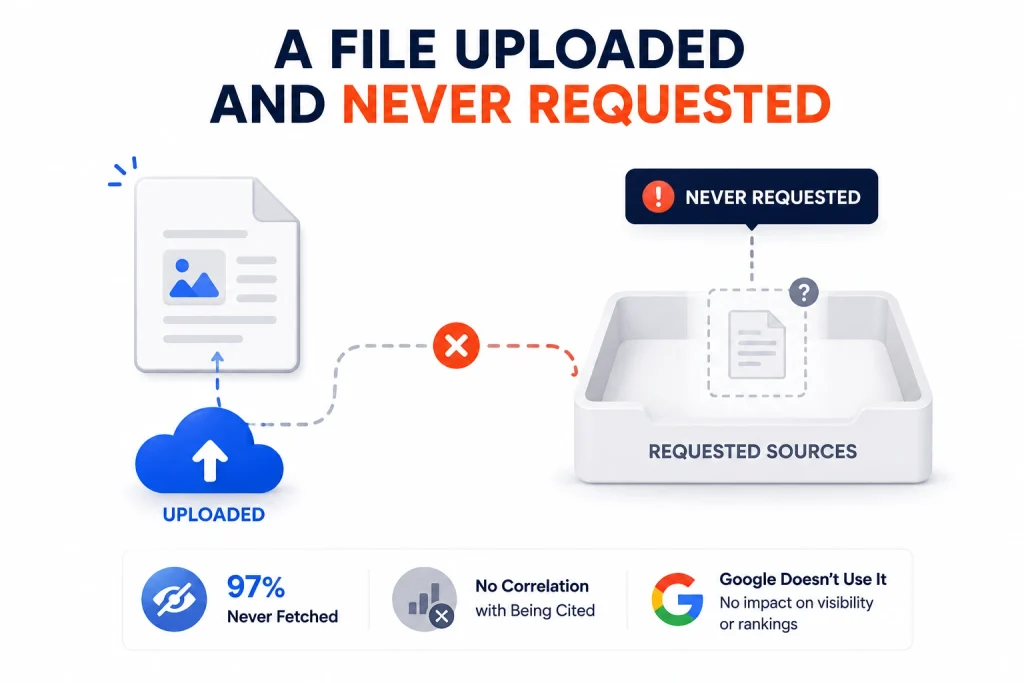
Which brings us to llms.txt — a file placed at the root of a site, listing its content for language models, marketed through 2026 as the way to be visible in AI answers. It is being sold in India right now, sometimes as a standalone package.
The evidence against it is unusually clear for this subject.
Analysis across roughly three hundred thousand domains reportedly found no correlation between having the file and being cited. Around 97 per cent of the files were never fetched by anything. Among the fifty most AI-cited domains, one had the file.
And Google has stated publicly that it does not use llms.txt and has no plans to, and that the file will not affect visibility or rankings in Search either way.
The file does have a real purpose, which is worth stating fairly: it is useful as documentation for autonomous agents working with your site, and some AI companies recommend it in that context. That is a developer concern. It is not a search visibility measure, and anyone selling it to a small business as one is either behind on the evidence or counting on you being behind on it.
If you have one, no harm done. If someone is quoting you for one, that is the quote to decline.
And the question we deferred
Our article on structured data declined to answer whether schema helps you appear in AI answers, and promised this page.
Here is the answer, and it is unsatisfying.
Nobody has established it. Structured data makes your content easier for a machine to parse, which is a reasonable prior. No published study we would trust has isolated its effect on citation, and none of the major AI companies has said. Meanwhile Google’s own position on structured data — that it establishes eligibility for a feature rather than influencing ranking — was written about a system that predates all of this.
So implement schema for the reasons that article gives, which are visible and checkable. Do not implement it because somebody told you it helps in AI search. That claim is currently unsupported in both directions.
Measuring it, which is genuinely broken
Updated since first publication. Google now reports this. Since 3 June 2026, Search Console has carried dedicated generative AI performance reports isolating impressions and clicks from AI Overviews and AI Mode. Our original text said no such reporting existed, which was accurate when written and is now wrong for Google
It remains right for everything else. ChatGPT, Perplexity, Claude and the standalone assistants report nothing to the sites they cite. So the largest surface is now visible and the rest is dark, and our article on tracking AI search traffic sets out how to handle each — including a double-counting trap inside the new Google report.
For the systems that still report nothing:
Referral traffic from these systems arrives inconsistently, is small relative to the impressions it represents, and often is not distinguishable in analytics at all. Most of the exposure produces no click, which is the entire problem.
A market of AI visibility platforms has appeared to fill the gap. They query the systems repeatedly and report how often you appear. The method is reasonable in principle. The sampling is usually undisclosed, the query sets are chosen by the vendor, and the numbers move with the sample. We would not present their output to a client as measurement.
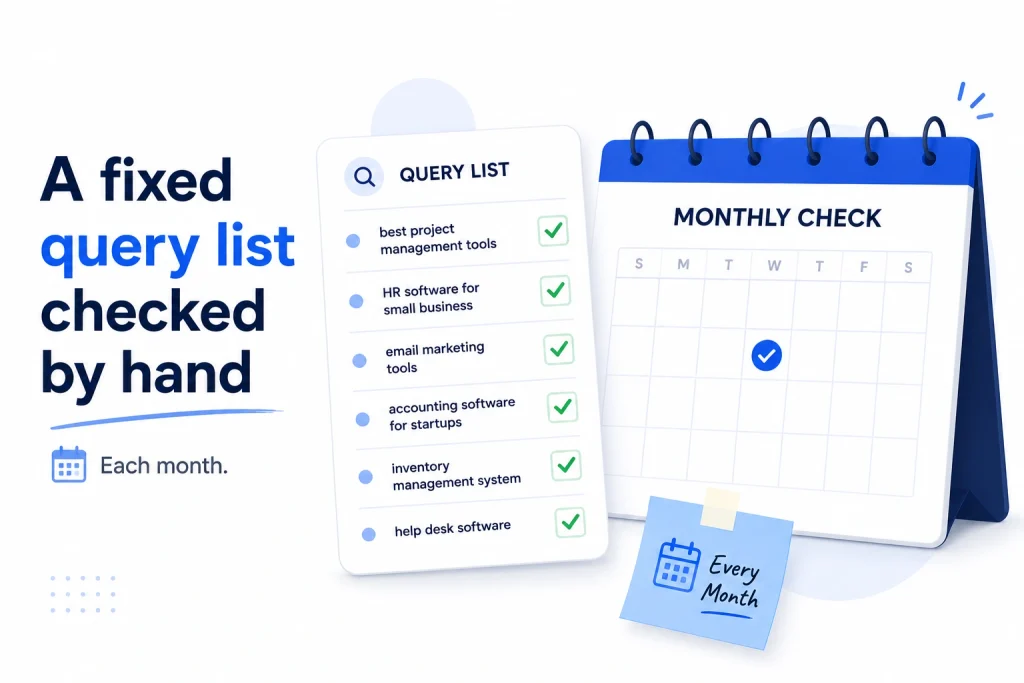
The honest method costs nothing and takes an hour a month.
Write down fifteen questions a real buyer would ask — the ones your sales calls actually open with. Once a month, put each one to the two or three systems your customers use, from a signed-out session, and record which sources are named. Keep the list fixed so the months are comparable, and keep the raw answers so you can see what changed.
That gives you a directional read on whether you are appearing, who is appearing instead, and what those sources have that you do not. It is tedious, it is real, and no vendor can sell it to you.
Do not read it as a performance metric in the sense our measurement article describes. It is closer to competitive reconnaissance.
The click you are not going to get
Suppose the mechanism works and you are cited. Most of the time, nobody clicks. That is the defining property of the format.
Which raises a question the GEO material almost never addresses: what is the citation actually worth if it does not produce a visit?
Two things, and both are real.
The first is being named. A citation typically carries your business name beside the statement. That is a brand impression delivered at the exact moment somebody is trying to decide something, which is the most expensive moment to reach by any other means. It behaves less like a search result and more like being quoted in a trade publication.
The second is the search that follows. Some proportion of people who see your name in an answer will search for it separately. That behaviour shows up as branded search, and our B2B article covers why it is the cleanest available proxy for demand you created but cannot trace. It is now also the most practical downstream evidence that citation is doing anything for you.
Which produces two operational consequences worth acting on.
Make sure the material likely to be quoted actually names you. A statement lifted from your page and attributed to your firm is worth considerably more than the same statement lifted anonymously, and pages written in a passive institutional voice make attribution harder than it needs to be.
And make sure the branded search lands somewhere good. If people are going to look you up after seeing your name, the page they arrive at matters more than it did when they arrived from a query about a problem. That is a page you fully control and most businesses have never examined it in that light.
Is SEO finished
No, and the framing is unhelpful.
The systems producing these answers are drawing on the open web, and they retrieve pages that exist, are indexable, and say something. Everything in our SEO work — being in the index, being about something specific, being referenced by other people — remains the input. What changed is the last step, where the answer is assembled and the click frequently does not happen.
The one clear reallocation is that effort should move from things that only produce clicks toward things that also produce mentions. Ranking a page and being named as a source are now partly separate outcomes, and the second is more durable.
The link-building work we describe in our article on the spam policy is still worth doing for ordinary search. It is simply no longer the only reason to do outreach.
What we cannot tell you
Almost all of it, and we would rather say so.
We cannot tell you how any of these systems weights anything. None publishes it, and the systems change on a monthly cadence.
We cannot vouch for the correlation research. It is produced largely by companies selling AI visibility tools, and we have reported direction rather than magnitude for that reason.
We cannot tell you what your industry’s citation rate looks like in India specifically. Nearly all published work is US-based, and Indian query behaviour — including across languages — is unexamined.
And we cannot tell you this will look the same in six months. It will not. This page carries a quarterly review for that reason, which is the shortest cadence on anything we publish.
Anyone offering you a guaranteed GEO package is selling certainty that does not exist in this subject yet.
What to do this quarter
Check that your important pages render their content without JavaScript. Make the facts about your business agree across every place they appear. Write in passages that stand alone. Put the fifteen questions on a page and check them monthly.
Then go back to being worth mentioning, which was always the actual work and is now worth more than it was.
If you are being quoted for a GEO package and want an honest read on what is in it, you can reach out to us on whatsapp at +91 7738844851 .
More in Blog
Keep reading
All articles →
Ready to talk about your growth?
Tell us what's stuck and we'll tell you what we'd do first. Free, 30 minutes, no pitch.